
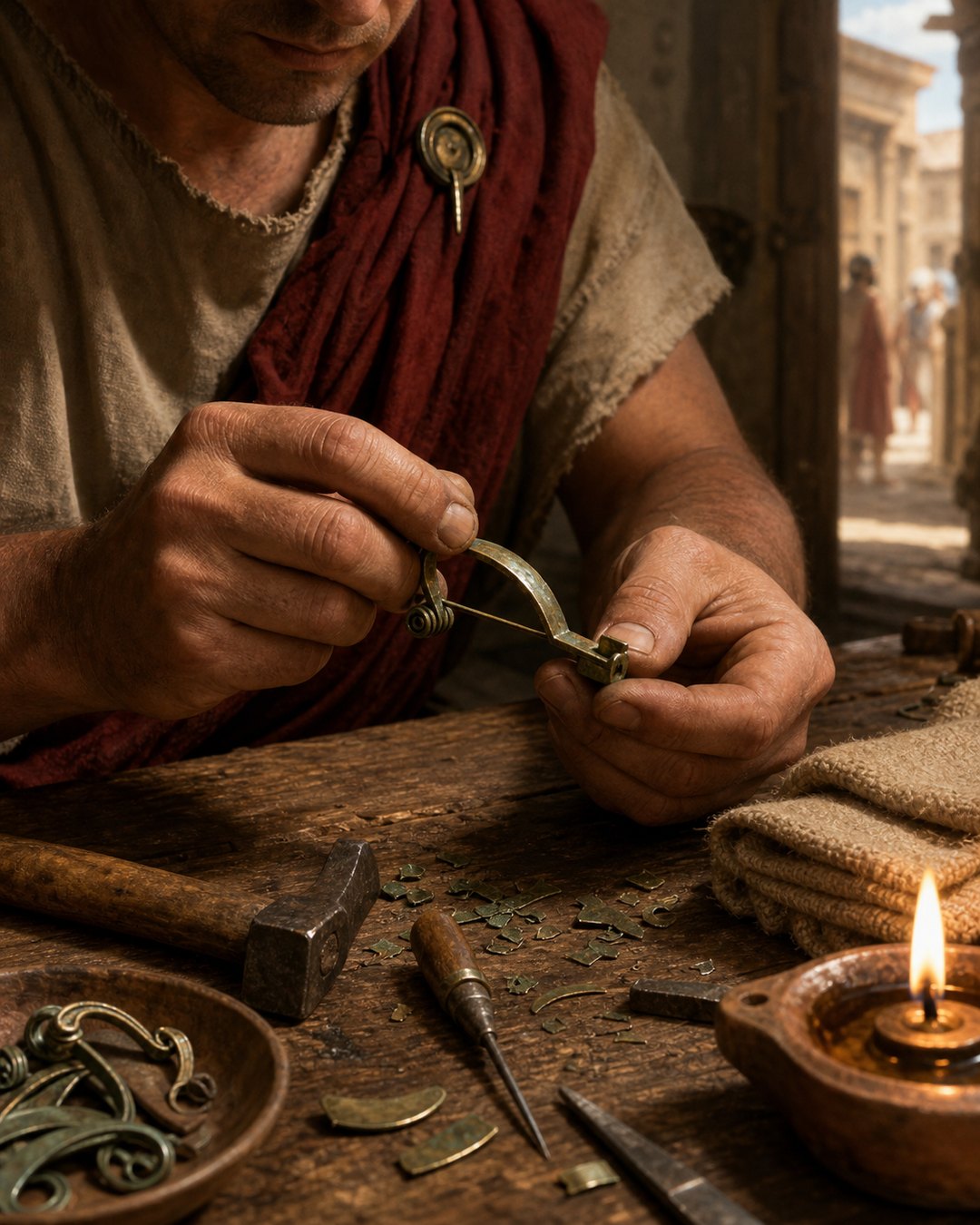
A cloak could look effortless after one sharp point had done dangerous work. A Roman fibula pushed through folded cloth, bent the fabric around a metal bow and trapped its pin beneath a catch. The fastening sat on the shoulder or chest where every step tugged at it—and where other people could see it.
This was more than ancient jewelry placed on finished clothing. The spring, pin and catch made the garment possible in its chosen arrangement. At the same time, metal, shape and decoration turned a practical joint into a social object. A fibula held cloth together while exposing how craft, region and identity were fastened to the body.
A sharp pin became a controlled mechanism
The basic problem was simple and unforgiving. Two layers of cloth needed to remain together while the wearer walked, worked, mounted steps or lifted an arm. A loose knot added bulk; a bare pin could slide free or stab skin. The fibula controlled the point by connecting it to a rigid bow and a secure catch.
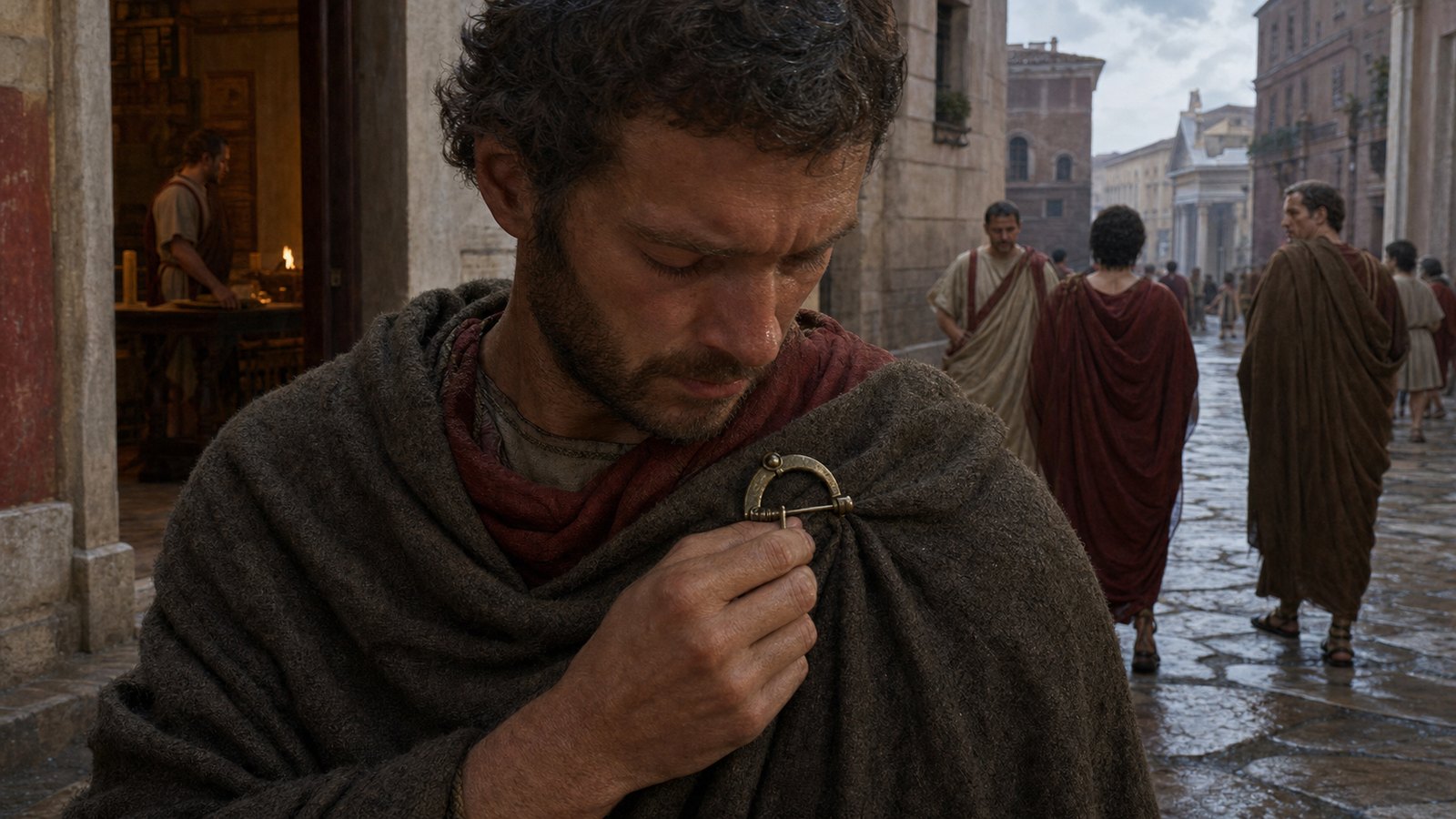
To fasten it, the wearer gathered the intended fold, drove the pin through the textile and guided the point into the catch at the foot. The bow bridged the pierced cloth instead of disappearing inside it. Tension spread between pin and body, so the object worked as a small frame clamping flexible material.
The catch mattered as much as the decorative bow. It had to receive the point without releasing it during motion, yet remain accessible when the garment came off. A catch bent too open invited failure; one crushed tight made dressing slow. Reliability lived in a narrow gap shaped by the maker and tested by use.
This mechanism made dressing tactile. Fingers felt for the pin, resisted its spring and searched for the catch without always seeing the underside. Cold metal, thick wool and a moving cloak met in one small operation. Successful fastening was remembered by the body long before anyone admired the ornament.
Spring and hinge offered different kinds of control
Many fibulae stored force in coils of wire near the head. Pulling the pin away from the catch twisted the spring; releasing it encouraged the point back toward its resting line. The same principle that made the object resemble a safety pin also made metal elasticity part of daily dress.
Other Roman-period forms used a hinge. The pin pivoted on an axis rather than flexing from a coil. A hinge could create a neat head and predictable movement, but it added fitted surfaces that could wear, seize or loosen. Neither solution abolished maintenance. Each relocated the place where repeated motion accumulated damage.
The wearer experienced the difference as resistance. A strong spring fought the fingers but pressed firmly into the catch. A loose hinge moved easily but relied on alignment and gravity until secured. Makers balanced metal thickness, pin length and catch position so the final object could be operated without sacrificing hold.
The contrast resembles the logic of Roman locks and bolts at another scale. Both systems directed a movable piece into a receiving space. Security depended less on visual mass than on alignment, controlled motion and a point that could not escape its intended path.
Metal made an ordinary joint worth looking at
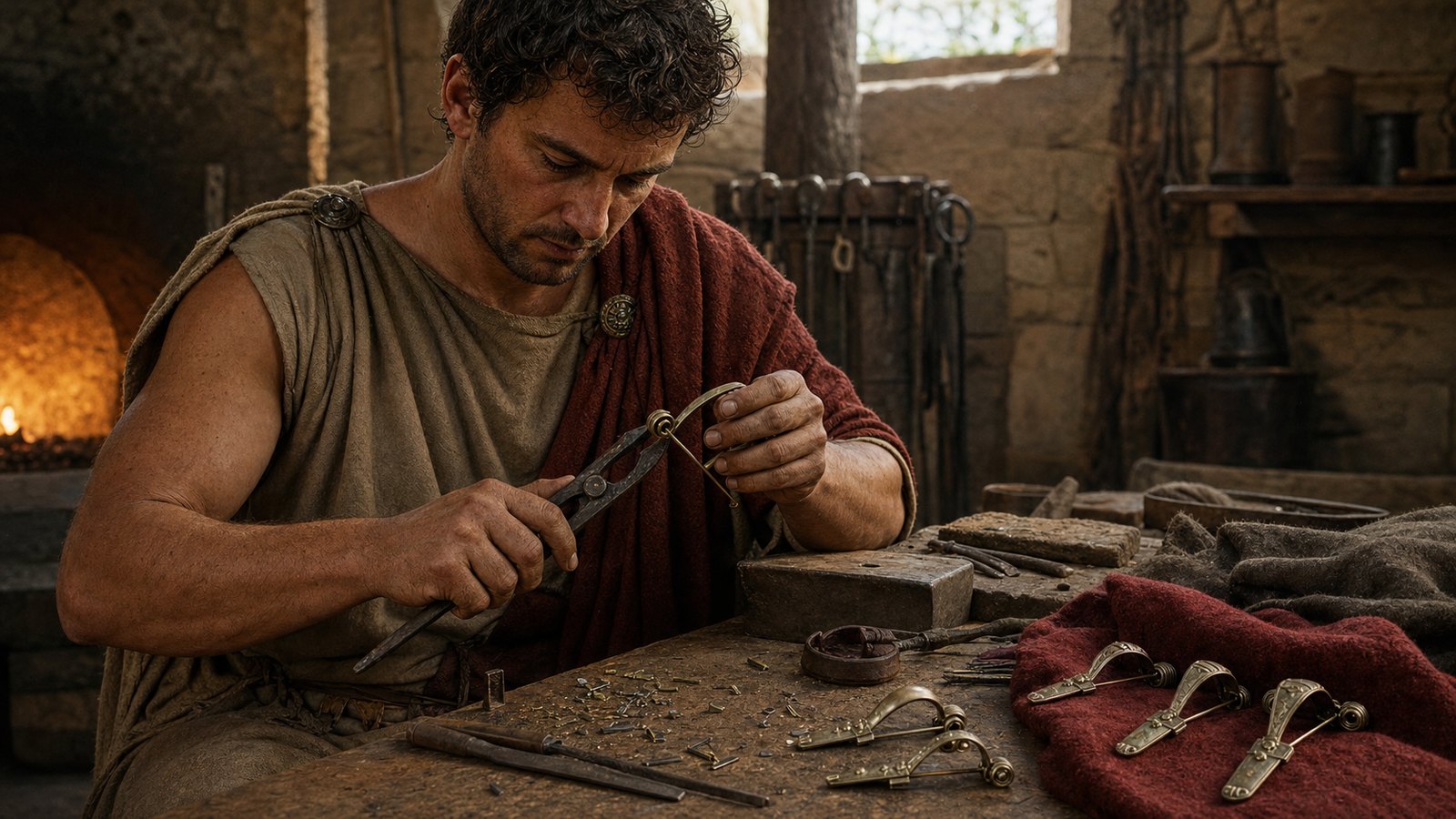
Once the bow remained visible above the cloth, makers had a surface for display. Copper alloy offered warm color and casting possibilities; iron supplied strength; silver or gold moved the fastening into conspicuous wealth. A practical object could therefore range from plain equipment to a possession guarded and inherited.
Decoration followed construction rather than floating free of it. Ridges strengthened or emphasized the bow. Knobs marked transitions. Enamel, incised lines or attached pieces caught light when the wearer turned. Ornament helped the eye read the mechanism’s shape, making head, arch and foot into a deliberate sequence.
The fibula shared space with Rome’s larger language of public dress, but it spoke differently. A toga communicated through expanse, color and difficult folds. A brooch condensed attention into a few centimeters of metal, offering a close-range clue that could survive after the whole arrangement shifted.
Value also altered risk. A cheap fastening could be replaced when its pin snapped. A decorated one invited repair: a new pin, straightened catch or reinforced hinge might preserve the visible bow. Wear and restoration accumulated as evidence that utility and attachment had become difficult to separate.
Every movement tested the fastening
Cloth did not remain still after dressing. A shoulder rose, a cloak caught wind and the weight of wool pulled downward. Each movement loaded the holes around the pin and pressed the metal against the catch. The fibula survived not one dramatic force but thousands of small changes in direction.
Placement determined the strain. Too little cloth in the pin could tear; too much created a thick bundle that pushed the bow outward. A heavy cloak demanded more hold than a light garment. The wearer adjusted folds and angle, turning the same brooch into a slightly different engineering solution each morning.
Failure gave warning. A loosening catch let the point move. A bent pin resisted alignment. Green corrosion roughened copper alloy; rust attacked iron; grit entered a hinge. Someone attentive could correct the problem before cloth fell open. Neglect converted a visible ornament into a hidden hazard against skin.
Imagine a crowded doorway on a wet morning: damp wool grows heavier, one hand holds a basket and the other reaches instinctively to the shoulder after the cloak shifts. Fingers confirm that the bow remains flat and the point is trapped. The gesture lasts a second because the mechanism has earned trust through repetition.
Types carried histories beyond their owners
Fibulae changed in outline, spring arrangement, hinge construction, foot and decoration across regions and centuries. Modern archaeologists use those differences to organize types and suggest dates. The method works because makers repeated recognizable solutions while altering them in ways that spread unevenly through communities and trade.
A type is not a perfect identity card. Old objects could remain in use, travel far from manufacture or be copied elsewhere. One brooch cannot automatically name its wearer’s language, occupation or origin. Strong interpretation combines construction and context: where it lay, what accompanied it and whether the deposit was domestic, military or funerary.
Even with caution, the survival is remarkable. Textile usually decays, taking color, weave and cut with it. Metal fasteners remain as durable punctuation where cloth once met. Their position in a grave or building can suggest how vanished material was arranged without pretending that the brooch preserves the entire costume.
This imbalance makes humble hardware disproportionately informative. Archaeologists often know a fastening more precisely than the garment it served. The fibula becomes a surviving joint between metal evidence and textile absence, allowing technology to outline a body whose clothing has otherwise returned to soil.
The smallest visible object joined craft to identity
A fibula began in workshops and material supply. Ore became metal; alloy was selected; a body was cast or forged; wire was drawn or hammered; the pin was aligned and the catch finished. Each step had to produce both a recognizable appearance and a device able to flex without immediate failure.
It ended in personal habit. The wearer knew which cloak it held, how hard the spring pulled and where the catch accepted the point. Scratches recorded fingers and fabric. Repairs recorded value. What looks in a museum like a static type once belonged to a repeated sequence of dressing, checking and removal.
That sequence made technology social. Other people could identify a shape, admire material or notice that a military or regional style sat on someone’s shoulder. Yet the signal remained credible because the object was actually working. Display and function occupied the same piece of metal rather than competing for space.
Roman fibulae made fastening clothes visible by placing the solution on the outside. A spring or hinge controlled a sharp pin; a catch secured it; a bow carried strain and meaning. Long after the cloth vanished, the surviving brooch still shows exactly where Roman craft touched a moving body.
Sources & Further Reading
- Smith Dictionary, Fibula
- Fibula (brooch)