
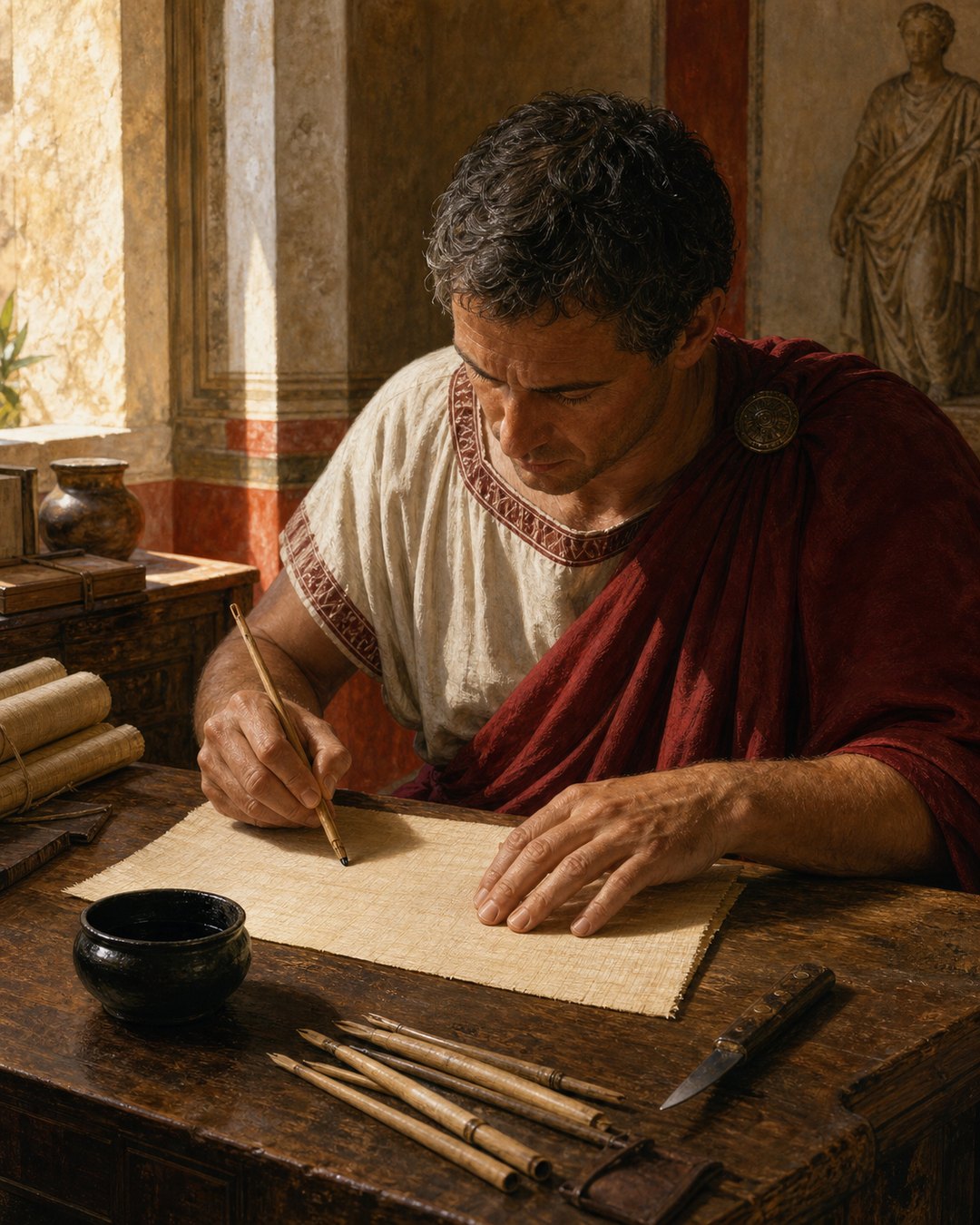
A Roman sentence began before the first letter. Someone selected a reed, cut its end on a slant, opened a narrow slit and sharpened the writing edge. Ink waited nearby as black liquid rather than an idea. When the nib touched papyrus, the hand had only a short distance before the reed ran dry and demanded another dip.
The reed pen made writing rhythmic. Dip, touch, draw, lift, return: every phrase crossed between vessel and page. The hollow stem carried little, the split nib regulated flow and papyrus fibers decided whether a stroke stayed crisp or spread. Roman voices survived because a fragile plant tool repeatedly converted soot, liquid and pressure into marks.
A river plant became a precision edge
Reed offered a useful contradiction. Its outer wall was firm enough to hold a sharpened shape, while the hollow interior created a natural channel. A maker cut a manageable length, hardened or dried it, then sliced the end obliquely so one side projected as the writing face. The ordinary stem became directional.
A narrow slit divided the point into two tines. When the nib pressed lightly, the slit could open by a minute amount and allow ink to move toward the edge. Too wide a split flooded the surface; too narrow a channel starved the stroke. The cut transformed stored liquid into a measured line.
The edge also determined appearance. A broad oblique nib could create thick and thin strokes as its angle changed. A finer point produced smaller characters but wore quickly against fibers. Writing style was therefore partly built into the tool before the writer formed a single recognizable letter.
The Latin calamus kept the material origin visible in the tool’s name. Unlike a stylus pressing grooves into wax, the reed did not alter the surface by force alone. It carried a separate substance and left part of that substance behind.
Ink had to flow without escaping all at once
Carbon ink could begin with soot or lampblack, an intensely dark residue made of tiny particles. Mixed with liquid and a binder, those particles became a suspension capable of traveling from pot to nib. The recipe had to remain fluid enough for writing while depositing enough black material to be seen.
The reed held only a modest charge. Surface tension and the narrow slit kept some liquid near the point, but gravity and pressure constantly threatened release. A gentle first touch produced a controlled stroke; a heavy landing could unload a dark spot. Each dip reset the risk at the beginning of another line.
As water evaporated from the page, carbon particles and binder remained among the surface fibers. This helped words endure, but fresh writing stayed vulnerable. A sleeve, hand or rolled sheet could smear a sentence before it dried. The writer managed not only letters but the time during which they were still wet.
Ink in the vessel changed too. Evaporation thickened it; contaminants entered from the nib; sediment could settle. Stirring, adding liquid or preparing a fresh batch restored useful behavior. The written archive depended on quiet material judgments that rarely appear in the text those judgments made possible.
Papyrus fibers gave every stroke a direction
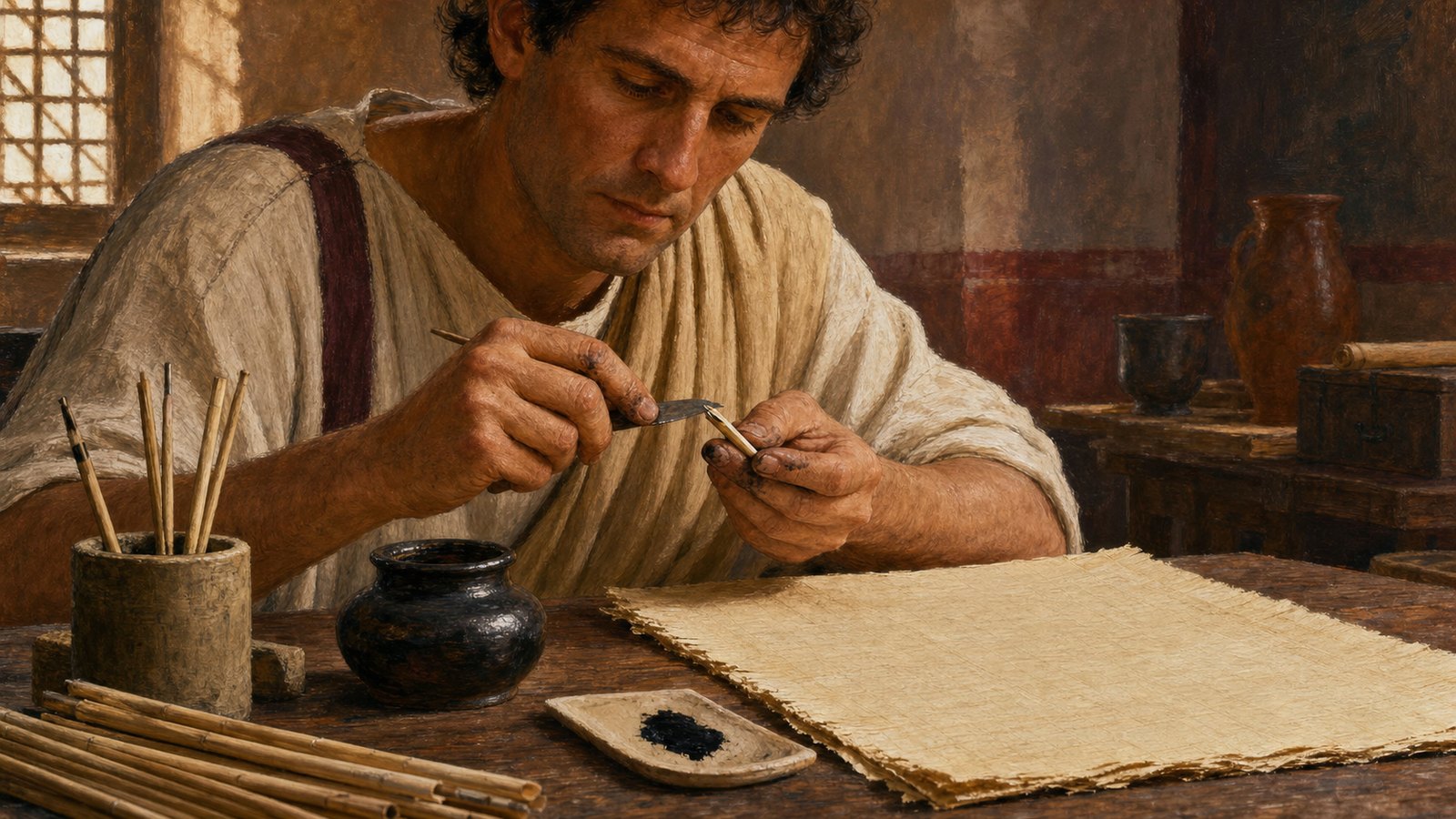
Papyrus was not a perfectly smooth modern sheet. Strips of plant material created visible fibers and joins. A nib moving with the grain encountered less resistance than one crossing rough edges. The writer oriented the sheet and adjusted hand movement to a surface whose structure could be felt through the reed.
A damaged nib caught fibers and splattered ink. A rough patch widened a stroke or pulled the point from its intended line. Skilled writing did not mean ignoring material irregularity; it meant compensating for them quickly enough that the reader saw letters instead of the struggle between plant surfaces.
Absorption had to be balanced. If ink sank and spread too readily, edges feathered and small forms closed. If the surface resisted liquid, a bead sat above it and smeared. Preparation of papyrus or parchment helped create a usable meeting between wet mark and durable support.
The sheet thus participated in handwriting. Letter size, line spacing and speed adapted to available width and surface quality. The apparent freedom of a written voice was constrained by fibers, margins and the cost of material, just as Roman administrative tablets shaped what could be stored and moved.
Repeated dipping divided thought into physical units
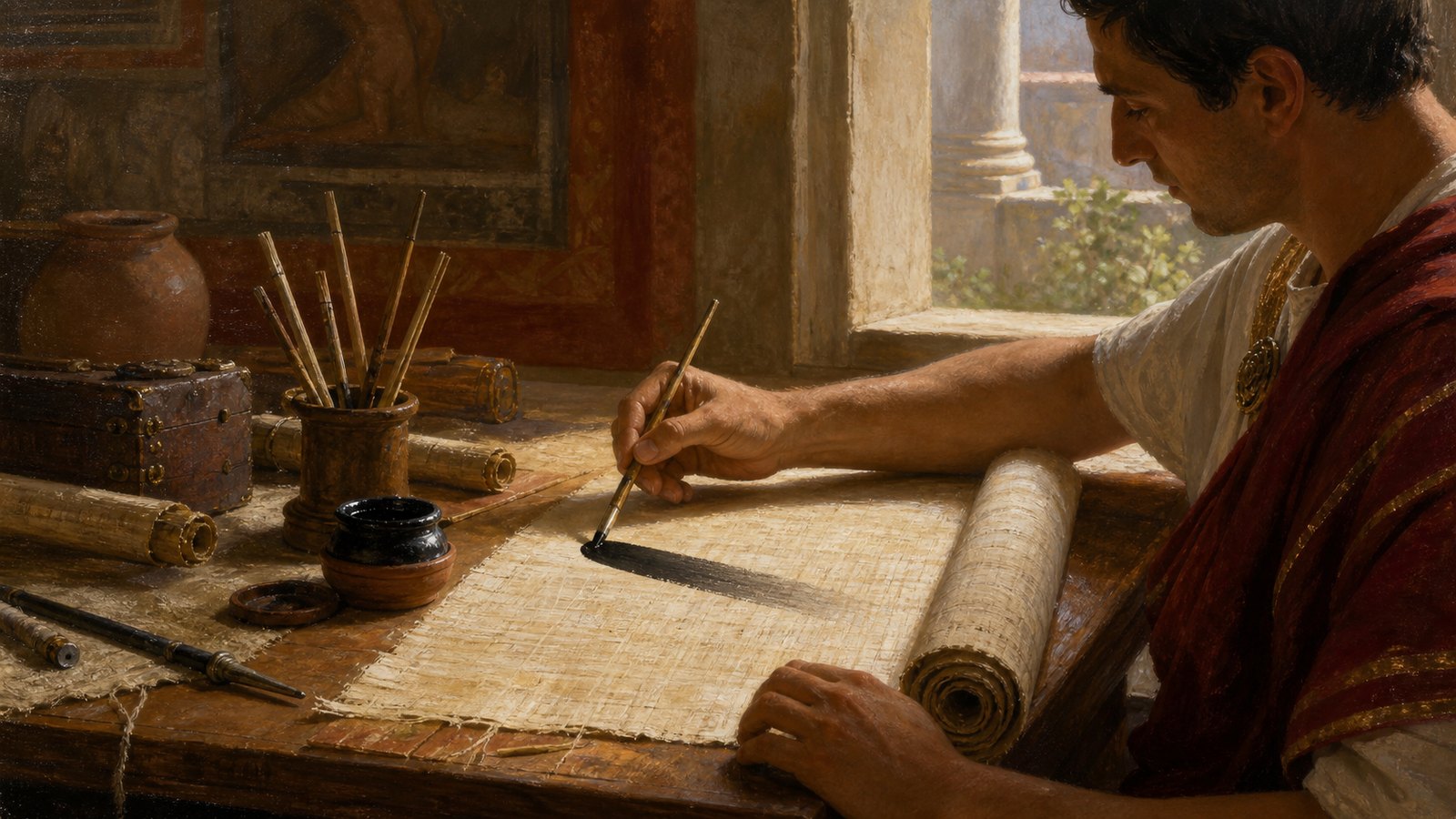
A reed could not write indefinitely after one visit to the ink. Several words, perhaps less depending on nib and liquid, exhausted the charge. The hand returned to the vessel, found the opening without overturning it, removed excess ink and resumed near the exact place where the line had stopped.
This repetition gave composition a pulse. A scribe might plan the next phrase during the dip, while a hurried writer risked uneven spacing or a blot at every restart. The page records only continuous language, but production was punctuated by hundreds of small departures from and returns to the surface.
Imagine a desk in afternoon light: the papyrus curls slightly, a shallow inkpot sits inside the writer’s reach, and the reed scratches more audibly as it dries. The final letter pales. Without looking away for long, the hand dips, taps the rim and begins again with a darker downstroke.
Posture followed the tools. The vessel had to stay close but clear of the forearm. The sheet needed support and room to advance. A knife waited to trim the point. Writing occupied a small organized landscape in which one careless movement could spill the material meant to preserve careful words.
A knife restored the voice of a worn pen
Reed points softened, split or gathered fibers. The line grew broad and ragged; the nib stopped feeding evenly; one tine became longer than the other. The writer did not necessarily discard the entire stem. A small cut could expose fresh material and remake the edge.
Recutting shortened the pen each time. The knife shaved the oblique face, reopened the slit and squared or angled the tip for the desired line. Too much pressure cracked the reed farther up; too little left a blunt edge. Maintenance required the same precision as initial preparation, now performed on a stained tool.
The pen therefore carried a history of use in its length and ink-darkened end. A frequently sharpened reed became shorter until grip or hollow structure no longer suited the task. Replacement was easy in material terms where reeds were available, but every new nib still required the writer to adjust to its particular response.
Tool care separated a failing instrument from failing skill. Uneven letters could signal fatigue, rough papyrus, thick ink or a damaged nib. An experienced scribe diagnosed the whole system before blaming the hand. Roman literacy at work was as much troubleshooting as abstract command of language.
A fragile tool made distant speech durable
Reed, soot and papyrus were individually unassuming. Together they could carry accounts, letters, literature and orders beyond the speaking body. The contrast is striking: a pen might be discarded after wear, while the marks it made could outlive writer, recipient and institution under favorable conditions.
That durability was never guaranteed. Water blurred or displaced material; abrasion removed surface carbon; insects and decay attacked the support. Storage and copying mattered. A surviving text is evidence not only of the first writing act but also of repeated choices to roll, shelve, transport, recopy or protect it.
The technology shaped authority without making every writer powerful. Access to materials, training and clerical labor remained uneven. Yet whenever ink writing entered administration or private exchange, claims could travel without the speaker. A carefully controlled liquid line became a voice detached from breath.
Roman reed pens turned ink into voices through disciplined scarcity. The nib held only a little liquid, the surface offered limited room and every point wore down. Those limits produced a practiced sequence whose reward was extraordinary: soot suspended in water became names, arguments and memories that could speak again after silence.
Sources & Further Reading
- Smith Dictionary, Calamus
- Reed pen
- Ink