
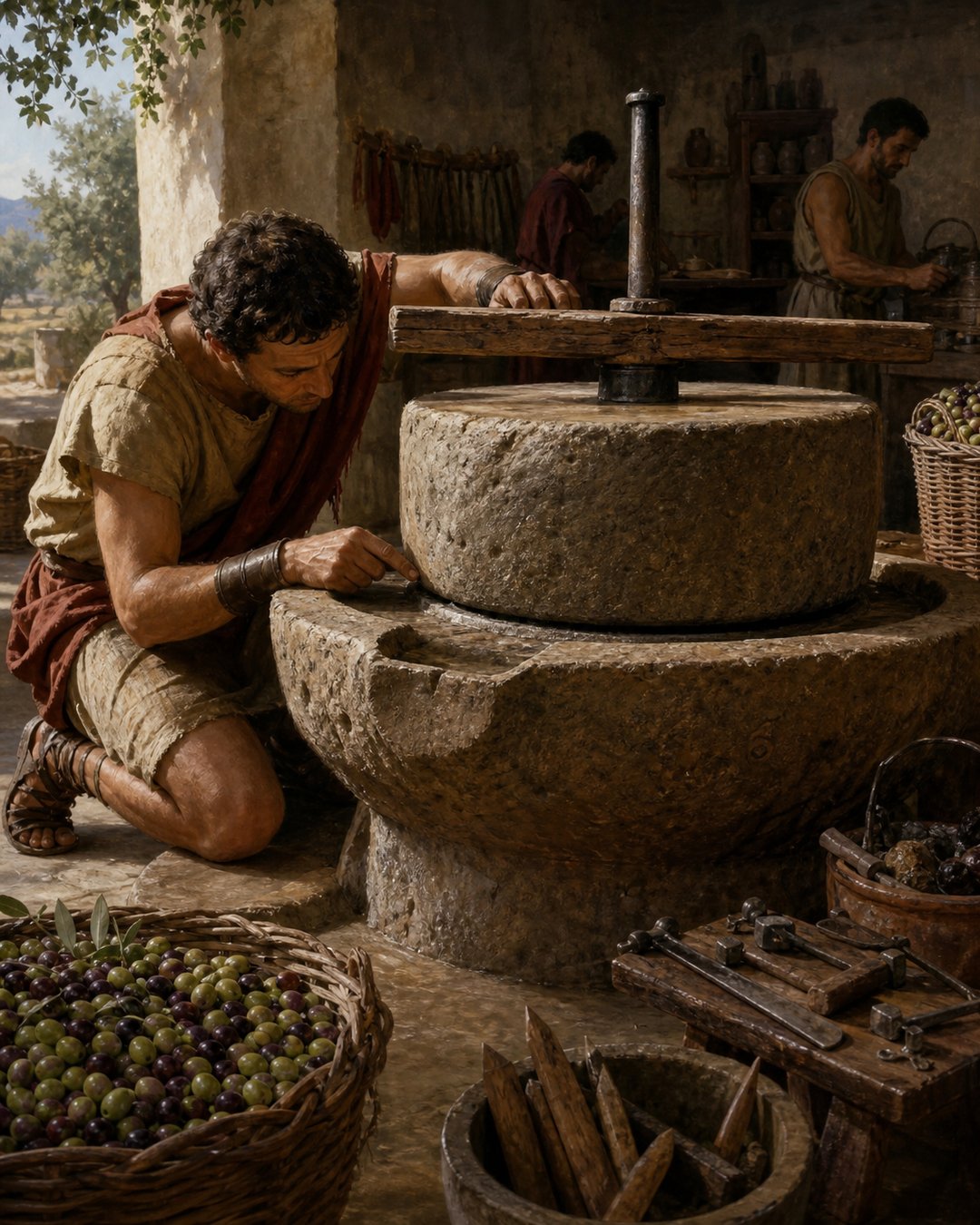
The olive harvest could fill a farmyard with baskets, shouting and urgent work. Cato began his most revealing instructions somewhere quieter: at the iron pivot in the middle of the mill.
It had to stand upright. Willow wedges held it. Poured lead stopped it shaking. If it moved, the installer was not told to hope the weight of the stones would settle it. He was told to take it out and fix it again.
Only after that foundation was secure could the rotating stones be mounted and adjusted. Their final position was judged in finger-widths. They had to sit evenly, avoid rubbing the basin and clear its bottom by about the breadth of a little finger.
The detail turns a familiar Roman crop into a mechanical problem. Oil did not begin with an amphora or a merchant. It began with a gap narrow enough to crush olives without making the machine crush itself.
The harvest depended on work completed before the fruit arrived
Cato’s On Agriculture often reads like a proprietor’s notebook sharpened by expense. He inventories rooms, tools, ropes, vats, hooks, presses and labour. The lists can look dry until the season behind them becomes visible. Ripe olives did not wait while a loose pivot was reset or a rubbing stone was dressed. A processing room had to be ready before baskets came through the door.
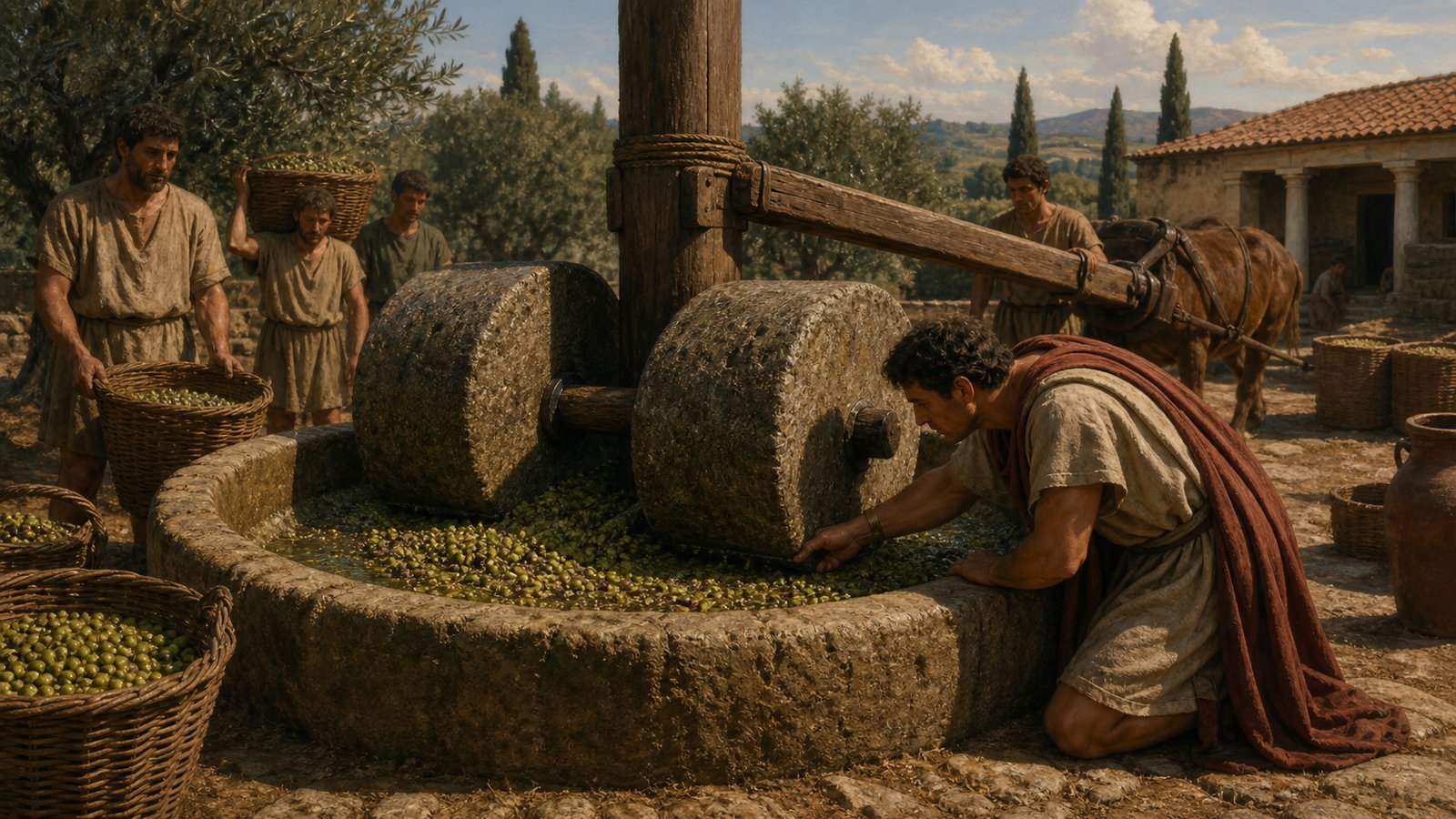
The mill described in his instructions was not the same device as a household hand quern. Heavy stones travelled around a central support in a shaped mortar. Their path broke the fruit and prepared it for pressing. The work demanded force, but force alone was useless. The stones had to follow a repeatable route through the crop without grinding hard against the stone basin.
Cato therefore separates installation into linked tasks. The post and pivot establish the centre. Sockets and a crossbar carry the moving assembly. Iron fittings protect places where wood would wear. Lead locks components that must not shift. Adjustment then decides how close the stones travel to the mortar and column.
This is a different stage of farm management from Cato’s advice to inspect a property repeatedly before buying. One evaluates land, neighbours and access. The other makes a machine behave once the estate is operating. Both share the same suspicion of appearances: a promising farm or impressive mill means little until its working details have been tested.
The urgency of harvest made such preparation valuable. Every delay risked damaged fruit and disordered labour. Calibration was not workshop fussiness added after production. It was part of the agricultural calendar.
Willow wedges and poured lead made the centre hold
The iron pivot carried the geometry of the whole mechanism. Cato says it must stand straight upright at the centre of the post. That sounds obvious, but the rest of the instruction shows how actively straightness had to be made. Workers packed willow wedges around the iron and poured lead into the fixing. The combination filled irregular space and resisted movement.
If the pivot still shook, Cato’s remedy was uncompromising: remove it and fasten it again in the same way. A small movement at the centre would become a larger wandering path at the stone. The machine might scrape one side, leave too much space on another or impose uneven stress on the bar and sockets.
The insistence recalls the hanging weight Roman builders used to make vertical visible. Neither a plumb line nor Cato’s pivot was spectacular. Each created a reference that many later operations depended upon. Once the reference was wrong, skill farther down the sequence could only disguise the error.
Cato also specifies sockets of orcite olive wood, fixed with lead, and a central bar drilled to receive the iron pivot and its casing. Iron plates faced vulnerable surfaces. Rings reduced wear where moving parts met. The materials were chosen as a system: wood supplied structure and replaceable bearing surfaces, iron concentrated strength, and lead secured fittings into joints that were not perfectly uniform.
His price list makes the assembly even more concrete. The smith’s work cost 60 sesterces. Lead for the bar cost four. The person who set the sockets with lead and adjusted the mill received at least eight, excluding helpers. Adjustment was paid work with a named place in the budget, not an accidental favour after construction.
The smallest measurement protected the largest stones
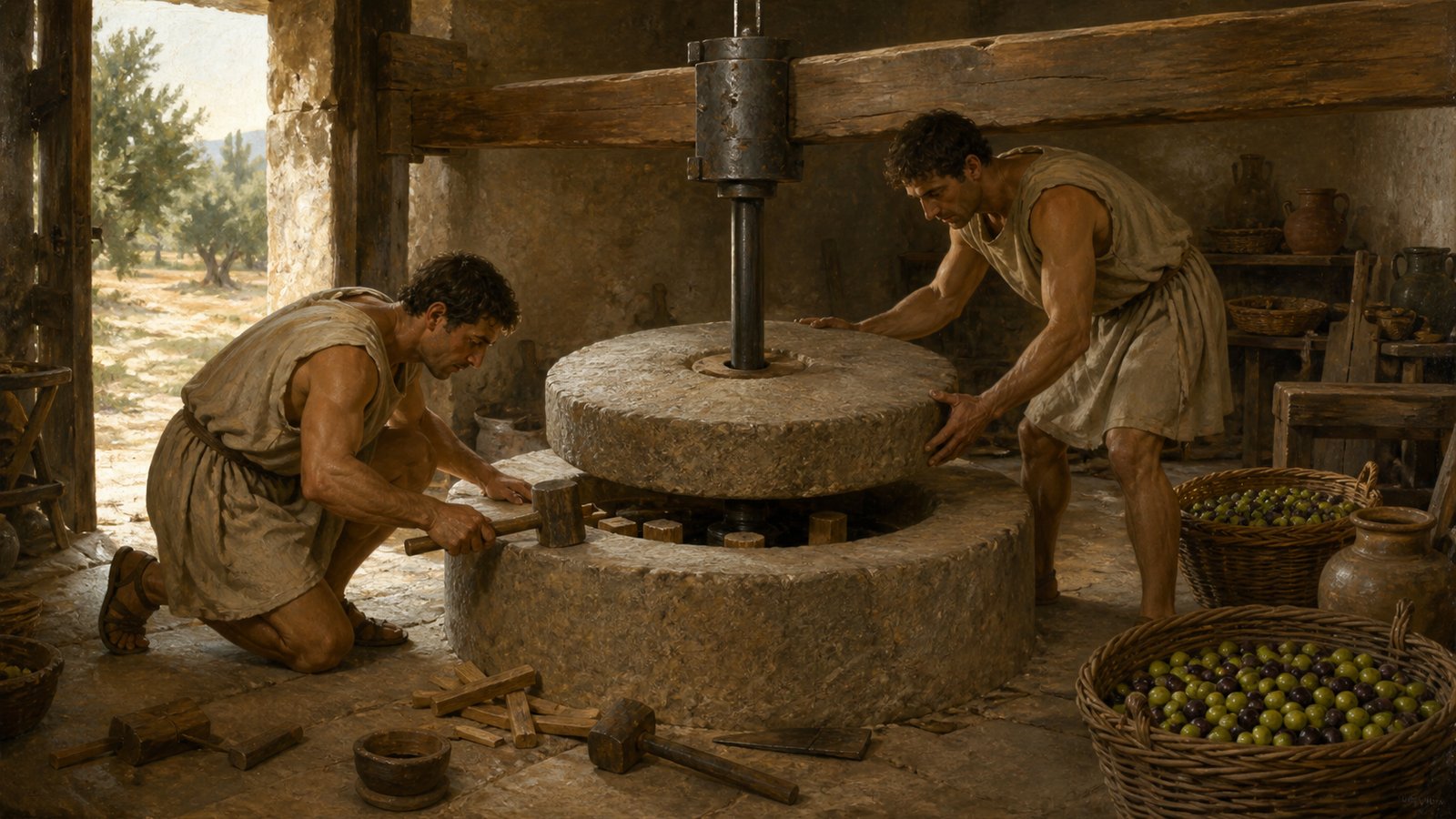
Once mounted, the mill had to be levelled. Cato wanted the stones equally distant from the rims and slightly above the bottom of the mortar. He defines that lower clearance with the body: a little finger’s breadth. The stones must not rub the basin at all.
That gap balanced competing needs. Raise the stones too far and olives could escape effective crushing beneath them. Set them too low and hard stone met hard stone. Friction would waste effort, damage surfaces and contaminate the processed mass with grit. Equal spacing mattered because a tilted assembly could satisfy the measurement on one side while scraping on the other.
The finger was not a claim to microscopic precision. It was a portable shop-floor standard available wherever the mill stood. A worker could crouch beside the basin, rotate the assembly and test whether the clearance remained plausible around its path. The body translated a written instruction into a repeatable physical check.
A second finger-width governed the space between stone and central column. If that opening was too large, Cato told the installer to wind cord tightly around the column until the excess disappeared. The correction is striking because it is adjustable and reversible. Rather than remake the entire central element, workers could build up the bearing surface with an ordinary material and test the fit again.
The contrast with the animal-driven grain mills preserved at Pompeii is useful. Both machines turned agricultural produce through stone, but their shapes and products imposed different demands. Cato’s olive mill had to bruise and break fruit inside a mortar while preserving clearance beneath travelling stones. Its correct movement depended on setup that an observer might never notice once the room filled with olives.
Cato recorded a maintenance culture, not merely a machine
The instructions reveal more than a reconstruction diagram. They divide responsibility. A smith makes and sets ironwork. Another skilled worker handles sockets, lead and adjustment. Helpers provide labour. The owner or overseer knows enough to judge prices, dimensions and the final behaviour of the mill.
They also assume failure is diagnosable. A shaking pivot points back to its wedges and lead. Stones rubbing the basin point to levelling or clearance. Excess space at the column can be taken up with cord. Each fault has a location and a remedy. The machine is not treated as a mysterious object that either works or does not.
That habit mattered on an estate where equipment had to survive repeated seasons. Wood compressed, cord wore, fittings loosened and stone surfaces changed. The original build established tolerances, but continued production depended on workers recognizing when those tolerances had drifted.
Cato’s prose is terse because he assumes action. Stand the pivot. Secure it. Check it. Remove it if it moves. Level the stones. Keep them from rubbing. Fill unwanted space. The sequence reads less like admiration for Roman engineering than a refusal to let expensive equipment remain almost correct.
The olive mill’s most important space was the space that remained empty. Between stone and basin, a little finger preserved motion. Between stone and column, another measured gap kept the assembly true. Oil flowed later, after crushing and pressing, but the conditions for that flow were set in these narrow clearances.
A Roman agricultural writer made the point without a slogan. The biggest stones in the room were governed by the smallest measurement.
Sources
Cato, On Agriculture 20–22