
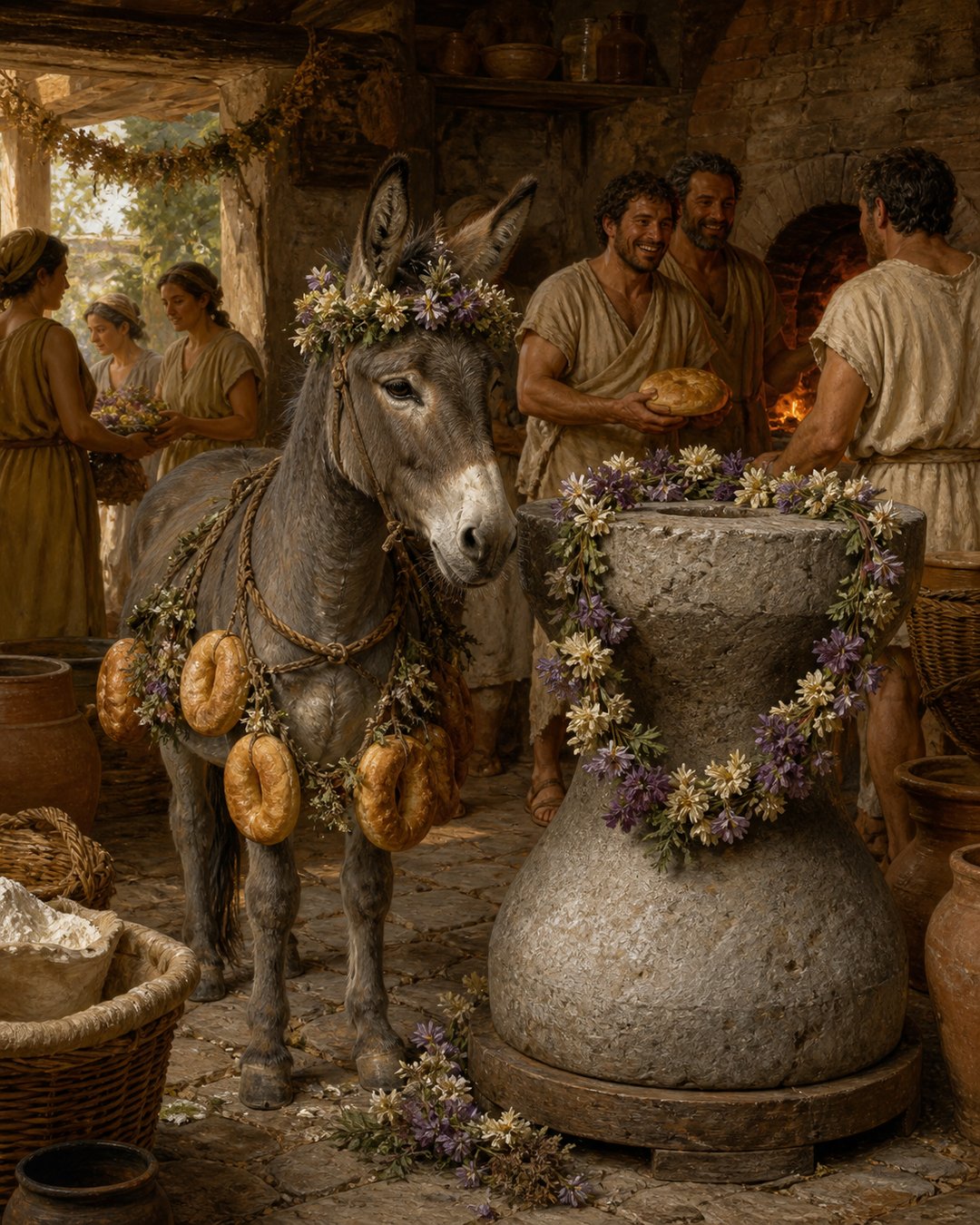
For most of the year, a millstone announced work through weight, friction and noise. On Vesta’s holiday, Ovid saw the same rough stones disappear beneath flower garlands. The animals that normally turned them wore wreaths, and loaves hung from their decorated bodies. Bread was no longer only the product at the end of labor. For one ritual interval, it became part of the costume worn by the laborer.
The scene belongs to the Vestalia in Book Six of Ovid’s Fasti. It is easy to treat the flowers and garlanded donkeys as picturesque festival color. Ovid’s sequence is more exact. He moves from an offering on a clean platter to decorated animals and resting stones, then back through older ways of preparing grain: spelt toasted in ovens, dough baked beneath ashes, and a broken tile laid on a warm floor. The holiday made breadmaking visible by pausing its machinery.
That pause joined religion to craft. Vesta was mistress of the hearth; bakers worked through heat; a she-ass supplied the force that turned pumice millstones. Ovid lets each part appear in the same ritual frame. Flowers covered the tool, wreaths honored the animal, and loaves displayed the result. The festival did not pretend bread arrived without effort. It briefly rearranged effort into public recognition.
A Clean Platter Opened the Holiday at the Hearth
Ovid introduces the observance through an old custom that he says had survived into his own time. Food offered to Vesta was placed on a clean platter. The adjective matters because the poet has already connected this part of June with the condition of Vesta’s sanctuary and the purification that would follow. Domestic-looking simplicity stood beside the formal calendar of Rome.
Vesta’s divine space was not defined by a cult statue in Ovid’s explanation. He insists that the goddess’s temple contained no image of Vesta or of fire. Her presence was understood through the living flame and through the round form of the sanctuary, which he associated with the earth. Whatever we make of his antiquarian reasoning, his festival scene keeps returning to things people could touch: a plate, bread, flowers, stone, ash and tile.
The clean platter therefore begins at the smallest scale. Before the procession of decorated working animals, there is food set before the hearth. The offering turns an ordinary requirement—keeping food and fire properly ordered—into ritual action. Vesta’s festival could move from Rome’s sacred flame to the material habits of kitchens and bakehouses because both depended on controlled heat.
A broader Lost Eagles account explains why Romans tied Vesta’s fire to the security of the community. Ovid’s June details show that protection translated into craft practice as well as state symbolism. The baker did not honor an abstract idea of food. He honored the hearth where raw grain products became edible bread.
Wreaths and Loaves Changed the Animal’s Public Role
Then Ovid gives the image that made the day memorable. Loaves were hung on asses decked with wreaths. The arrangement joined the finished food to the body that had helped produce it. An animal normally seen leaning into repetitive traction now carried the result rather than supplying motion.
The poet identifies the she-ass as the creature that turned the millstones of pumice. He does not offer a technical drawing, a daily ration or an estimate of output. His claim is narrower and more useful: animal power belonged inside the chain of baking that the festival honored. The donkey’s decoration only makes sense because its ordinary work was familiar.
Wreaths marked a different condition from harness. They made the animal festive and temporarily separated it from routine exertion. Loaves added a visual explanation. Anyone looking at the decorated ass could connect the animal’s circular labor to the bread hanging from its side. The body became a moving account of production without requiring an inscription.
The shift did not erase hierarchy. A garland did not transform a working animal into a citizen, and Ovid does not claim lasting relief from labor. What the ritual did was interrupt the normal appearance of use. Instead of being valued only through the force it delivered to the mill, the ass was made conspicuous as a participant in the sacred economy of grain, stone, heat and bread.
Flowers Made Silent Millstones Impossible to Ignore
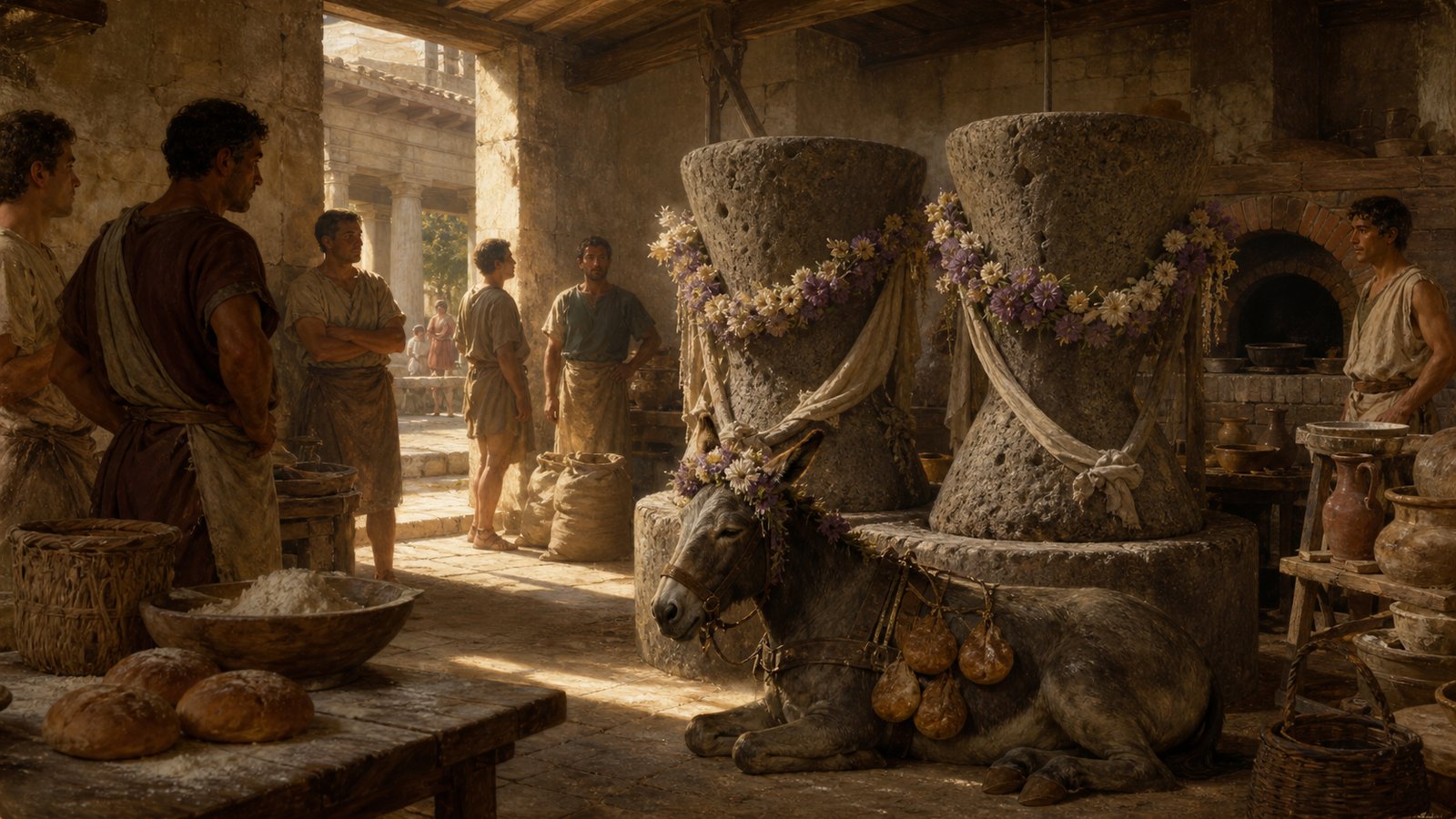
Ovid balances the moving animal with the stationary tool. Flowery garlands veiled the rough millstones. His verb gives the flowers a covering function: the working surface was hidden at the moment when the object itself became most visible as part of the celebration.
A nearby scheduled article follows how an animal drove Pompeii’s hourglass-shaped grain mills. The Vestalia approaches the same material system from the opposite direction. It is not about the geometry of upper and lower stones or the sequence of crushing grain. It asks what a mill looked like when motion stopped and ritual took possession of the equipment.
Silence was part of the transformation even though Ovid does not pause to describe the usual sound. A stone covered with garlands could not be grinding in the ordinary way. Decoration depended on suspension. The flowers announced that production had yielded to observance, while the mass of the millstone prevented the holiday from becoming detached from labor.
The roughness under the flowers matters. Ovid does not replace the millstone with a polished ceremonial model. The same surface associated with abrasive work received temporary beauty. Roman ritual often operated by changing the status of familiar material for a bounded time. Here the contrast between coarse stone and fragile flowers made that change immediately legible.
Spelt, Ashes and a Broken Tile Recalled Older Baking
After showing the decorated equipment, Ovid turns backward. Husbandmen, he says, once toasted only spelt in ovens. The line imagines an earlier stage before specialized urban baking, when preparing grain belonged more directly to agricultural households. He also mentions sacred rites for the goddess of ovens, placing heat itself within a field of divine attention.
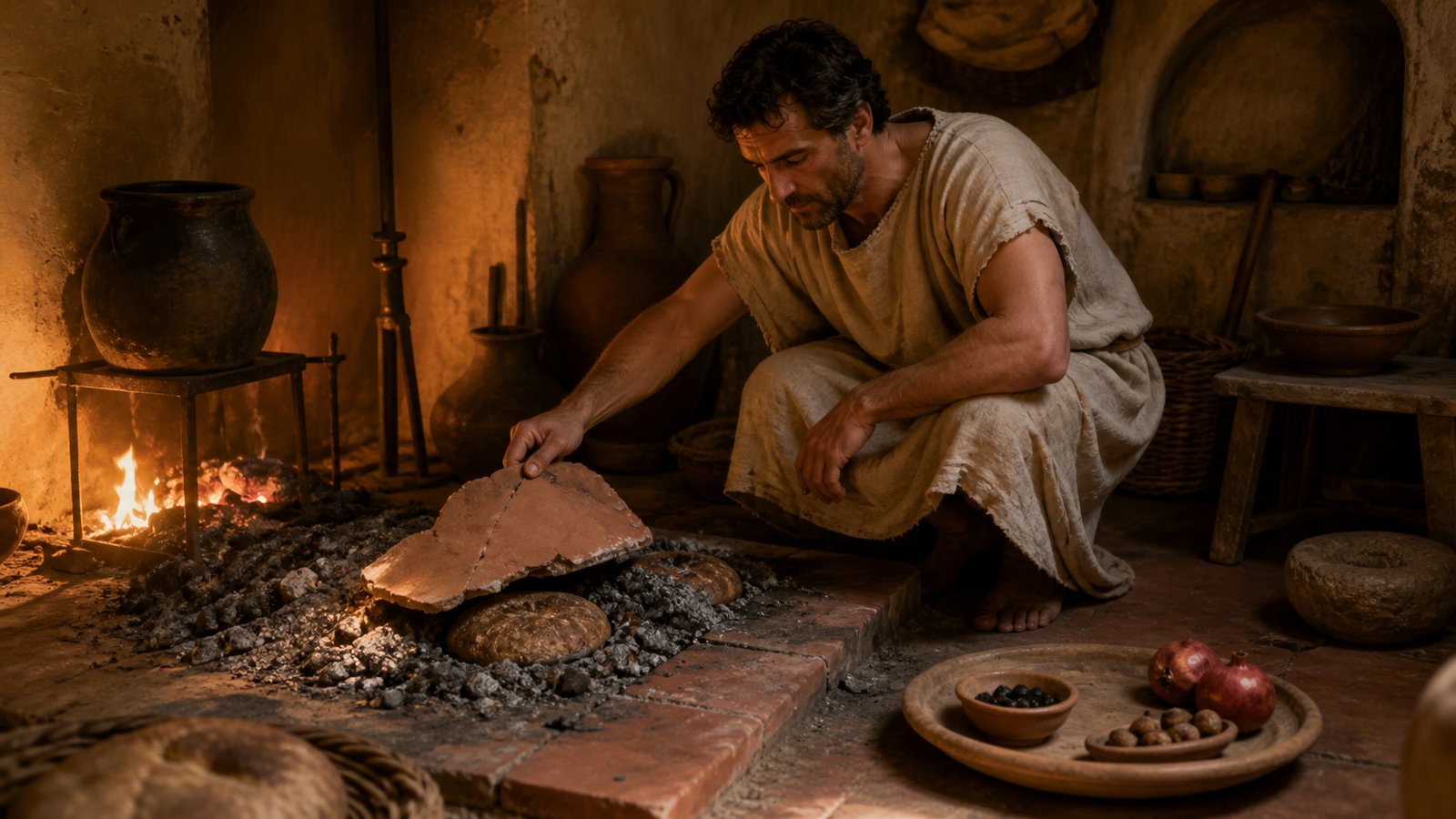
His next details are physical. The hearth baked bread placed beneath the ashes, and a broken tile lay over the warm floor. These are not lavish ceremonial implements. Ash retained and distributed heat; tile helped contain it. Ovid’s picture makes early breadmaking depend on arranging ordinary materials around a hot surface.
The retrospective gives the festival depth. Bakers of Ovid’s Rome did not honor Vesta merely because contemporary shops used fire. The poet presents the hearth as the ancestor of their craft. Millstones and animal traction could become more specialized, but the final transformation still required managed heat. The holiday folded newer production into an older domestic story.
That story should not be mistaken for a modern archaeological report. Ovid was a poet explaining rites through inherited narratives and visible customs. His account tells us how he connected what Romans could see during the Vestalia with an imagined history of food preparation. The spelt, ashes and tile are valuable because they are his chosen bridge between present ritual and ancestral practice.
The Baker Honored an Entire Chain, Not One Machine
Ovid closes the explanation by naming the relationships. The baker honors the hearth, the mistress of hearths and the she-ass that turns the pumice millstones. Tool, animal, worker and goddess are not competing explanations. They occupy different points in the same chain.
The formula gives the festival its structure. Fire transformed dough; Vesta governed the sacred meaning of that fire; the animal powered the preparation of grain; the baker coordinated the process. Flowers and wreaths distributed honor across the system by resting the equipment and marking the animal. The loaf displayed what their combined work made possible.
This is why the holiday’s prettiest details should not be detached from production. Violets or other flowers on a stone mattered because the stone was usually bare and working. Bread on a donkey mattered because the animal normally helped turn grain toward bread. A clean plate mattered because food and hearth demanded ordered handling. The festival made dependencies visible by reversing their ordinary appearance.
There is also restraint in Ovid’s account. He gives no speech for a baker, no named donkey and no timetable for the day’s ceremonies. We should not invent them. The surviving scene is already concrete: clean platter, wreath, loaves, rough stones, spelt, ashes, broken tile and pumice. Together they show how much Roman religion could say through arranged material rather than doctrine.
On the Vestalia, Rome’s breadmaking world paused long enough to look at itself. The millstone vanished beneath flowers. The draft animal wore the loaf it helped create. The baker’s hearth became an object of honor rather than merely a source of heat. Rest did not conceal labor. For a day, it exposed the full route from animal strength and abrasive stone to warm bread placed before Vesta.
Sources
Ovid, Fasti, Book 6, lines 249–348.