
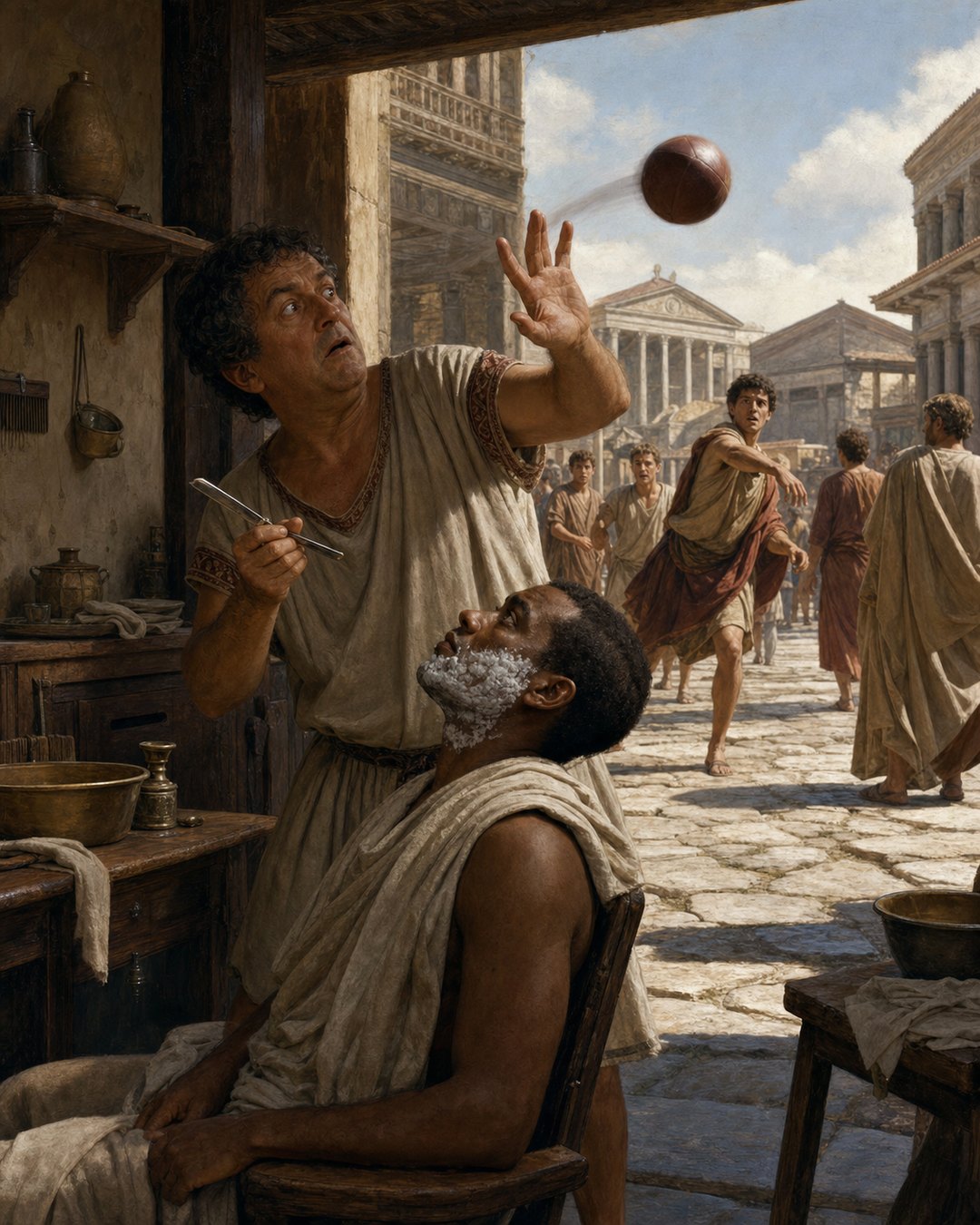
A player struck a ball with unusual force. The ball flew into a barber’s hand. The hand drove a razor across the throat of the slave sitting under the blade. In a few movements, a game beside a public workplace became a fatal problem in Roman law.
The chain survives in Book Nine of Justinian’s Digest, where Ulpian discusses damage covered by the Lex Aquilia. He preserves Mela’s account of the accident, then adds Proculus’s view about the barber and his own sharp final observation about the customer. The passage is short. Its reasoning is not. Each jurist changes the question by changing which choice matters.
Was the player careless because he hit too hard? Was the barber careless because he shaved where games or heavy traffic made interruption predictable? Or had the person under the razor accepted an obvious danger by sitting there? Roman jurists did not need to deny the physical sequence in order to disagree. They moved responsibility along it.
The Accident Began with Force, Not with a Mysterious Weapon
Mela’s example starts with several people playing ball. One of them struck it with excessive force. That detail does legal work. A ball in motion was not automatically wrongful, and the game itself was not described as forbidden. The initial departure from ordinary conduct was the strength of the blow.
The ball then hit the hand of a barber who was shaving a slave. The razor cut the slave’s throat. Nothing in the surviving passage requires a planned attack, a quarrel or a hidden defect in the blade. It is a sequence of ordinary actions whose conjunction produced extraordinary harm: play, shaving, impact and a cutting edge held against skin.
The legal interest came from that conjunction. The Lex Aquilia supplied a route for addressing wrongful damage, but the jurist still had to identify fault. Mela’s answer was conditional. Whoever was blameworthy was liable under the statute. The formula refuses to let the most vivid object—the razor—settle the issue by itself.
That is what makes the example more than a grisly anecdote. A physical cause can be traced backward from wound to blade, hand, ball and player. Legal responsibility requires another map. It asks where conduct became culpable and whether a later actor had placed the victim in a danger that should have been anticipated.
Mela Made Culpa the Hinge of the Whole Sequence
Mela’s preserved opinion does not simply announce that the player must pay. He says liability falls on whichever person is at fault. The phrase opens the chain rather than closing it. Excessive force points toward the player, but the location and conduct of the barber remain available for examination.
This was a practical way to reason about an indirect injury. The player did not hold the razor. The barber did not launch the ball. Yet both actions were necessary to the result described. Culpa allowed the jurist to distinguish participation in the chain from blameworthy participation in it.
The account also keeps its claims narrow. It does not give the ball’s weight, the distance of the strike, the slave’s name or the compensation awarded. Those missing facts should remain missing. What survives is enough to stage the legal problem: a forceful stroke, a deflected hand, a razor and a workplace exposed to activity around it.
Readers can compare this tight problem with the public setting of Roman legal conflict. The barber passage does not preserve a courtroom speech. It preserves juristic analysis—the quieter work of turning a concrete mishap into distinctions that could guide legal judgment.
Proculus Looked Past the Player to the Barber’s Location
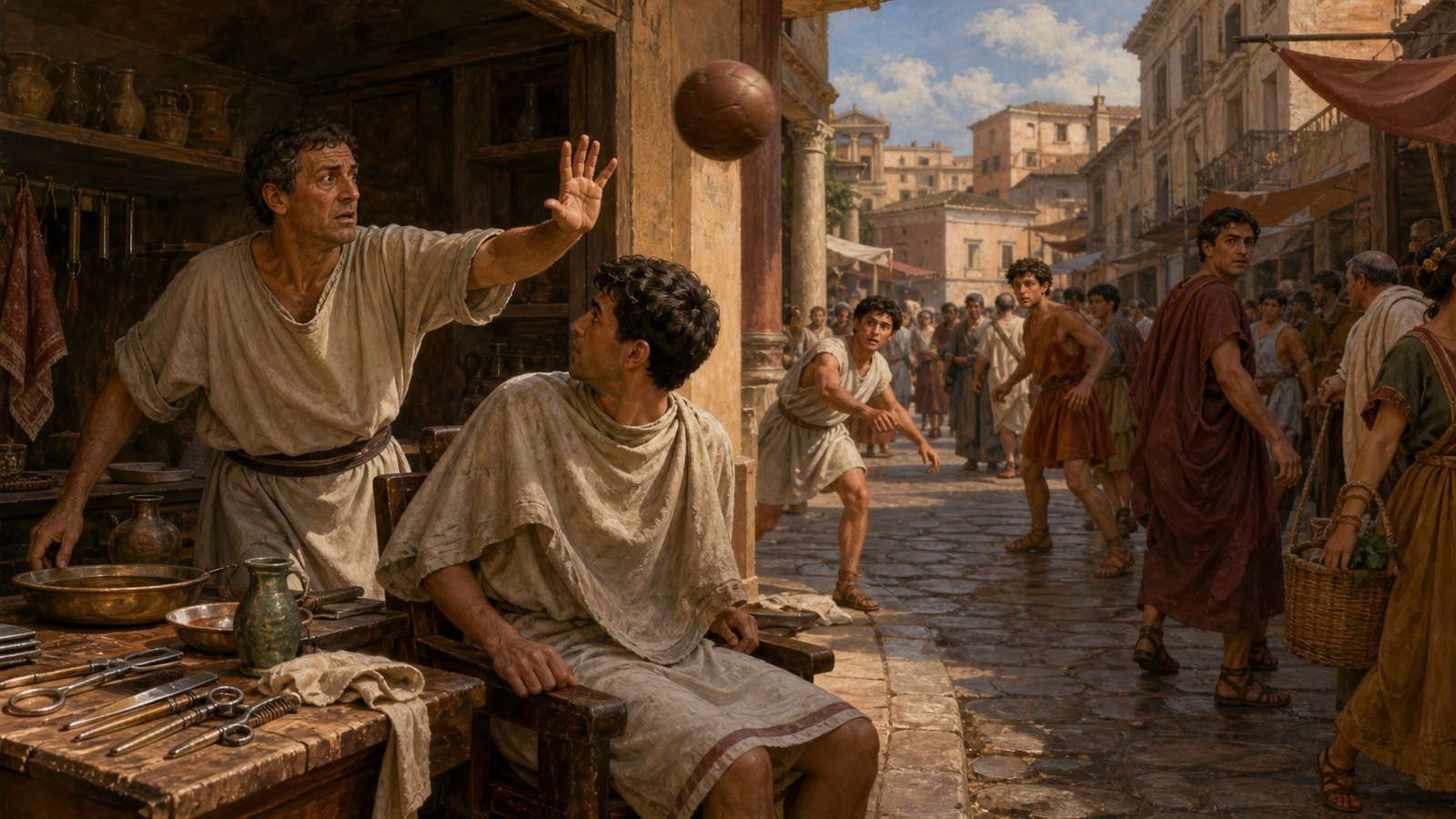
Proculus placed fault on the barber. Ulpian then gives the condition that makes this position intelligible. If the barber was shaving in a place where people habitually played games, or where traffic was heavy, blame could properly attach to him.
The location changes the quality of holding a razor at another person’s throat. In a quiet room, a flying ball might be an exceptional intrusion. Beside customary play, it belonged to the environment the barber had selected. In dense traffic, a jolt or collision was not unimaginable. The jurist treated setting as part of conduct.
This does not make the player’s force irrelevant. Instead, it shows that Roman legal reasoning could entertain more than one culpable choice inside one accident. The excessive hit explains why the ball reached the barber. The exposed shaving place explains why a predictable disturbance could become fatal.
A separate Lost Eagles article follows Roman barbers as visible figures in public social life. The legal fragment catches the darker edge of that visibility. A workplace open to movement and spectators could attract conversation and customers, but exposure also changed what hazards the barber was expected to recognize.
Heavy Traffic Turned Background Movement into Legal Evidence
Ulpian’s wording pairs habitual games with a place of frequent traffic. The two settings are not identical. One contains a known recreation; the other contains repeated movement. Both make disturbance less surprising than it would be in an isolated shaving room.
This is a remarkably physical form of legal analysis. The jurist asks us to imagine bodies passing close to a seated customer, a hand maintaining a blade angle and activity occurring within range of the barber. He does not need a statistical table of accidents. The arrangement itself gives reasons to anticipate interruption.
The barber’s craft increased the stakes of that interruption. A small displacement of a hand might be trivial while holding a comb or cloth. With a razor at the throat, the same displacement could be lethal. The place and the instrument therefore had to be considered together. Risk came from their combination.
The fragment never says that all outdoor or public shaving was negligent. Its condition is more exact: shaving where games were customary or traffic dense. That precision matters. Roman jurists were not converting every unfortunate result into liability. They were identifying circumstances in which a person’s chosen conduct exposed another to a recognizable danger.
Ulpian’s Final Turn Put the Customer’s Choice on Trial
After reporting the views of Mela and Proculus, Ulpian adds a severe alternative. If someone entrusted himself to a barber operating in a dangerous place, it was not unreasonable to blame that person. The observation shifts attention again, this time to the one under the razor.
The remark can sound startling because the customer suffered the fatal wound. Ulpian does not erase the player’s blow or the barber’s hand. He asks whether choosing to be shaved in an obviously hazardous setting should affect the allocation of culpa. The person who accepted the service may also have accepted a danger visible before the accident.
The status detail is equally stark. Mela’s victim was a slave. Under the Lex Aquilia, the legal question concerned damage to property as Roman law classified it, even though the physical event was the cutting of a human throat. The passage therefore joins sophisticated fault analysis to a social order that treated an enslaved person’s death through the owner’s patrimonial loss.
We should not soften that fact, but neither should we add a biography the source does not provide. The victim is unnamed. The passage records no words from him and no opportunity to explain why he sat there. Ulpian’s final turn is a jurist’s proposition about assumed danger, not the surviving testimony of the person killed.
One Mishap Produced Three Different Maps of Responsibility
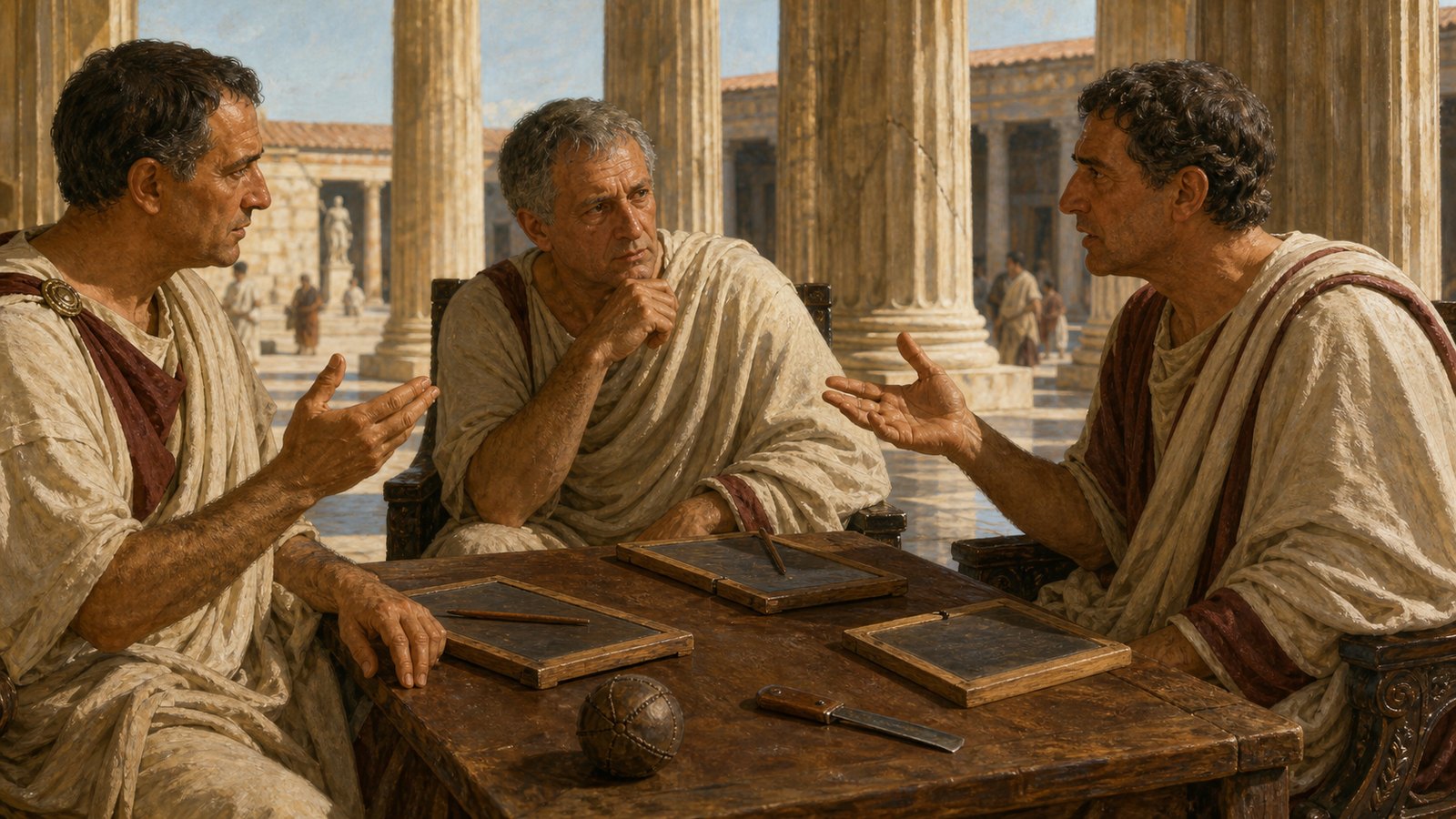
The case endured because its few objects could support several legal maps. Follow force, and attention returns to the player who struck too hard. Follow professional control of the blade, and the barber becomes central. Follow the selection of a dangerous service, and even the customer’s judgment enters the analysis.
None of those maps changes the event’s mechanics. The ball still hits the hand; the razor still cuts the throat. What changes is the normative description. A strong shot becomes careless play. A public shaving station becomes a poorly chosen workplace. Sitting for a shave becomes voluntary exposure to a visible hazard.
The surviving text also shows jurists in conversation across generations. Ulpian cites Mela, reports Proculus and supplies his own response. Roman law appears here not as a single voice issuing a timeless answer, but as accumulated argument attached to a concrete example.
The razor case is memorable because it refuses a comfortable distance between law and daily life. Its evidence is a game, a craft, a crowded place and a momentary loss of control. From those materials, the jurists built a durable question: when several ordinary choices combine in disaster, which choice should the law call culpable?
Their answers do not collapse into one rule. Mela leaves liability with the person at fault. Proculus directs blame toward a barber who chose a hazardous station. Ulpian makes room for blame falling on the person who trusted that barber. The stray ball supplied the motion. Roman law turned the motion into competing accounts of responsibility.
Sources
Justinian, Digest 9.2.11 (Ulpian, citing Mela and Proculus).
William Smith, A Dictionary of Greek and Roman Antiquities, “Pila.”