
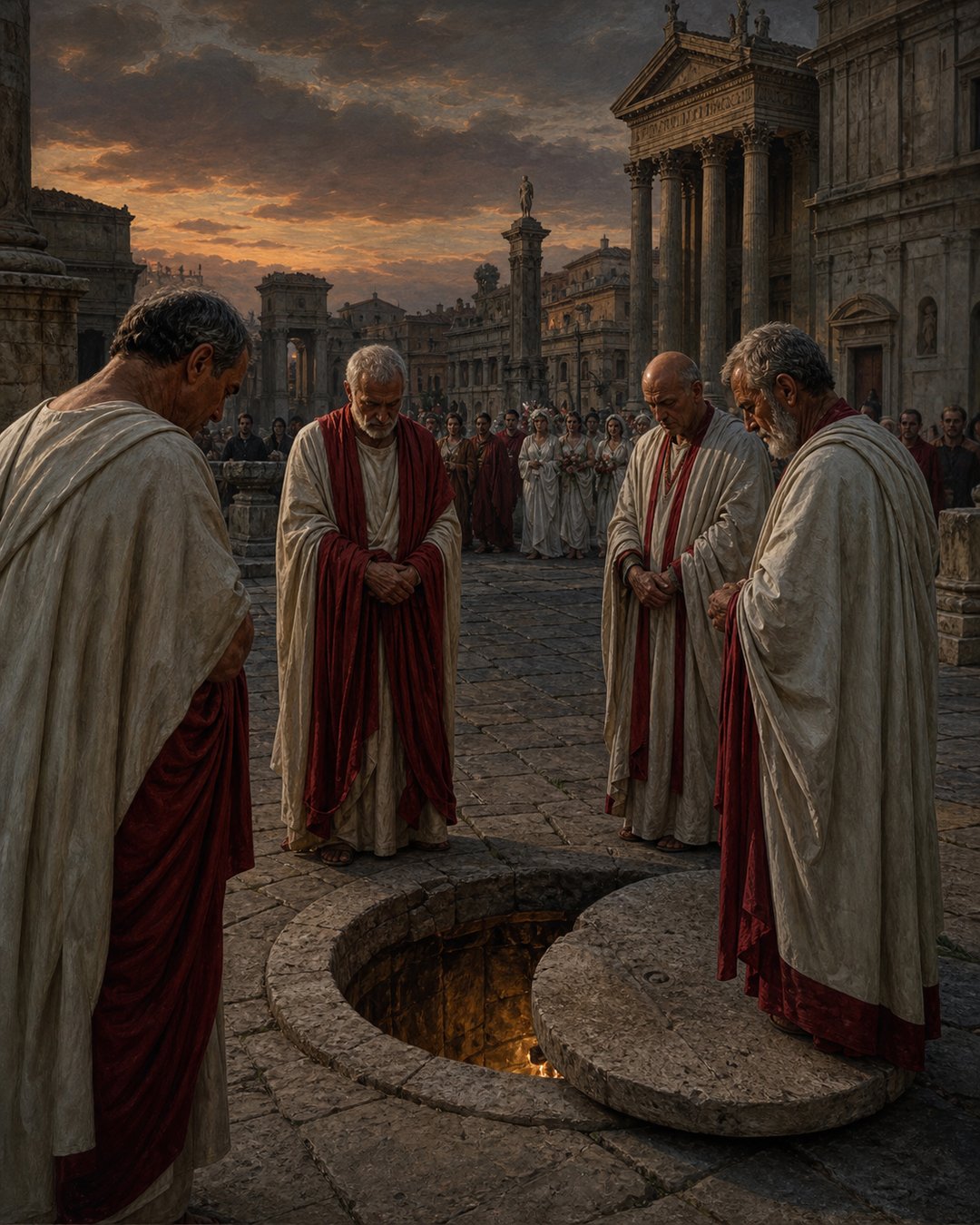
On 24 August, Rome’s calendar marked an opening. The same thing happened on 5 October and 8 November. Ancient antiquarians described the mundus as open on those three dates, and Macrobius says the days were too religiously charged for battle, military recruitment or marriage.
What opened is harder to recover. The surviving accounts do not give us one tidy structure with one agreed location and purpose. They preserve a cluster of ideas: a normally closed cavity, a stone cover, the foundation of the city, offerings from settlers, the gods below and three interruptions in ordinary civic time.
That uncertainty is the point rather than an inconvenience to hide. Rome’s mundus shows ritual working through boundaries. A place could remain obscure while the act of opening it still changed what Romans thought it was safe to do.
Three Entries in the Calendar Created an Exceptional Season
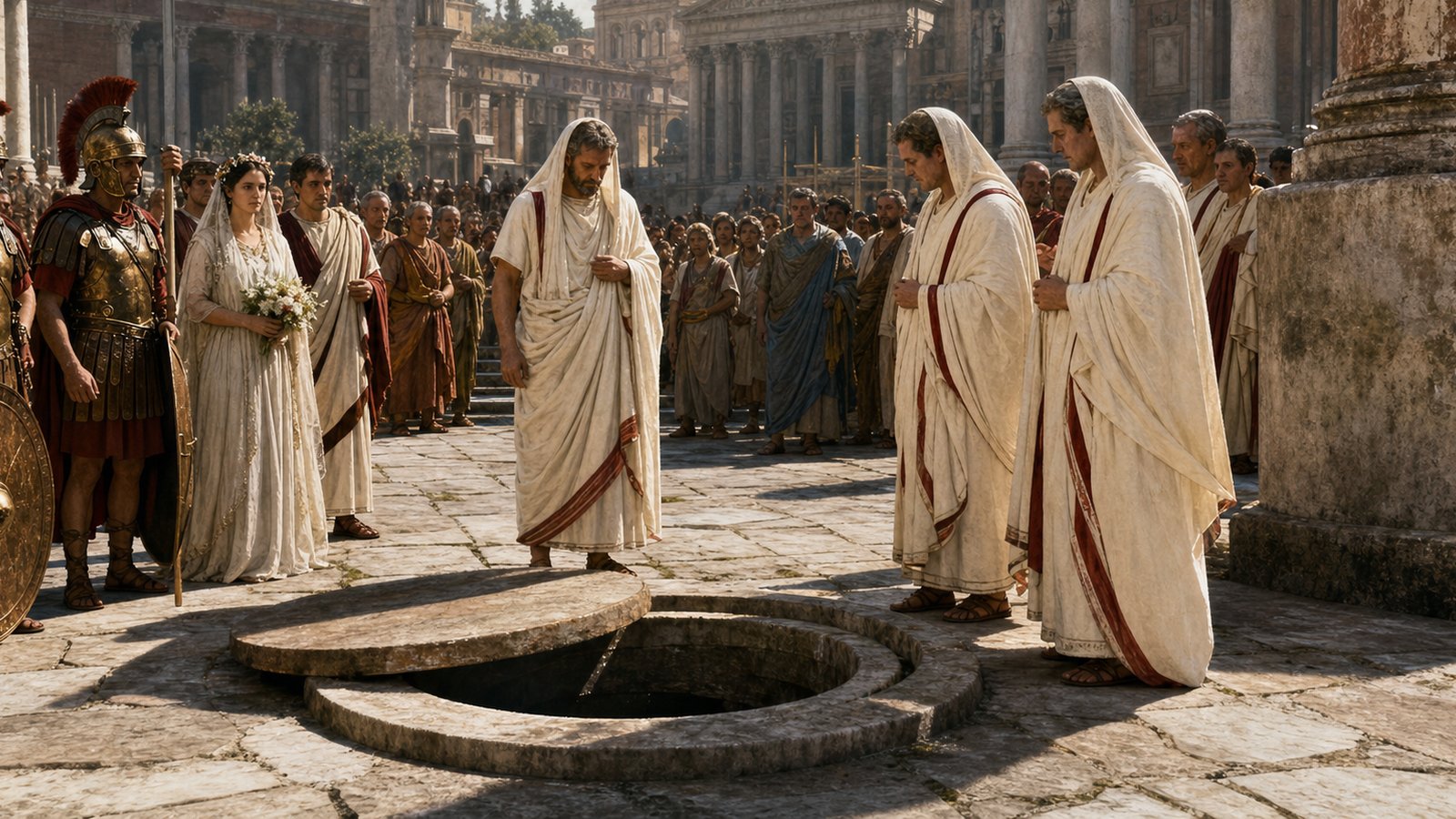
Festus preserves the antiquarian notice that the mundus was accustomed to stand open three times each year. The dates, reconstructed with the help of the abbreviated version attributed to Paulus, are the day after the Volcanalia, 5 October and 8 November. In modern terms, that produces the memorable sequence 24 August, 5 October and 8 November.
The dates are scattered rather than grouped into one festival week. That made each opening a separate interruption. Most days, the place was understood to be shut. On three named days, the calendar announced a changed condition: mundus patet, “the mundus is open.”
Macrobius, quoting Varro, explains the danger in spatial language. When the mundus stood open, he says, the gate of the gloomy gods below was open as well. He then lists consequences in the world above. Romans should not join battle, undertake an important military operation, hold a levy or contract a marriage.
These prohibitions give the fragment its public weight. The opening was not merely a priest’s private observation beside an unseen cavity. It reached the army, civic manpower and the formation of households. Compare the way a recurring market cycle organized movement in Rome’s eight-day nundinae: in both cases the calendar changed the uses of a day, although the mundus dates restricted action rather than inviting trade.
A Closed Place Mattered More Than a Visible Monument
Festus’s preserved discussion says the lower part of the mundus was consecrated to the Di Manes, the divine dead. It was to remain closed at all times except the specified days, which the ancestors judged religiosi. The normal condition was therefore closure. Opening was exceptional because it crossed a boundary maintained through most of the year.
A stone called the lapis manalis appears in later attempts to explain the closure. The name is treacherous because Roman antiquarian writing also attached it to a different stone used in rites for rain. W. Warde Fowler warned that similar terminology had encouraged explanations to blur together. A stone over the mundus and a rain stone should not be treated as one object simply because a surviving label resembles another.
Nor can the cavity be drawn with archaeological confidence. Cato, quoted by Festus, said its form could be known by those who had entered it. That suggests an accessible lower space, but it does not supply measurements, masonry phases or a secure plan. Fowler imagined something like a cellar with an opening above; he presented that as reconstruction, not excavated fact.
The ritual logic needs less certainty than the architecture. A cover establishes inside and outside. Keeping it closed stabilizes that division. Removing or opening it on a marked date makes the division temporarily permeable. The public prohibitions show that Romans responded to that change even when our texts leave the physical object indistinct.
Plutarch Put a Different Mundus at the Birth of the City
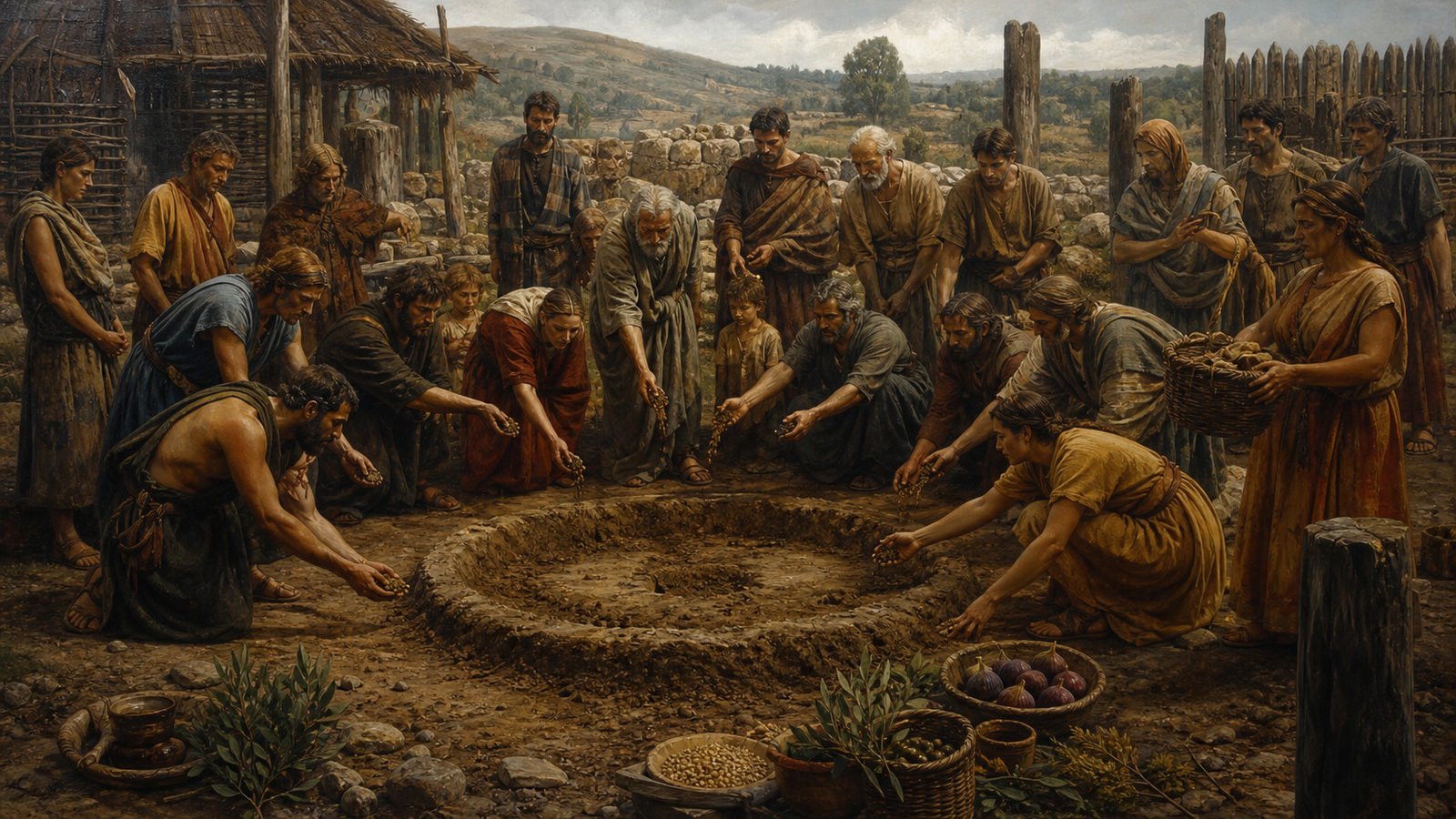
Plutarch tells another story in his Life of Romulus. During Rome’s foundation, he says, a circular trench was dug in the area of the Comitium. First fruits of things considered useful or necessary were thrown into it. Each settler then brought a small portion of soil from his own country and cast it in with the rest.
The image is not one of ghosts escaping on three dates. It is one of many origins being combined at a new centre. Imported earth made settlement physical: newcomers contributed pieces of other landscapes to the place they were agreeing to share.
Plutarch says the trench was called mundus, the same word used for the universe. He also connects the procedure with Etruscan ritual specialists. Yet his location at the Comitium does not sit neatly beside antiquarian traditions placing the mundus on or near the Palatine. The accounts may preserve different places, different phases or later efforts to make separate customs explain one another.
Rome’s foundation traditions often accumulated rather than resolving alternatives. The tensions resemble those explored in the dangerous plurality of Roman foundation stories. The responsible conclusion is not that one late author gives us a photographic report. It is that Roman writers repeatedly used a cavity called mundus to think about connection: settlers to a city, the upper world to the lower and an enclosed centre to the space around it.
Seed Corn Offers an Ingenious Theory, Not a Settled Answer
In 1912 Fowler proposed a practical origin for the ritual. He noted that the August opening fell between the Consualia and Opiconsivia, festivals associated in Roman scholarship with harvest and storage. He suggested that an underground place might once have protected grain, perhaps especially the seed reserved for the next sowing.
The October and November dates encouraged him to extend the argument. Ancient agricultural writers placed sowing across the autumn. Virgil advised delaying wheat until the Pleiades had set, and Fowler connected their early-November setting with the opening on 8 November. In his reconstruction, the three dates could be traces of putting seed away and taking it out at agriculturally useful moments.
It is an attractive mechanism because it connects closure, seasonal dates and the survival of a community. Seed grain demanded protection from damp, animals, theft and war. A store holding next year’s crop could easily acquire restrictions more intense than those around an ordinary bin.
But Fowler repeatedly called the proposal a conjecture. The ancient notices do not plainly say, “The mundus was opened to move seed corn.” His article tries to explain why these dates existed; it does not turn that explanation into a recovered Roman instruction manual. The distinction matters. Agricultural context can illuminate a ritual without cancelling what Varro, Festus and Macrobius say about the gods below.
Opening the Mundus Changed Rome Above Ground
The safest reconstruction begins with what the evidence actually repeats. There was a normally closed mundus. Three dates were associated with its opening. Roman antiquarians treated those days as religiously constrained, and one influential explanation imagined communication with the lower world.
A second body of tradition attached a similarly named cavity to the founding of Rome. Modern scholarship has then asked whether agricultural storage, Etruscan ritual, Greek ideas of the underworld and later antiquarian system-building became layered together. Those layers need not have formed at one moment.
The most concrete result was temporal. A boundary in the ground altered decisions made elsewhere. A commander was not to choose that day for battle. Officials were not to call men into military service. Families were not to begin a marriage. The calendar carried the opening outward through the city.
That is why the mundus remains valuable even without a secure excavation plan. Roman religion did not always depend on a large temple or a spectacle visible to thousands. It could work through a covered place and three dates, making absence, closure and temporary access socially powerful.
The phrase mundus patet did not explain every origin of the custom. It announced a condition. For most of the year, the boundary held. On 24 August, 5 October and 8 November, Rome treated it as open—and changed the business of the living accordingly.
Sources
Festus, On the Meaning of Words, entries on mundus.
Macrobius, Saturnalia 1.16.18.
Plutarch, Life of Romulus 11.
W. Warde Fowler, “Mundus Patet: 24th August, 5th October, 8th November,” Journal of Roman Studies 2 (1912).