
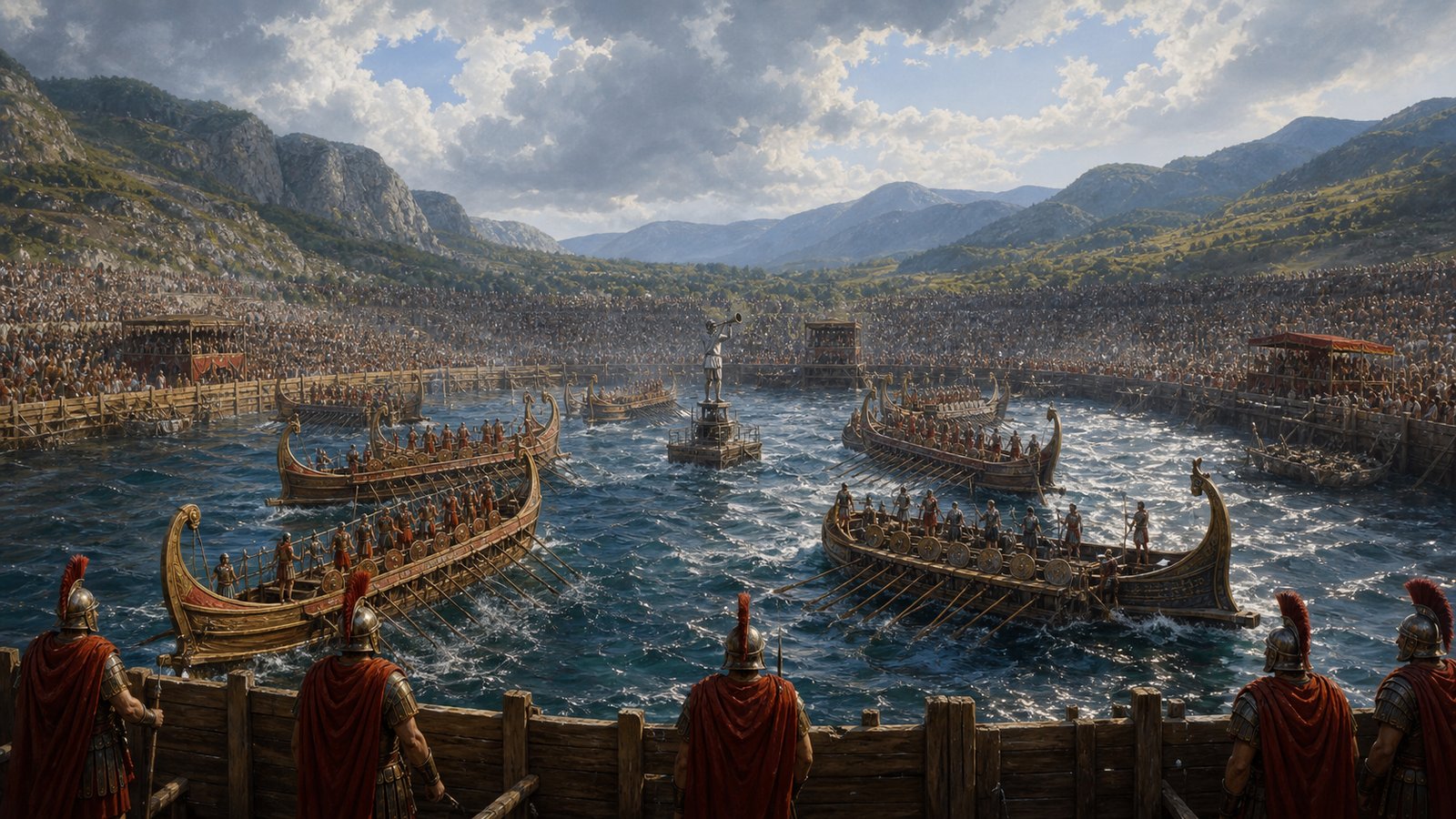
A silver Triton rose from the middle of Lake Fucinus and sounded a horn. Around it, two fleets prepared to collide while spectators packed the shores, hills and mountain crests. Emperor Claudius had not gathered them merely for a naval show. The performance was supposed to mark the opening of a tunnel that had taken eleven years and thirty thousand workers to drive through a mountain.
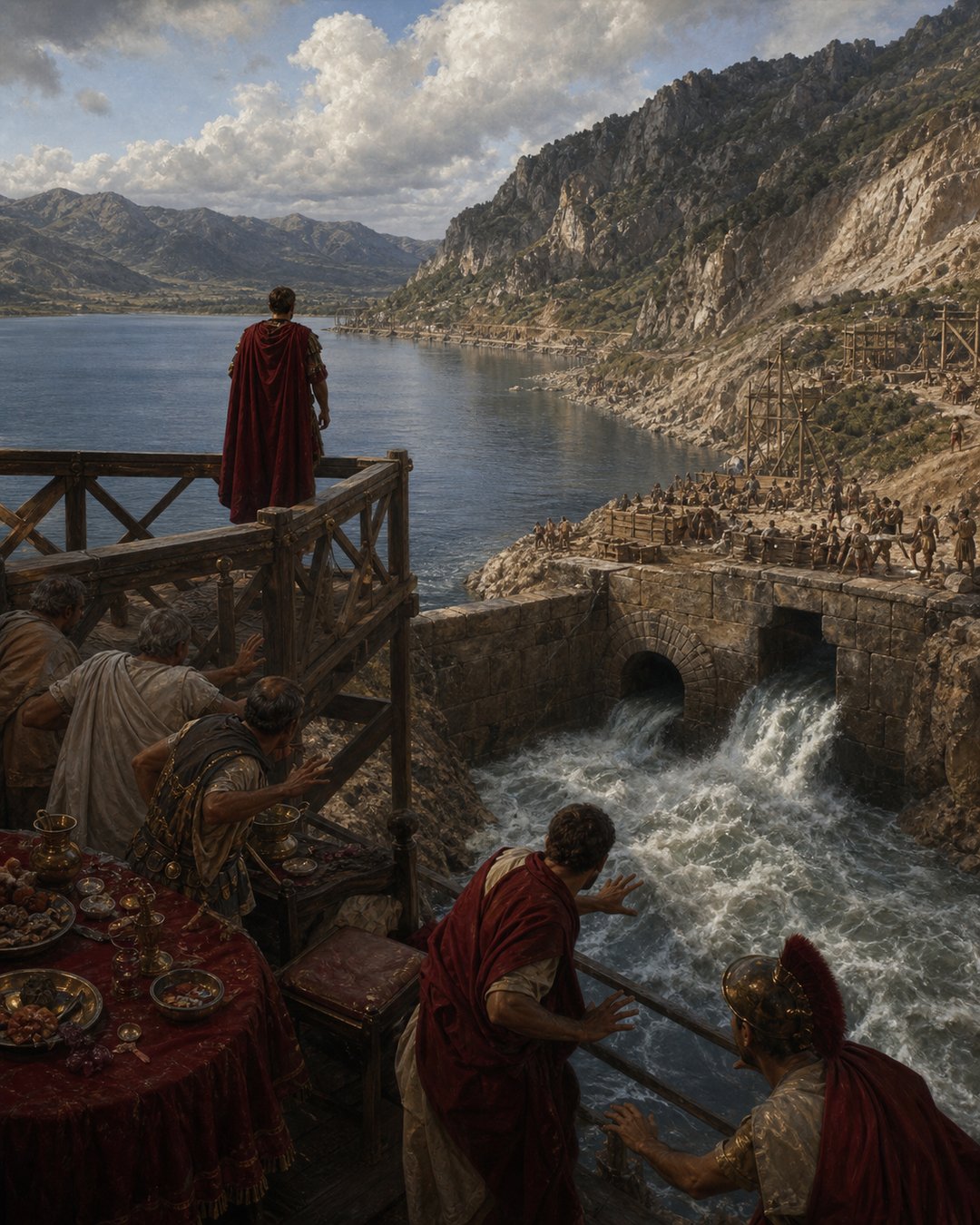
Then the water was released, and the monument to imperial persistence exposed its central mistake. Tacitus says the channel had not been sunk even to the lake’s average depth. A project designed to reveal dry land could not draw the water down as intended. When engineers later cut it deeper, the outflow surged hard enough to damage nearby works and throw an imperial banquet into panic.
The failure was more than a technical embarrassment. Claudius had tied engineering to spectacle, personal glory and the promise of new land. Once the water refused to behave, the lake also became a court weapon. Agrippina accused the freedman Narcissus, who directed the scheme, of greed and embezzlement; he answered by attacking her ambition.
Thirty Thousand Workers Cut Toward a Promised Shore
Lake Fucinus lay in the central Apennines, enclosed by high ground and without a natural outlet capable of keeping its level reliably low. Suetonius says the Marsians had repeatedly asked Augustus to attempt a drainage scheme, but Augustus refused. The difficulty was therefore known before Claudius adopted the project. Taking it on allowed the new emperor to present hesitation as a challenge his government could master.
The expected reward was land. Suetonius writes that private parties had offered to drain the lake at their own expense if they received the ground uncovered by the falling water. Claudius pursued the work “as much in the hope of gain as of glory.” Those motives belonged together: reclaimed soil could carry crops and property claims, while the emperor received credit for forcing a landscape into a more useful shape.
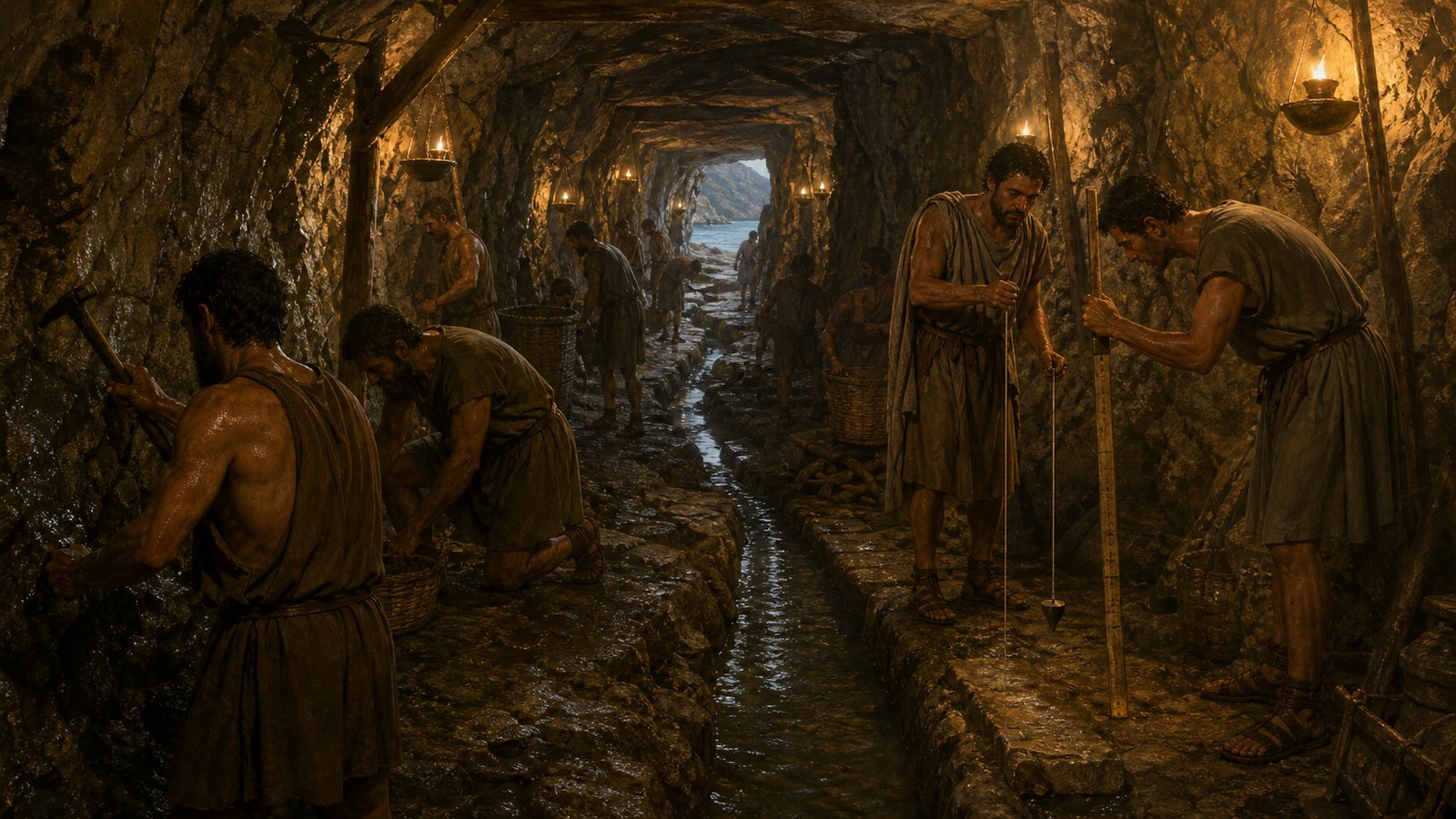
The physical undertaking was severe. Suetonius gives the outlet a length of three Roman miles and says part of its course was made by levelling while part required tunnelling through a mountain. He assigns thirty thousand men to the task for eleven years without interruption. Even if ancient totals deserve caution, the figures show how he wanted readers to measure the work: by distance, labour and time.
Claudius placed the Fucine outlet beside the aqueducts and harbour at Ostia among his major public works. The comparison matters. The harbour addressed the movement of supplies into Rome, a political promise examined in the building of Ostia’s imperial harbour. At Fucinus, the desired movement ran the other way. Water had to leave an enclosed basin through a calculated descent. No number of labourers could compensate if that descent finished at the wrong level.
A Naval Battle Turned the Outlet into Imperial Theatre
The tunnel’s opening was staged for an audience large enough to make the achievement visible beyond the work crews. Tacitus says visitors filled the shores, hills and mountain tops, arriving from neighbouring towns and from Rome. The landscape became a theatre whose central arena was the water Claudius intended to release.
His spectacle was a naumachia, a mock naval battle fought with real danger. Tacitus lists triremes and quadriremes and gives a total of nineteen thousand combatants. Rafts enclosed the fighting area so there would be no unauthorized route of escape. Praetorian companies and cavalry squadrons stood on those platforms behind breastworks equipped with catapults and ballistae, while marines occupied decked vessels elsewhere on the lake.
Suetonius preserves different operational detail. He describes Sicilian and Rhodian fleets, each with twelve triremes, and the mechanical silver Triton that rose to sound the signal. The two authors need not be forced into a single inventory. Together they show a carefully produced imperial event: named sides, warships, mechanical scenery, armed security and spectators positioned across the natural slopes.
Claudius and Agrippina presided in costume. Tacitus puts the emperor in a splendid military cloak and Agrippina nearby in a Greek mantle woven with gold. The engineering launch therefore borrowed the visual language of victory. Claudius was not shown holding a surveyor’s level. He appeared as commander of an artificial war whose battlefield existed because his tunnel was ready—or was believed to be ready.
One Ambiguous Reply Nearly Stopped the Fleets
Before the ships moved, the combatants hailed the emperor with the line Suetonius renders as “Hail, emperor, they who are about to die salute you.” Claudius replied, “Or not.” The fighters treated those two words as a pardon and refused to begin. Whatever the emperor intended as wit, his answer collided with the deadly seriousness of people trapped inside an enclosed arena.
Suetonius says Claudius considered destroying them with fire and sword. He eventually ran along the edge of the lake and induced them to fight through a mixture of threats and promises. Tacitus reports that the criminals fought with the courage of free men and, after much bloodshed, were spared complete destruction.
The episode reveals the human machinery behind the imperial image. Rafts had been placed to prevent escape; guards and artillery ringed the arena; a verbal misunderstanding could suspend the production before force restarted it. The crowd had come to see mastery over water and mountain, but first watched authority struggle to make its own performers obey.
Claudius had previously emerged as emperor through a different collision of uncertainty and armed power, when a soldier found him concealed behind a curtain. That moment is reconstructed in the accident that put Claudius before the Praetorian Guard. At Fucinus, years later, the guards were arranged as scenery and enforcement for a ruler deliberately displaying command. The refusal at the opening of the battle briefly made that command look fragile again.
The Water Revealed a Fault No Pageant Could Conceal
After the battle, the passage was opened. Tacitus states the problem with unusual precision: the tunnel had not been sunk to the maximum depth of the lake, or even to its mean depth. Water only flows away to the level its outlet permits. The channel could be long, expensive and spectacular while still failing the main test imposed by the basin.
Engineers were given time to clear the channel to a lower level. A second audience was then assembled, this time for gladiatorial combat on pontoons. Repetition shows that Claudius did not separate repair from display. The revised outlet would also be demonstrated before a crowd.
A banquet stood close to the outflow. When the water was released, its force carried away adjoining portions of the work. People farther off felt the shock or heard the crash and reverberation, producing general panic. Suetonius supplies an especially personal detail: Claudius held a banquet near the outlet and was nearly drowned when the sudden rush flooded the site.
The first failure came from too little depth; the later danger came from a violent release through the corrected passage. These were not opposite stories. They were two consequences of trying to control a large body of water through a new and imperfectly tested system while an emperor, courtiers and crowds occupied the working zone.
A Drainage Error Became an Argument About the Court
Tacitus makes the political conversion immediate. Agrippina used Claudius’s agitation to accuse Narcissus, the director of the project, of cupidity and embezzlement. Narcissus responded with charges against her imperiousness and extravagant ambition. The damaged works became evidence in a contest that was already larger than engineering.
That exchange does not prove where money went, and it does not let us assign the faulty depth to one named surveyor. It shows how responsibility travelled at court. A freedman could command an immense imperial scheme, and failure could expose his wealth and authority to attack. The emperor’s wife could frame technical inadequacy as corruption; the director could answer by framing criticism as a bid for power.
Claudius’s tunnel was not imaginary. Ancient writers agree that years of labour drove a passage through the mountain, and Tacitus describes a functioning outflow after it was deepened. The failure lay in the difference between completing a structure and achieving its promised result. The lake did not yield merely because the calendar, workforce and pageant declared the work finished.
Fucinus therefore preserves a rare sequence: ambition measured in miles and workers, triumph translated into ships and gold cloth, miscalculation revealed by water, then blame redirected through the palace. Roman public works could deliver practical benefits, but they were never only practical. Claudius made the outlet a test of imperial capacity. When the lake stayed high and the repaired channel roared through the banquet, nature returned the test in public.
Sources
Suetonius, Claudius 20–21, 32.
Tacitus, Annals 12.56–57.