
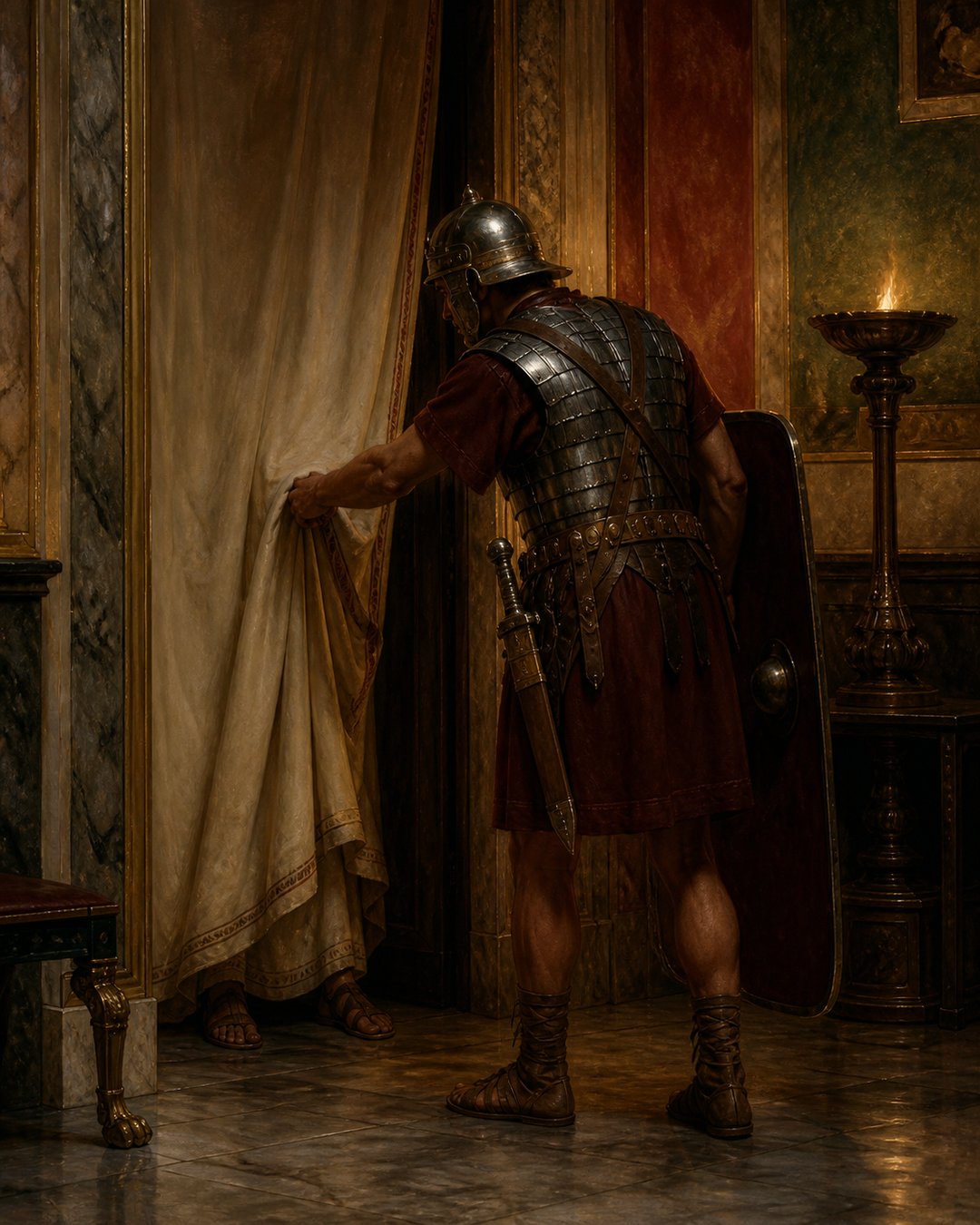
Claudius did not step forward when Caligula was killed. He was pushed out with the crowd, withdrew into an apartment called the Hermaeum and then hid among curtains hanging before a balcony door. Suetonius says he was terrified. The man who would rule Rome had arranged himself as someone trying not to be seen.
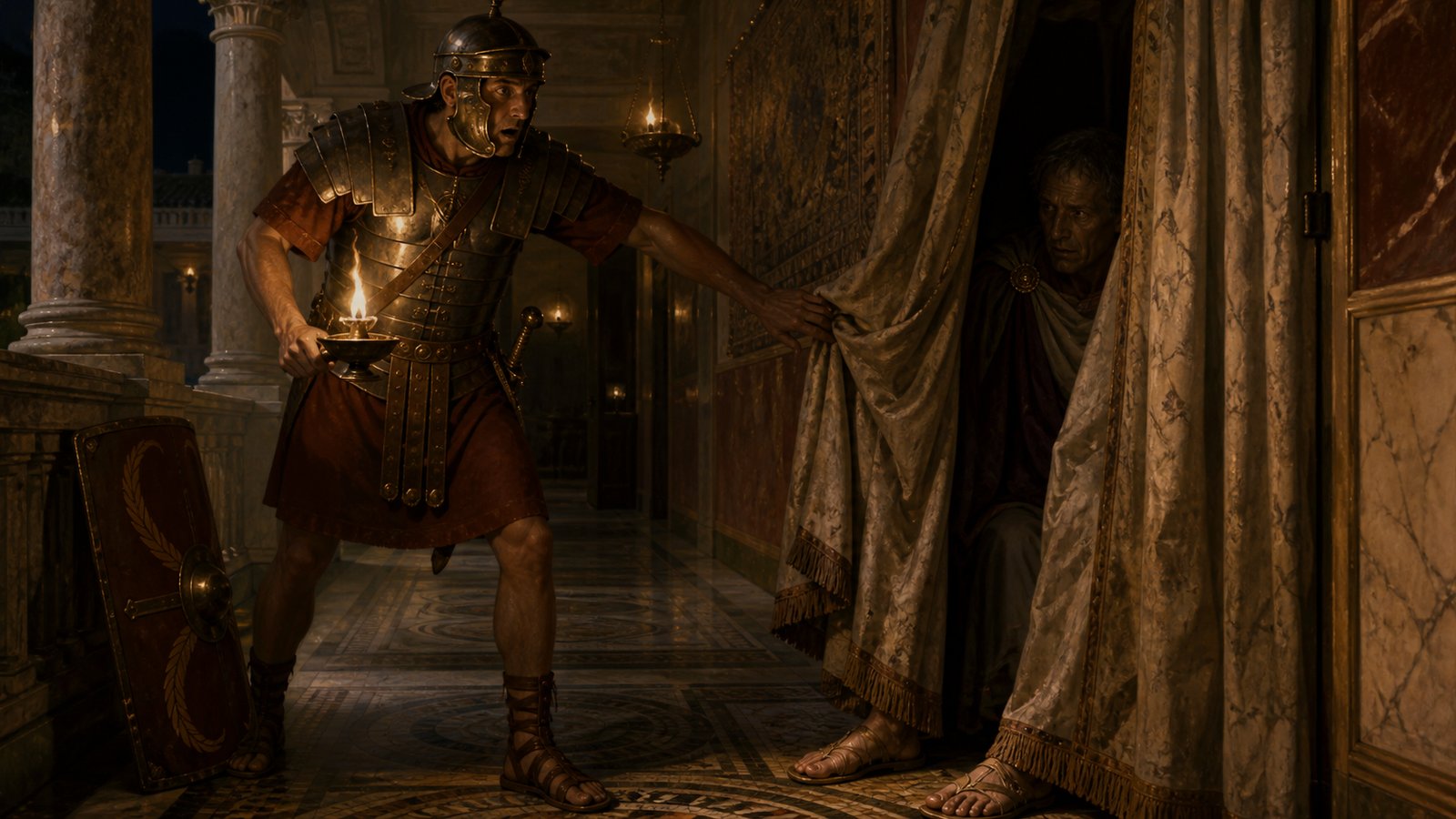
One detail defeated the hiding place. A common soldier prowling without a clear purpose noticed Claudius’s feet beneath the fabric. He pulled the concealed man out, recognized him and hailed him as emperor while Claudius fell at his feet in fear. Rome’s next ruler entered the political scene from the floor upward: feet, face, name, acclamation.
The episode is often enjoyed as an accident, but Suetonius gives it a sequence. Recognition put Claudius in soldiers’ hands. Soldiers put him in a litter and carried him to their camp. The senate hesitated while different plans competed. By the next day Claudius could accept an oath from an armed assembly and promise each man fifteen thousand sesterces. Chance found him; custody, delay and money turned the discovery into power.
The Hermaeum Became a Refuge After Murder
Suetonius begins with exclusion. The assassins of Gaius Caligula kept the crowd out by pretending the emperor wished to be alone. Once the murder became known, the palace ceased to be an ordered court and became a landscape of danger. Claudius, expelled with the rest, sought distance rather than command.
He was in his fiftieth year. Suetonius emphasizes that he had spent most of his earlier life under humiliating and restricted circumstances before becoming emperor through what the biographer calls a remarkable freak of fortune. The background makes the hiding scene more than comic staging. Claudius had no practiced public posture for seizing a throne amid violence.
The named room, the Hermaeum, anchors the episode in a particular interior. Claudius moved from there to a nearby balcony and placed the doorway curtains between himself and those searching the palace. Curtains could block a face and torso, but they did not create a locked chamber. His refuge depended on hurried concealment in a building full of armed men.
An earlier Lost Eagles article follows another imperial succession shaped inside the Praetorian Camp. Claudius’s story begins one stage earlier, before any formal contest: a vulnerable person had to become visible to a soldier who could decide what that visibility meant.
A Pair of Feet Changed the Soldier’s Search
Suetonius does not make the finder a commander executing a prepared plan. He calls him a common soldier and says he was moving around at random. The soldier saw feet and intended to ask who the hidden man was. Only after pulling Claudius out did recognition change the encounter.
That order matters. The soldier did not first identify a candidate and then rescue him. An unexplained physical trace prompted investigation. Claudius’s identity supplied the political possibility after the curtain had failed. A tiny failure of concealment therefore connected palace confusion to the only surviving adult male of the imperial household whom these soldiers could immediately present.
Claudius’s response was not confident acceptance. He fell at the soldier’s feet in terror. The soldier answered that posture by hailing him as emperor. One man was acting as if he expected violence; the other reclassified him as the source of authority. The reversal happened before any senate vote, public oath or written decree.
Suetonius does not name this soldier in the passage, and we should not improve the scene by inventing a speech or a coordinated conspiracy. Its force comes from the biographer’s narrow claims: random movement, visible feet, recognition, fear and acclamation. Every later step depended on that first interpretation holding long enough to reach more soldiers.
The Litter Turned a Captive-Looking Man into a Claimant
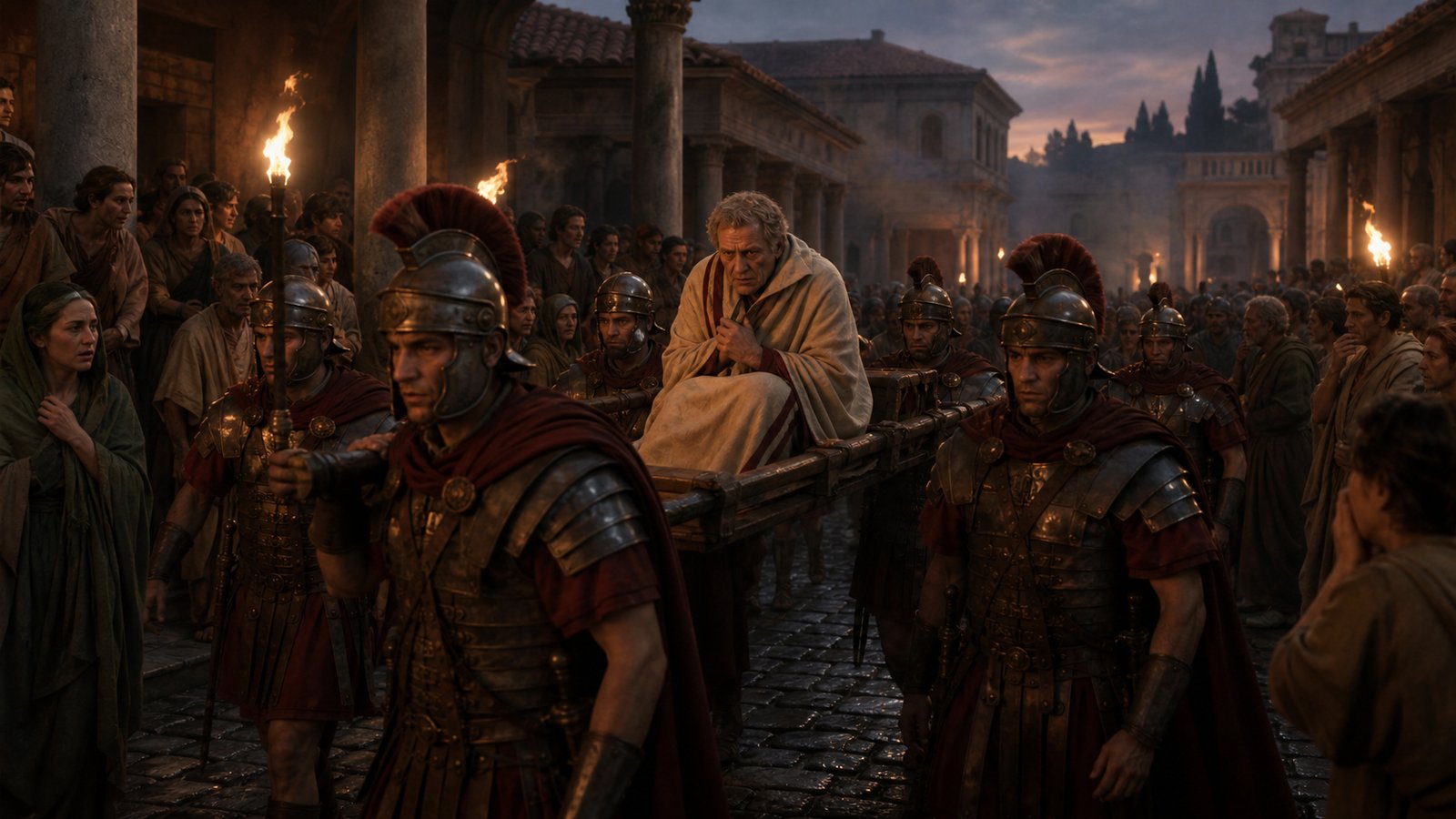
The other troops were still uncertain and enraged when Claudius was brought to them. They placed him in a litter. His own bearers had fled, so soldiers took turns carrying it to the Camp. This was improvised transport, but it also made the discovery mobile and public.
People who met the procession pitied Claudius because they thought an innocent man was being hurried to execution. That reaction reveals the image the group presented. The crowd did not yet read the litter as a triumphal vehicle. Armed custody could look like protection to the soldiers and a death escort to everyone outside it.
The ambiguity favored the men who controlled the route. Claudius did not need to persuade each spectator while crossing the city. He needed to arrive inside the rampart. Once there, the soldiers could guard access to him, repeat the acclamation and wait while Rome’s civilian institutions decided what they could actually enforce.
Our account of lictors and authority moving through Roman streets shows how office normally traveled in a recognized visual language. Claudius’s litter carried no settled office at first. Its meaning changed because the destination belonged to the armed group naming him emperor.
One Night Let the Senate’s Alternatives Fray
Claudius spent the night among sentries. Suetonius says he had much less hope than confidence, a phrase that preserves his uncertainty even after reaching the camp. Across the city, the consuls, senate and urban cohorts occupied the Forum and Capitol and declared an intention to preserve public liberty.
There was therefore a genuine rival center. Claudius did not become emperor at the instant his feet were seen. Soldiers held a possible ruler inside their fortification while senators possessed Rome’s central civic spaces and debated a future without one-man government.
When tribunes summoned Claudius to advise the senate, he answered that force and compulsion detained him. The message allowed fear and politics to overlap. It accurately reflected military custody while avoiding a voluntary walk into a chamber whose outcome remained unclear.
Suetonius then points to delay. The senate’s plan stalled amid tiresome disagreement. People around the meeting hall called for one ruler and specifically named Claudius. Time did not stand empty between discovery and accession. Each hour let the military claim acquire repetition while the civilian alternative lost coherence.
Fifteen Thousand Sesterces Closed the Sequence
On the following day Claudius allowed the armed assembly to swear allegiance. He promised fifteen thousand sesterces to each man. Suetonius marks a precedent: Claudius was the first of the Caesars to use bribery to secure the troops’ loyalty.
The number converted a fragile acclamation into an obligation with individual value. A soldier no longer supported only a shouted possibility. He stood to receive a precisely stated payment from the man whose survival and recognition the camp had made politically important.
Calling the promise bribery is Suetonius’s judgment, and it keeps the ending from becoming a sentimental rescue. The soldier under the curtain may have acted spontaneously. The armed institution did not remain spontaneous. Claudius secured fidelity by attaching money to the oath.
The payment also changed who carried the risk. Before the oath, each soldier had joined an uncertain initiative that the senate might still condemn. Claudius’s promise made the claimant responsible for rewarding the collective choice if he survived. The camp was no longer merely sheltering a frightened relative of Caligula; it was bargaining with a prospective emperor whose authority and debt would begin together.
The full scene is neither a pure accident nor a hidden master plan. A curtain failed, a soldier interpreted what he found, comrades moved the discovered man behind their walls, the senate argued and a payment stabilized allegiance. Claudius reached the throne because improvisation accumulated faster than opposition could organize. Rome’s government turned on visible feet, a borrowed litter, one guarded night and fifteen thousand sesterces per soldier.
Sources
Suetonius, Claudius, sections 10–11.