
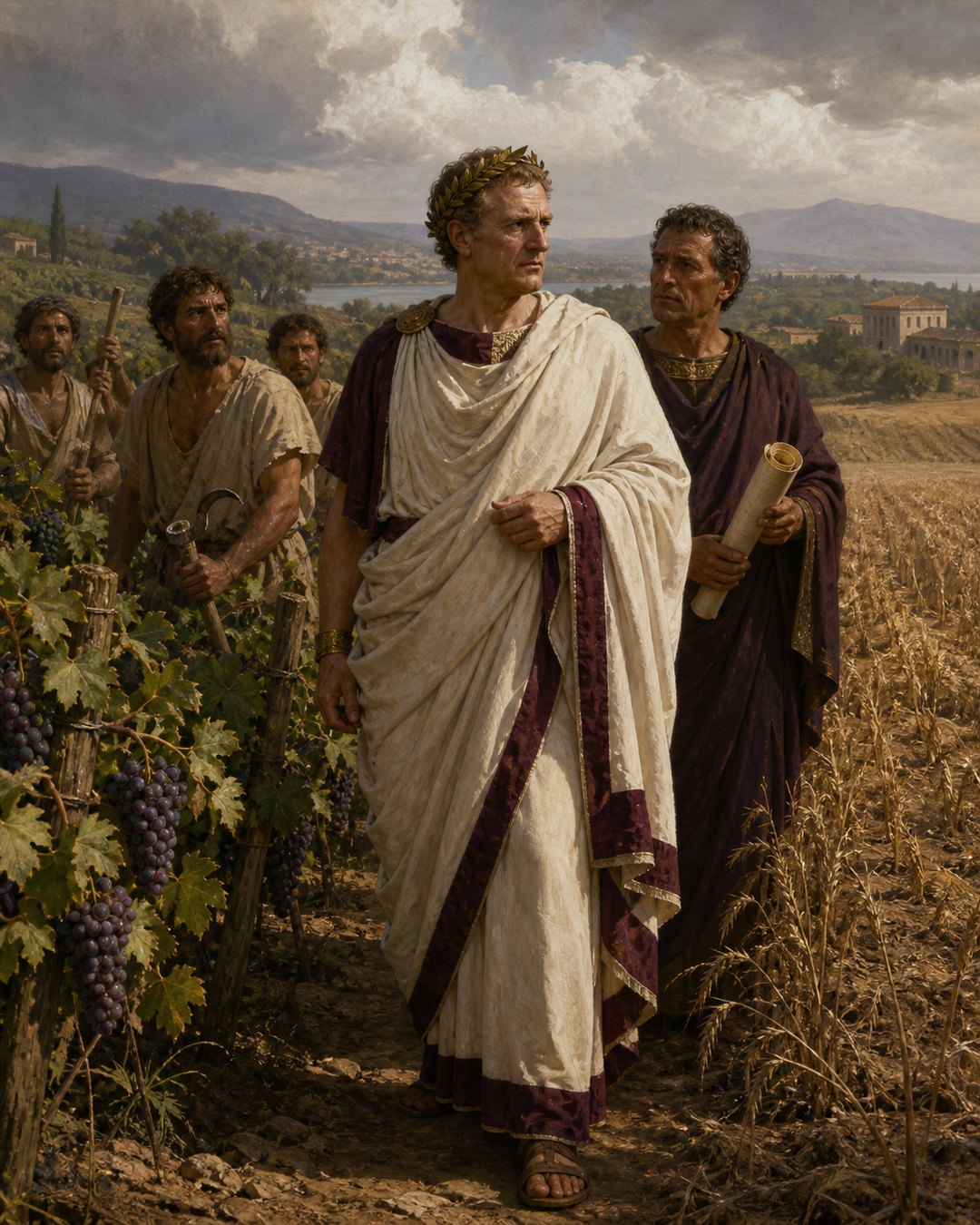
A plentiful wine harvest should have looked like good news. For Domitian, it became evidence of a dangerous imbalance. Suetonius says an abundant crop of wine arrived alongside a shortage of grain. The emperor concluded that farmers were giving vineyards too much attention and arable fields too little.
His answer was an edict with two unequal commands. No one was to plant any more vines in Italy. In the provinces, existing vineyards were to be cut down so that no more than half remained. This was not a tax adjustment or a suggestion to sow more wheat. It attempted to redraw agricultural choices by imperial order.
Then the policy stopped. Suetonius ends the episode by saying Domitian did not persist in carrying it out. That final clause is the mechanism’s most revealing part. The edict could make wine and grain look like interchangeable uses of land, but implementation encountered a world of mature vines, provincial property, local work and regional trade that a sentence from Rome could not instantly rearrange.
An Abundant Harvest Looked Like the Wrong Kind of Plenty
Suetonius connects two conditions: wine was plentiful and grain was scarce. He then gives Domitian’s interpretation. Fields were being neglected because too much attention went to vineyards. The passage does not supply acreage surveys, prices or a cabinet debate. It offers the emperor’s diagnosis as a direct line from the harvest pattern to land use.
That diagnosis carried an intuitive appeal. Vines and cereals both occupy cultivated ground and demand labor. If wine multiplied while grain diminished, a ruler could imagine one crop crowding out the other. The simplicity was politically useful because it identified an action the state might command: stop expansion where vines were still being planted, and reduce them where they already dominated.
Yet a harvest is not a complete map of agricultural causation. Weather, storage, transport and regional specialization can separate the abundance of one commodity from the scarcity of another. Suetonius does not say Domitian investigated those alternatives. The biography gives us the conclusion he reached, not the data by which officials tested it.
Our article on Rome’s grain ships and political hunger shows why a shortage of staple food could not remain merely agricultural. Grain touched urban order and imperial legitimacy. Faced with scarcity, Domitian’s attention moved from the missing food to the vines he believed had displaced it.
Italy Received a Freeze; the Provinces Faced the Axe
The edict distinguished sharply between Italy and the provinces. In Italy, it forbade new planting. Existing vineyards could remain. Outside Italy, Suetonius says vineyards were to be cut down and at most half left standing. One part of the empire was asked to stop expansion; another was ordered to destroy productive capital already rooted in the ground.
The asymmetry matters more than a generic description of a “vine ban.” A planting freeze changes the future slowly. It prevents new rows while allowing old vines to keep yielding. Cutting down half a vineyard changes the present. It erases years of cultivation and removes the expectation of later harvests from the same plants.
Suetonius does not explain why Domitian divided the burden this way. We should not manufacture a motive from silence. The text securely preserves the difference itself. Italy’s wine landscape was protected from immediate destruction, while provincial growers faced the far more severe remedy.
The provincial order also raised a measurement problem. “Half” sounds precise, but half of what—each estate, each district, or provincial acreage? Suetonius summarizes the command rather than reproducing the legal text, so those administrative details are unavailable. The neat fraction therefore survives without the machinery that would have turned it into thousands of local decisions.
A Mature Vine Made the Order Material
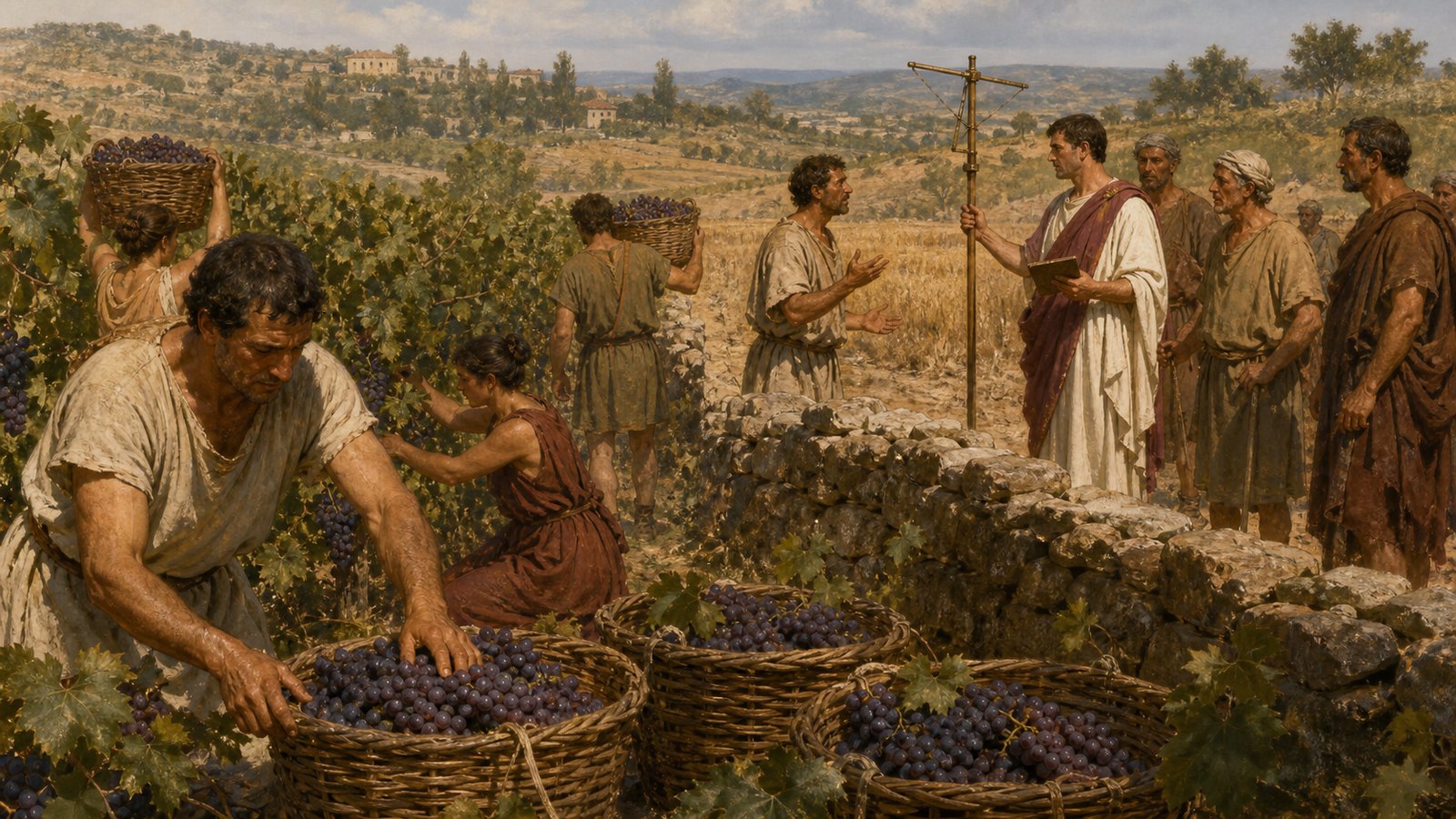
Vines are not annual grain stalks that can simply be replaced after one season. A vineyard embodies pruning, supports, paths, knowledge and time. Destroying it meant more than choosing a different seed for the next sowing. It meant dismantling a crop system whose value depended on continuity.
Wine also moved through presses, jars, warehouses, ships and markets. Our article on Roman amphorae and the visible routes of trade follows the containers that carried such regional production. The edict would have begun in the soil, but its consequences would travel through every workshop and route attached to the harvest.
That wider mechanism is why the order cannot be reduced to an emperor disliking wine. Suetonius says Domitian acted because of grain scarcity and an inferred neglect of fields. Wine was targeted as a competing use of agricultural attention. The goal was not abstinence; it was a forced rebalancing of production.
The distinction also keeps the story away from easy caricature. Domitian could be severe without being irrational in every premise. A ruler responsible for supply might reasonably worry about food land. The harder question was whether a blunt empire-wide command could identify where vines genuinely displaced grain and impose the same fraction across very different provincial economies.
The Edict Reached Further Than Enforcement
Suetonius’s closing words are concise: Domitian did not persist in carrying out the measure. The source does not narrate a formal repeal, list protests or identify the official who refused. It leaves the gap between order and outcome visible without filling it with a dramatic confrontation.
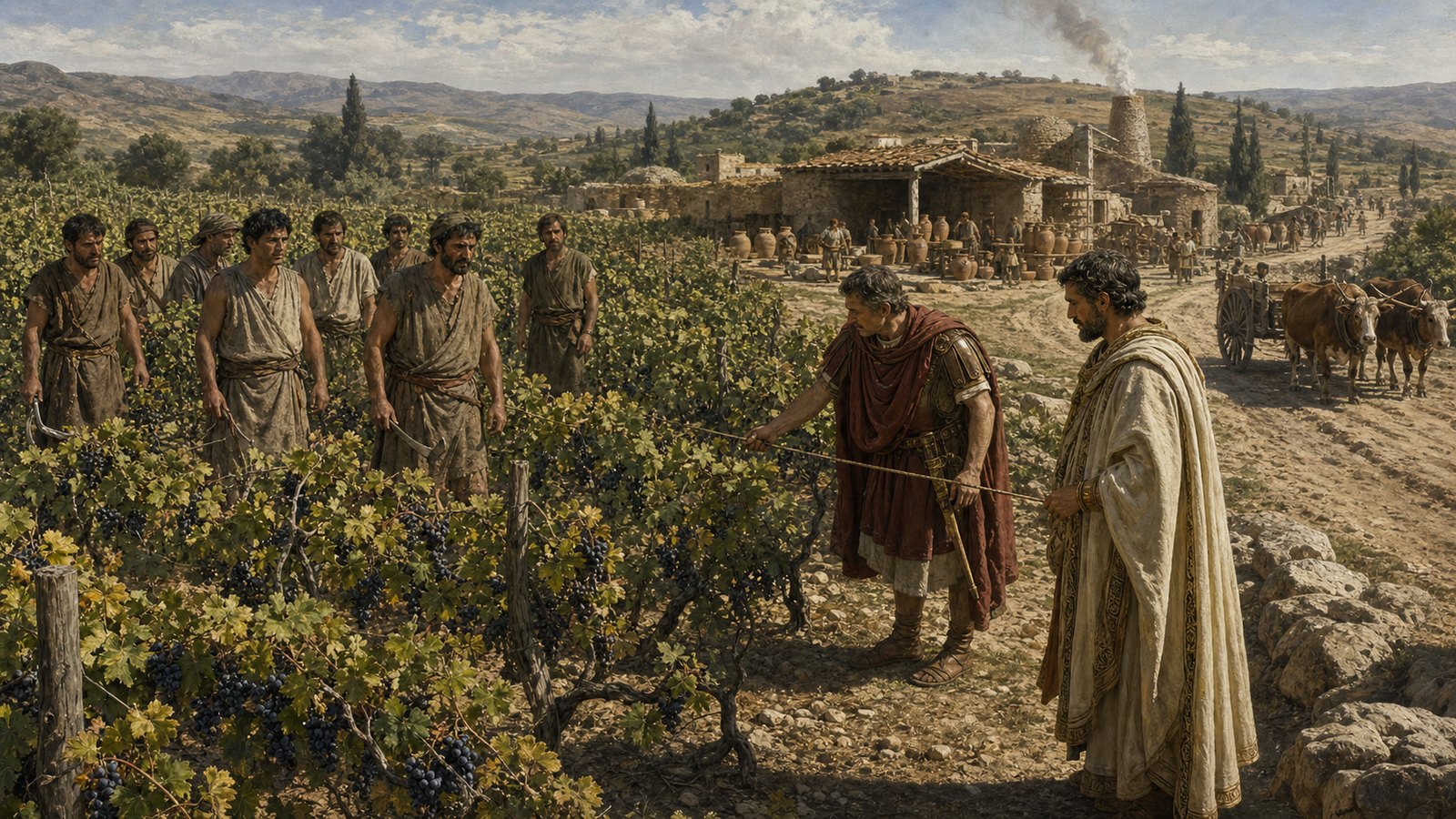
That gap is important evidence about Roman government. An imperial edict could announce a universal intention, but the empire still depended on communication, governors, local authorities, inspections and compliance. Vines had to be found, ownership established, the relevant “half” calculated and destruction verified. Every stage converted a clear command into contested local practice.
The abandoned implementation also changed the edict’s historical meaning. Had the vineyards been cut as ordered, the policy would be remembered through transformed landscapes and altered trade. Because Domitian did not persist, the surviving event is primarily the attempt: a moment when imperial government imagined it could correct grain scarcity by ordering provincial agriculture into a different shape.
We should resist turning the failure into proof that nothing happened anywhere. Suetonius’s summary does not tell us whether some local cutting began before persistence failed. It tells us only that the measure was not carried through as intended. The secure conclusion is narrower and stronger: promulgation did not become sustained empire-wide enforcement.
One Short Episode Exposed the Scale of Imperial Choice
Suetonius places the vineyard episode among other acts of Domitian’s rule. Nearby, he records restrictions on stage performers and castration, changes in court officeholding, rules about legionary camps and soldiers’ deposits, and an increase in military pay. The biography presents an emperor repeatedly willing to regulate institutions through direct commands.
The vine edict differs because its objects were alive, dispersed and economically embedded. A legion could receive an order through a military hierarchy. Provincial vines grew across private and local landscapes. To remove half of them required the state to enter an enormous number of fields and make the same imperial anxiety legible at ground level.
The episode also captures the danger of reading abundance too quickly. Plenty of wine appeared beside scarcity of grain, and the visible surplus became the suspect. Domitian’s remedy treated the relationship as causal. Whether or not that diagnosis fit every region, the order distributed risk unevenly: Italian growers faced limits on tomorrow, while provincial growers faced destruction today.
What survives is not a triumphant agricultural reform but a policy arc in miniature. A harvest produced alarm; alarm produced a diagnosis; diagnosis produced an edict; and enforcement failed to match the reach of the words. Domitian could command that half the provincial vines disappear. He could not make the complexity of imperial agriculture disappear with them.
Sources
Suetonius, Domitian, section 7.