
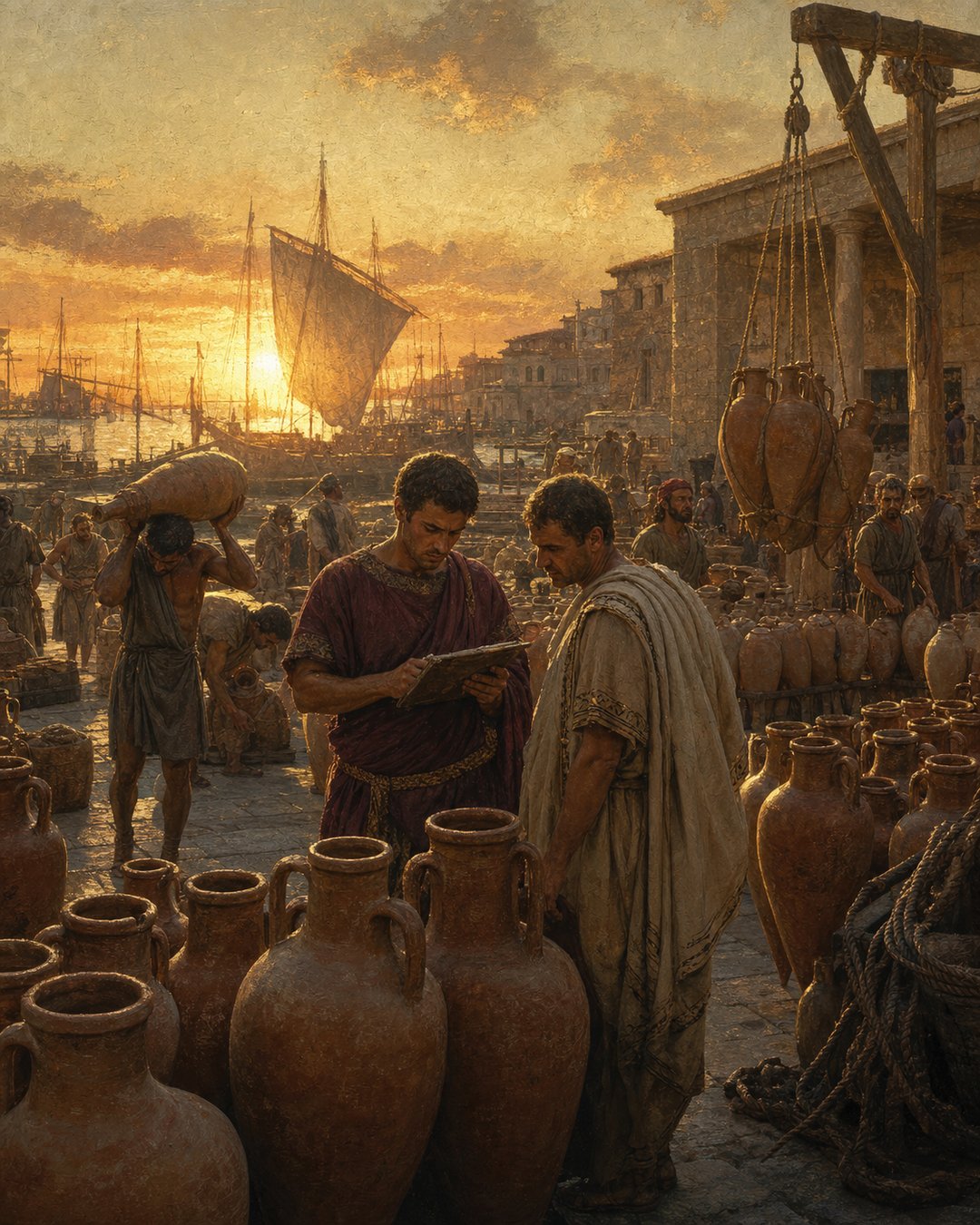
A Roman amphora looks humble until you notice how much information it carried. It was a jar, but also a transport tool, a label, a standardized shape, and eventually an archaeological witness. Wine, olive oil, fish sauce, and other cargoes moved in these two-handled ceramic containers because they could be stacked, counted, sealed, handled, and recognized.
That made the amphora one of the quiet engines of Roman trade. Coins showed faces, monuments showed victories, and roads showed control. Amphorae showed movement. They made commerce visible in clay, long after the oil had been poured, the wine drunk, and the merchants forgotten.
The shape was part of the message
Modern archaeologists can often read an amphora before reading any inscription on it. Shape, fabric, thickness, handle form, and rim can point toward a region or cargo type. A Dressel 20 jar, for example, is closely associated with Baetican olive oil from southern Spain. The container was not neutral packaging. It belonged to a recognizable commercial world.
For Roman handlers, that visibility mattered practically. Dockworkers, warehouse staff, shippers, and buyers needed to know what kind of cargo stood in front of them. A jar designed for oil did not behave like a jar meant for wine or fish sauce. Weight, balance, fragility, and storage all affected how cargo moved.
Clay turned distance into evidence
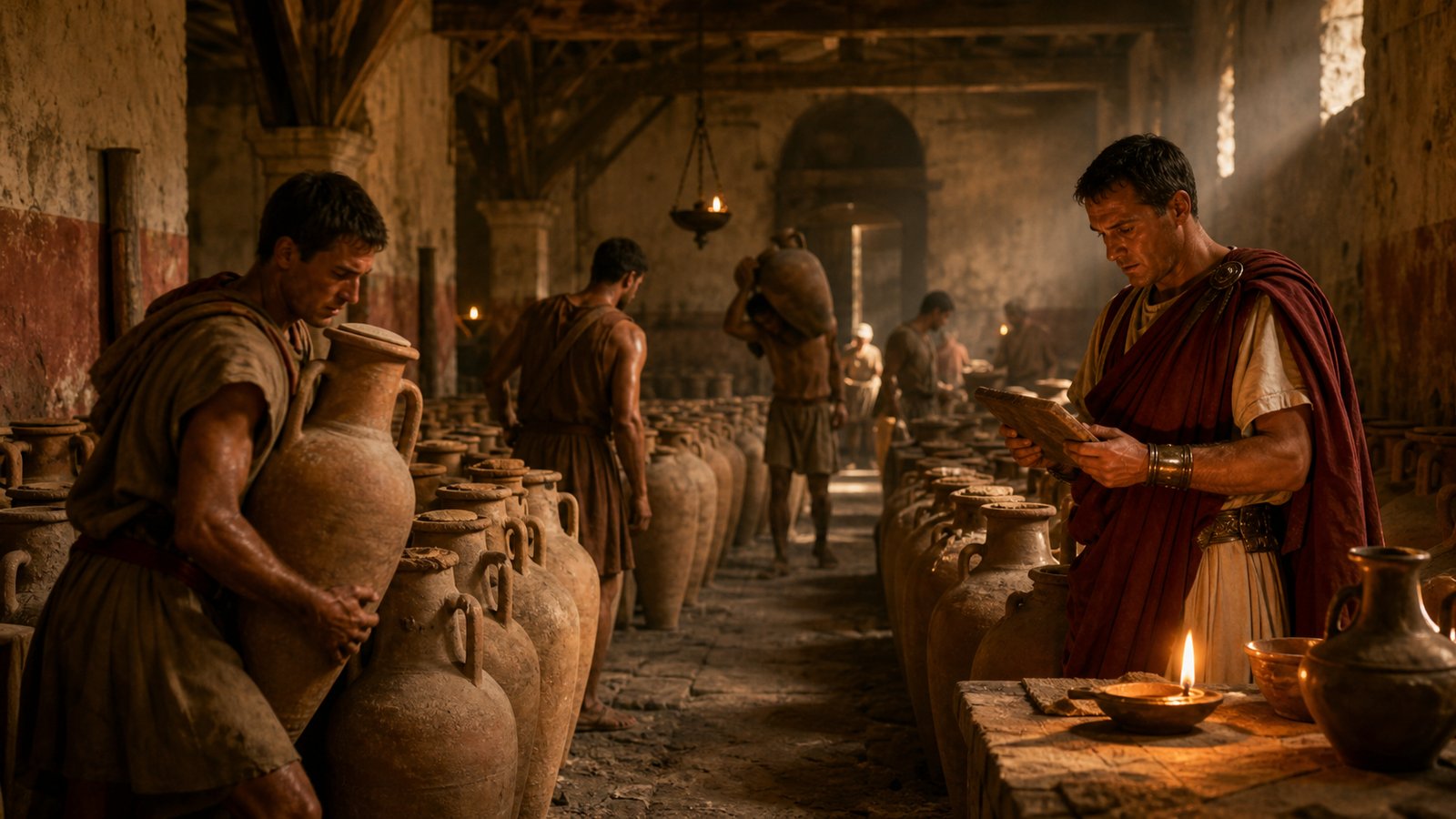
Organic goods vanish easily. Oil is consumed. Wine evaporates from history. Fish sauce leaves smell in imagination more than in the ground. Ceramic survives. That is why amphorae give Roman trade a strangely physical afterlife: broken necks, stamped handles, painted notations, and whole dumps of discarded jars.
Monte Testaccio is the most dramatic reminder. The hill in Rome was formed largely from broken olive-oil amphorae, especially from the imperial supply system. It is trade turned into landscape. A visitor is not looking at one shipment, but at repetition: jar after jar, cargo after cargo, year after year.
Warehouses made the jar part of administration
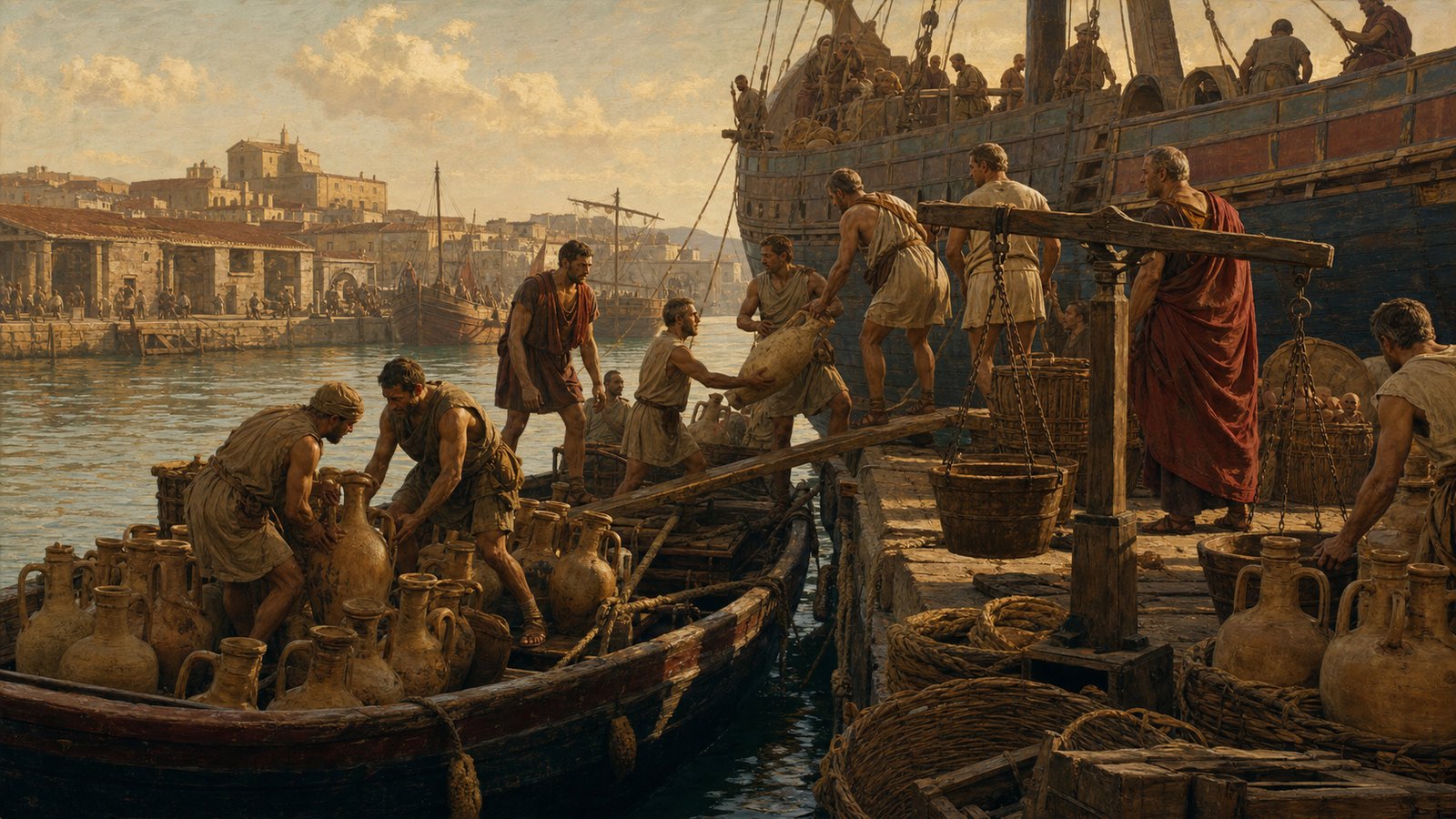
An amphora did not travel alone. It passed through ports, storehouses, contracts, taxes, inspections, and local markets. Ostia and Portus mattered because Rome needed places where maritime cargo could be unloaded, sorted, stored, and moved onward. The jar sat at the meeting point of private commerce and public need.
Marks on amphorae sharpen that point. Stamps and painted tituli picti could record names, weights, origins, or other commercial details. Not every jar was a paperwork machine, but enough of them carried information to show that Roman cargoes were tracked by more than memory. Clay and recordkeeping worked together.
A broken jar could expose an imperial appetite
Olive oil is a useful example because it was ordinary and enormous at the same time. Pliny’s comments on provincial products remind us that Rome’s table depended on landscapes far beyond the city. Spanish oil could become a Roman household substance, a military ration, a tax problem, and an archaeological layer.
This is the power of the amphora: it links a hand pouring oil to a provincial estate, a kiln, a ship, a warehouse, and a city that expected supply. The jar’s body makes that chain less abstract. Someone shaped it. Someone filled it. Someone lifted it. Someone broke it when its work was done.
Trade was not invisible to ordinary Romans
A modern reader may imagine ancient trade as numbers in a ledger. Romans encountered it as objects underfoot and at eye level. Jars stood in shops, leaned in storerooms, stacked in ships, and shattered in dumps. Their pointed bases, heavy shoulders, and tied handles made the Mediterranean economy feel like something with weight.
That sensory presence mattered. The scrape of ceramic, the oily residue, the pitch seal, the rope around a neck, and the clatter of unloading all turned distant provinces into urban routine. Trade was not merely an elite policy. It was a daily material fact.
Amphorae made the empire readable
The amphora did not make Rome rich by itself. It made Roman exchange easier to move and easier to see. Standard containers helped goods travel through repeated acts: loading, counting, storing, selling, discarding. A jar could be copied across workshops and recognized across ports.
This is why amphorae made trade visible. They turned supply into a form that hands could manage and later eyes could study. Rome’s economy did not survive in one grand document. It survived in broken clay, in a hill of discarded oil jars, and in the stubborn shapes that still tell us what the empire moved.
The evidence is especially useful because it joins tiny details to enormous patterns. A single stamped handle may name a workshop or official; a repeated shape may point to a production zone; a dump of fragments may reveal the scale of supply. None of those clues is dramatic by itself, but together they let Roman trade be reconstructed from ordinary breakage.
There is also a human scene behind the ceramic. A potter chose clay and fired the vessel. A laborer carried it while it was still empty. Another worker filled it with oil, wine, or sauce. A sailor wedged it among other jars so the cargo would not shift. A clerk or buyer later cared about the mark, weight, and contents. The amphora gathered all of those hands into one surviving object.
That helps explain why amphorae can feel more honest than literary boasting. A poet could exaggerate luxury and a monument could flatter a patron, but a shipping jar had practical work to do. Its form had to survive the journey, and its traces had to make sense to people who handled thousands of similar containers.
The jar also shows how Roman consumption depended on standard habits. Repeated packaging made repeated supply possible. If a city expected oil, wine, and sauces to arrive year after year, it needed containers that fit ships, storerooms, backs, carts, and accounts. The amphora made abundance manageable before anyone called it prosperity.
So the broken jar is not a small subject. It is a way to see the empire from below the level of emperors: through clay, residue, stamps, ports, and disposal. Roman trade became visible because the things that carried it were too useful, too numerous, and too durable to disappear.
The same point applies to scale. One amphora tells a story of a shipment; thousands tell a story of expectation. Rome did not simply enjoy imported goods when they happened to arrive. It built routines around their arrival, and those routines needed containers that could be trusted by people who never met each other. In that trust, ordinary clay became infrastructure, as necessary to routine supply as roads, harbors, ledgers, trained hands, ship space, warehouse floors, and repeated trust. Without that boring reliability, Mediterranean abundance would have remained scattered cargo instead of becoming a Roman habit.
Sources & Further Reading
- World History Encyclopedia, Amphora
- University of Southampton, Roman Amphorae
- Britannica, Monte Testaccio
- Roman Amphorae: a digital resource, Dressel 20
- Roman Amphorae: Epigraphy
- Ostia Antica, warehouses
- Pliny the Elder, Natural History, 15
- Britannica, garum
- Cambridge Core, Trade in the Ancient Mediterranean
- Oxford Classical Dictionary, amphorae