
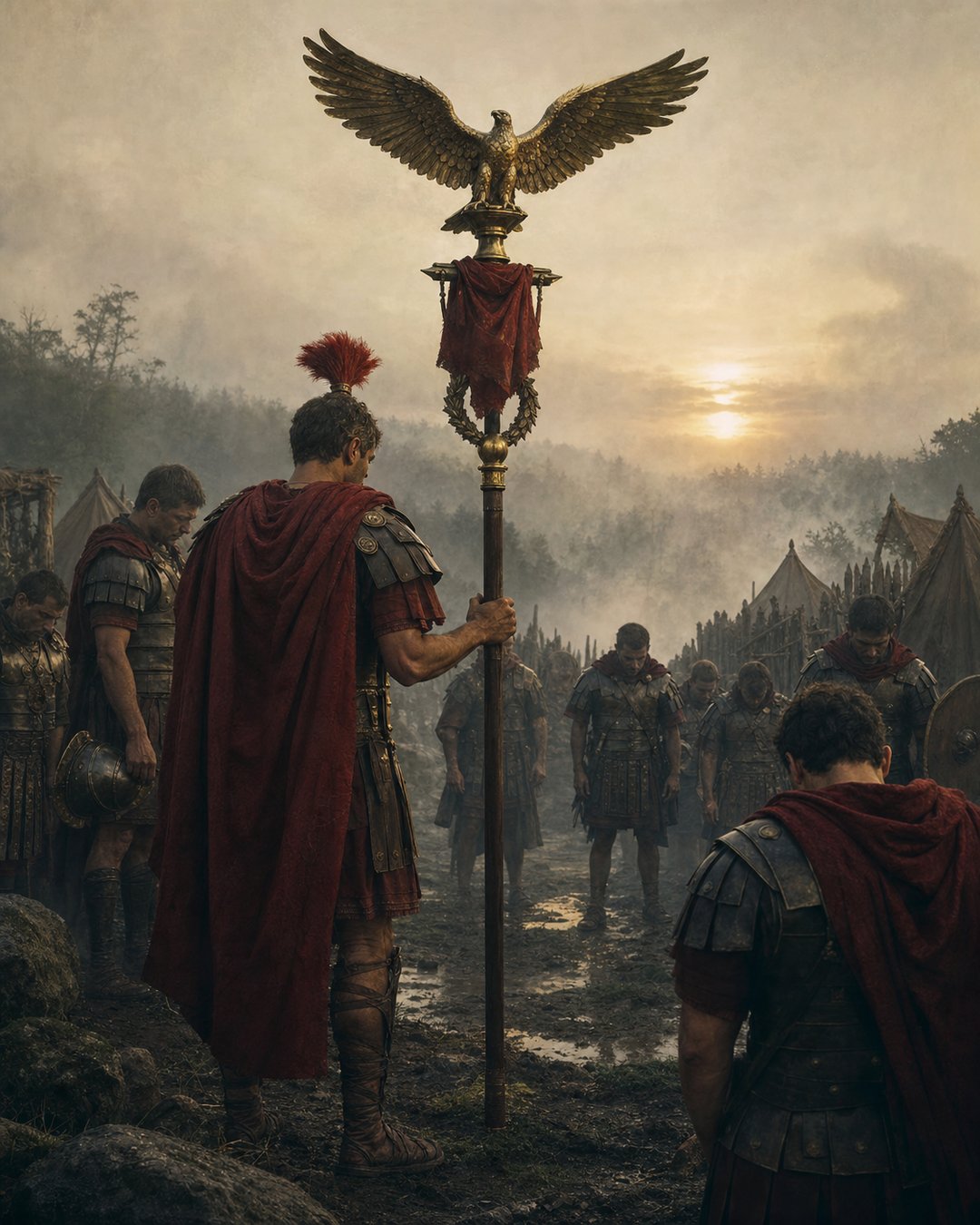
A Roman eagle standard was not valuable because of its metal. It was valuable because men had been trained to see a legion inside it. The aquila stood above the unit as a focus of honor, memory, command, and fear. To lose it was not like losing a spear or shield. It meant the legion’s story had been wounded in public.
That is why Roman writers remembered lost eagles with such force. A standard could be carried, guarded, recovered, displayed, and mourned. It made an invisible thing visible: the identity of thousands of soldiers bound into one name. Rome could replace metal. It could not easily replace dishonor.
The eagle gathered the legion into one object
The aquila was the chief standard of a Roman legion, and the aquilifer who carried it held a dangerous honor. In camp or battle, the eagle gave men a point of orientation. Soldiers could look toward it and understand where the legion’s presence was concentrated. The object helped turn many bodies into one military identity.
That symbolism mattered because Roman armies were not only instruments of violence. They were communities with habits, memories, rewards, punishments, gods, pride, and shame. The eagle stood where practical command and sacred feeling overlapped. It could mark position on a field and also carry the emotional weight of belonging.
Marius’ reform gave the symbol sharper force
Pliny connects Marius with making the eagle the legion’s standard. Whether one treats the tradition as a neat reform story or as a remembered consolidation, the point is clear: by the late Republic and Empire, the eagle had become the emblem that mattered most. It was no longer one sign among many in the imagination of Roman military identity.
The timing is revealing. As Roman armies became more durable, professional, and attached to commanders and long service, symbols that held unit identity became more powerful. Men who served for years needed objects that could carry continuity through marches, camps, battles, and losses. The eagle did that work.
Teutoburg made lost standards unforgettable
The disaster in the Teutoburg Forest in AD 9 destroyed three Roman legions under Varus. The defeat mattered militarily, but its symbolic damage lasted because the lost standards became emblems of humiliation. Suetonius says Augustus was shaken enough to cry out for Varus to give back the legions. The line survives because it captures grief, rage, and disbelief at once.
Rome had lost men before. It had suffered defeats before. But a lost eagle made defeat portable in memory. It was a visible absence. Somewhere beyond Roman control, an object that should have stood in a Roman camp or procession was in enemy hands. That thought turned loss into an ongoing insult.
Recovery was staged as restoration
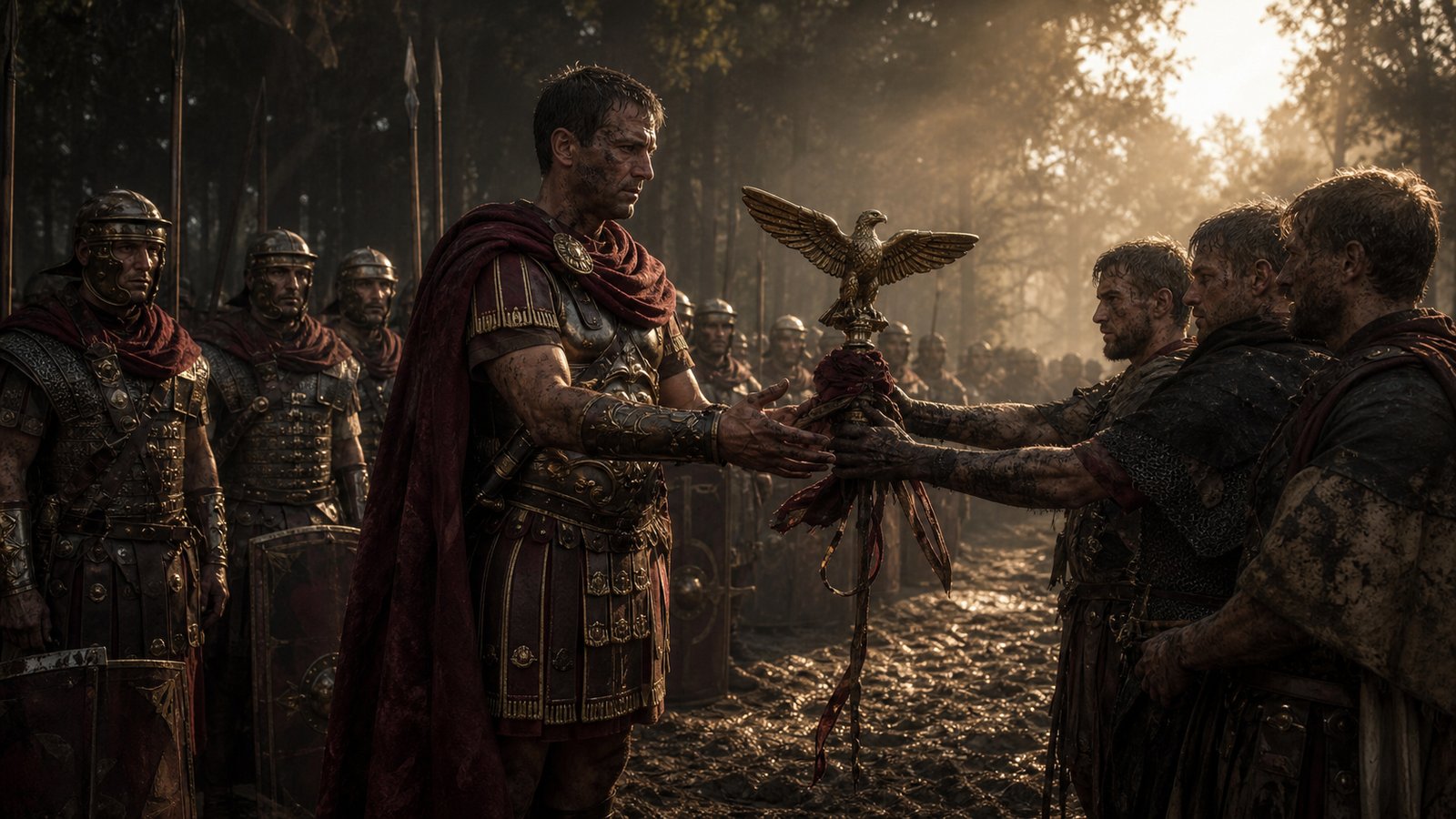
Tacitus describes Germanicus recovering one of the lost eagles during campaigns in Germany, and later tradition records another recovery under Claudius. These recoveries mattered because they offered more than battlefield tidying. They allowed Rome to tell a story of restored honor.
A recovered standard could be displayed, reported, and folded into imperial prestige. The emperor or commander who brought it back did not merely retrieve equipment. He repaired a narrative. The legion’s disgrace could be answered, at least symbolically, by return. That recovery could become public news.
The standard made courage visible and cowardice shameful
Battlefield standards had practical uses. They helped soldiers orient themselves, rally, and recognize formations amid noise and dust. But their practical role strengthened the emotional one. A man who stayed near the standard could imagine himself staying near the legion’s heart. A man who abandoned it abandoned more than a position.
This pressure explains why standard-bearers were important and why standards were defended fiercely. The eagle turned courage into a visible location. It gave soldiers something to protect when fear made the field confusing. That visibility could steady men, but it could also magnify shame if the standard fell.
The eagle linked army, empire, and memory
Roman power often depended on making distant things feel present: the emperor’s face on coins, milestones on roads, law in provincial towns, and standards over camps. The eagle belonged to that world. It made Rome’s military identity visible wherever a legion marched.
That visibility carried risk. If the standard was captured, the enemy held not only an object but a piece of Roman meaning. The loss could be shown, boasted about, hidden, or remembered. Rome’s symbols made power stronger when protected and more painful when exposed.
The metal was never the real treasure
A Roman eagle was worth more than gold because it contained recognition. Soldiers recognized the legion in it. Commanders recognized discipline. Enemies recognized prestige. Emperors recognized public memory. That pile of meanings made the object heavier than its material.
When an eagle was safe, it reassured the men around it that the legion still existed as more than a list of names. When it was lost, the absence accused everyone who had failed to protect it. When it was recovered, Rome could claim that humiliation had been answered. The standard mattered because it turned honor into something a soldier could see, carry, lose, and win back.
The object also disciplined memory inside the army. Veterans could remember marches, commanders, punishments, and victories around the same sign. New recruits learned that the eagle was older than their own service and would outlast it if they did their duty. In that way, a standard gave the legion a past and a future at the same time.
That continuity explains why capture was so poisonous. An enemy who seized the eagle did more than interrupt a battle. He interrupted the legion’s claim to be unbroken. Even if surviving soldiers reassembled, even if replacements arrived, the missing standard left a question hanging over the unit’s name. Rome’s military culture could endure grief, but it hated visible disgrace.
Recovery answered that question with a scene everyone could understand. No complicated legal argument was needed. The eagle returned, soldiers looked at it, commanders reported it, and the state could present restoration as fact. The metal had come home, and with it came the story Rome wanted to tell about defeat: that shame could be pursued, found, and carried back under Roman eyes.
This is why standards belonged in ceremony as well as battle. They could be sworn around, guarded in camp, displayed after success, and remembered after disaster. The eagle gave the army a sacred-looking center without needing a long explanation. Even a tired recruit could understand the rule: while the standard stood, the legion’s honor stood with it.
For Rome, that rule made a small object carry an enormous historical burden.
The eagle was precious because it made loyalty visible where fear was strongest.
Sources & Further Reading
- Britannica, aquila
- Smith Dictionary, Aquila
- Pliny the Elder, Natural History, 10.16
- Britannica, Battle of the Teutoburg Forest
- Suetonius, Augustus, 23
- Tacitus, Annals, 1.60
- Cassius Dio, Roman History, 60.8
- World History Encyclopedia, Roman Standards
- Smith Dictionary, Signa Militaria
- Tacitus, Annals, 2.25