
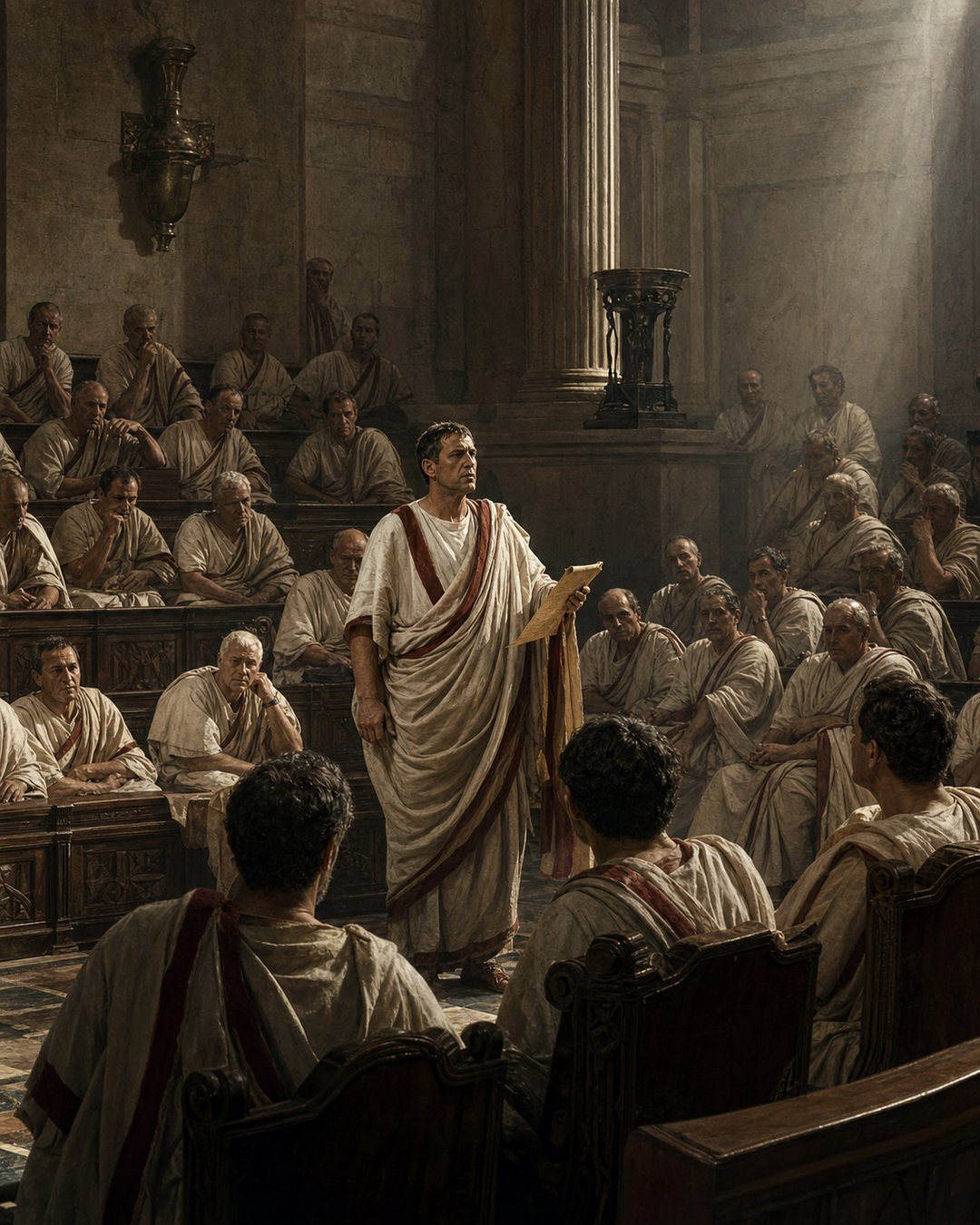
The Roman Senate was not only a constitutional idea. It was also a place people could point to. The Curia gave Roman politics doors, benches, walls, a threshold, and a public setting in the Forum. Before anyone voted, the building had already communicated something important: some men entered, others waited outside, and the city could see where authority gathered.
That physical visibility mattered in a society obsessed with rank. Roman politics depended on offices, families, seniority, reputation, clothing, attendants, and ritual. The Curia gathered those signals into one charged space. It did not make politics honest or peaceful, but it made power legible.
The door mattered almost as much as the debate
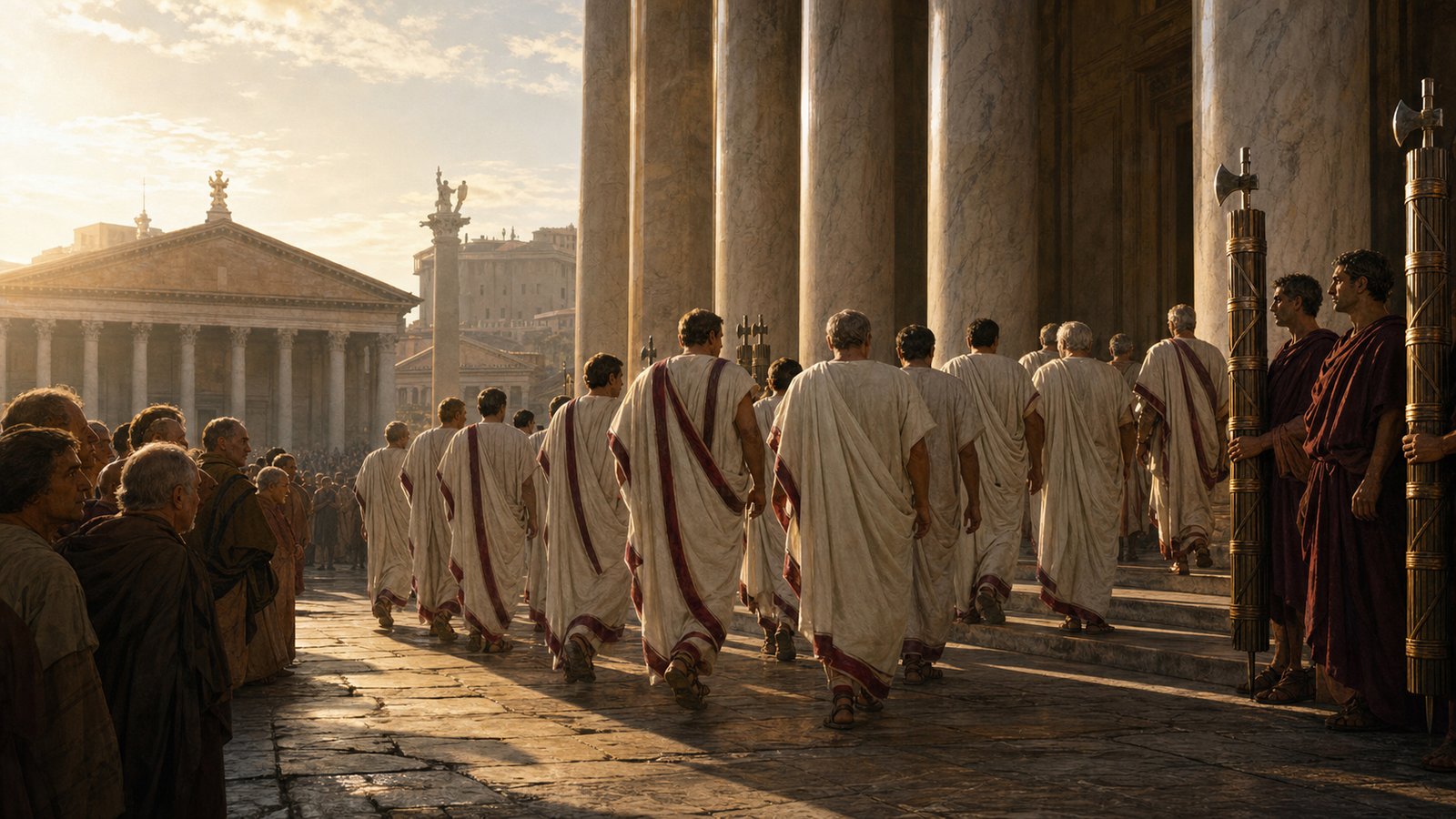
A Senate house creates a boundary. To enter is to belong to the political class; to remain outside is to watch. That boundary did not need to be explained every morning. Citizens in the Forum could see magistrates, senators, lictors, clients, and bystanders arranging themselves around access.
The scene was therefore political even before speeches began. A magistrate arriving with lictors carried visible office. Senators in togas carried rank and memory. People waiting nearby could read movement as news: who came, who delayed, who looked confident, who seemed isolated. The Curia turned procedure into public theater.
The Curia Julia tied old authority to a new age
The Curia Julia was begun by Julius Caesar and completed by Augustus. That fact gives the building a political edge. A Senate house associated with Caesar and finished under Augustus could claim continuity while standing inside a transformed political world. It said that the Senate still had a home, even as the conditions of power changed around it.
Augustus was skilled at making restoration look like order rather than conquest. Buildings helped him do that. A renewed Senate house did not need to announce, in crude words, that the Republic had become something else. Its existence allowed old forms to continue visibly while new realities settled into place.
Inside, rank became architecture
The Senate was made of men who were not equal in reputation, age, office, or influence. The room helped turn those distinctions into an arranged experience. Benches, sightlines, speaking order, and proximity mattered because Roman authority was never purely abstract. It lived in bodies placed in relation to other bodies.
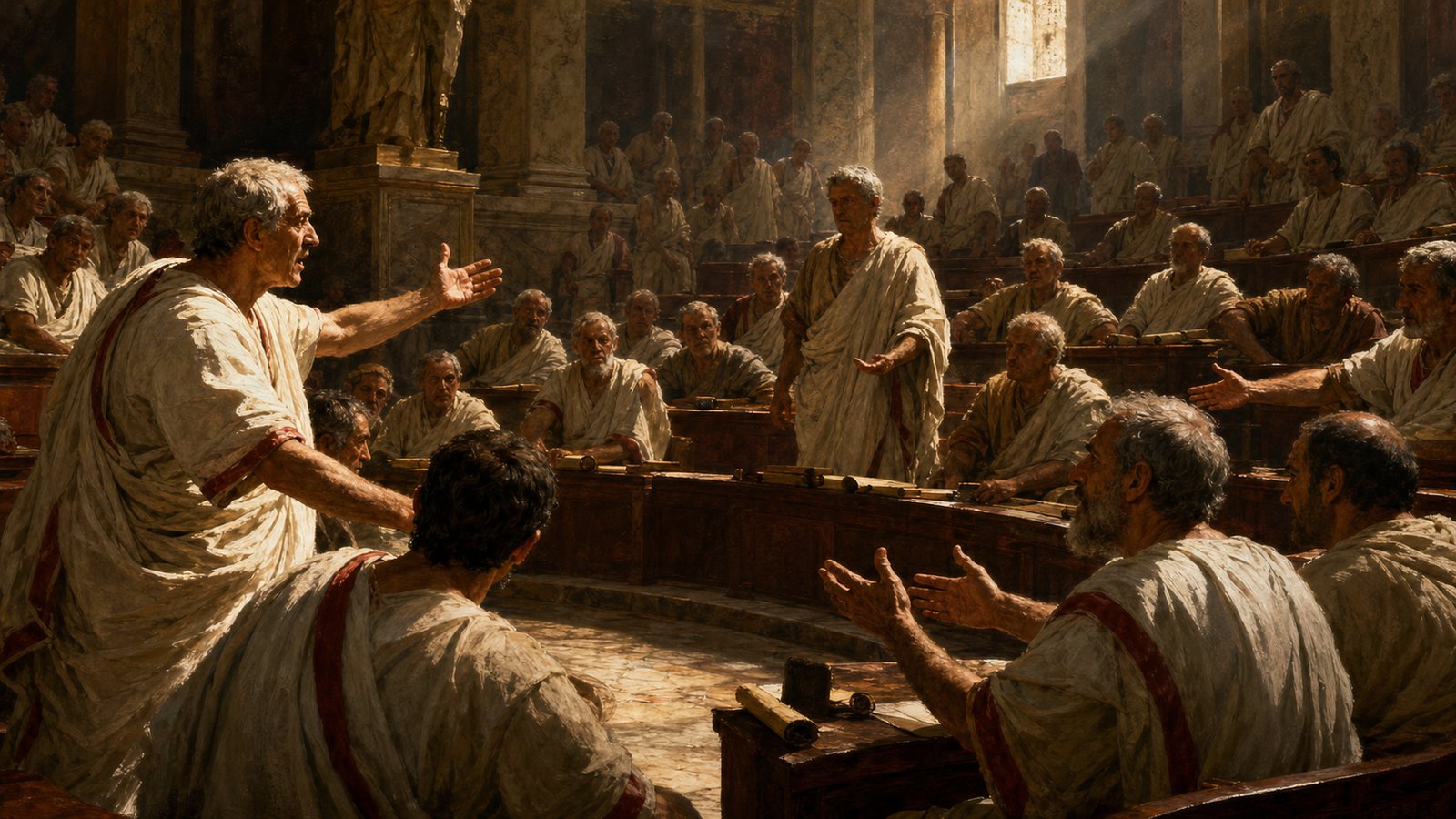
For this reason, senatorial debate could be both deliberation and performance. A strong speech did not only persuade by logic. It displayed courage, memory, family honor, legal knowledge, and the ability to shame opponents. Cicero’s attacks on Catiline show how accusation could transform a meeting into a drama of loyalty and danger.
The Forum made the room louder
The Curia’s setting in the Roman Forum multiplied its meaning. The Forum was full of temples, basilicas, monuments, crowds, business, memory, and rumor. A Senate meeting did not happen in an empty civic void. It happened beside the city’s symbolic heart, where the past pressed in from every direction.
This setting meant that a closed or limited meeting could still have a public afterlife. News emerged. Allies reported. Enemies interpreted. Crowds reacted. The building concentrated elite speech, but it could not fully contain political meaning. Rome was too talkative for that.
Caesar’s murder shows why place mattered
Julius Caesar was not killed inside the later Curia Julia, but at a Senate meeting in the Theatre of Pompey. That distinction matters because it proves the larger point. A Senate meeting carried symbolic force wherever it gathered. To attack Caesar in that setting was to wrap violence in the language of public authority and elite judgment.
Roman politics often used places as arguments. A temple, a rostra, a theater, a Senate house, or a camp could change how an action looked. The Curia mattered because it normally supplied the proper stage for senatorial authority. When politics broke its stages, Romans noticed.
Under emperors, visibility became more delicate
The Senate retained prestige under the emperors, but prestige did not mean unchanged power. The Curia still allowed elite debate, ceremony, and status to appear continuous. Yet the emperor’s influence changed the weight of what happened there. The building could show dignity even when real decision-making had shifted.
That tension made the Curia useful and uncomfortable. It preserved a visible language of republican authority while reminding everyone that public forms can outlive their original balance. Senators still entered. Speeches were still made. Honors were still voted. The old room remained powerful partly because it helped hide how much power had moved.
The Senate house made politics harder to ignore
The Curia’s importance was not that every Roman could participate in senatorial debate. Most could not. Its importance was that Roman political hierarchy had a visible center. People saw access, ceremony, debate, and exclusion. They saw power take up space.
That is why the building deserves attention beyond architecture. It was a machine for turning rank into sight. Rome’s politics were made from laws and offices, but also from repeated scenes: senators crossing a threshold, lictors standing nearby, arguments echoing in a room, rumors spilling back into the Forum. The Curia showed Rome that authority was not floating above the city. It had a door.
The door also made absence meaningful. If a famous senator stayed away, if a faction arrived together, or if a magistrate came with unusual urgency, the building helped turn those movements into signals. Roman politics was a culture of interpretation. People watched bodies, timing, clothing, attendants, and route as carefully as they listened to formal words.
That habit gave the Curia a second life outside its walls. A speech could be repeated badly, exaggerated by an enemy, praised by clients, or converted into rumor before the day ended. The room gathered elite voices, but the Forum redistributed them. A Senate house therefore acted like a lung: drawing the governing class inward, then breathing political meaning back into the city.
For that reason, a restored Curia under Augustus could feel reassuring and ambiguous at the same time. The benches, rituals, and senatorial names promised continuity. The new political order surrounding them changed what that continuity meant. Rome did not need to demolish old spaces to transform power. Sometimes it was enough to keep the room, refill it with familiar gestures, and let everyone learn the new rules slowly.
That slow learning is part of the building’s importance. The Curia did not settle the question of who truly ruled Rome; it staged the question in a recognizable form. A citizen could see senators assemble and feel that the old city still existed. A careful observer could also see that access to the emperor, imperial favor, and managed consensus increasingly shaped what those assembled men could safely do.
The building made that tension survivable by giving change an old shape.
Rome could look at the Curia and recognize itself, even while power quietly learned new paths around the room.
Sources & Further Reading
- Britannica, Curia
- Rome Reborn, Curia Julia
- Britannica, Roman Senate
- Britannica, Senate
- Cicero, First Catilinarian
- Suetonius, Julius Caesar, 80-82
- Res Gestae Divi Augusti, 19-21
- Britannica, Roman Forum
- Britannica, lictor
- Oxford Classical Dictionary, senate