
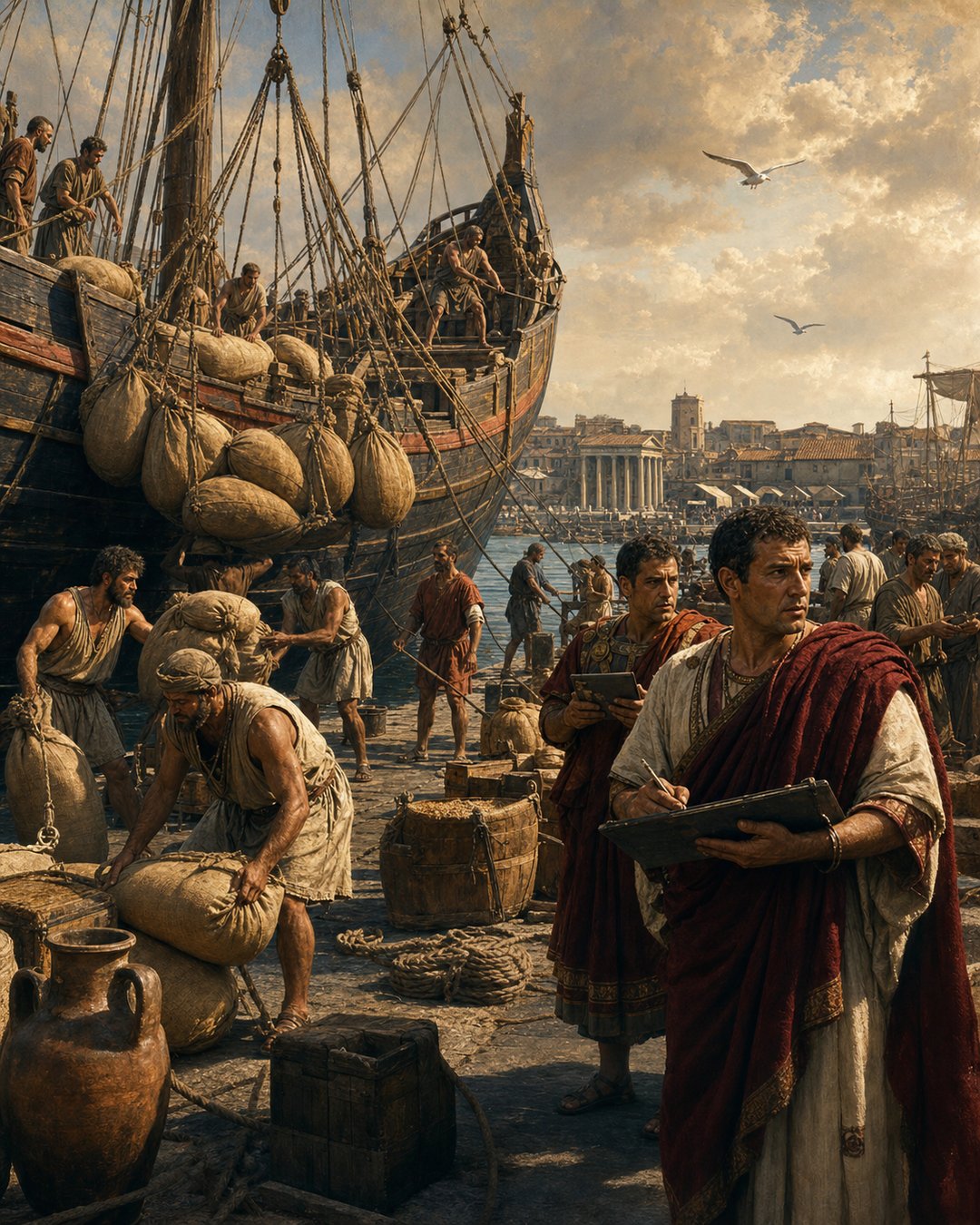
Rome’s bread began before the baker touched the dough. It began on farms in Sicily, North Africa, and Egypt; in warehouses near harbors; in ships facing bad weather; and in the records of officials who knew that a hungry capital was never only a household problem. A grain ship was cargo, but it was also a moving piece of political calm.
The city’s size made that true. Rome could not feed itself from the fields around the walls. Its daily confidence depended on the annona, the grain supply system that connected provinces, ports, storage, distribution, and imperial reputation. When the ships arrived, order could feel natural. When they were late, the sea became part of Roman politics.
The capital ate through an empire-wide chain
It is easy to imagine Roman food as a local market scene: a stall, a loaf, a coin, a customer. The more unsettling reality is that the loaf rested on a chain stretching across the Mediterranean. Egyptian grain, African harvests, Sicilian routes, dockworkers, shipowners, clerks, animals, warehouse guards, and bakers all stood between harvest and breakfast.
That chain made Rome impressive and exposed at the same time. The empire’s reach allowed it to feed a giant capital, but the system had many points where anxiety could gather. A storm, a delay, fraud in storage, official incompetence, or rumor at the docks could make ordinary people feel the distance between imperial scale and personal hunger.
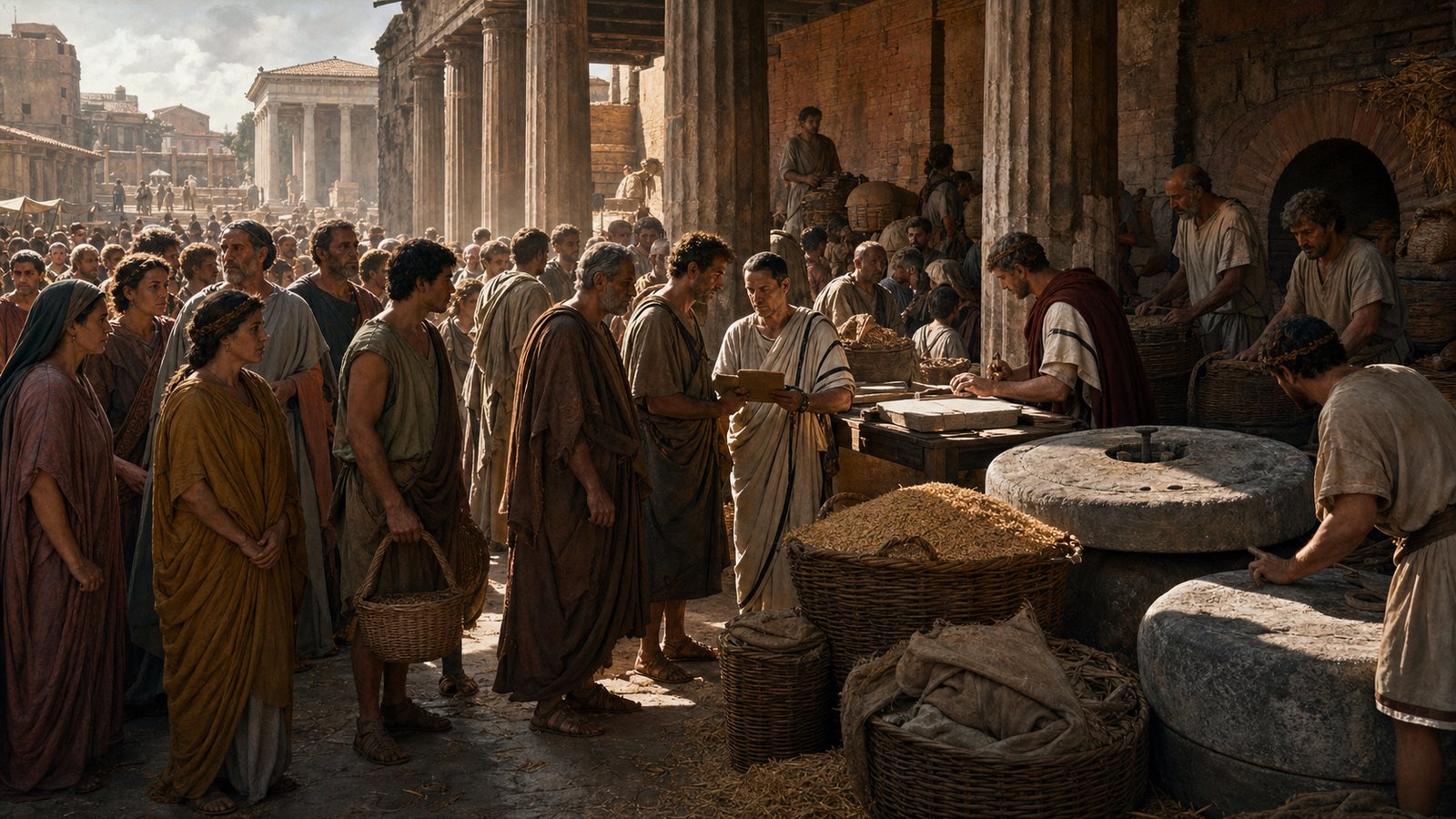
Ostia and Portus turned food into infrastructure
Ostia was not just a pretty harbor in the Roman story. It was one of the places where imperial dependency became visible. Warehouses, docks, labor gangs, ships, accounts, and river transport made the city’s food supply physical. People in Rome might argue about emperors in the Forum, but the empire’s stability also depended on sacks being moved correctly near the mouth of the Tiber.
Claudius began a major harbor project at Portus, and Trajan later developed the great hexagonal basin. Those projects were not decorative gestures. They addressed a practical fear: Rome needed a more reliable maritime gateway. A harbor could be a monument, but it was a monument with a job. It told the city that the state understood the danger of interrupted supply.
The annona made administration politically visible
Augustus’ creation of a grain-supply prefect placed a practical problem inside imperial administration. That is revealing. Roman rulers knew that feeding the capital could not be left to luck or scattered private effort alone. The office did not eliminate shortages, but it showed that the government accepted responsibility for managing them.
This responsibility changed expectations. If bread appeared, the system worked quietly. If bread failed, blame had somewhere to go. The emperor did not personally sail the grain fleet, but his authority became attached to its arrival. In that sense, every dock record and warehouse door carried political meaning.
A delay could become public emotion
Tacitus preserves the connection between food supply and public order because Romans themselves understood it. Hunger did not remain private. Shortage made crowds alert, rumors sharp, and officials nervous. A delayed cargo could turn into questions about competence, favoritism, divine anger, or imperial neglect before anyone had a complete explanation.
The sensory details mattered. Empty bins, shouted arguments in markets, slower baking, heavier prices, and anxious waiting at distribution points could make politics bodily. People did not need a theory of logistics to understand vulnerability. They felt it in queues, counters, and kitchens.
Egypt made food supply strategically sensitive
After Augustus defeated Antony and Cleopatra, Egypt became one of the empire’s crucial grain provinces. Its importance helps explain why emperors treated the province carefully. Control of Egypt was not only about prestige or wealth. It was tied to the stomach of Rome.
A province that helped feed the capital could not be politically ordinary. Its harvests, river cycles, ports, and officials mattered far beyond the Nile. When grain moved from Egypt toward Rome, it carried more than food. It carried proof that the imperial settlement still had reach into the places it depended on most.
Bread and circuses was sharper than a joke
Juvenal’s phrase about bread and circuses survives because it is memorable, but it can sound too cynical if treated as a throwaway insult. Bread was not a trivial bribe. It was a basic condition of urban peace. A ruler who ignored it risked making politics immediate to people who otherwise might remain spectators.
The grain supply therefore belonged to the same world as armies, taxes, and succession. It was one of the systems that made a capital governable. Rome’s leaders could win battles abroad and still face danger if the city doubted the next loaf. The ordinary object on a table depended on extraordinary coordination.
The grain ship was a test of Roman power
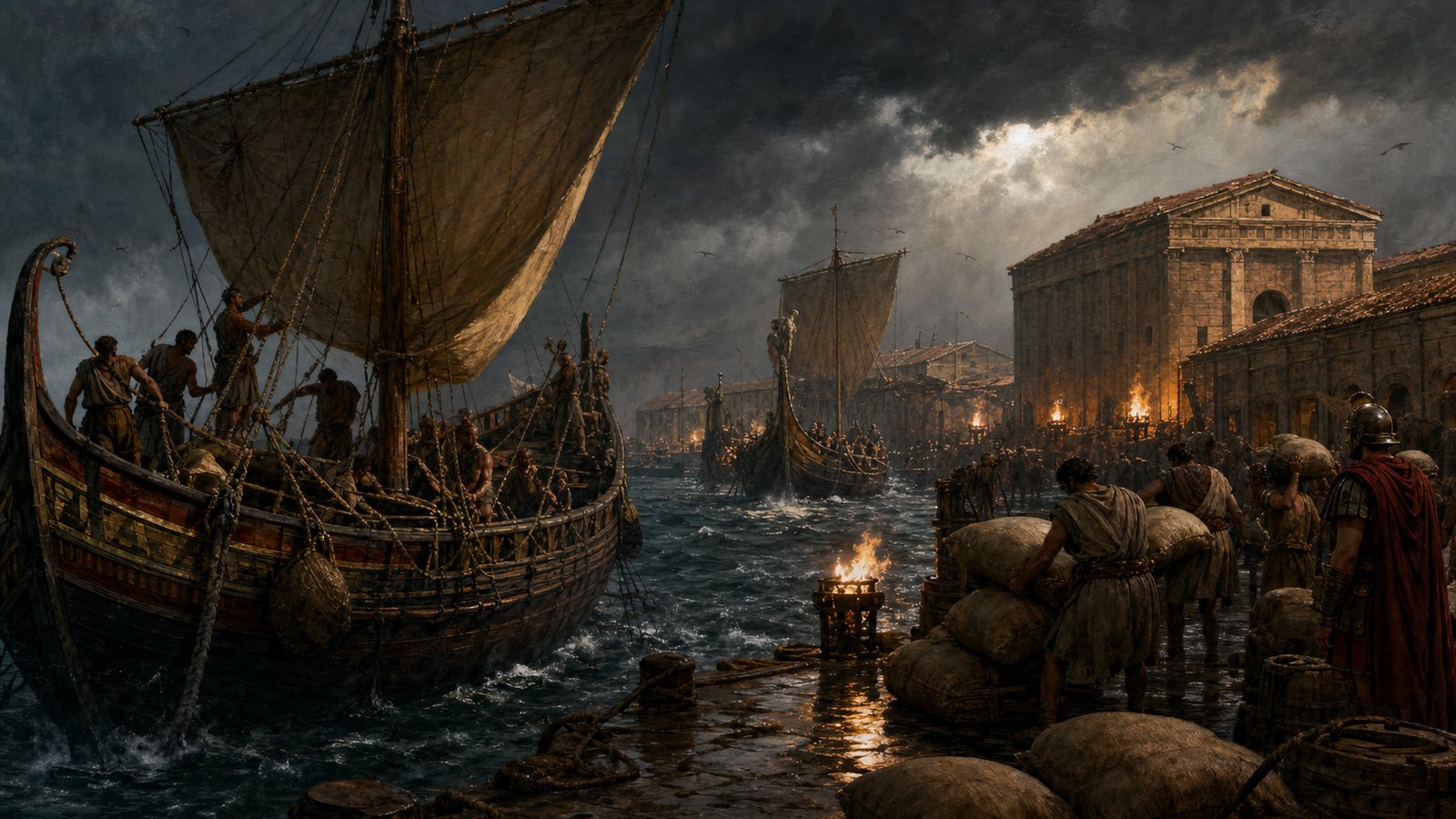
A grain ship approaching Ostia looked like commerce. In political terms, it was a report card. It said that provincial harvests had been gathered, merchants or state contractors had moved cargo, harbors were usable, warehouses had space, and officials had not lost the chain. The ship’s arrival made imperial scale edible.
That is why Rome’s grain ships made politics nervous. They revealed a truth every large state eventually learns: power must arrive on time in ordinary forms. Not only as law. Not only as soldiers. As bread, measured and moved before anger gathers. Rome could command provinces, but the capital still waited for sails on the horizon.
The nervousness also came from visibility. A shortage could not be hidden in a city that ate together through markets, bakeries, and distributions. Officials might know the numbers first, but the crowd learned the truth through texture: thinner loaves, longer waits, harder bargaining, and more watchful faces near the stalls. The supply system turned administrative delay into a street-level mood.
That mood gave food a political vocabulary. A ruler did not need to be accused in a formal trial to be judged by hungry citizens. The question was simpler and sharper: had the state kept the grain moving? When the answer was yes, the machinery disappeared behind daily routine. When the answer was no, every missing sack became evidence.
Rome’s genius was that it built structures to answer the danger before panic became normal. Harbors, basins, storehouses, offices, and fleets made the grain supply a permanent concern of power. The city was not ashamed of needing distant food. It made that need part of the empire’s operating system. The result was magnificent and fragile at once: a capital fed by the world, and therefore always listening for news from the sea.
The system also explains why Roman food politics could look both generous and controlling. Distribution reassured the crowd, but it also reminded the crowd where relief came from. A loaf could be practical assistance and political message at the same time. The empire did not have to choose between feeding people and displaying authority, because in the capital those acts often became the same thing.
Sources & Further Reading
- Britannica, ancient Rome
- Ostia Antica, history of Ostia
- Suetonius, Claudius, 20
- World Monuments Fund, Portus
- Smith Dictionary, Annona
- Britannica, prefect
- Tacitus, Annals, 6.13
- Juvenal, Satires, 10.81
- Britannica, Egypt under Rome
- Cambridge Core, Food and the City in the Roman Empire