
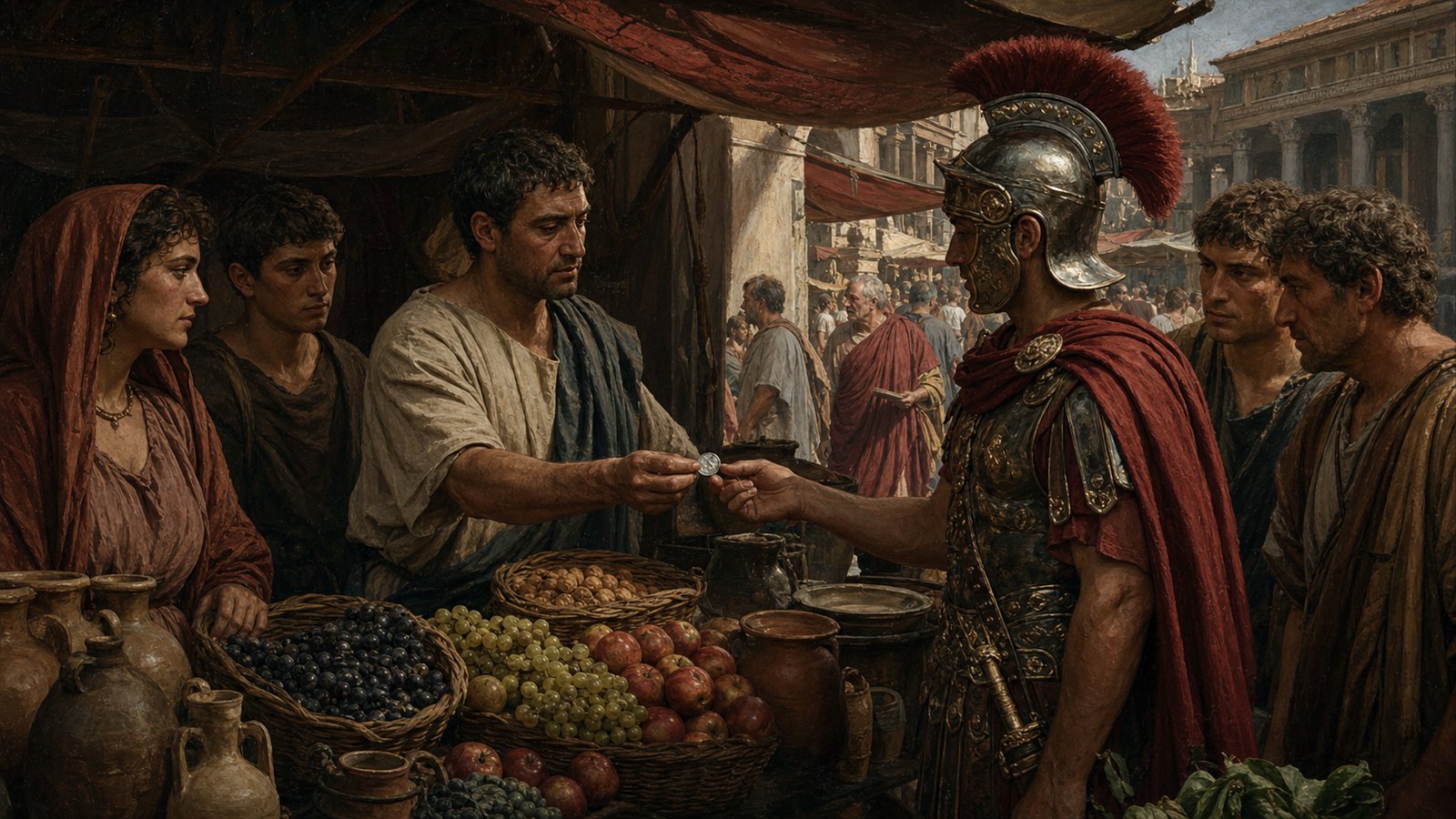
A Roman coin was easy to underestimate. It could disappear inside a purse, lie under a market table, or pass from a soldier to a wine seller without ceremony. Yet that small object carried one of the empire’s most persistent political messages. A face, a title, a victory, a deity, or a promise could travel wherever money traveled.
Coins did not replace monuments, speeches, or public ritual. They did something those media could not do as constantly. They entered ordinary exchange. A denarius could move through camps, shops, tax payments, gifts, and savings. Each transfer made imperial power visible at hand-size. Rome had invented pocket-sized news.
The portrait made rule physically portable
Julius Caesar’s lifetime portrait coinage in 44 BC was a turning point because it placed a living Roman’s face into a medium everyone understood. Later emperors inherited and expanded that habit. The portrait on a coin was not merely decoration. It told users whose authority stood behind the money and whose image deserved recognition.
That mattered in a vast empire where most subjects would never see the emperor. A statue might dominate a forum, but it stayed where it was placed. A coin moved. It could carry the ruler’s profile from Rome to a frontier fort, from a tax office to a market, and from one province to another. The image made distant power repeatable.
The reverse side turned money into a message board
The other side of a coin could be just as political. Roman coins showed victories, gods, buildings, heirs, virtues, and public promises. A reverse type might announce peace, celebrate conquest, or imply that a dynasty was secure. These images compressed a claim into a form that did not require a long explanation.
The method was powerful because it was ordinary. A person did not have to attend a ceremony to encounter the message. The message arrived while buying bread, receiving pay, or counting savings. Imperial communication was not limited to grand occasions. It was embedded in the small frictions of daily life.
Augustus understood that victory needed repetition
Augustus used every available language of legitimacy: restoration, peace, family, victory, and divine favor. Coinage fitted that program perfectly. It could repeat themes across many hands and places, turning political settlement into a familiar visual vocabulary.
This did not mean every user studied each type like a scholar. Many people probably noticed only broad signals: the ruler’s face, a goddess, a trophy, a temple, a familiar title. But broad signals are exactly what public messaging often needs. A coin could make the emperor seem present without requiring the emperor to speak.
Mint work made propaganda durable
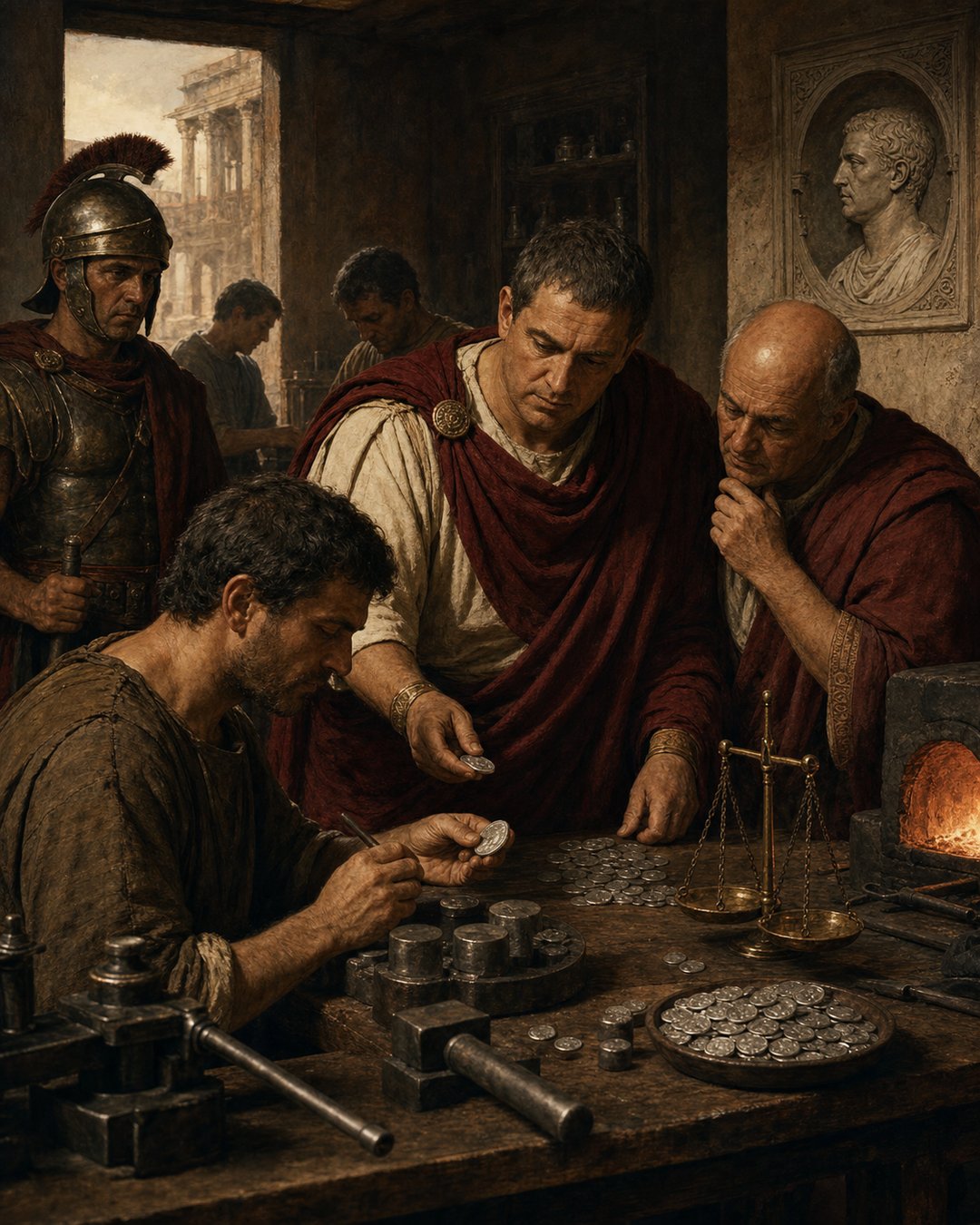
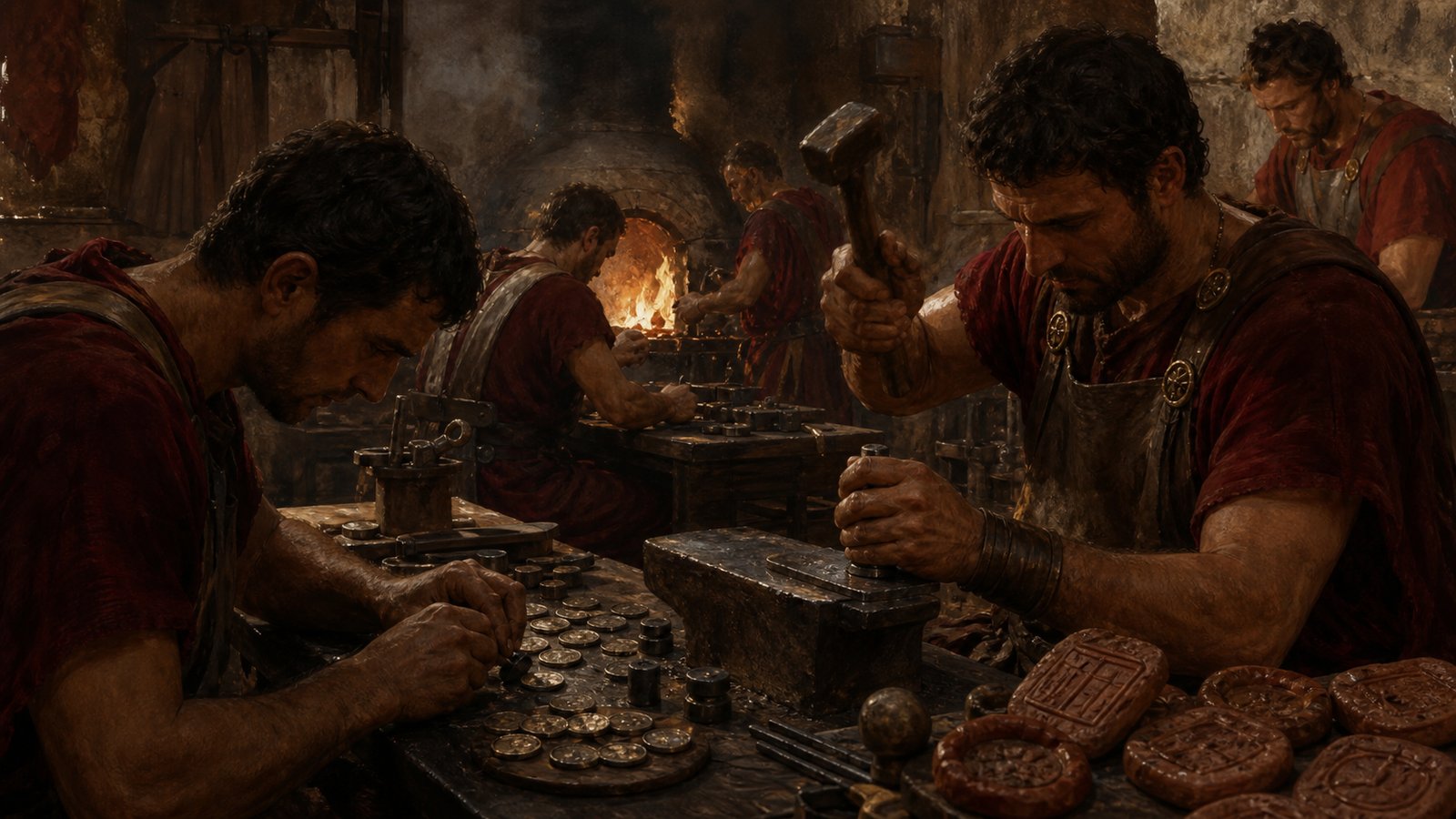
The political message depended on physical craft. Metal had to be weighed, blanks prepared, dies cut, and pieces struck. A coin’s authority came partly from trust that the object was real money. That trust gave its imagery access to daily life. Bad metal or confusing designs could damage more than accounting; they could damage confidence.
This is why a mint workshop belongs in the political history of Rome. The men striking coins were not only making payment tools. They were multiplying official symbols. Every finished piece could outlast the moment that ordered it and continue speaking after the ceremony, battle, or succession crisis had passed.
Coins reached people monuments missed
A triumphal arch required a viewer to stand before it. A senatorial decree required literacy, access, or someone to repeat it. A coin could reach the illiterate through image, the distant through circulation, and the busy through use. Its scale was small, but its network was immense.
That reach helps explain why coin evidence is so valuable to modern historians. Coin finds can help date layers, trace circulation, and reveal what rulers wanted to emphasize. They are archaeological objects, but also fragments of official messaging. The empire left tiny statements scattered through the ground.
The smallness was the point
Roman power often loved size: roads, walls, baths, amphitheaters, aqueducts, and marching camps. Coins worked in the opposite way. They were persuasive because they were small enough to be unavoidable. A person might avoid a ceremony, but not exchange. Money made ideology portable, repeatable, and useful.
That does not mean every coin persuaded every user. People could distrust rulers, ignore images, or care only about silver content. But communication does not require perfect obedience. It requires repeated contact. Roman coinage gave emperors repeated contact on a scale no single monument could match.
The next time a Roman coin appears in a museum case, it is worth imagining the opposite of silence. That little object once moved through hands, arguments, wages, debts, and hopes. It carried metal value, but also a face and a story about power. In Rome, even loose change could announce who ruled the world.
The message was especially useful during succession. A new ruler needed recognition quickly, and a coin could pair a portrait with titles, family connections, or symbols of stability. It did not convince everyone, but it gave the new order a repeatable form. Each payment could become a tiny rehearsal of acceptance.
Coins also worked because they joined authority to trust. Users wanted the metal to be accepted by others. That desire gave official imagery a ride on practical need. A farmer, shopkeeper, soldier, or tax collector might care more about value than ideology, but the image still moved with the value.
This is the quiet genius of coinage as communication. It did not ask people to stop their lives and listen. It entered the life already happening. Rome’s rulers could not be everywhere, but their money could approach that fantasy one transaction at a time.
The effect was cumulative. A single coin might be ignored, scratched, hoarded, or melted. Thousands of coins, struck with related images and passed through many hands, created a background language of rule. Portraits normalized faces. Reverse types normalized victories and virtues. Repetition turned political claims into familiar objects.
That familiarity mattered most when politics was uncertain. After a victory, adoption, accession, or crisis, coinage could present the desired answer in durable metal. People might argue about the ruler, but the ruler’s face kept arriving in payment. The coin did not end debate. It made one side of the debate unavoidable.
It also let emperors speak to audiences they could not name. A reverse showing victory might matter to soldiers, taxpayers, provincial elites, and city crowds in different ways. That flexibility was useful. The same small object could promise security, celebrate conquest, advertise continuity, and remind every holder that money itself was tied to Roman authority.
Coins were therefore not merely evidence left for archaeologists. They were working political instruments, worn smooth by the very circulation that made them powerful.
Sources & Further Reading
- British Museum, Roman coins and coinage
- American Numismatic Society, Julius Caesar portrait coinage
- British Museum, Augustus and coinage
- Encyclopaedia Britannica, denarius
- Suetonius, Augustus, 52-53
- Metropolitan Museum of Art, Roman coins
- Oxford Classical Dictionary, coinage Roman
- Metropolitan Museum of Art, Roman portraiture and coinage
- Tacitus, Annals, 1.7
- Portable Antiquities Scheme, Roman coins