
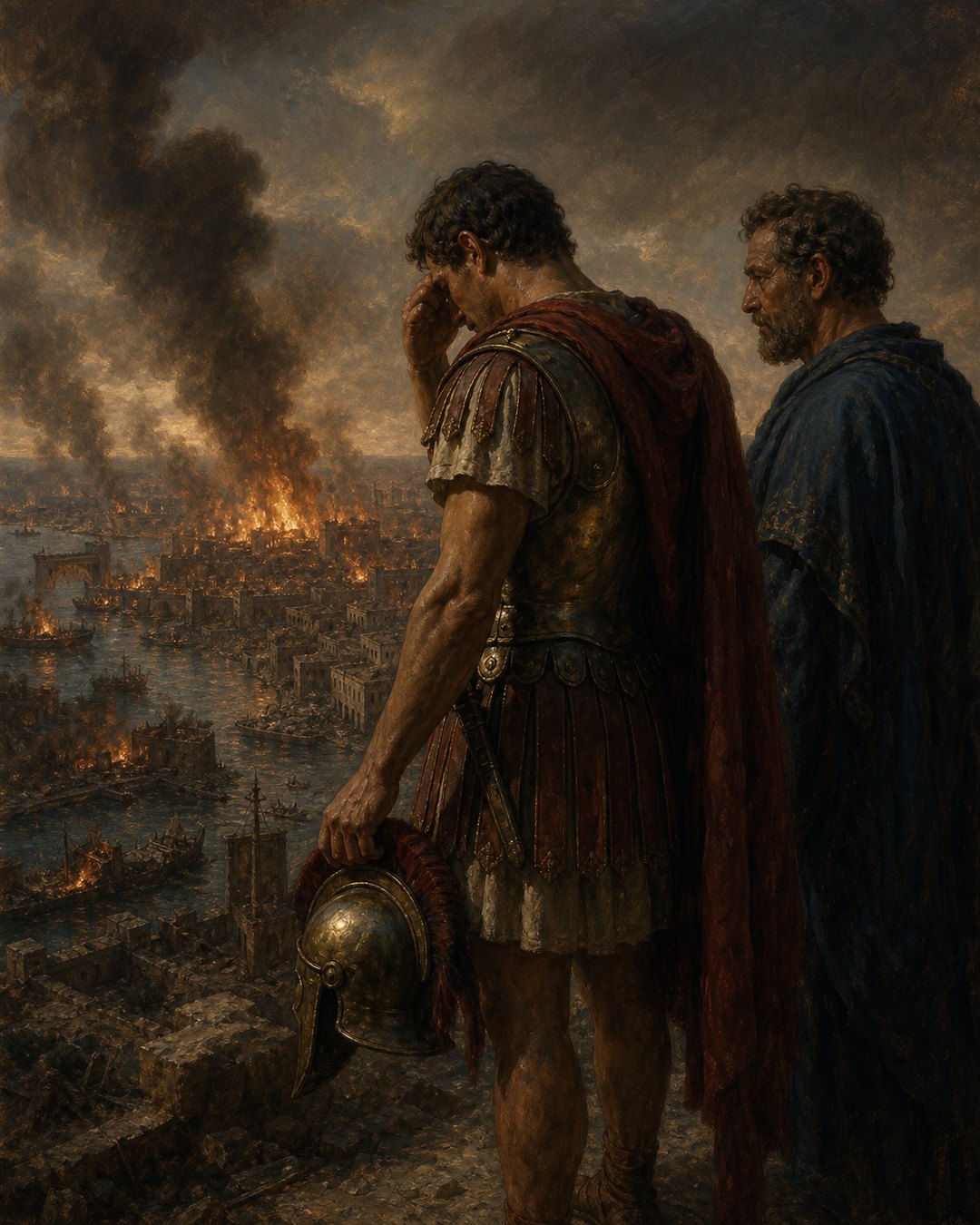
Carthage was burning when the Roman commander began to cry. Appian places Scipio Aemilianus before a city that had resisted for three years and had now reached total destruction. This was the victory Rome had demanded. Yet Scipio did not greet the spectacle with a simple boast. He looked at the enemy’s ruin, reflected in silence, and quoted the lines in which Hector foresees the day when Troy, Priam and Priam’s people will perish.
Polybius was close enough to ask what he meant. Scipio answered that he was thinking of Rome. The fate of Carthage had made him fear for his own country because human affairs never remain fixed. Polybius then recorded the exchange as something he had heard directly.
The scene survives because it reverses the expected direction of a victory story. A defeated city usually confirms the conqueror’s strength. Here the defeated city becomes a warning to the conqueror. Scipio’s tears were not a rejection of the campaign he had led. They were recognition that success had placed Rome inside the same sequence of rise, power and collapse that had just ended Carthage.
Three Years of Resistance Ended in One View
Appian asks the reader to see more than flames. He describes Carthage as a city that had flourished for seven hundred years from its foundation. It had ruled lands, islands and seas, accumulated arms, fleets, elephants and money, and matched great monarchies in power. His catalogue gives the final spectacle historical depth: Scipio was not watching an anonymous settlement disappear but a political world reach its endpoint.
The account also stresses the final imbalance. Carthage had endured continuous war for three years while deprived of ships and arms and suffering famine. Its resistance made the destruction look neither quick nor accidental. Rome had overcome a city that continued fighting after many of the instruments of normal warfare had been stripped away.
Immediately before Scipio’s reflection, Appian narrates the end of Hasdrubal’s family in the temple. Hasdrubal had surrendered. His wife, still with their children, denounced him within Scipio’s sight, killed the children and entered the fire herself. The sequence is brutal, and Appian marks parts of it as reported tradition rather than private knowledge. It leaves Scipio facing both the physical destruction of a city and the collapse of its leading household.
An earlier Lost Eagles article on Cato’s repeated political use of Carthage explains why the enemy had become an obsession at Rome. The scene in 146 BC shows the other side of that obsession. Once the threat was finally removed, its absence created room for a harder question: what did Rome’s ability to end Carthage say about the future of Rome itself?
Hector Supplied the Words for a Roman Fear
Scipio did not invent a speech about impermanence. He reached for Homer. The lines come from the sixth book of the Iliad, where Hector knows that sacred Troy, Priam and the Trojan people will one day perish. In their original setting, the words belong to a defender who can imagine defeat before it arrives.
Placed at Carthage, the quotation acquired another speaker and another direction. Scipio was not Hector on the losing wall. He commanded the army that had won. Quoting Hector let a victor speak from the mental position of the defeated without pretending that the sides were the same. Troy’s future fall gave him language for what the present triumph could not guarantee.
The wording moves from city to ruler to people. Troy will fall; Priam will fall; the people governed by Priam will fall. That sequence suited the scene before Scipio because Carthage was more than masonry. Appian had just evoked its power, resources, endurance and human losses. The Homeric lines compressed all of those levels into a familiar image of collective extinction.
Nothing in the passage says that Scipio expected Rome to fall soon or by a particular enemy. He offered no date, mechanism or prophecy. His point was structural: a state powerful enough to seem permanent could still enter history’s past tense. The ashes at Carthage made that possibility visible in a way an abstract maxim could not.
Polybius Asked the Question That Preserved the Answer
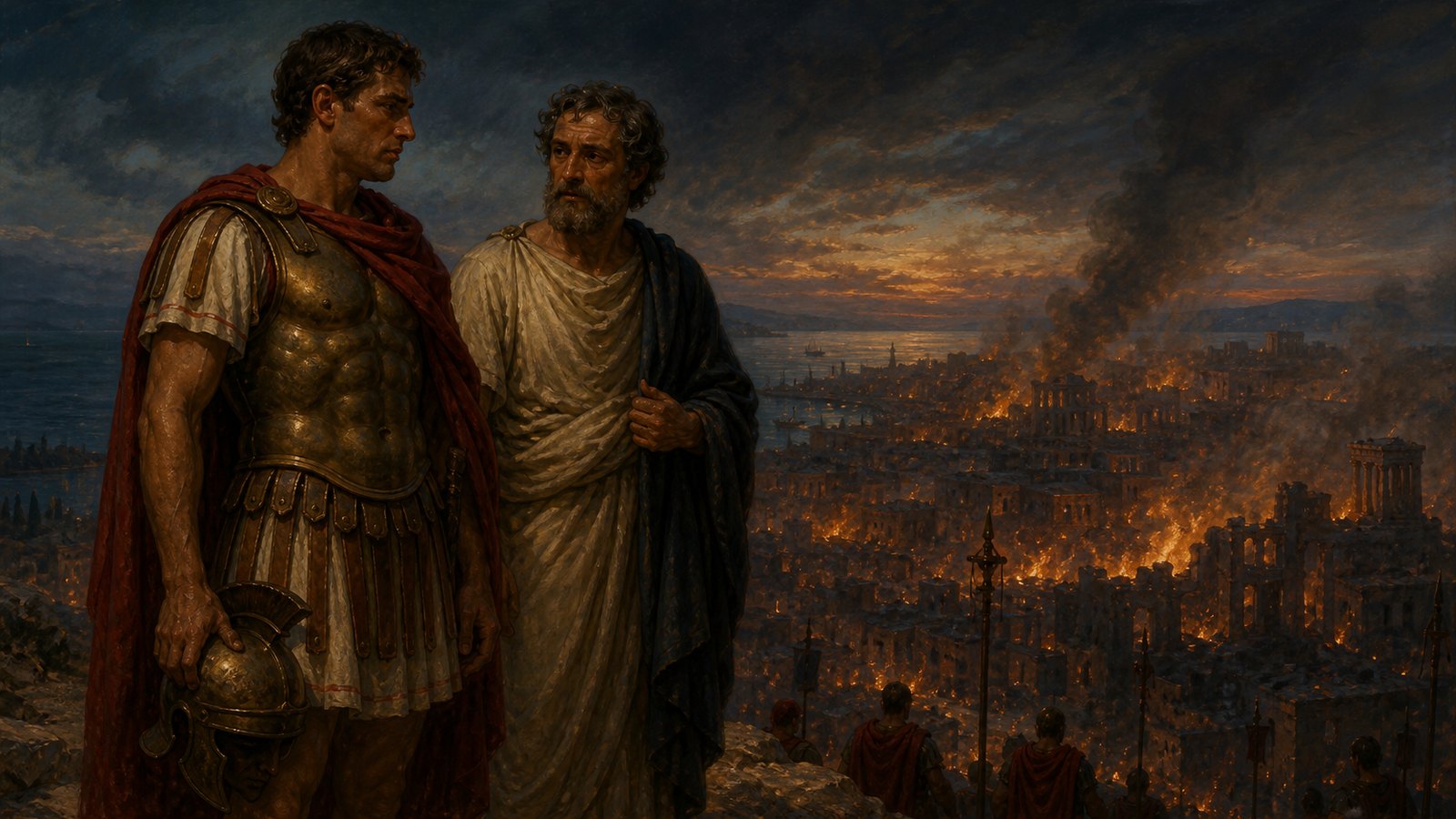
Appian says Polybius asked Scipio what he meant in familiar conversation and identifies the Greek historian as his tutor. That relationship matters. A public quotation could have remained ambiguous, perhaps treated as sympathy for the defeated or admiration for Homer. The follow-up question drew out the Roman object of Scipio’s fear.
Scipio answered frankly that he meant his own country. He considered the changing fortune of human affairs and did not hesitate to name Rome. Polybius wrote the explanation down as he heard it. The passage therefore presents a chain of preservation: a Roman commander quoted a Greek poet, a Greek historian questioned him, and Appian later transmitted the exchange in his history of Rome’s wars with Carthage.
That chain does not turn the scene into a verbatim recording in the modern sense. Appian wrote centuries after the event, and the episode reached him through historiographical transmission. His explicit appeal to Polybius is the ancient account’s way of identifying its authority. Responsible reading preserves both features: the scene is an ancient literary report, and that report names a participant who claimed direct conversation.
Polybius was unusually suited to recognize the force of the answer. His histories examined how Rome acquired Mediterranean power, and his connection to Scipio placed him near the men exercising it. Our article on Scipio’s earlier namesake and the midnight attack on Syphax follows victory through timing and battlefield decision. At Carthage, Polybius preserved a different military detail: the pause after victory when a commander interpreted what he had done.
The Conqueror Included Rome in the Pattern
Appian expands Scipio’s meditation beyond Troy. He says the commander considered the rise and fall of cities, nations, empires and individuals. Assyrians, Medes, Persians and the Macedonian empire entered the sequence. The list made impermanence cumulative. Each power could once have appeared central; each had become an example available to a later victor.
Rome might have claimed exemption by pointing to its institutions, gods, discipline or scale. Scipio did not do so in this scene. He put his country inside the pattern rather than above it. That is the sharpest part of the anecdote. The man who had just demonstrated Roman superiority refused to treat superiority as a permanent category.
His response also avoids the comfortable posture of pitying only the loser. Tears for Carthage could have left Rome morally untouched: the victor remains stable while compassion flows outward. Fear for Rome redirected the lesson home. The city under Roman assault became evidence about the assailant’s eventual vulnerability.
This does not make Scipio a secret opponent of Rome or of the war. Appian still presents him as the commander at the moment Carthage was destroyed. The episode is powerful precisely because reflection and conquest coexist. Roman action produced the ruin; Roman historical consciousness recognized what the ruin implied.
A Victory Scene Became a Measure of Mortality
Later readers can easily turn the tears into an omen of the Western empire’s end. Appian’s passage is more disciplined than that. Scipio does not foresee a fifth-century date or describe the path Rome will follow. He responds to one destroyed city with a general fear grounded in examples of former powers.
The restraint keeps the episode human. He had no privileged view of Rome’s whole future. He had memory, literature and the scene before him. Homer supplied a language older than Roman supremacy. Carthage supplied the visible proof that a great city could become an object of lament while its conqueror was still standing.
Appian says the words either escaped Scipio voluntarily or otherwise. That uncertainty catches the moment well. A polished victory speech would have arranged its lesson for an audience. This quotation appears as a thought crossing into sound, followed by Polybius’s question and a private explanation made public through history.
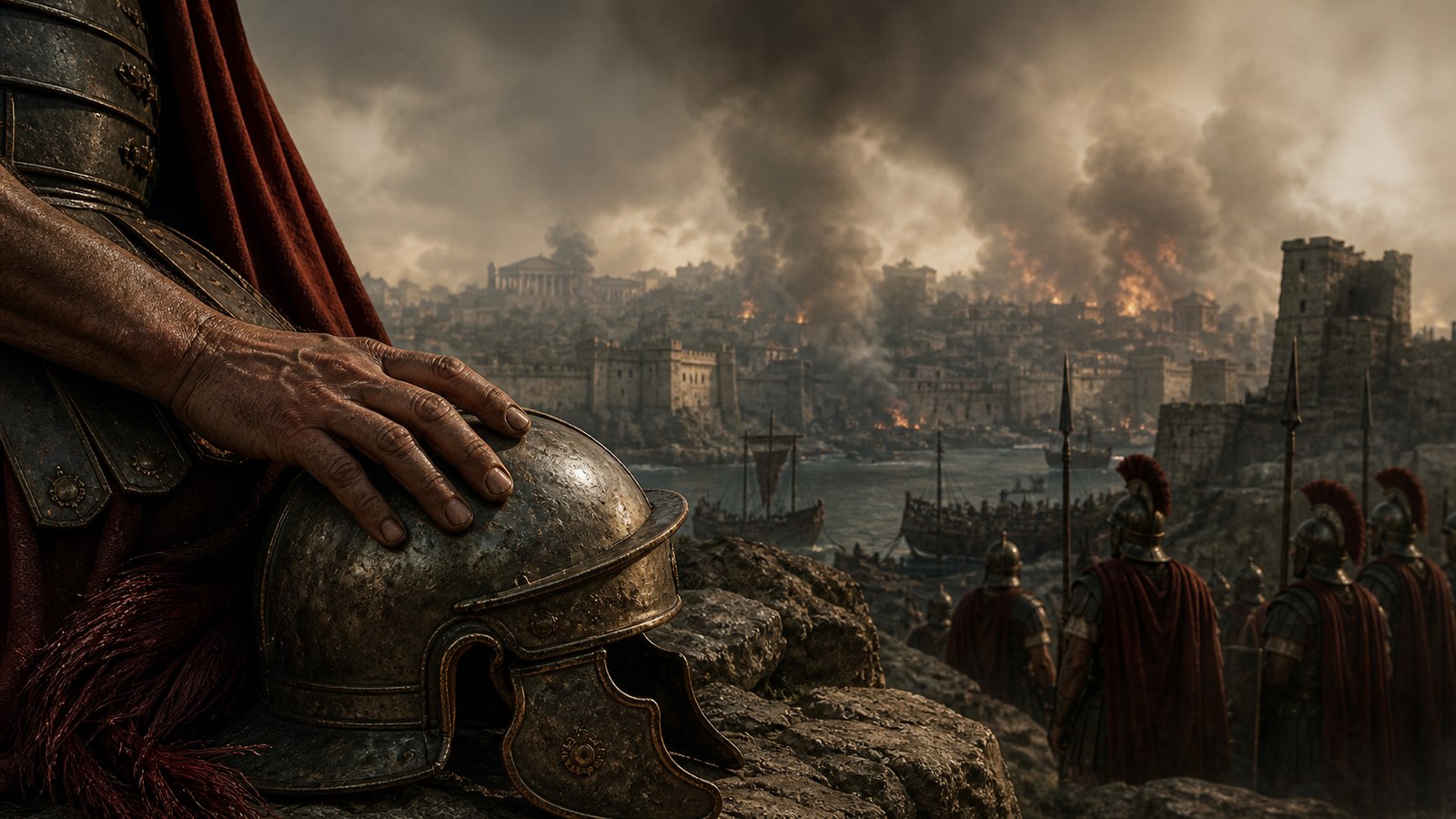
Rome won at Carthage, but Appian refused to end with invulnerability. The commander looked at seven centuries of power reduced to destruction and placed Rome beside Troy, Persia and Macedon. His tears did not undo the conquest. They revealed the limit that conquest could never remove: every city powerful enough to destroy another city is still a city living in time.
Sources
Appian, Punic Wars, sections 131–133; Homer, Iliad, 6.448–449.