
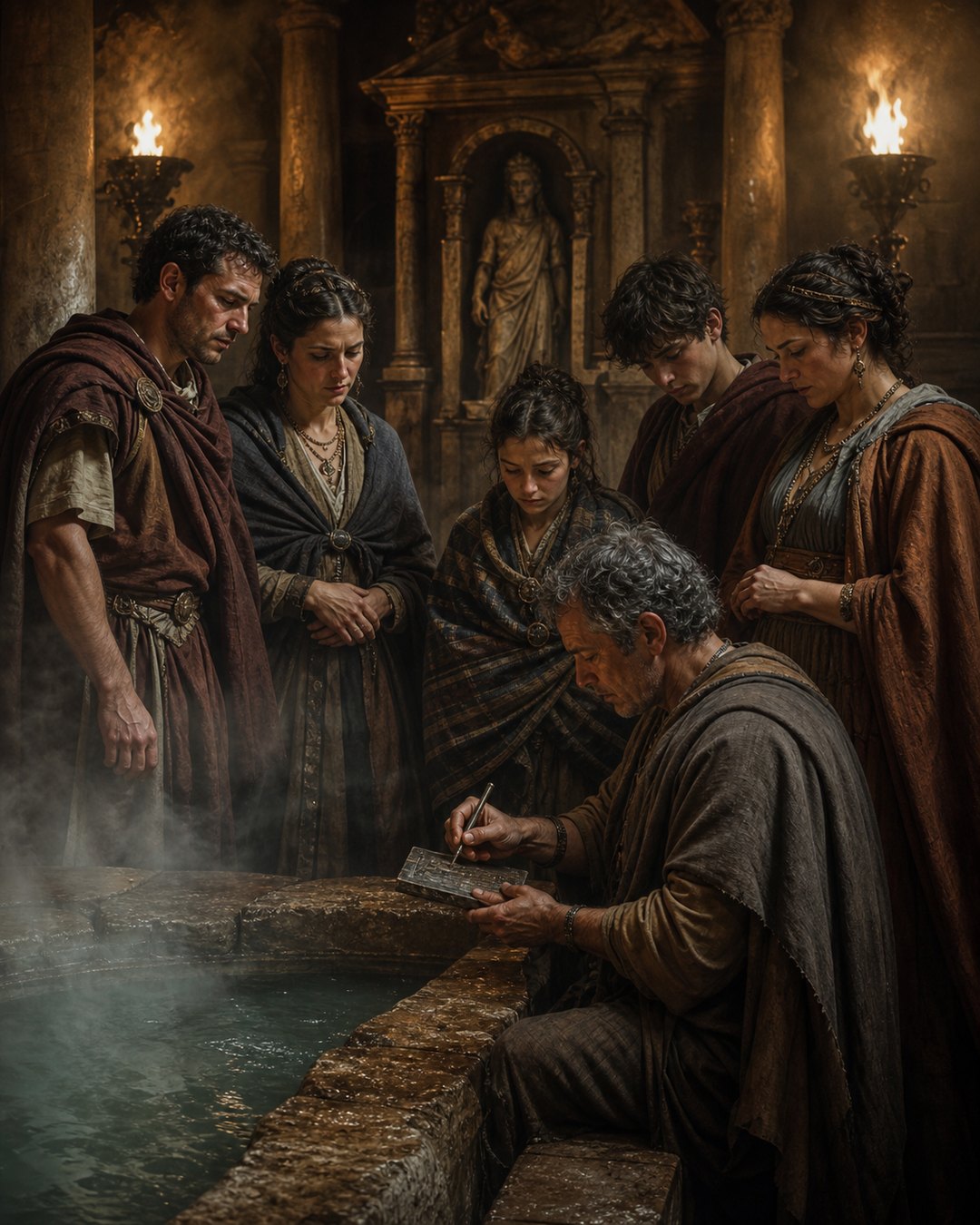
Six names were cut into a thick metal sheet and placed in the sacred spring at Bath: Uricalus; Docilosa, his wife; Docilis, his son; Docilina; Decentinus, his brother; and Alogiosa. The text says they had sworn there on 12 April. It does not preserve what they promised. Instead, it preserves the consequence if one of them had lied.
The goddess Sulis was asked to make the perjurer satisfy her with his own blood. That language sounds like a curse, and the object is catalogued among Bath’s curse tablets. Yet Roman Inscriptions of Britain calls Tablet 94 unique. It is not a normal petition against a thief or enemy. It is a sanction attached to an oath already sworn at the spring.
The distinction changes the story. A curse begins from an injury and seeks supernatural redress. This tablet begins with a named group, a location and an exact day. The hot spring was not merely where a written complaint was deposited. It was where the family’s words became dangerous to break.
A Thick Alloy Sheet Held a Family Group
Tablet 94 measures 75 by 55 millimetres and is 1.5 millimetres thick. Analysis identifies a tin-rich alloy: 59.1 percent tin, 40.6 percent lead and 0.3 percent copper. A rectangle had been cut from the sheet. One lower corner is missing, corrosion marks the surface and the patina looks brassy, but most of the text survives.
The object was found in 1979 during excavation of the votive deposit from the hot spring and Roman reservoir beneath the floor of the King’s Bath. Unlike many small inscribed sheets, it had not been folded. Its words remained on an open surface even after the tablet entered the deposit.
A practised hand incised the text with a stylus in a distinctive square form of New Roman Cursive. The physical combination is striking: a compact metal sheet, deliberate letter strokes and a list whose relationships are partly spelled out. Uricalus stands beside his wife, son and another female name; his brother Decentinus and Alogiosa follow.
Roman household religion often worked through modest objects rather than monumental temples. Our account of the Lares within domestic routine shows sacred attention close to family life. Tablet 94 moves the family outside the house and fixes its obligation at a public cult place whose water supplied the threat.
The Names Mixed Family Relations and Naming Traditions
The text explicitly calls Docilosa the wife of Uricalus, Docilis his son and Decentinus his brother. Editors infer that Alogiosa was probably Decentinus’s wife. Docilina appears after Docilis; the commentary treats both children as named from their mother, Docilosa.
The names do not fit a simple division between “Roman” and “Celtic” people. Uricalus appears to be an unattested Celtic formation. Decentinus develops from the Latin cognomen Decens. Roman Inscriptions of Britain notes that after more than two centuries of Roman rule, families could draw Roman and Celtic names from a common stock.
Docilosa and Docilina also appear to be unattested developments from the Latin cognomen Docilis. Alogiosa is unusual and has parallels connected with a Greek formation. The tablet therefore preserves a family whose names carry different linguistic histories without telling us that the household experienced those histories as contradictions.
The relationships matter more than ancestry labels. An oath involving two brothers, wives and children created risk inside a connected group. The commentary cautiously suggests that the unstated subject might have concerned a family matter, perhaps inherited property. That remains a possibility, not a recovered fact. The tablet never says what was divided, disputed or promised.
Twelve April Turned the Spring into a Witness
The oath was sworn on the day before the Ides of April: 12 April. This is the only explicit date found in the Bath tablets. The year is absent. Perhaps everyone involved knew it; perhaps the day carried a local significance that made further specification unnecessary. In Rome the date coincided with the first day of the Ludi Cereales, but the tablet does not connect the family’s oath to those games.
More important is the phrase “at the spring of the goddess Sulis.” Roman Inscriptions of Britain identifies this as the only occurrence of that exact expression and the first explicit inscriptional mention of the sacred spring from which Aquae Sulis took its name.
Location gave the oath material force. The family did not merely invoke Sulis from anywhere. They stood at the water associated with her and recorded that fact. Heat, movement and depth could make the spring feel like an active presence rather than a neutral backdrop.
Public religion and legal obligation were not sealed into separate systems. Our article on Roman altars and visible vows follows promises displayed before divine witnesses. Tablet 94 uses another medium. A small alloy sheet carried names and date into the spring whose resident goddess was expected to punish falsehood.
The Tablet Asked for Payment in Blood
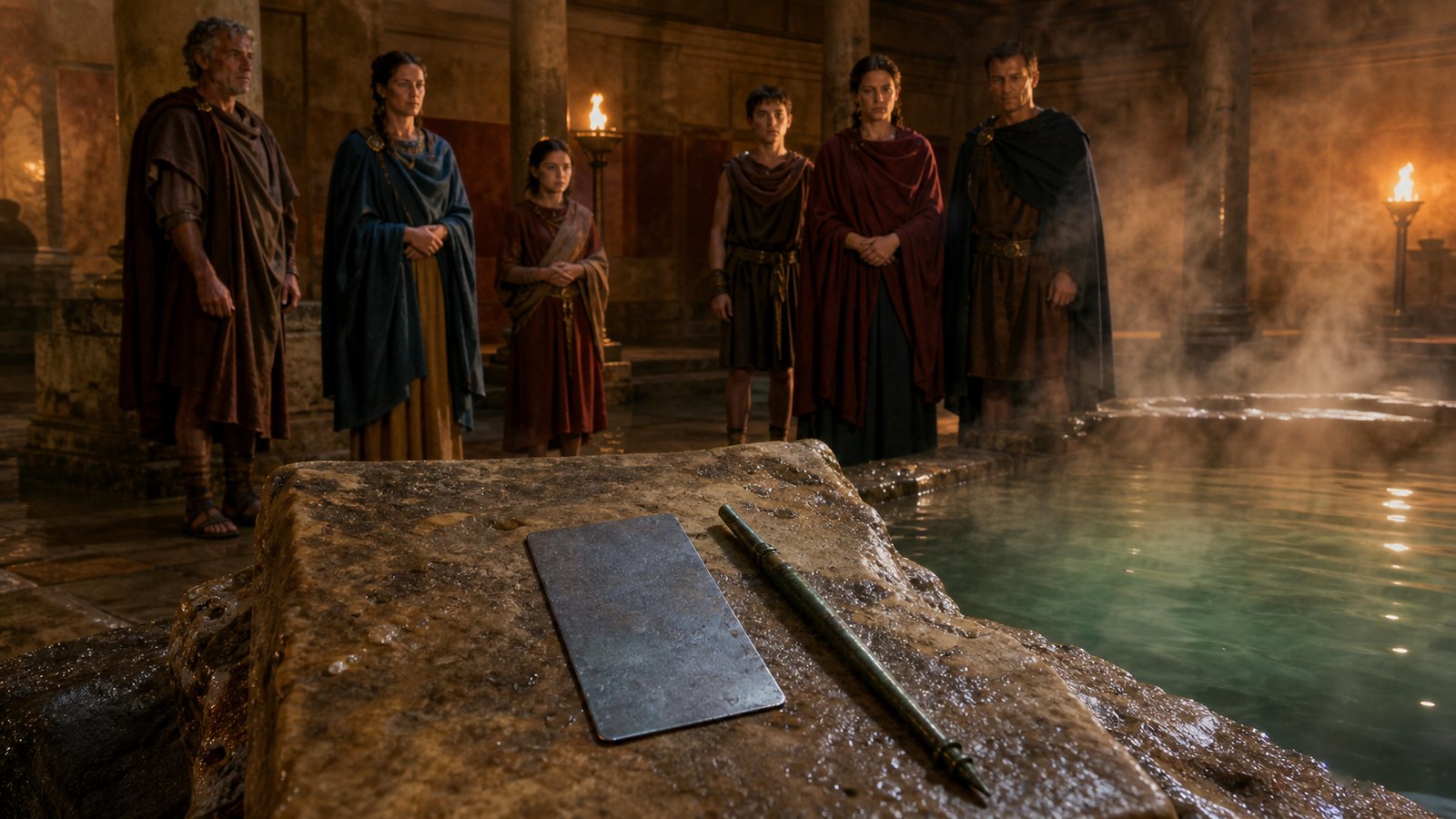
The final lines address the consequence: whoever committed perjury there was to satisfy Sulis with his own blood. The verb belongs to the language of making satisfaction or compensation. The perjurer did not simply deserve vague misfortune. He owed the goddess a payment drawn from his body.
Similar blood-payment formulas occur in other British curse tablets, especially complaints about stolen property. Tablet 94 redirects that formula from an unknown thief to one possible liar within a named group. Everyone recorded on the sheet had sworn; only the false swearer, if there was one, became liable.
The grammar is not perfectly smooth. The scribe repeats phrases, omits or alters endings and directly tells the goddess—or possibly the spring—to act. Editors explain how familiar wording addressed to Sulis could pull the sentence away from formal grammar. The irregularities do not erase the intended threat, which the translation makes clear.
Calling the sanction “blood payment” should not be expanded into a known ritual procedure. The tablet does not specify illness, injury, sacrifice or execution. It asks Sulis to exact satisfaction. The mechanism remained in divine hands, which may have been precisely why the formula was useful.
A Hot Spring Could Test Truth
The commentary places the Bath text beside a wider ancient belief that hot springs and seething pools punished perjury. A Gallic spa associated with Apollo Grannus was said to punish false oaths in its hot water. Other traditions describe oath tests in Sardinia, near Padua, near Tyana and at the pools of the Palici in Sicily.
Those parallels do not prove that Bath copied one standard ordeal. They show why a spring could seem suited to enforce speech. Water that emerged hot from the ground already behaved unlike ordinary water. A person who lied in its presence risked turning an uncanny natural property into judgment.
Tablet 94 is the first epigraphic evidence for that belief at Bath. It joins the general idea to six local names and one local date. A literary writer might describe miraculous pools at a distance; this object records people placing their own relations under the jurisdiction of Sulis.
Its silence about the oath’s subject is frustrating but productive. The sheet was not written for modern investigators. It needed to identify the sworn group, the divine venue and the sanction, not explain family history to strangers. Uricalus and the others apparently knew what 12 April meant. What they wanted preserved was the danger of denying it.
The Unfolded Sheet Preserved Obligation, Not Outcome
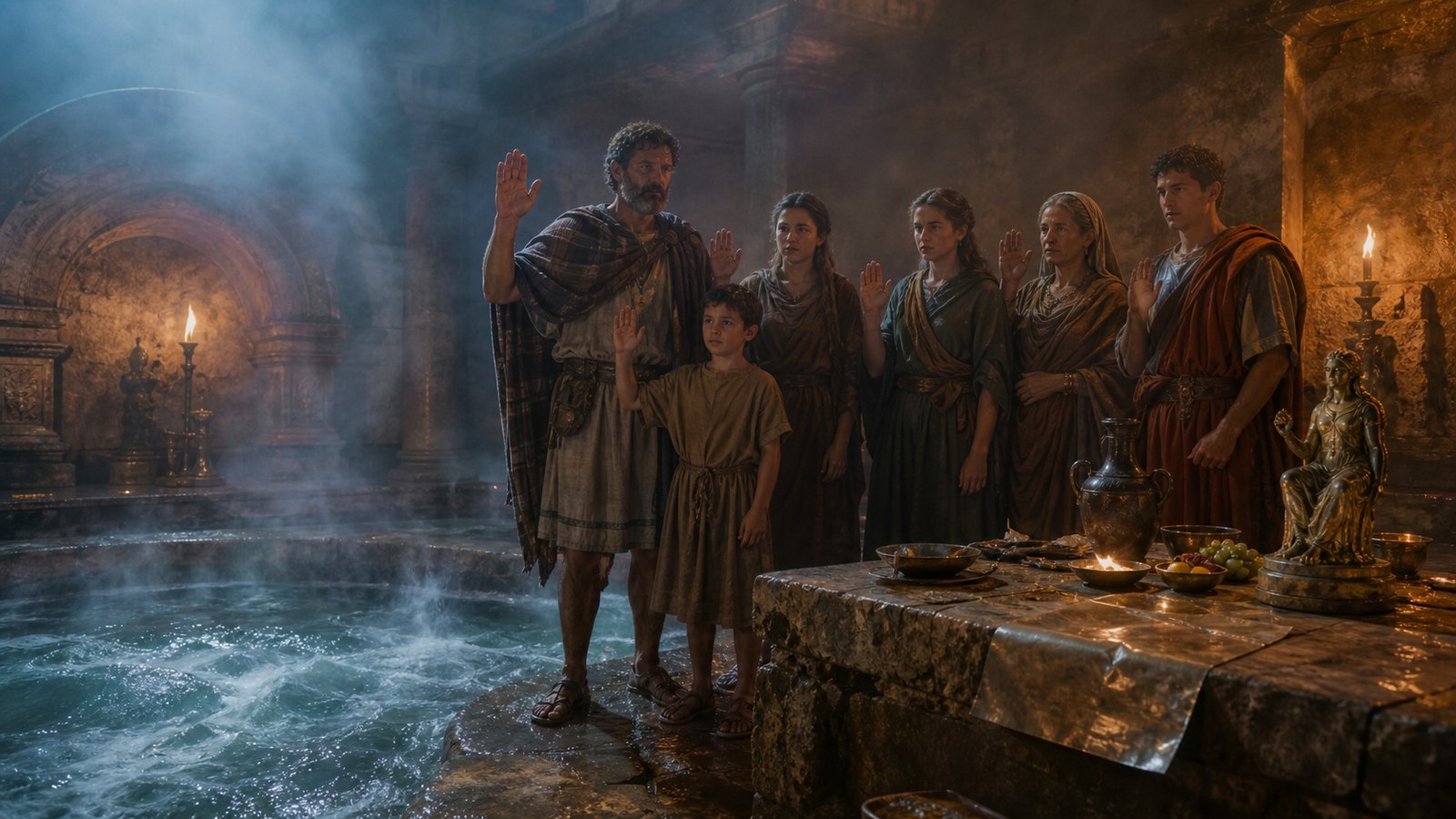
Because the tablet was not folded, its open surface may tempt us to imagine public display, but the archaeological record only securely places it in the spring deposit. We do not know how long it remained visible before deposition or who watched it enter the water.
Nor do we know whether anyone actually perjured himself, whether a dispute ended, or whether the family remained together. The text records a preventive or punitive condition, not a later verdict. Its power lay partly in making the consequence imaginable before any breach could be proved.
That restraint separates the object from a moral tale in which a liar is dramatically exposed. Tablet 94 offers no culprit. It offers a structure: six related people, one exact day, one sacred place and one bodily sanction. The spring held the tablet because the spring was already part of the oath.
The family’s unknown business disappeared, but their method survived. They made obligation durable by binding names to place and date, then giving enforcement to a goddess whose hot water rose in front of them. The compact alloy sheet did not tell Sulis what truth was. It told her whose blood should answer if the truth had been broken.
Sources
Roman Inscriptions of Britain, Bath Tablet 94; R. S. O. Tomlin, Tabellae Sulis.