
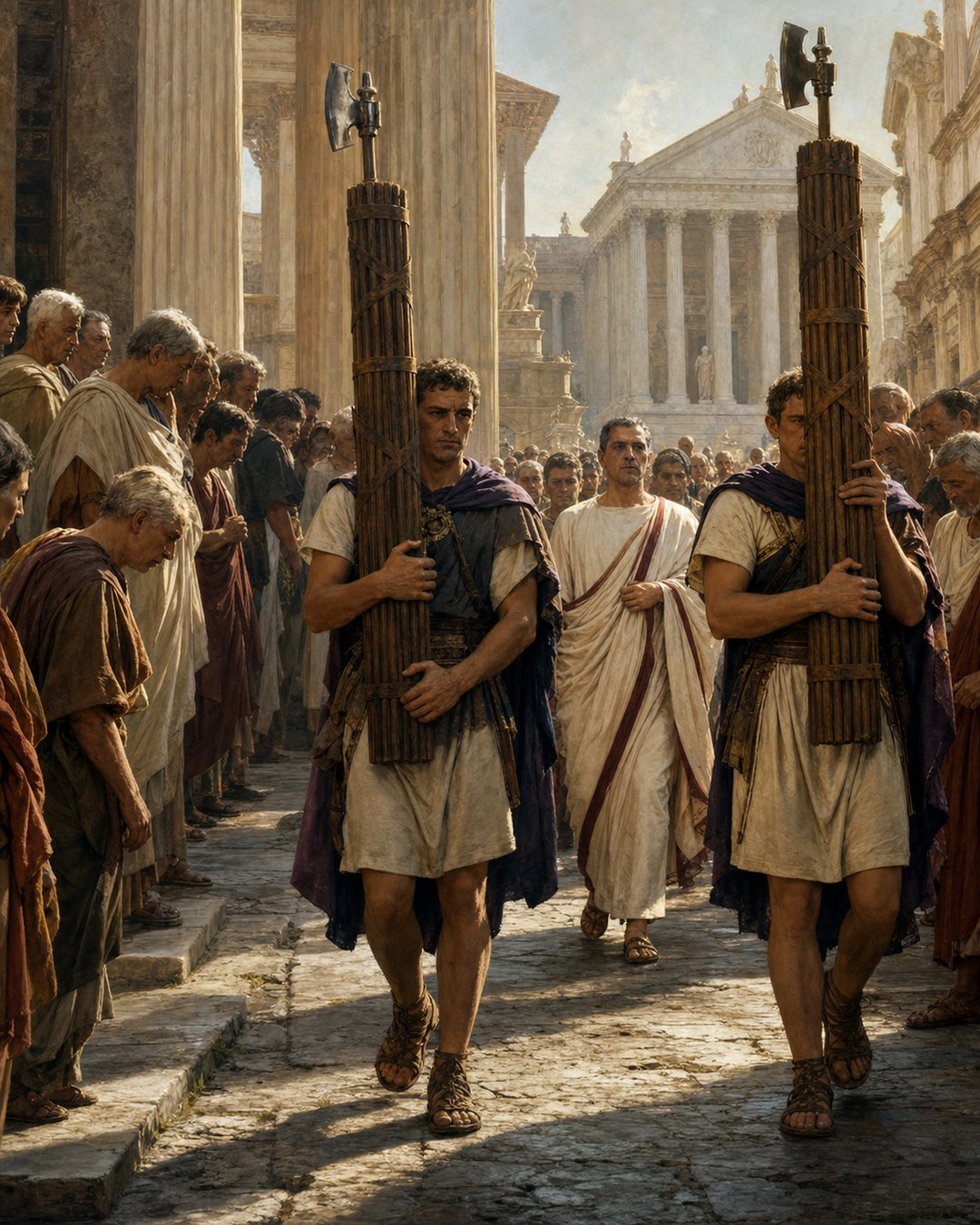
A Roman magistrate did not need to shout to announce authority. The street could see him coming. Lictors walked before him with the fasces, pushing a public message through the crowd: this person carried a kind of power ordinary citizens had to notice.
That is why lictors matter. They made Roman authority mobile, visible, and physical. Law did not remain inside documents or speeches. It moved through the Forum with attendants, rods, axes, space, and expectation.
Authority arrived before the man did
The first lesson of the lictors was timing. They came before the magistrate, so power reached the crowd a few steps early. People did not simply recognize a famous face; they recognized an arrangement of bodies and objects designed to make deference happen.
That arrangement turned a walk into a ceremony. The magistrate’s route through public space became a small performance of rank. Anyone nearby could see that the city had placed force, honor, and office around one person.
The fasces made coercion visible
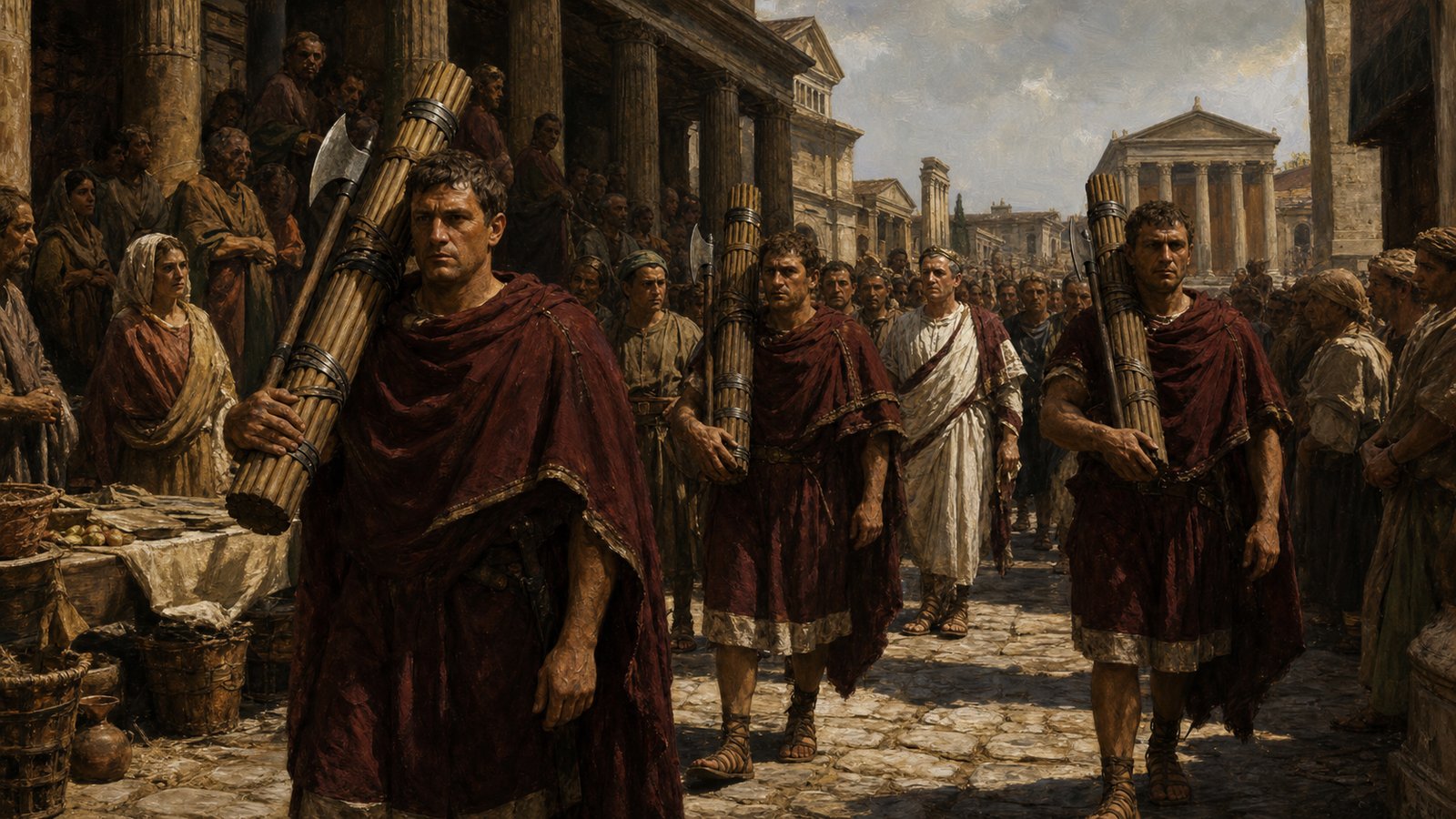
The fasces were bundles of rods, sometimes with axes depending on context and jurisdiction. They were simple objects, but their simplicity was the point. A bundle could be carried, recognized, counted, and feared. It translated abstract authority into something a citizen could see at eye level.
Rods suggested beating; axes suggested the ultimate edge of coercion beyond ordinary civic restraint. Even when legal limits mattered, the symbol reminded viewers that magistracy was not merely advice. It carried the possibility of compulsion.
Numbers turned rank into arithmetic
Roman offices did not all look the same. The number of lictors attached to an official helped mark rank and office. Twelve lictors around a consul, for example, made authority countable. Public hierarchy became visible through repeated human figures.
This mattered in a city obsessed with precedence. A crowd did not need a written chart of offices if it could see who was escorted, how many attendants moved ahead, and what symbols they carried. Politics had a visual grammar.
Public space became a courtroom before the hearing
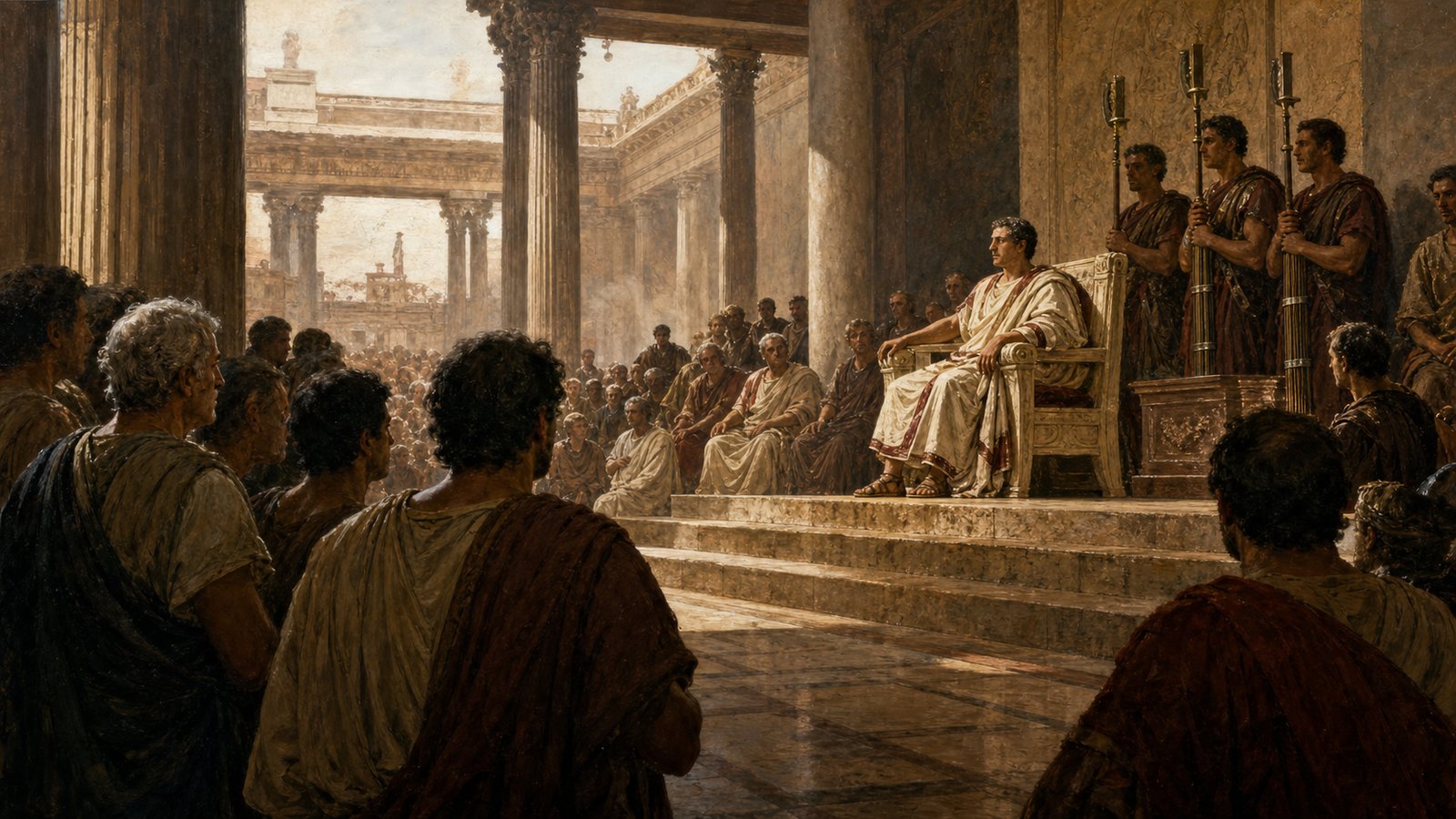
Lictors also changed the mood of spaces they entered. A portico, street, or approach to a tribunal could feel different when fasces appeared. The magistrate’s authority was staged before formal judgment began.
Imagine a citizen waiting under a basilica roof while attendants arrange space around a curule chair. The hearing has not started, yet the lesson has. The state is already present in posture, silence, distance, and the careful movement of people making room.
The symbol worked because everyone knew the script
The power of lictors depended on public recognition. If no one understood the fasces, the procession would have been a cluster of men carrying sticks. Roman civic culture taught people what the objects meant and how bodies should react when they appeared.
That shared script made authority efficient. The magistrate did not need to explain himself at every corner. The city had already trained its residents to read the sign.
Republican liberty still needed visible force
It is tempting to imagine republican Rome as a world suspicious of kings and therefore free from royal display. The lictors complicate that picture. Rome rejected monarchy, but it did not reject ceremonial power. It redistributed and regulated it through offices, terms, colleagues, customs, and symbols.
This is why lictors made Roman power walk through the street. They showed that liberty and coercion lived beside each other. The citizen saw office moving in public, impressive enough to command respect and bounded enough to remind everyone that Roman power was supposed to have rules.
The lictor was therefore not a decorative extra. He was a working part of political communication. He cleared paths, accompanied magistrates, maintained ceremony, and helped make the public body of the state visible before any formal act was performed.
That visibility could reassure as well as intimidate. A magistrate without attendants might look like a private man. A magistrate with lictors looked like an office made flesh. The crowd could identify where legal authority was concentrated in a noisy city.
The rods also linked punishment to order. Rome often explained authority through discipline: fathers, commanders, magistrates, and laws all occupied different places in a hierarchy of correction. The fasces compressed that hierarchy into an image ordinary people could remember.
At the same time, civic limits gave the symbol tension. The axe was not always displayed in the same way in the city as beyond it, and Roman political culture argued constantly about the proper reach of command. Symbols of force were powerful precisely because their use had to be watched.
The scene also had sound and texture. Sandals on paving stones, murmurs of clients, the scrape of rods, a sudden widening in the crowd, and the whiteness of a toga behind darker attendants all helped authority become sensory. The law had footsteps.
Lictors remind us that Roman politics was theatrical without being unreal. Ceremony did not hide power; it organized how people encountered it. The procession made hierarchy legible in a city where visibility could become legitimacy.
The attendants deserve attention because they stood between official power and ordinary bodies. They made room, carried warning, and announced that the man behind them did not appear as himself alone. He appeared as Rome had authorized him to appear.
The institution also shows how Rome used repetition to make government familiar. The same gestures, objects, and order of movement appeared often enough that people could understand authority quickly even in a crowded street. A magistrate did not have to invent his dignity each morning; the city supplied an inherited script.
That inherited script could be contested, but it still mattered. Romans argued fiercely over who deserved office, how command should be limited, and when coercion became tyranny. The lictors stood at the edge of those arguments. They were proof that the republic and later the empire needed public force, yet also proof that force had to be attached to recognizable office.
A crowd watching lictors pass therefore saw more than intimidation. It saw Rome trying to make power legible before it became arbitrary. The rods warned, the number ranked, the procession identified, and the public setting invited judgment. Roman authority walked through the street because it wanted to be obeyed, but also because it needed to be seen obeying its own forms.
The small human reactions made the system work. A seller shifted a basket, a client lowered his voice, a petitioner straightened his tunic, and a passer-by stepped away from the path. None of those gestures was spectacular. Together they renewed the lesson that office could rearrange public space for a few moments.
That lesson outlasted any single magistrate. Individual officeholders died, failed, or were replaced, but the visual language of attendants and fasces remained available to the next holder of command. The lictors made Roman power feel continuous because the street kept recognizing the same signs.
Sources & Further Reading
- Smith Dictionary, Lictor
- Smith Dictionary, Fasces
- Livy, History of Rome, Book 1
- Smith Dictionary, Sella Curulis
- Cambridge Core, Roman Republican politics
- Encyclopaedia Britannica, Fasces
- Smith Dictionary, Imperium
- Oxford Classical Dictionary, Roman magistrates