
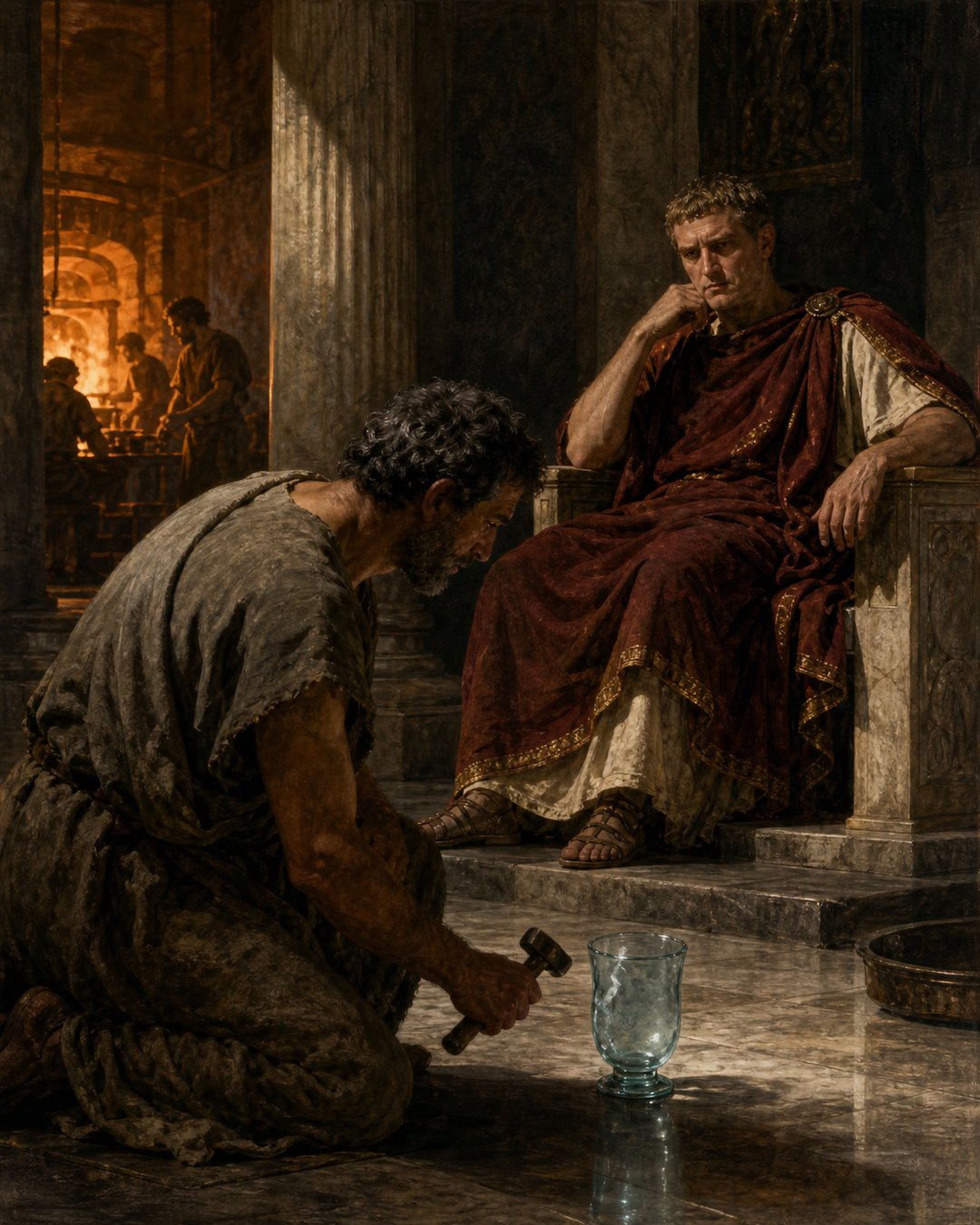
The glassworker arrived with a gift fit for an emperor: a drinking vessel no other workshop could make. Tiberius accepted it, admired it, and handed it back. Then the craftsman threw the cup onto the floor.
It did not shatter. The impact left a dent, according to Petronius, but the maker calmly took out a small hammer and restored the vessel’s shape. The demonstration had the rhythm of a perfect court performance—risk, surprise, proof—until Tiberius asked a question the inventor had not prepared to answer. Did anyone else know the method?
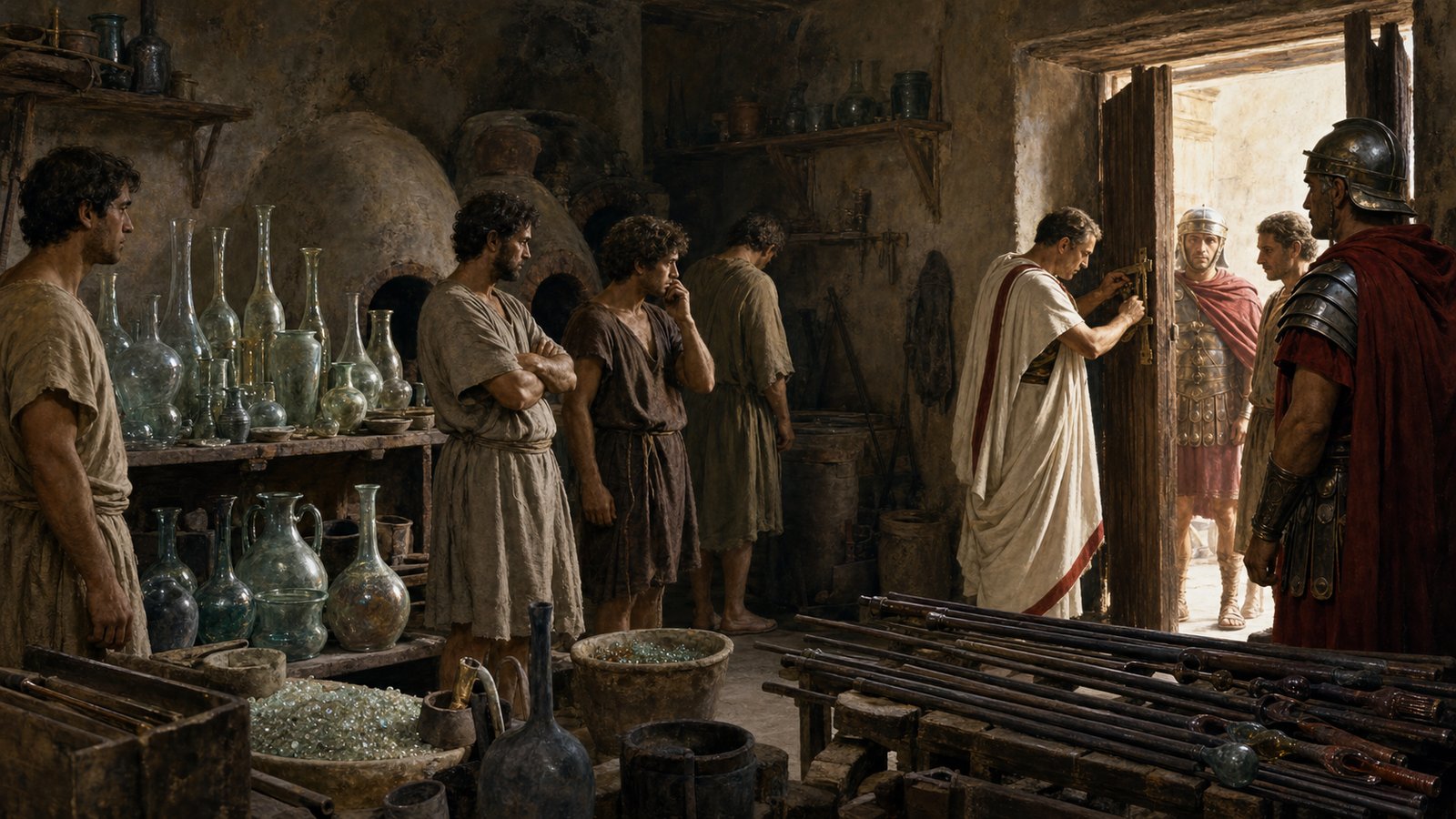
When the man said no, the emperor had the workshop destroyed. Petronius adds a sharp economic motive: if such glass became known, gold would be valued like dirt. Pliny the Elder heard that an entire workshop for flexible glass had been suppressed. Cassius Dio made the ending darker still, turning the inventor into an architect condemned after repairing a damaged glass vessel before Tiberius’s eyes.
A Court Gift Became a Destructive Test
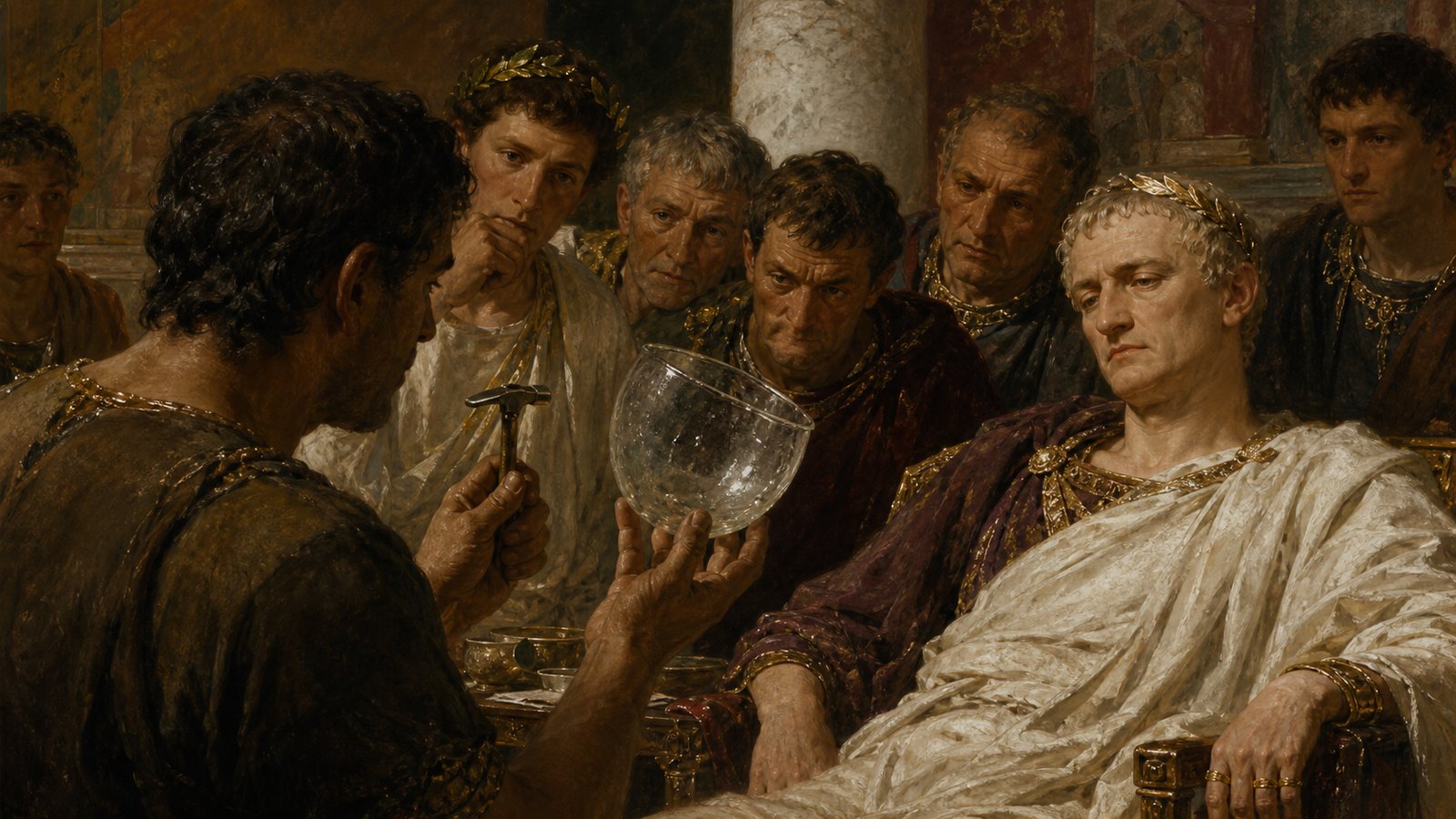
Petronius places the tale inside Trimalchio’s dinner, where expensive objects and unreliable learning compete for attention. Trimalchio praises glass because it does not smell, then complains that it is breakable. From there he tells his guests about a craftsman who presented Tiberius with a glass bowl. The setting matters: this is not a technical handbook but a boastful after-dinner story about value.
The maker first ensured that the emperor alone would receive credit for the marvel. Petronius says he made Tiberius return the vessel, then threw it down. The bowl was dented “as if it had been bronze,” not scattered into dangerous fragments. The craftsman used a hammer from his clothing to beat the damaged place back into form. Glass had behaved like worked metal.
That comparison would have startled anyone familiar with an ordinary Roman workshop. Molten glass could be blown, moulded, cut and polished, processes followed in the craft of Roman glassblowing. Once cooled, however, a vessel did not normally submit to a hammer. The anecdote makes its impossibility visible through a tool that should have destroyed the object.
Tiberius did not ask for the recipe. He asked whether anyone else knew it. The question shifted the scene from wonder to control. The artisan swore that the knowledge was his alone. In Petronius’s telling, that answer doomed both maker and workshop.
Three Authors Preserved Three Different Endings
Petronius provides the fullest theatrical sequence. The craftsman proves the bowl’s resilience, repairs it with a hammer, claims exclusive knowledge, and is beheaded. Tiberius orders the workshop destroyed so that the new material cannot make precious metals worthless. Every detail drives toward Trimalchio’s lesson about price.
Pliny is more cautious. In his survey of glass, he says that in Tiberius’s reign a process was devised for making glass flexible and that the worker’s shop was completely destroyed. He marks the story as report rather than witnessed fact. He does not need the thrown bowl, hidden hammer or execution to preserve the essential claim: a new kind of glass appeared and imperial power erased its means of production.
Cassius Dio changes the inventor’s identity and the path to the palace. His expert is an architect whom Tiberius first banished after a dangerous repair to a colonnade. Hoping to win recall, the man dropped a glass vessel before the emperor, showed that it was bruised rather than broken, and straightened it with his hands. Tiberius asked whether anyone else knew the technique; when the architect said no, he was put to death.
These accounts cannot be stacked as if they were independent minutes of one demonstration. The object is a bowl in one, simply a glass vessel in another. The repair uses a hammer in Petronius and the hands in Dio. The maker is a glassworker or an architect, and his fate ranges from a destroyed shop to execution. Their disagreement is evidence about storytelling, not permission to choose every vivid detail at once.
The Threat Was a Price, Not Merely a Cup
Petronius explains Tiberius’s violence with one line: gold would become as cheap as dirt. The line exaggerates, but its logic is precise. Luxury depends not only on beauty but on scarcity, durability and the social rules that let one material outrank another. A transparent vessel that survived impacts could challenge the distinction between fragile glass and durable metal.
Roman glass was already capable of astonishing effects. The Lycurgus Cup, examined in the vessel that changes colour with transmitted light, shows how difficult it can be to infer ancient technique from a finished object. Yet flexible glass is different: no securely identified surviving Roman vessel demonstrates the behaviour described by the texts.
The tale therefore works even if the material never existed. It imagines invention arriving without a guild, public grant or broad production network—one man, one secret, one workshop. That concentration makes suppression appear possible. Destroy the site and silence the maker, and a whole branch of craft disappears before it becomes an industry.
The economics are also court economics. The artisan approaches Tiberius directly and frames novelty as a personal gift. Success depends on imperial favour rather than an open market. When the gift threatens the hierarchy of materials instead of flattering the ruler, the same access that promised reward exposes the inventor to punishment.
The different repair gestures sharpen that problem. A hammer belongs to the visible language of manufacture: Petronius lets the craftsman prove that the bowl can take the treatment of metal. Dio removes the tool and has the architect straighten the bruised vessel with his hands, making the material seem stranger still. Neither author pauses to explain heat, ingredients or a second example. The demonstration proves exclusivity because the emperor accepts the maker’s answer, not because a workshop test establishes it.
Nor do the authors describe customers already using such vessels. The story begins at the palace before any market for the invention exists. That sequence supports the economic fear built into Petronius’s ending: value might change if production spreads, but suppression occurs while knowledge can still be imagined as one person’s possession. The cup is less a product than a decision placed before Tiberius.
An Impossible Material Made Imperial Power Legible
Modern readers often turn the story into a hunt for a lost recipe. That question is tempting, but the ancient witnesses offer no ingredients, furnace temperatures or repeatable procedure. Their interest lies elsewhere. Pliny records a process and its suppression; Petronius turns the invention into a joke about luxury; Dio makes it a lesson in the insecurity of expertise before a suspicious emperor.
Tiberius’s role is equally literary. The emperor does not test the vessel repeatedly, summon other craftsmen or commission production. He identifies a monopoly and destroys it. The speed of that decision makes authority as extraordinary as the glass. A cup resists the floor; the emperor makes an invention vanish.
The damaged-and-restored vessel supplies the tale’s unforgettable physical detail. A dent can be seen, touched and corrected. It lets listeners imagine brittleness suspended for a moment while a hammer taps a translucent wall back into place. The workshop’s destruction then reverses that restoration: the object survives, but the knowledge behind it does not.
Flexible glass remains unverified as a Roman material, and the contradictions among the sources should remain visible. But the story is not empty. It preserves Roman anxieties about secret knowledge, unstable value and access to the ruler. The craftsmen thought he had brought Tiberius an indestructible cup. The authors remembered an emperor deciding that the most dangerous part was not the vessel’s strength, but the possibility that someone else might learn how to make it.
Sources
Petronius, Satyricon 51.
Pliny the Elder, Natural History 36.195.
Cassius Dio, Roman History 57.21.