
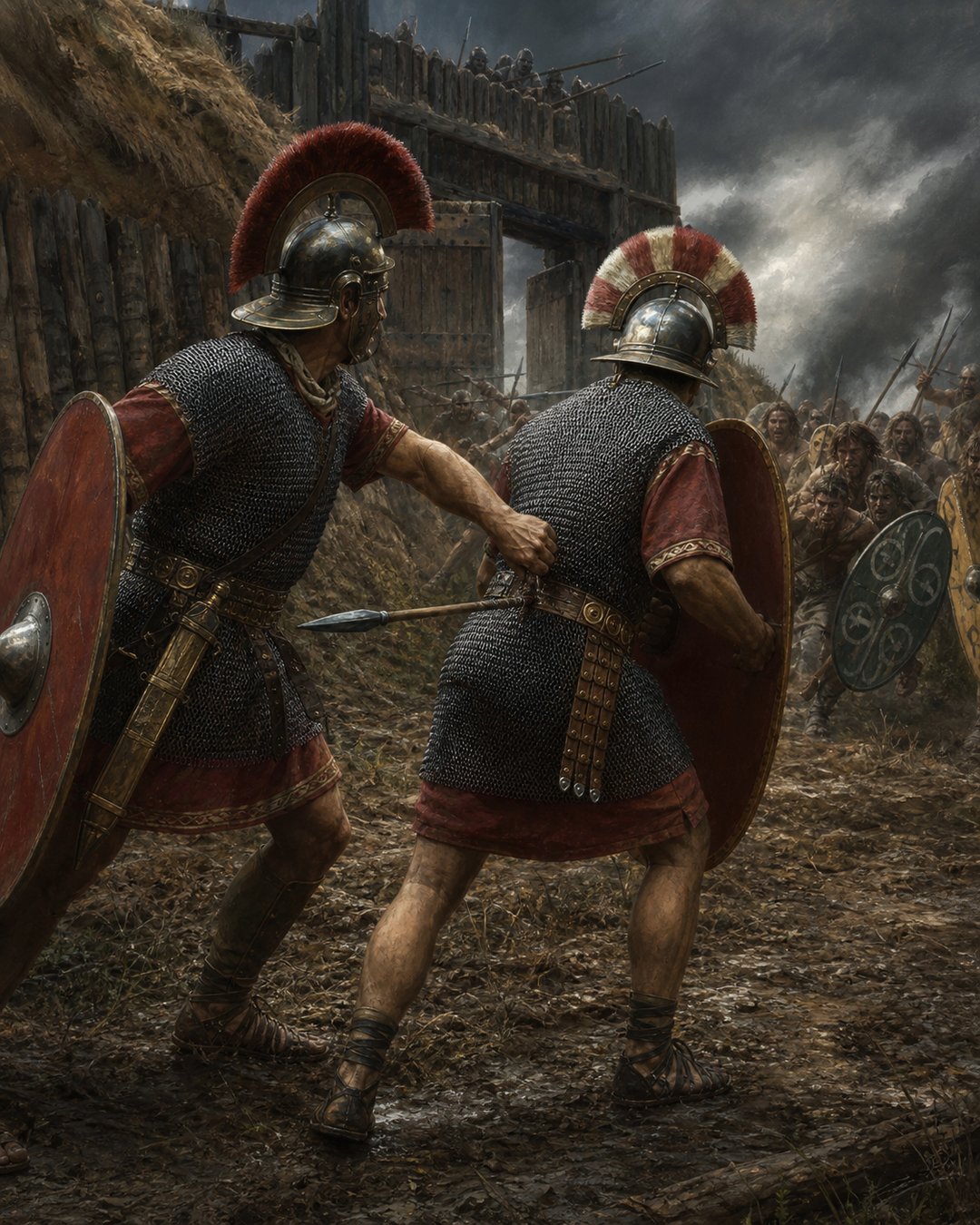
Titus Pullo shouted his challenge where the whole camp could hear it. “Why hesitate, Vorenus?” Caesar has him ask. If Lucius Vorenus wanted to prove his courage, the day had arrived. Pullo then stepped beyond the fortifications and charged the densest part of the Nervian line.
The two centurions were rivals for promotion. Each year, Caesar says, they fought over which man should be preferred. Their argument belonged to the hierarchy of the legion, but the enemy assault gave it an audience, a deadline and lethal consequences. Pullo’s challenge converted professional competition into a public performance beyond the rampart.
What followed refused to produce a clean winner. Pullo wounded one opponent, then found his sword arm trapped when a spear pierced his belt. Vorenus came to his rescue, killed one attacker and drove the others back. Then Vorenus stumbled into a hollow and was surrounded. Pullo returned the rescue. Both men reached the camp alive, each having been helpless and indispensable in turn.
Promotion Made Courage a Contest Before the Enemy Arrived
Caesar introduces Pullo and Vorenus as centurions approaching the first ranks. They were not anonymous soldiers suddenly made famous by one charge. They were experienced officers competing near the top of the centurionate, and neither would yield. Caesar says their advancement was disputed year after year with intense rivalry.
Rank made courage visible in two directions. A centurion had to control soldiers under pressure, but his own performance was also watched by commanders and peers. The dispute between Pullo and Vorenus therefore had institutional stakes: preference meant status, authority and a stronger claim to future advancement.
Their story occurs during the attack on the winter camp commanded by Quintus Cicero, Caesar’s legate and the brother of the orator. The Nervii had approached after the destruction of Sabinus and Cotta’s force, hoping to repeat the shock against another isolated Roman position. Cicero’s camp was surrounded before reliable news could reach Caesar.
Fortification shaped everything that happened. The Roman army’s habit of building defended camps is examined in the repeated labour behind a marching camp. Here the rampart protected the unit but also marked a boundary between disciplined defence and Pullo’s chosen risk. Crossing it without waiting for an order made the rivalry impossible to ignore.
Pullo Turned a Taunt into an Exposed Charge
Caesar gives Pullo direct speech. He calls Vorenus by name, asks what opportunity for proving courage he expects, and declares that the day will decide their disputes. The words make the sortie personal before it becomes tactical. Pullo does not describe an objective, request support or claim that the enemy line can be broken. He promises a verdict.
He goes outside the fortification and heads toward the part of the enemy that appears thickest. The choice amplifies the challenge. A cautious skirmish would not distinguish him from the defenders on the wall; the densest group supplies the most witnesses and the greatest danger.
Vorenus follows because remaining inside would concede the comparison. Caesar says concern for reputation prevents any delay. Rivalry thus moves both officers into a space where normal protection is behind them. The same social pressure that can drive exceptional effort can also pull leaders away from the position they are meant to hold.
Caesar never says that Cicero ordered the sortie. The initiative belongs to Pullo’s challenge and Vorenus’s fear of losing standing. That distinction keeps the scene focused on competitive honour rather than a planned counterattack: the two officers choose the danger that the rampart was built to contain.
Pullo throws his spear and strikes one opponent advancing from the crowd. The enemy cover the fallen man with their shields and direct their missiles at Pullo. A spear penetrates his belt. His scabbard is pushed aside, and his right hand cannot draw the sword. The officer who chose close combat suddenly cannot reach the weapon needed to survive it.
One Rescue Reversed the Score, Then Reversed Again
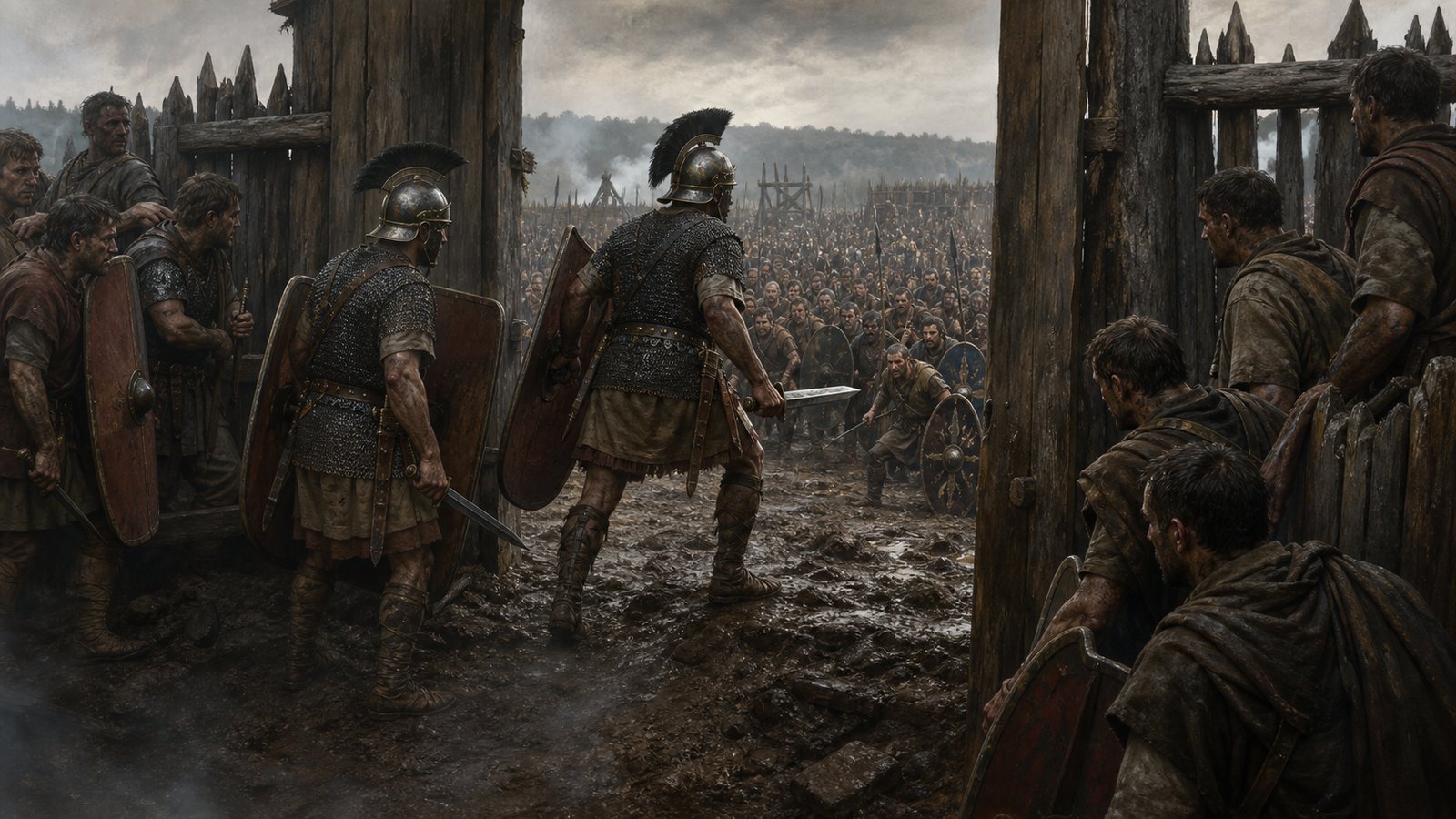
The Nervii press around Pullo when Vorenus arrives. Their attention shifts to the second centurion, whose sword is free. Vorenus kills one opponent and forces the others to give ground. In the simplest heroic version, this would settle the rivalry: Pullo created the danger, while Vorenus saved him.
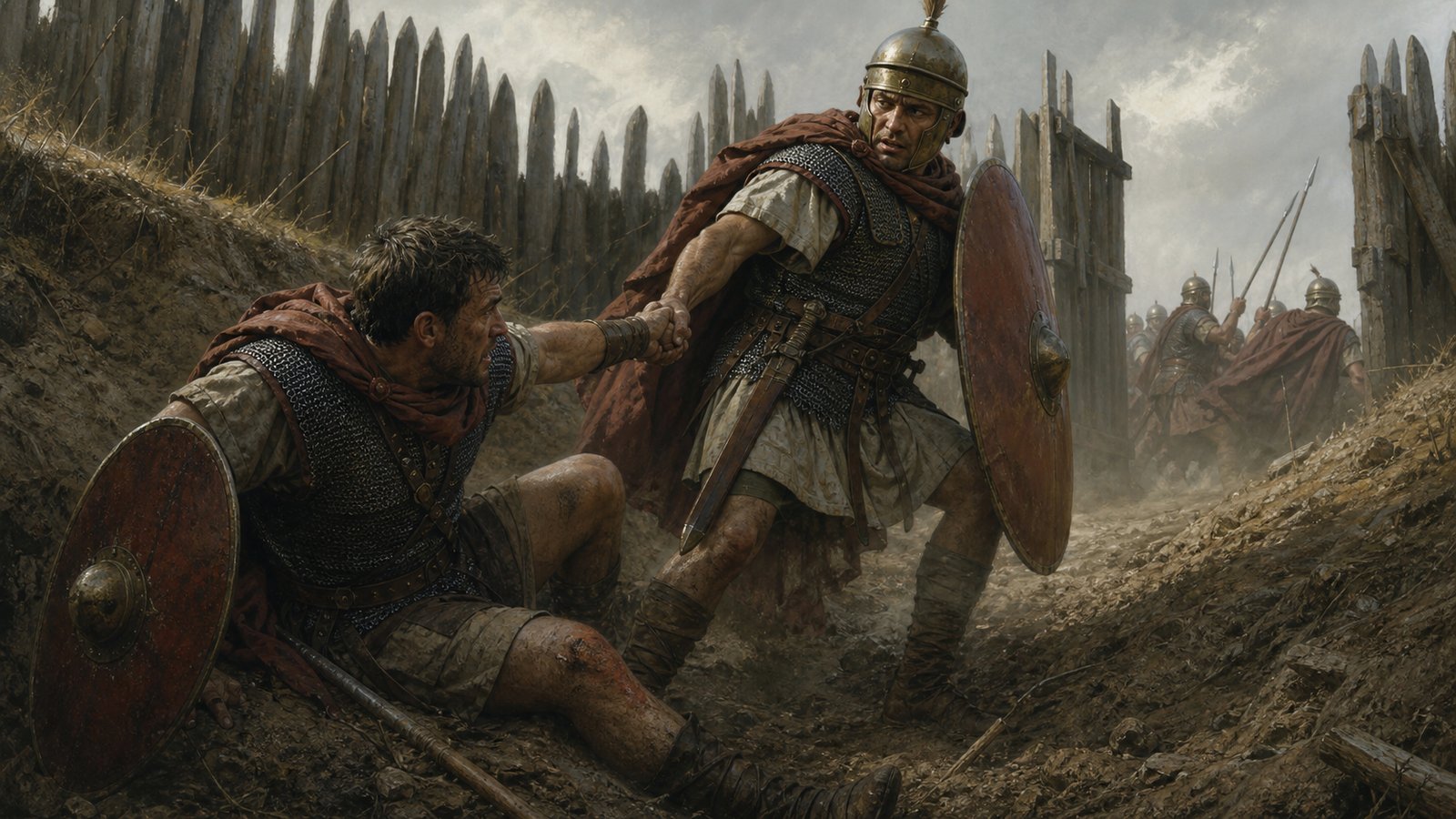
Caesar immediately overturns that result. Vorenus advances too eagerly, encounters uneven ground and falls into a hollow. The rescuer becomes the surrounded man. Pullo, though moments earlier disabled by the spear in his belt, now returns the aid he received.
The pair kill several opponents and fight their way back within the fortifications to great acclaim. Caesar’s choreography is almost symmetrical. Pullo goes out first and is trapped; Vorenus saves him and is trapped; Pullo saves Vorenus; both return. Courage belongs to each man, error touches each man, and survival depends on reciprocity.
That balance explains Caesar’s final judgment. Fortune, he says, dealt with them in their rivalry so that each helped and saved the other, and it could not be decided which should be preferred in courage. The battlefield delivered a verdict, but not the one Pullo demanded. Their equality became more memorable than either man’s claim to superiority.
Caesar Made Two Centurions Carry a Whole Siege
The episode occupies a small space in the account of a much larger emergency. Cicero’s soldiers were building towers and strengthening the camp while wounded men remained at their posts. Messengers trying to reach Caesar faced capture. The legion’s condition was defined by pressure, incomplete information and exhaustion.
Unit labels alone can hide how many soldiers are detached, absent or unable to fight, a problem explored in the scattered reality behind one Roman cohort. Caesar instead gives readers two names. Pullo and Vorenus make the camp’s aggressive confidence tangible even while its defenders are encircled.
His narrative is not a neutral casualty report. Direct speech, the spear through the belt, the displaced scabbard and the fall into a hollow make the scene easy to visualize. Caesar selects details that let courage survive tactical recklessness. The officers leave the rampart for a private contest, yet their mutual rescue returns them to the collective defence as celebrated examples.
That does not require dismissing the event as invented. It requires reading the form in which Caesar chose to preserve it. He knew the names, their rivalry and their rank. He also knew how to shape one sortie into a compact lesson about competitive honour under Roman command.
The Rivalry Ended Without Producing a Loser
Later popular retellings often turn Pullo and Vorenus into inseparable comrades with long shared biographies. Caesar gives nothing of the kind. In this passage they are promotion rivals, and the text does not supply their families, origins or later friendship. Their bond is created in action, not explained through invented background.
The restraint matters because the incident’s force comes from its narrowness. One taunt starts the movement. One spear traps a sword arm. One hollow brings down the rescuer. Each reversal can be traced, and none permits a solitary hero to own the outcome.
When they climbed back over the defences, Pullo and Vorenus had not resolved who deserved promotion. They had proved something less convenient for a rivalry and more valuable for Caesar’s story: neither man’s courage worked alone. The competition pushed them outside; reciprocal obligation brought them back.
Caesar ends with Fortune refusing to choose between them. That ending protects both reputations while transforming a dangerous contest into a legionary exemplum. The men sought a ranking. The narrative gave them equality—two centurions remembered not because one defeated the other, but because each reached the moment when only his rival could save him.
Sources
Julius Caesar, Gallic War 5.44.
Dickinson College Commentaries, Caesar, Gallic War 5.44.