
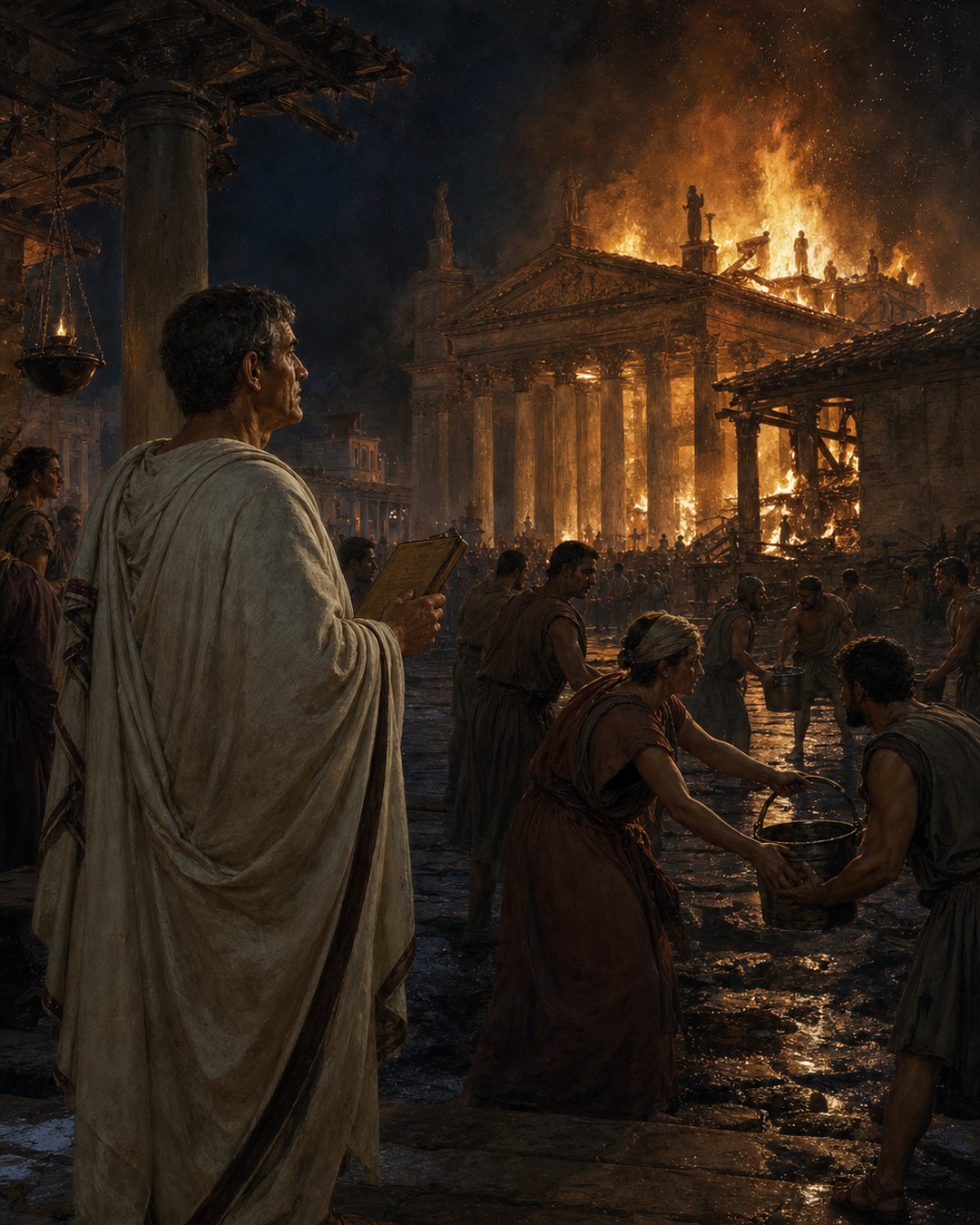
The road should have stopped the flames. It separated Nicomedia’s almshouse from the temple of Isis, yet both public buildings burned. Private houses went with them. Pliny the Younger, governing Bithynia for Trajan, listed the failures with the severity of someone writing after a preventable disaster: violent wind, citizens who stood watching, and a city without a public engine, bucket or any other appliance for mastering fire.
His remedy sounded modest. Form a company of about 150 men. Admit only genuine firefighters. Keep the charter narrow. Watch the body closely enough that it could not become something else. Pliny had already ordered equipment; the new company would supply trained hands to use it.
Trajan refused. The emperor did not deny the destruction or argue that 150 was too expensive. His objection was political. Bithynian cities, he warned, were prey to factions. Whatever respectable name an association received, it could soon become a dangerous secret society. Nicomedia would get apparatus, but not the organization Pliny wanted.
Wind, Spectators and Empty Hooks Let the Fire Cross a Road
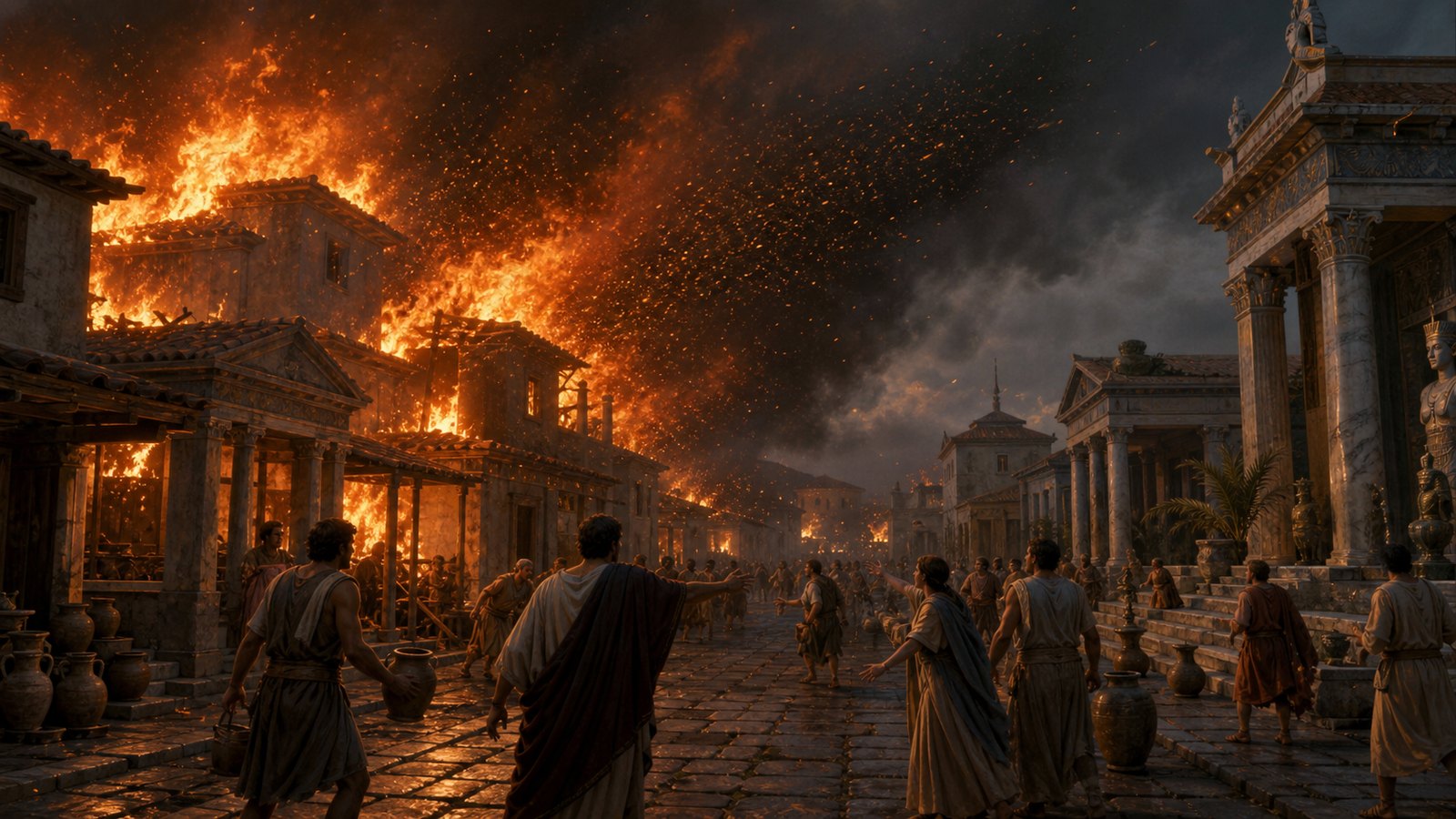
Pliny’s report begins with physical spread. A destructive fire broke out in Nicomedia and consumed a number of private homes. It also reached the almshouse and the temple of Isis even though a road lay between those two structures. The detail turns urban geography into evidence. Open space existed, but it did not become an effective firebreak.
The governor named wind first. In a dense ancient city, moving air could throw heat and embers beyond the nearest wall. Roof timber, shutters, doors, shop fittings and stored goods supplied fuel even when major structures used masonry. A road reduced continuity; it could not replace a coordinated response.
Pliny then blamed the inhabitants. By common account, he wrote, they remained inactive and watched. The accusation may also protect the governor, who was explaining failure upward to the emperor. Yet it records the most unsettling scene in the exchange: a crowd present at the disaster but not transformed into a working force.
There was little for that crowd to take up. Pliny says Nicomedia lacked a single public fire engine or bucket and had no appliance for controlling fire. His wording is categorical. The city had buildings worth saving, streets capable of separating them, and people close enough to watch, but no prepared chain joining water, tools and labour.
A surviving firehouse at Aquincum tells a different material story. Its collapse preserved a water organ, explored in the instrument recovered from a firefighters’ headquarters. Nicomedia’s evidence is textual and negative: Pliny found no civic apparatus at all when the emergency exposed the gap.
Pliny Tried to Turn 150 Men into a Controlled Tool
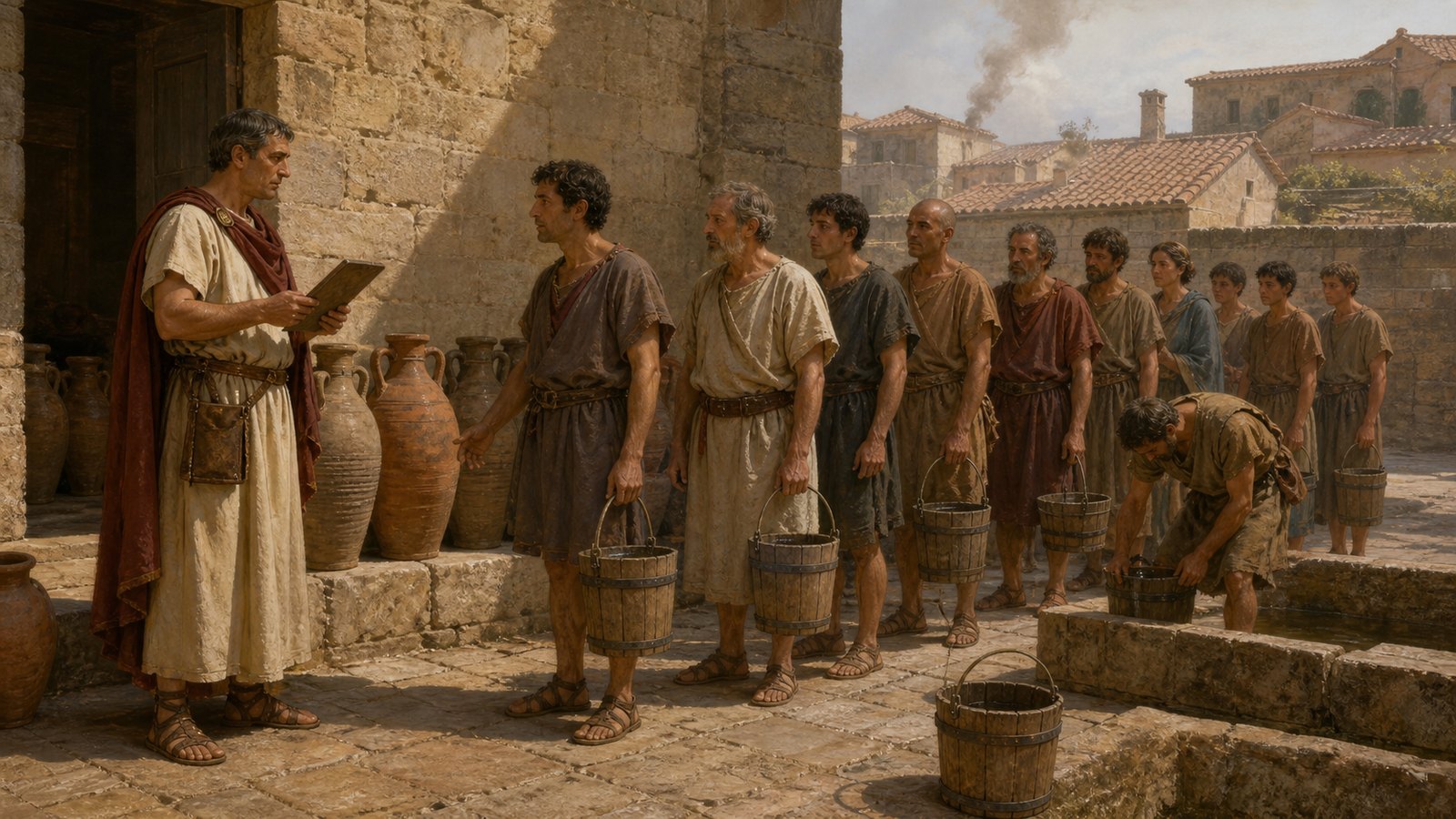
Equipment was the first repair, and Pliny said he had already given orders for it. He nevertheless understood that buckets do not pass themselves and pumps do not decide where to stand. His proposed company joined people to apparatus before the next alarm.
The number—about 150—made the plan sound governable. This was not a request for an unlimited civic movement. Pliny promised that only genuine firefighters would be admitted. He would prevent the guild from misusing its charter, and he believed a group of that size could be watched without difficulty.
Those assurances reveal what he expected Trajan to fear. Membership rules, a legal charter and official supervision were not incidental details; they were the political casing around the practical machine. Pliny presented the company almost as another item of equipment: limited, specialized and kept for one function.
The proposal also answered the idleness described in the first letter. An improvised crowd had watched because no one had assigned roles in advance. A standing company would create recognized members, repeated practice and an expectation of movement. In modern terms it resembles emergency preparedness, but Pliny’s language belongs to Roman government: authorized persons operating within a bounded corporate identity.
Firefighting itself required collective timing. Water had to move from a source, containers had to circulate, access had to be cleared, and nearby property holders had to decide what could be sacrificed to protect what remained. A trained group could make those actions familiar before smoke made instruction difficult. Pliny’s 150 were valuable precisely because they would know one another and act together.
Trajan Saw a Faction Where Pliny Saw a Brigade
Trajan acknowledged that Pliny had models in mind: fire companies existed elsewhere. The refusal was therefore not based on an inability to imagine the institution. It was based on place. Bithynia, and cities such as Nicomedia in particular, had a history of factional division in the emperor’s view.
The emperor’s warning attacked naming as a weak safeguard. Call the body what one wished and provide the best reason for organization; it could still degenerate into a secret society. The very qualities that made a brigade useful—membership, discipline, repeated assembly and mutual loyalty—also made it politically legible as a potential faction.
Roman authorities often negotiated uneasily with associations. A charter could state one purpose, but officials worried about what members might discuss, whom they might support and how quickly a professional bond could become a voting bloc or street force. Trajan did not accuse Pliny’s proposed firefighters of an existing conspiracy. He rejected the conditions from which one might grow.
The decision exposes two measures of danger. Fire was immediate, visible and destructive. An association was prospective and political. Nicomedia had just lost houses and public buildings, yet the emperor treated the second risk as strong enough to limit the response to the first.
That hierarchy resembles the caution shown in Roman military discipline, where reliable collective action could be both essential and tightly controlled. The story of a camp punished through one formal signal concerns soldiers rather than townspeople, but both cases show Roman command attending to how a group becomes one acting body.
The Approved Plan Had Tools but No Permanent Team
Trajan did not answer the fire with passivity. He instructed Pliny to provide apparatus. Property holders should be encouraged to use it, and when necessity arose, the crowd that gathered could be pressed into service. Each element addressed a failure in Pliny’s report: absent equipment, inactive residents and unmanaged spectators.
The alternative was deliberately temporary. Owners had a direct interest in defending property. Bystanders could be compelled at the moment of danger. Once the fire ended, the emergency workforce dissolved. It gained no charter, regular membership or continuing identity.
That arrangement saved political control at the cost of readiness. It assumed equipment would remain accessible and usable, that owners would cooperate, and that officials could turn a frightened crowd into a bucket line while flames and wind were already moving. Pliny had asked to solve coordination before the next fire; Trajan preferred to create it only during one.
The exchange does not tell us how the next Nicomedian fire was fought. It does preserve the decision point with unusual clarity. One letter describes a disaster and proposes an institution. The reply accepts the material diagnosis and rejects the social cure.
Nicomedia’s missing buckets were easy to classify as a defect. The missing brigade was harder because filling that absence would create a durable network of 150 men. Pliny believed screening and oversight could hold the network to its stated purpose. Trajan believed the province’s factional habits would eventually defeat the charter.
The road between the almshouse and the temple had failed as a firebreak. Trajan’s political firebreak was different: apparatus without association, compelled labour without corporate memory. The emperor was willing to assemble a crowd when buildings burned. He was not willing to let that crowd learn how to remain assembled afterward.
Sources
Pliny the Younger, Letters 10.33–34.
Trajan, reply to Pliny on the Nicomedia fire company.