
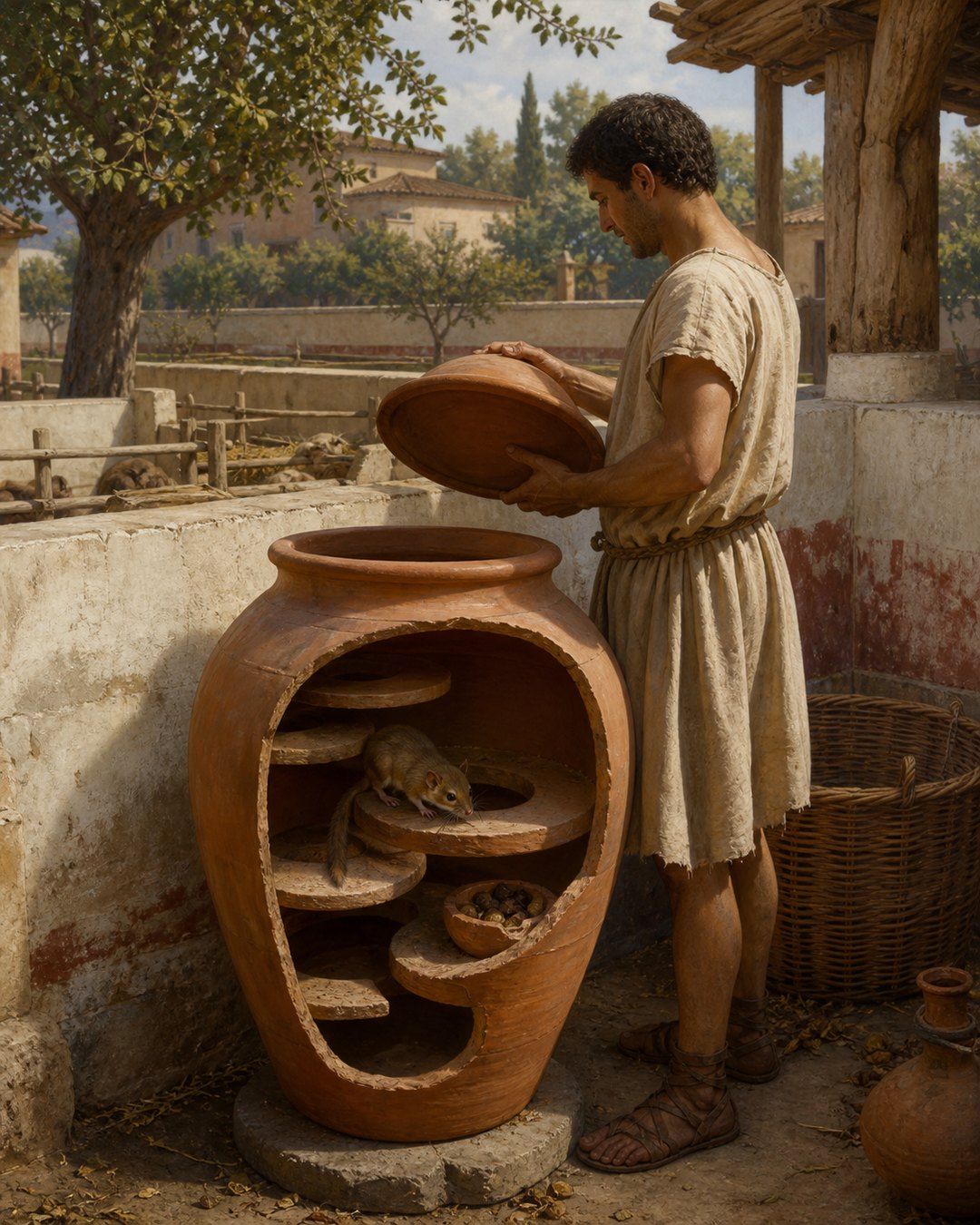
The jar was built to keep an animal moving in darkness. Its walls carried channels. A hollow held acorns, walnuts or chestnuts. Once the lid went on, the dormouse climbed, ate and accumulated fat inside a container designed for that single purpose.
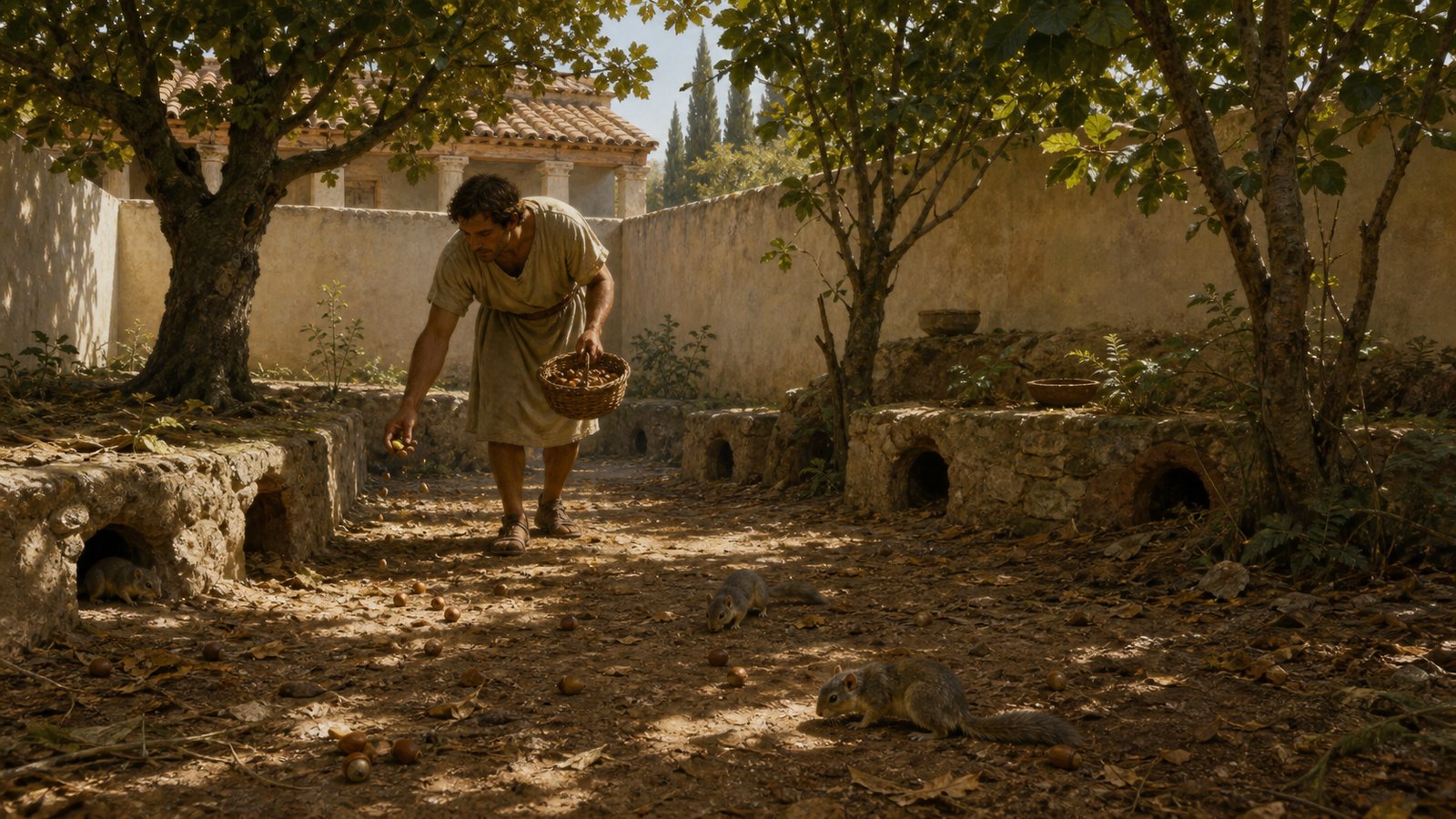
Varro’s account of villa husbandry does not begin at the dining couch. It begins outdoors, behind a wall faced with smooth stone or plaster so dormice cannot crawl away. Small nut-bearing trees grow inside. Roomy caves give the animals places to produce young. Water remains limited because, Varro says, they prefer dry ground.
This sequence matters. The famous clay dormouse jar was not a magical kitchen gadget that created a delicacy from nothing. It was the last chamber in a larger system of breeding, feeding and selection. Roman luxury reached the table through walls, trees, potters and patient control of an animal’s environment.
A Smooth Wall Turned Wild Movement into Farm Space
Varro places dormice among the smaller animals kept around the villa. His larger discussion divides rural production between herds in the fields and creatures managed near the farmstead: birds, fish, bees, snails, dormice and game. These activities could produce striking returns, especially when banquets or public celebrations pushed demand upward.
The dormouse enclosure depended on surface. It was surrounded by a wall, not by the water barrier Varro recommends for snails. The inner face had to be covered completely with smooth stone or plaster. Rough masonry offers claws, gaps and edges; a finished surface removes the route upward. The enclosure worked by denying traction.
That small specification is a piece of Roman process knowledge. Builders did not need to make the wall impossibly high if they could alter how an animal met it. Plaster was not decoration here. It was containment technology applied over the whole interior because one unfinished patch could become an exit.
Varro’s villas often blur architecture and husbandry. A wall creates a managed ecosystem, just as the repeated geometry of Pompeii’s animal-powered mills turned movement into flour. In the dormouse enclosure, the intended output was not mechanical force but living stock that could reproduce and later be fattened.
The animal remained active within the boundary. This was not yet the final jar. There was enough room for trees, shelter and breeding. Control came first from shaping a larger habitat rather than forcing every dormouse into immediate confinement.
Nut Trees and Breeding Caves Made the Enclosure Productive
Varro calls for small nut-bearing trees inside the wall. When those trees were not producing, the keeper should throw in acorns and chestnuts so the dormice could gorge themselves. Seasonal failure was anticipated. The system included both living feed sources and stored substitutes.
The wording is practical rather than culinary. Acorns and chestnuts supplied concentrated food before the animals reached individual fattening jars. The keeper did not depend on whatever the enclosure happened to produce. Feed could cross the wall when the trees could not meet demand.
Roomy caves served a different stage of production. Varro says they should be built so the dormice could bring forth their young. An enclosure designed only to hold captured animals would eventually empty. Breeding space turned it into a renewable stock.
Water was deliberately scarce. Varro says dormice use little and prefer a dry place. This distinguishes their needs from the misted, water-bounded snail yard described immediately before them. Roman villa husbandry did not treat all small edible creatures as one category. Each enclosure manipulated a different combination of surface, moisture, food and shelter.
The contrast also makes the dormouse system easier to see as work. A keeper monitored trees, supplied nuts out of season, maintained smooth plaster, protected breeding caves and avoided excess damp. Luxury at the end of the chain did not erase the repetitive maintenance at its beginning.
Potters Built a Second Habitat Small Enough to Carry
Selected dormice moved from the walled enclosure into jars. Varro notes that many people kept these vessels even inside the villa. The shift brought the final fattening stage closer to the household and made each animal individually manageable.
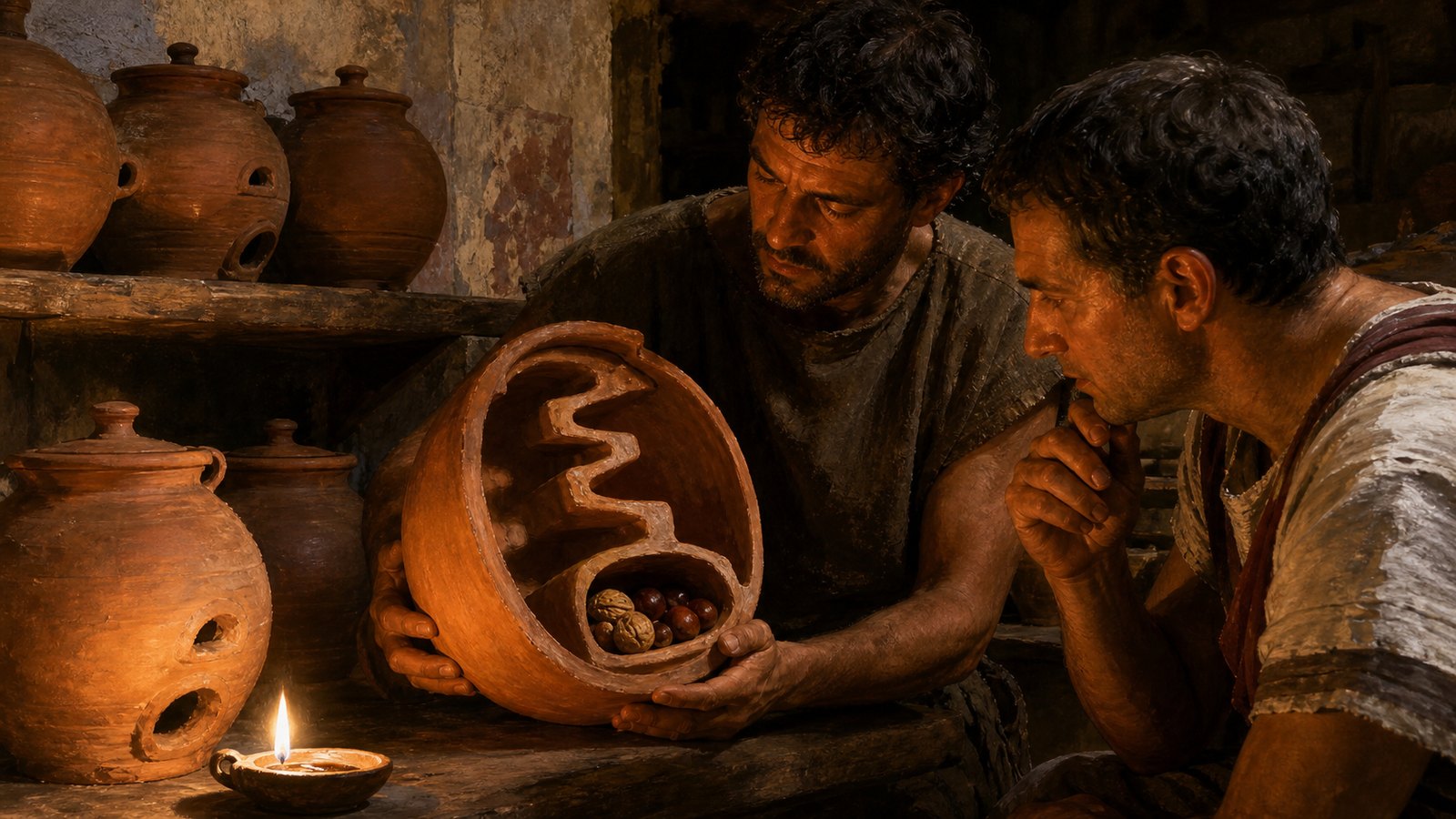
These were not ordinary storage pots. Potters made them in a very different form from other jars. Channels ran along the sides, giving the confined dormouse surfaces to traverse. A hollow held food. Archaeologists use the modern label glirarium for such specialized containers, but Varro’s description is enough to reconstruct their logic without pretending every perforated pot served the same purpose.
The lid changed light and movement. Once the jar was covered, the animal grew fat in darkness. Acorns, walnuts or chestnuts remained available in the food hollow. The pottery concentrated the conditions of the larger enclosure into a portable micro-habitat: climbing surface, feed, confinement and shade.
It would be easy to describe the grooves as exercise equipment in the modern sense, but Varro does not explain their purpose so neatly. He tells us they were made along the sides. We can safely say they shaped the interior and gave the animal something other than a smooth vertical wall; claims about a precise physiological training regime would outrun the text.
The six-part silver implement explored in Rome’s folding dining utensil compresses several table functions into one object. The dormouse jar compressed a husbandry stage instead. Both required specialist metal or ceramic work, but one travelled with a diner while the other held the future meal alive.
The Delicacy Began as a Market Calculation
Varro discusses dormice in a book concerned with revenue as well as technique. Creatures raised near the villa were expected to reach the market. Elsewhere in the same discussion, speakers marvel at income from birds and game, and they connect exceptional prices to public banquets, triumphs and club dinners.
That context changes the scale of the jar. It was not merely an eccentric object owned by one gourmand. Specialized pottery implies repeated demand: potters knew the form, villa managers knew the feeding sequence, and buyers valued the finished animal enough to justify the labour.
The process also divided risk. The outdoor enclosure supported reproduction and bulk feeding. Individual jars allowed selected animals to be finished without redesigning the whole habitat. If the nut trees failed, stored acorns and chestnuts crossed the gap. If a dormouse could climb rough masonry, plaster removed the grip.
Varro’s instructions are vivid because they remain close to materials. Smooth stone under a paw, dry caves, hard nuts striking the ground, grooves rising along clay walls, a lid shutting out light: each detail belongs to a controllable step. None requires imagining an extravagant banquet scene that the source does not describe.
The animals did eventually enter Roman food culture, but the farm writer’s attention rests on production. His dormice are classified with snails, game, birds and fish because villas could transform bounded environments into saleable abundance. The delicacy was already an economic object before a cook touched it.
A dark jar therefore represents the end of a long design argument. Keep the animals from escaping. Give them places to breed. Feed them when trees are bare. Match moisture to their habits. Then move selected dormice into containers whose form only a potter could supply.
Roman diners may have seen a small roasted animal. Varro saw the infrastructure behind it. The smooth wall, roomy cave and grooved jar were not curiosities around the meal; they were the reason the meal could exist in a predictable market at all.
Sources
Varro, On Agriculture 3.2, 3.12 and 3.15.
Bill Thayer’s LacusCurtius edition of Varro’s De Re Rustica, Book III.