
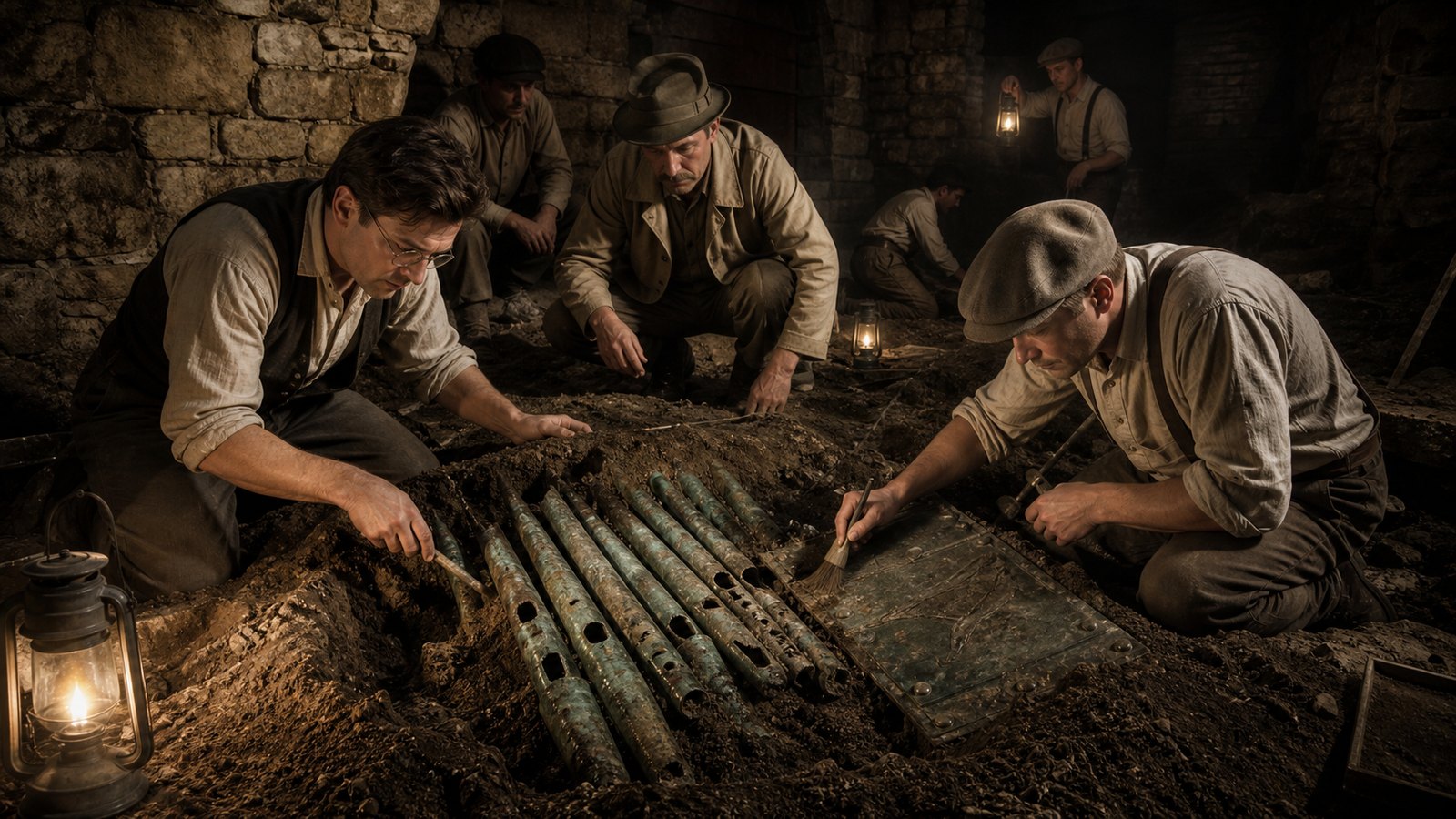
In 1931, excavators working at Aquincum found rows of corroded pipes and metal fittings in the ruins of a Roman building. The pieces did not look like a complete instrument. Collapse, fire and centuries underground had flattened the wooden frame and scattered its mechanism. An inscription made the wreck intelligible.
The object had been a water organ donated in 228 CE by Gaius Julius Viatorinus to the local association of centonarii, a collegium linked with firefighting. Its home was not an imperial palace in Rome but the headquarters of an urban group on the Danube frontier, beneath part of modern Budapest.
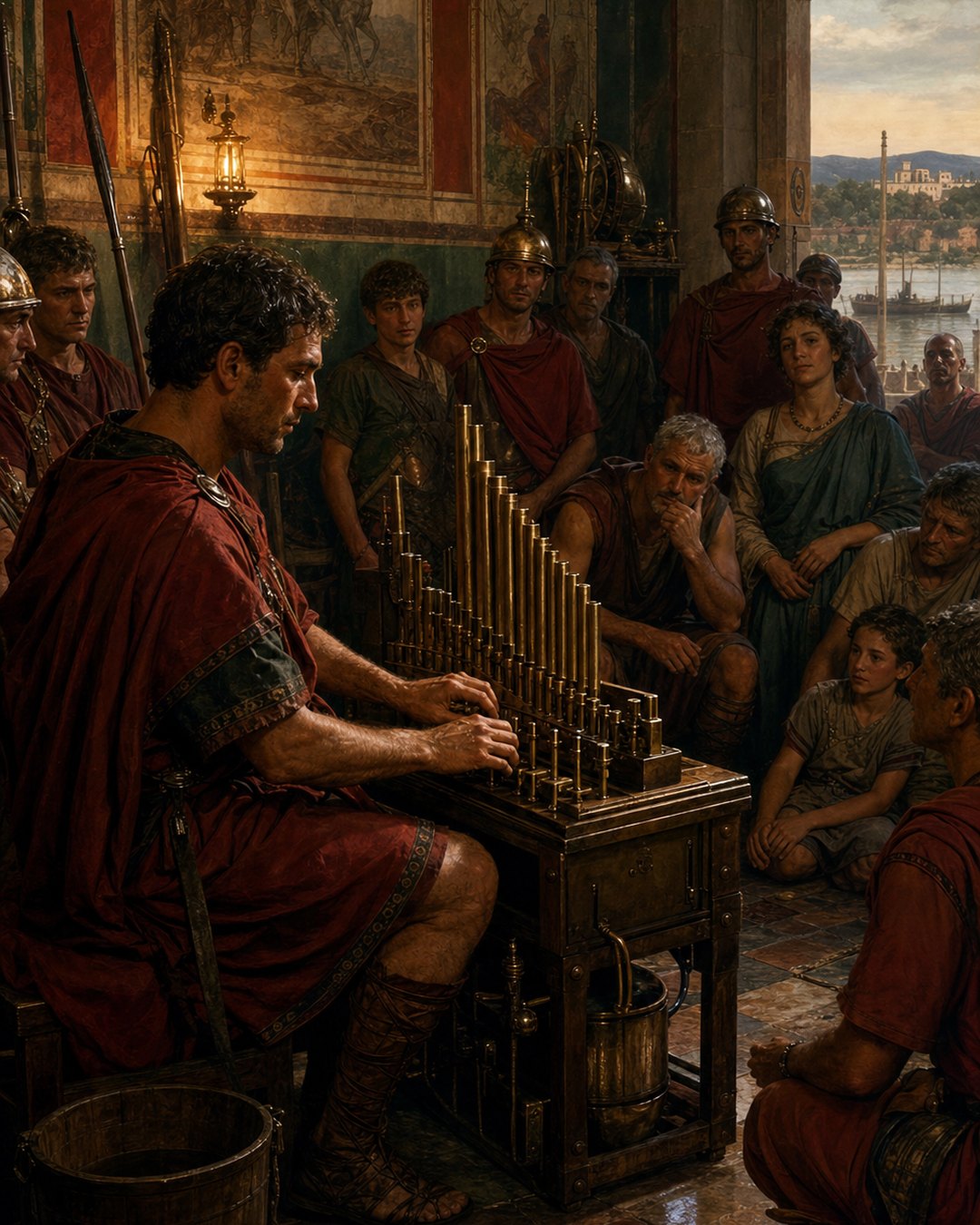
The water in a hydraulis did not play the melody. Air sounded the pipes. Water helped regulate pressure so that the performer could draw a steadier wind supply while selecting notes. The Aquincum fragments preserve that mechanical problem alongside a social one: why a fire brigade wanted music in its meeting hall.
An Inscription Restored the Instrument’s Biography
The dedication dates the gift to 228 CE and names Gaius Julius Viatorinus. It identifies the recipients as the collegium centonariorum of Aquincum. Without that text, the pipes would still be remarkable technology. With it, the instrument enters a relationship among donor, association, date and place.
Centonarii are often connected with urban firefighting, perhaps through the heavy cloth or equipment their name evokes, though collegia also served social, religious and funerary functions. Calling the group only a fire department makes it too modern. It was an organized body whose members could meet, honor patrons and stage collective occasions.
A donated organ suited that environment. Music could accompany ceremonies, meals and public display. The inscription made generosity durable: Viatorinus’s name remained attached to an object the association could use before members and guests. Patronage became audible each time the pipes sounded.
The archive’s rental notice painted at Pompeii’s baths shows another building speaking through public text. At Aquincum, the inscription did more than advertise. It allowed a crushed machine to retain the social identity of its giver and owners seventeen centuries later.
Water Stabilized Wind Rather Than Making Notes
The ancient hydraulis solved a basic musical difficulty. Pipes require air under pressure. If that pressure surges or fades, pitch and volume become unstable. A hydraulic chamber used water as part of the regulating system while pumps or bellows supplied compressed air.
The player operated keys or sliders that admitted air to selected pipes. Different pipe lengths produced different pitches. Water did not flow through the melody pipes, and the instrument was not a fountain with music attached. Its purpose was to smooth the wind reserve available beneath the pipe rank.
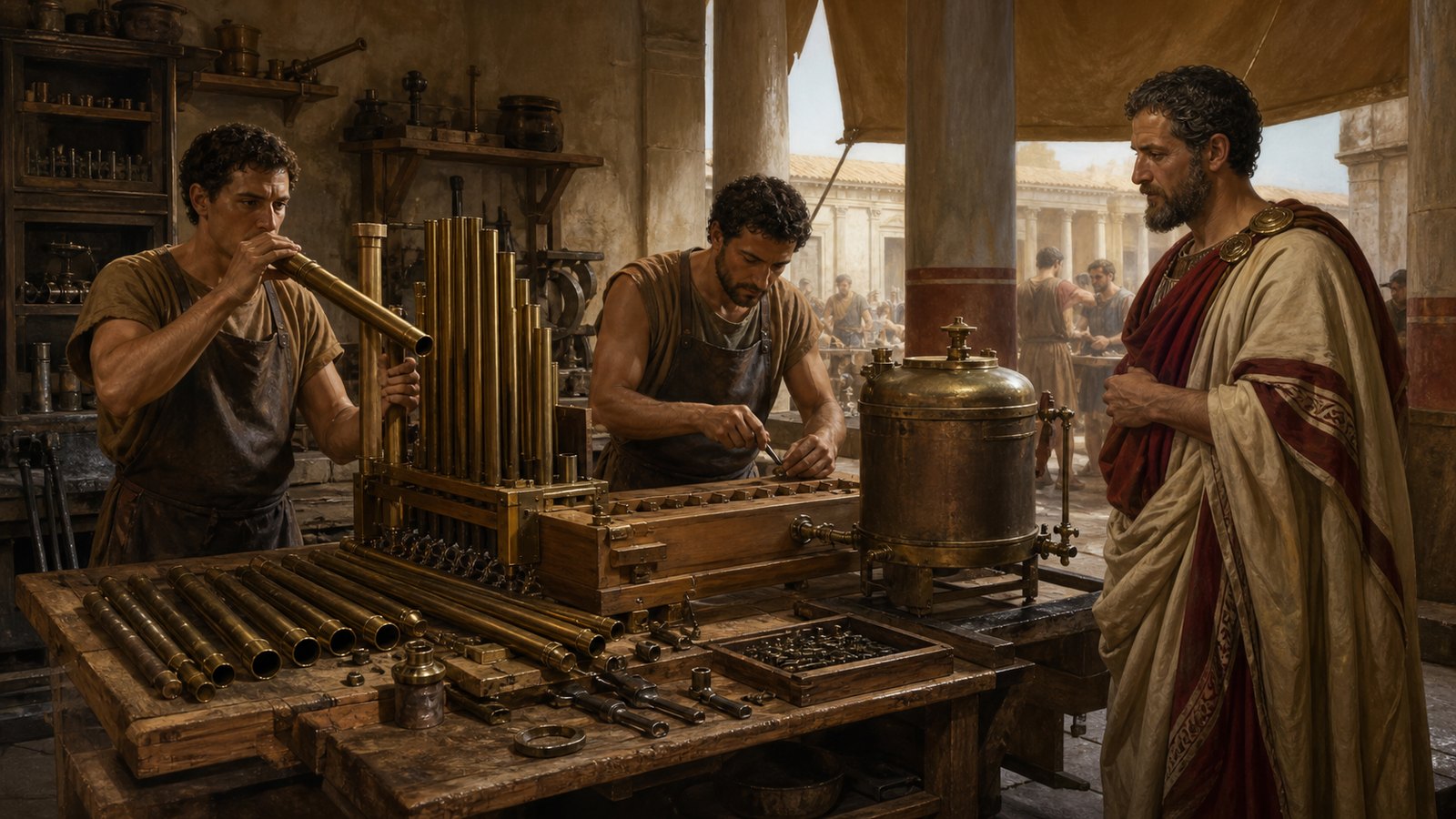
Reconstruction is demanding because wood, leather and other organic parts decayed. Bronze elements preserve dimensions and relationships, but missing materials have to be inferred from sockets, corrosion, parallels and mechanical necessity. A modern reconstruction is therefore an argument built from surviving parts, not a time machine.
This mechanical caution resembles the Roman ship pump that fought leaks. Both systems moved or controlled fluids through repeated human action. The organ converted regulated air into music; the pump converted rotation or leverage into drainage. Their parts only make sense as chains of force.
Thirty-Three Pipes Survived a Violent Collapse
The Aquincum Museum describes a compact instrument with thirty-three pipes arranged in ranks. Those pipes gave archaeologists a measurable sound-producing core rather than a literary picture alone. Their varying lengths preserve the principle of a scale even where the original tuning cannot simply be heard.
The building’s destruction damaged the organ but also buried it. Collapse can be both catastrophe and archive. Once covered by debris, metal escaped some later recycling that stripped useful bronze from accessible ruins. The same event that ended performance protected enough material for recovery.
The findspot linked the dedication to the collegium’s actual headquarters. Provenance is especially powerful here: inscription, machinery and architecture support one another. A loose pipe in an antiquities market could reveal metallurgy. Pipes in a dated association building reveal institutional life.
The 1931 discovery belonged to an early twentieth-century archaeology with different recording practices from today. Researchers have revisited the fragments, built reconstructions and debated how the mechanism sounded. Each stage adds interpretation, but the central evidence remains unusually dense: place, parts, donor, recipients and year.
Music Belonged on the Danube Frontier
Aquincum grew beside the Danube as a military and civilian center in Pannonia Inferior. The organ challenges any picture of frontier cities as barracks with markets attached. Urban associations cultivated ritual, entertainment and status in buildings furnished for collective life.
Water organs had a long history in the Mediterranean and appear in texts, mosaics and spectacles. The Aquincum example is exceptional because so much physical mechanism survived. It brings an instrument known from images down to pipe measurements, metal fittings and a specific club house.
The donor’s Roman name and the association’s Latin inscription do not tell us the identities of every player or listener. Soldiers, veterans, craftspeople, family members and townspeople moved through Aquincum, but assigning a particular audience to one performance would be invention. The building establishes an institutional setting, not a guest list.
Even without that list, the object shows cultural ambition far from Rome. A mechanical organ required specialized making, maintenance and someone able to play it. The collegium needed a reason to value those costs. Music helped turn membership into a shared experience rather than a line on an inscription.
The Wreck Preserves Both Machine and Occasion
It is easy to admire the organ as a technical ancestor of later instruments. That lineage should not erase its Roman form. It was compact, mechanically regulated and suited to the sound world of gatherings and display. It did not resemble a medieval church organ in scale, architecture or liturgical role.
The dedication also prevents a purely technological reading. Viatorinus gave the instrument to people. The centonarii maintained a headquarters, received benefaction and marked their corporate existence through objects. Pipes and pressure mattered because an association wanted occasions on which sound mattered.
The ruined building preserved an accidental package of evidence. The inscription supplies names and date. The pipes supply graduated sound-makers. Metal components preserve parts of the air system. The headquarters supplies ownership and use context. Few ancient musical instruments carry all four layers together.
Sound also imposed practical demands that a silent display can hide. Pipes had to remain clear, valves had to respond, joints had to hold air, and the pressure reserve had to recover while the player continued. Dust, corrosion or a leaking connection would change performance. Tuning also depended on keeping the working parts in a stable relation. Someone at the headquarters therefore needed knowledge beyond the ability to play a tune: the organ was equipment that required care.
The association’s meeting calendar gave that maintenance a purpose. Collegia honored gods, patrons and dead members; they shared meals and presented themselves to the city. The surviving dedication does not specify the exact occasion for every performance, but it places music inside an organized cycle of remembrance and display rather than treating it as casual noise from a street entertainer.
Aquincum’s water organ survived not as a melody but as a broken mechanism. No score was trapped beneath the debris. Yet the fragments recover something broader: a room where civic identity could be heard. In 228 CE, a donor placed controlled wind at the service of a frontier collegium. In 1931, collapse gave that vanished performance a body again.