
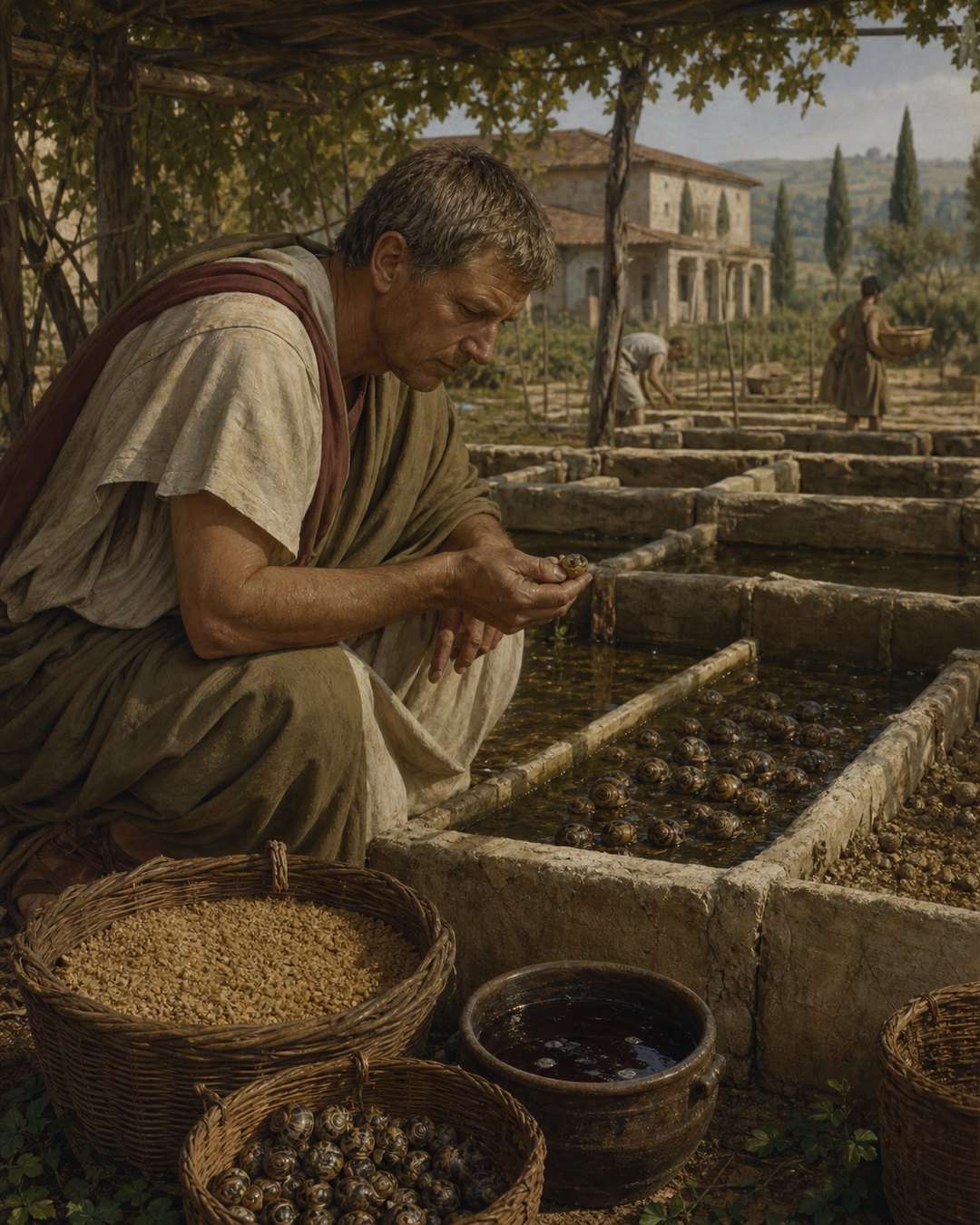
A snail is easy to collect and difficult to schedule. Rain, season and landscape decide when a forager finds it. A Roman host planning an expensive dinner wanted a different kind of certainty: animals available on the estate, separated by type, kept alive and fattened before they reached the kitchen.
Late Republican writers attach that change to Fulvius Hirpinus, also known in the manuscript tradition as Lippinus. On an estate near Tarquinii, he created enclosures for snails shortly before Rome’s civil wars. Varro describes the installation as a cochlearium. Pliny later treats it as the beginning of a fashion that spread quickly.
The story sounds comic because the livestock are small and slow. The system was serious. Walls controlled escape, shade and moisture protected the animals, channels or sprinkling supplied water, compartments separated varieties, and prepared feed altered their condition. Hirpinus did not invent eating snails. He helped turn gathering them into husbandry.
A Wall Changed Foraging into Ownership
Varro places the snail enclosure among the specialized enterprises of a villa farm. The principle was simple: surround suitable ground with a barrier the animals could not cross. Once movement was bounded, the owner could count stock, protect it and decide when to harvest. A creature from the field became an asset inside the estate.
The barrier needed attention. Varro recommends a smooth interior surface and describes water arrangements that kept the enclosure cool. Snails need moisture, but stagnant neglect would not produce reliable food. The keeper managed a small environment rather than leaving a basket in a dark room.
Hirpinus reportedly created separate divisions for different kinds. Roman writers distinguished local and imported snails, including stock associated with regions of Italy, North Africa and Illyria. Those labels do not give us modern biological taxonomy, but they show sellers and diners noticing origin, size and reputation.
The same desire to make quality repeatable appears in Roman fruit-tree grafting. A graft joined selected living material to a managed host; a snailery brought selected animals into a controlled habitat. Both practices reduced dependence on whatever nature happened to provide that week.
Varro Described a Habitat, Not a Cage
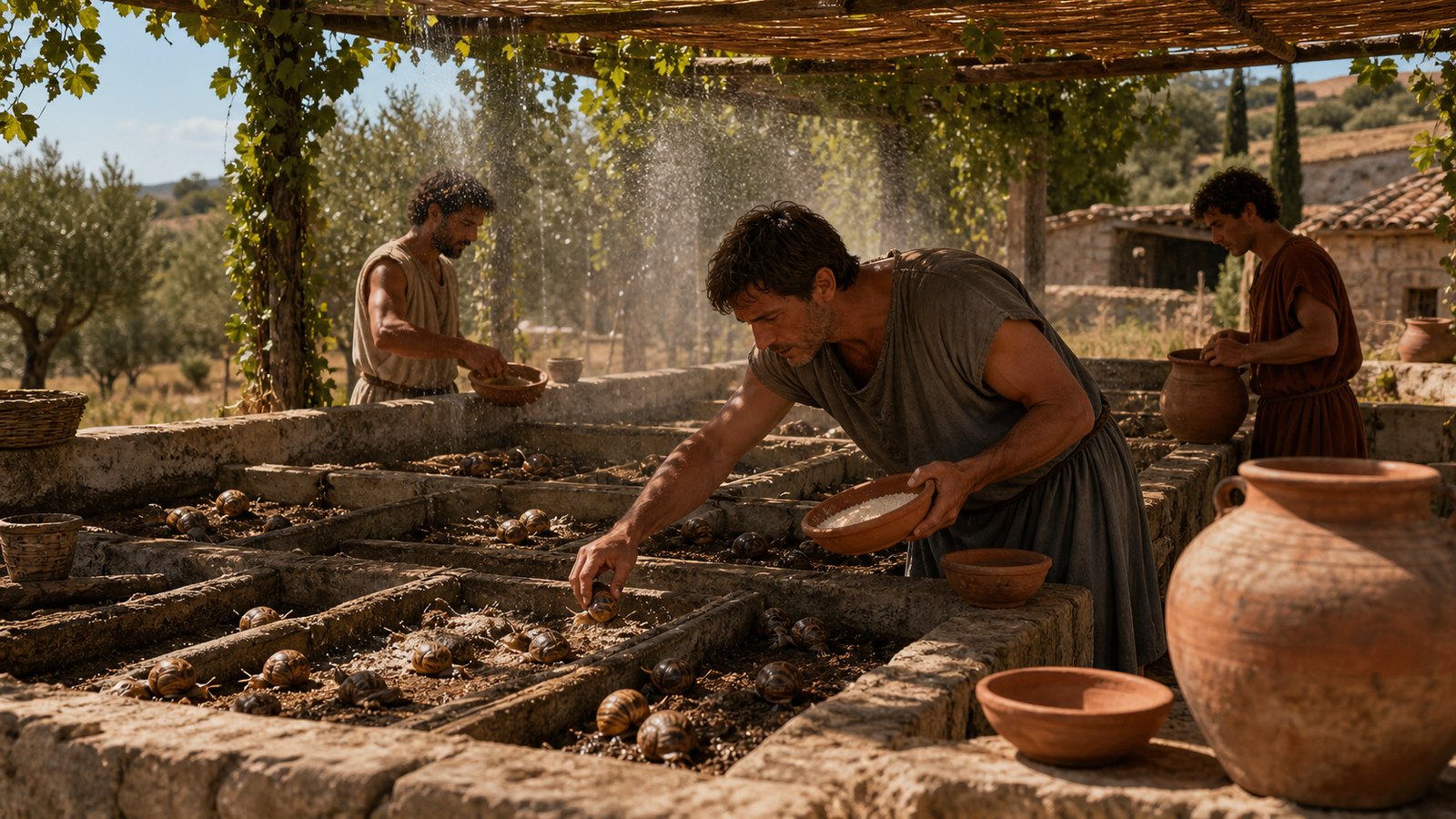
The cochlearium required more than confinement. Varro writes about a shaded place and a flow or spray of water. His wording has produced different reconstructions, but the operational goal is clear: prevent heat and dryness from ruining the stock. The enclosure had to imitate the conditions under which snails remained active and viable.
A manager also had to keep predators and thieves out. Birds, rodents and people could cross barriers designed only for snails. Villa agriculture always combined ecological knowledge with surveillance. The smaller the stock, the easier it was for losses to disappear without an obvious broken fence.
The installation made observation possible. Keepers could compare compartments, notice mortality and alter feed. Roman texts do not preserve day-by-day records from Hirpinus’s estate, so we should not invent production figures. They do preserve enough design detail to show deliberate iteration rather than a decorative garden feature.
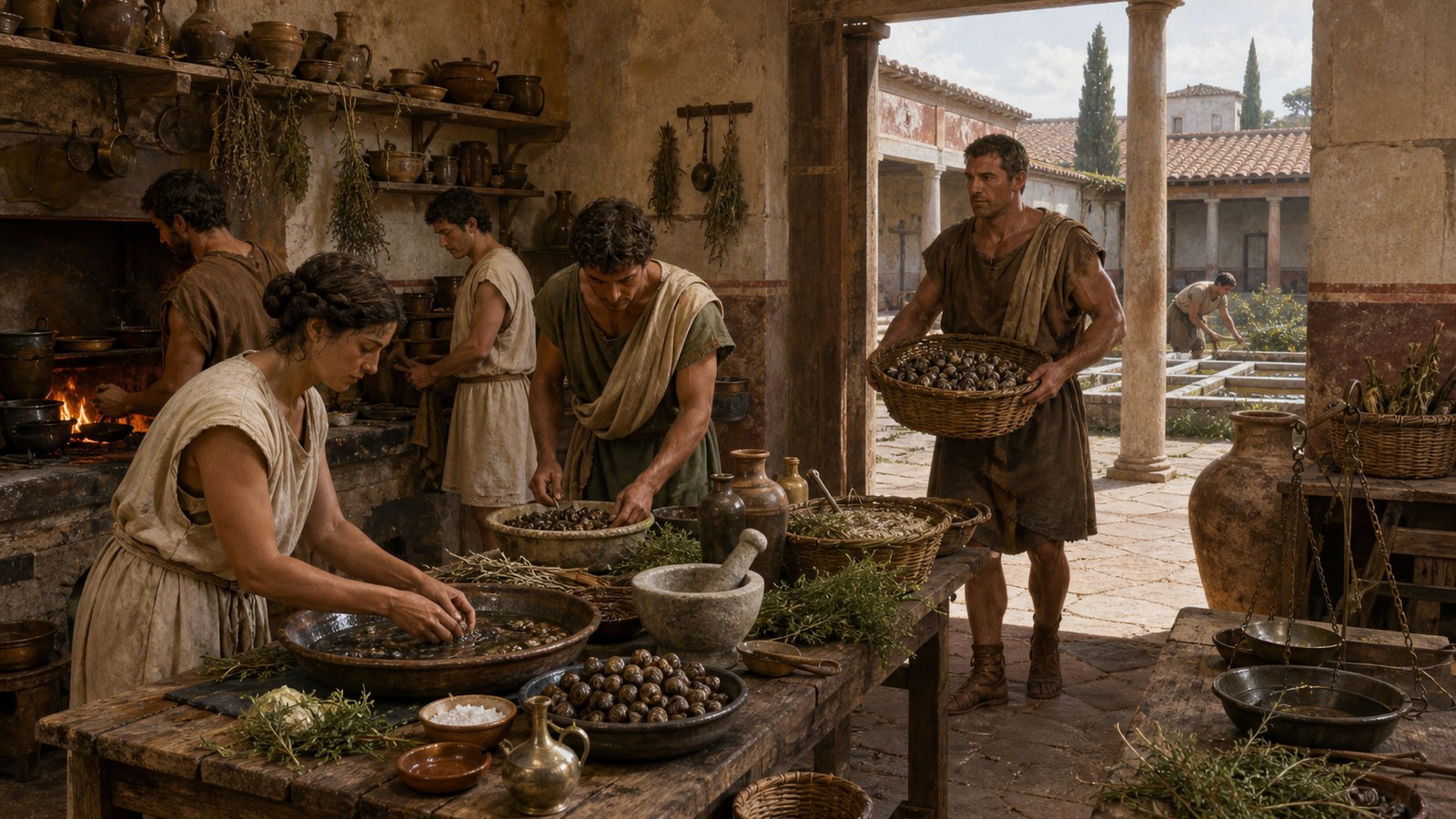
That practical scale resembles Trimalchio’s theatrical dinner only from the dining room. The fictional banquet hides labour behind surprise. The snailery restores it: someone repaired walls, carried feed, watched moisture and selected animals before any guest could treat the dish as effortless luxury.
Flour and Boiled Must Made Time Part of the Recipe
Pliny says fattening could involve flour and boiled grape must. The point was not simply to keep the animals from starving. Prepared feed changed the interval between capture and service into a stage of production. The snail’s body could be improved, at least in the eyes of Roman consumers, before cooking.
Grape must linked the operation to a villa’s other cycles. Vineyards generated sweet liquid and concentrated products; grain supplied flour. A specialized animal enclosure could consume outputs already moving through the estate. Luxury did not always require a separate economy. It could arise by redirecting familiar materials toward a narrow market.
Ancient authors also make spectacular claims about exceptionally large snails. Pliny reports shells of remarkable capacity associated with this fashion. Such figures belong to a writer who loved extremes and should not be converted into a precise average. The safer conclusion is that size itself became a selling point and a subject for competition.
The fattening regime demonstrates a Roman category that sits between hunting and conventional livestock. Snails were not driven in herds or bred with pedigrees in the surviving account. Yet they were stocked, sorted and fed. Husbandry could begin as soon as an owner controlled movement, environment and harvest.
A Fashion Spread Because Villas Could Copy the System
Pliny says the practice spread rapidly after Hirpinus. That does not mean every Italian farm built a snailery. It means the idea was legible to wealthy estate owners: a bounded installation, modest land, recognizable luxury output and room for claims about superior varieties.
The entrepreneur’s name survives because Roman agricultural writing liked first inventors. Varro and Pliny organize change around individuals who introduced a method or taste. We cannot verify that no earlier household ever enclosed snails. Hirpinus is better understood as the first named promoter of a system that elite authors considered new.
Tarquinii also matters. This was not a tale set in an abstract Roman suburb but in the agricultural world of Etruria, linked by roads and markets to the capital. A villa could test a specialty outside the city and sell status inside it. Distance from Rome did not prevent close attention to Roman demand.
The trade logic parallels the pepper vessels from the Hoxne treasure. Imported spice made distance visible at the table; managed snails made control visible. Both could turn food into a statement, but only one required the host’s own estate to keep a living crop damp and enclosed.
The Slowest Livestock Reveals the Fastest Lesson
The cochlearium compresses Roman villa ambition into a small space. It took an animal available in the wild and subjected it to boundaries, categories, water and feed. None of those operations was technically spectacular alone. Together they converted uncertainty into inventory.
The source limits remain important. Varro offers a landowner’s dialogue, not an excavated plan of Hirpinus’s exact installation. Pliny writes retrospectively and enjoys novelty, size and luxury. Their accounts tell us how educated Romans explained the practice, while the original walls and working records have not survived.
Those limits also prevent a false picture of effortless profit. A snailery tied up land, labour and feed while the stock matured. Heat could dry the enclosure; excess water could spoil it; damaged barriers could release the crop. A keeper also had to decide which animals were ready for sale and which should remain as stock. The method was attractive because those risks could be managed, not because the animals managed themselves.
Even through that filter, the mechanism is unusually concrete. A smooth barrier prevents escape. Moisture keeps the enclosure viable. Divisions preserve distinctions. Feed adds weight or desirable condition. Harvest waits for the owner’s decision. Each action changes the economics of a creature whose natural movement seems almost negligible.
Hirpinus’s snails were not important because Rome could not dine without them. They matter because they show how readily elite agriculture expanded its definition of livestock. If a product commanded attention at the table, the villa could build a habitat around it. Rome’s first named snail farm was luxury cuisine viewed from the other side of the kitchen door: walls, water, flour, must and patient control.