

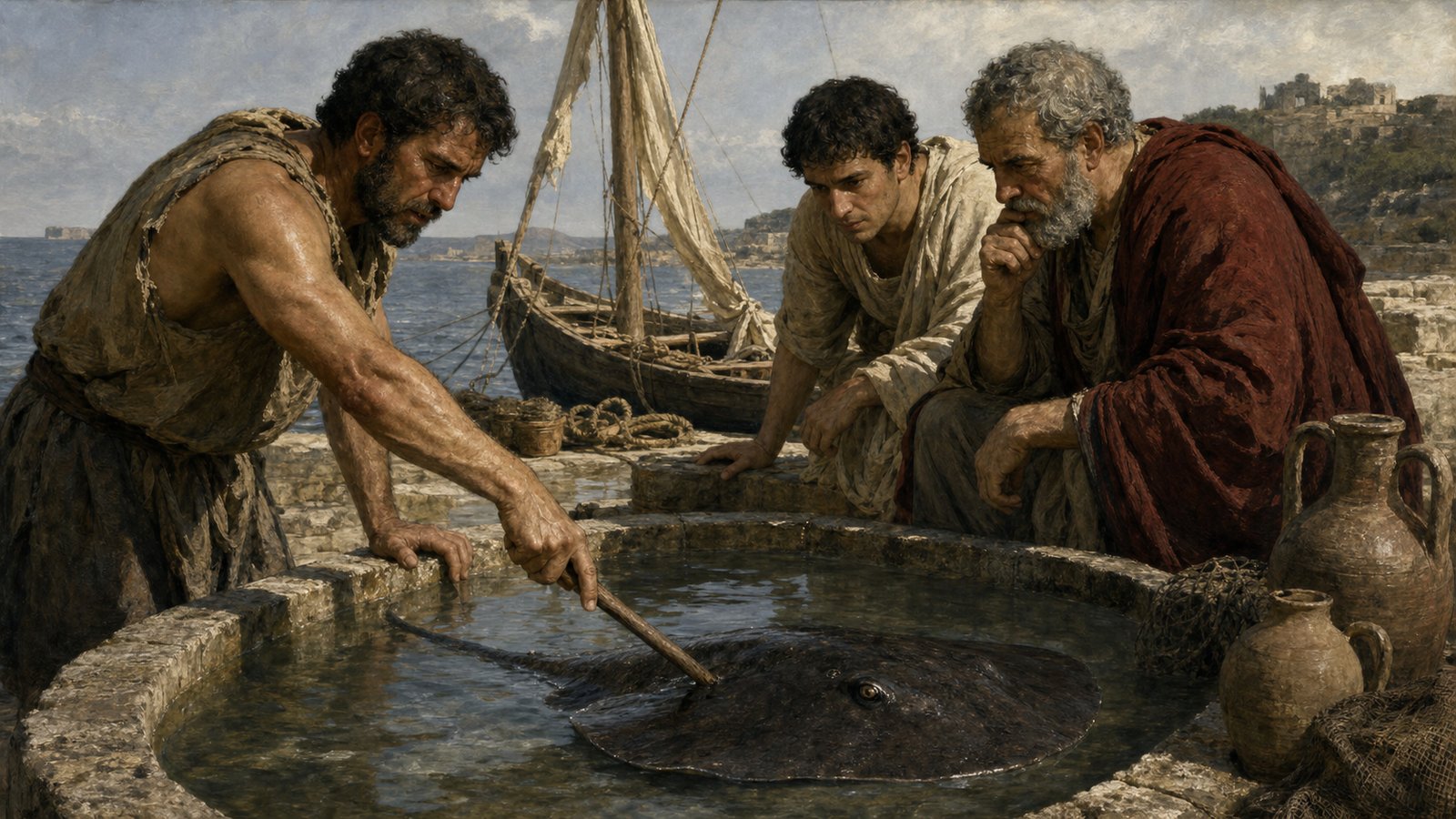
The prescription did not begin with a powder or a blade. It began with a living fish on wet sand. When gout pain arrived, Scribonius Largus wrote, a black torpedo ray should be placed under the patient’s feet. The patient was to stand where the sea washed the shore until sensation faded through the foot and up the leg toward the knee.
To a modern reader, the effect is recognizable as the discharge of an electric ray. Scribonius had no language of volts, nerves or current. He did have a repeatable sign that the animal was acting: numbness. His recipe turned that startling contact into a procedure with a selected animal, a body position, a damp setting and a point at which the exposure stopped.
That mixture of close observation and uncertain explanation is more interesting than calling the treatment either primitive superstition or ancient electrotherapy. Roman medicine could organize a real physical effect without understanding its mechanism. The torpedo ray sat exactly on that boundary: natural, measurable by the body and still mysterious enough to attract extraordinary claims.
Scribonius Writes a Procedure Around a Living Animal
Scribonius Largus compiled his Compositiones in the first century CE, dedicating the work to Gaius Julius Callistus, an influential freedman associated with the court of Claudius. The collection arranges compound drugs and treatments while its preface argues that medicine must be joined to mercy. The torpedo prescriptions belong inside that practical pharmacological project, not in a separate book of marvels.
For gout, the instruction specifies a live black torpedo. The patient stands on a moist shore washed by the sea with the animal beneath the painful feet. Contact continues until the entire foot and the leg as far as the knee become numb. The expected result is relief from pain already present and prevention when an attack is beginning.
The recipe also supplies a named success story. Anteros, described in later scholarship as an official connected with the imperial court, was said to have been cured in this way. That report remains a claim inside the medical tradition, not a controlled clinical trial. Its importance is that Scribonius used it to justify a procedure precise enough for another practitioner to attempt.
The treatment makes the patient’s sensation its instrument panel. There is no dial and no numerical dose. Species, vitality, water and duration are controlled through words; the rising numbness tells the practitioner when sufficient exposure has occurred. The body becomes both the site of treatment and the means of measuring it.
The Fish’s Name Already Carried the Feeling
Greek writers called the electric ray narke, a word connected with numbness or torpor. Plato could compare Socrates to the flat ray that leaves anyone who approaches it mentally benumbed. Aristotle described the fish stunning prey through a force residing in its body. The animal’s reputation therefore rested on an effect people and fishers could encounter directly long before anyone explained electricity.
Pliny the Elder gives the torpedo a prominent place in Book 32 of the Natural History. He says contact through the end of a spear or staff can benumb a strong arm and halt swift feet. His language imagines an emanation from the body rather than an electrical discharge, but it records transmission through an intervening object as part of the puzzle.
The Roman eye for manual effects appears elsewhere in the physical discipline of Roman surgery. The torpedo case reverses the usual relation between hand and tool. Instead of the practitioner directing an instrument, the living animal imposes a sensation on the patient, and the practitioner judges when that imposed numbness has travelled far enough.
Ancient testimony does not prove that every claimed cure worked or that each writer observed every phenomenon personally. It does show why the ray seemed medically promising. Its power was immediate, repeatable enough to be famous and linked directly to the sensation physicians wanted to alter.

A Real Shock Did Not Produce a Correct Explanation
Electric rays generate discharges with specialized organs, but Roman authors did not possess that model. Galen reportedly considered a cold or venom-like principle; Pliny spoke of exhalations or emanations. Both explanations tried to fit the fish into familiar categories of natural action even though its effect travelled in a disconcerting way.
This gap cautions against a smooth origin story in which Scribonius simply discovered modern electrotherapy. The procedure used bioelectricity in the literal sense that an electric animal acted on a body. Yet neither the treatment’s theory nor its evidence matched a modern device, dose standard or trial. The resemblance is real, but so is the historical distance.
The distinction resembles the challenge posed by Galen’s vanished books and working notes: ancient medicine reached us through selected texts, copied arguments and reported cases rather than a complete laboratory record. Scribonius’s concise directions preserve what he wanted another practitioner to do, not the full history of attempts, failures or variation among animals.
The honest reconstruction therefore keeps two statements together. The ray could produce a genuine electrical shock and numbness. A claim that a particular patient’s gout was cured remains a report from an ancient therapeutic text, not independent proof of durable efficacy.
Head Pain and Gout Required Different Contact
Scribonius is also credited with applying the torpedo to persistent headache. The broad principle remained contact with a living ray until numbness intervened, but the target changed from feet and legs to the painful head. This was not an oral remedy whose active substance circulated invisibly; placement mattered because the animal’s effect had to reach the afflicted region.
The gout instruction is especially vivid because it locates the encounter at the edge of the sea. Wet sand and seawater helped keep the ray alive and created the setting in which its discharge could act. The patient’s required stillness—standing through discomfort until numbness reached the knee—made the treatment physically demanding as well as unusual.
Modern summaries sometimes attach exact voltage figures to ancient cases. Those numbers describe known capabilities of electric-ray species or modern measurements, not a value Scribonius recorded for Anteros. No Roman practitioner could select a ray by an electrical reading. Individual animals, contact and conditions would have changed the exposure in ways the prescription could not quantify.
The recipe’s specificity should therefore not be confused with precision in the modern experimental sense. It was procedural precision: use this kind of living creature, in this environment, at this part of the body, until this sensation occurs. That is a meaningful form of control, even while the delivered force remained unknown.
Pliny’s Catalogue Shows Observation Drifting into Marvel
Pliny did more than describe the ray’s numbing power. Across Book 32 he attached torpedo preparations to a wide range of complaints, including digestive, splenic and rectal conditions, and repeated ritual details about timing and the moon. Some entries use the live animal; others use parts of its body. The catalogue expands far beyond Scribonius’s tightly staged contact treatment.
That expansion demonstrates how natural history could preserve observation beside credulity. A fisher’s shock through a staff and a patient’s numb foot belong to the animal’s actual electrical capacity. A remedy dependent on catching the fish while the moon stood in Libra belongs to a different explanatory world. Pliny transmitted both within the same project of collecting nature’s powers.
The torpedo ray therefore resists a simple label. It was not an imaginary beast, and the numbness was not invented. Nor does the reality of the discharge validate every ailment, preparation or cosmic condition attached to it. Ancient medical knowledge could begin from a striking true effect and build claims of very different reliability around it.
Scribonius’s most durable insight was narrower than the later legend. Pain might be altered by a controlled external stimulus, and the patient’s changing sensation could guide the exposure. The black ray offered that stimulus before Roman medicine knew what electricity was. Its body supplied the force; numbness supplied the measure; explanation lagged behind both.