
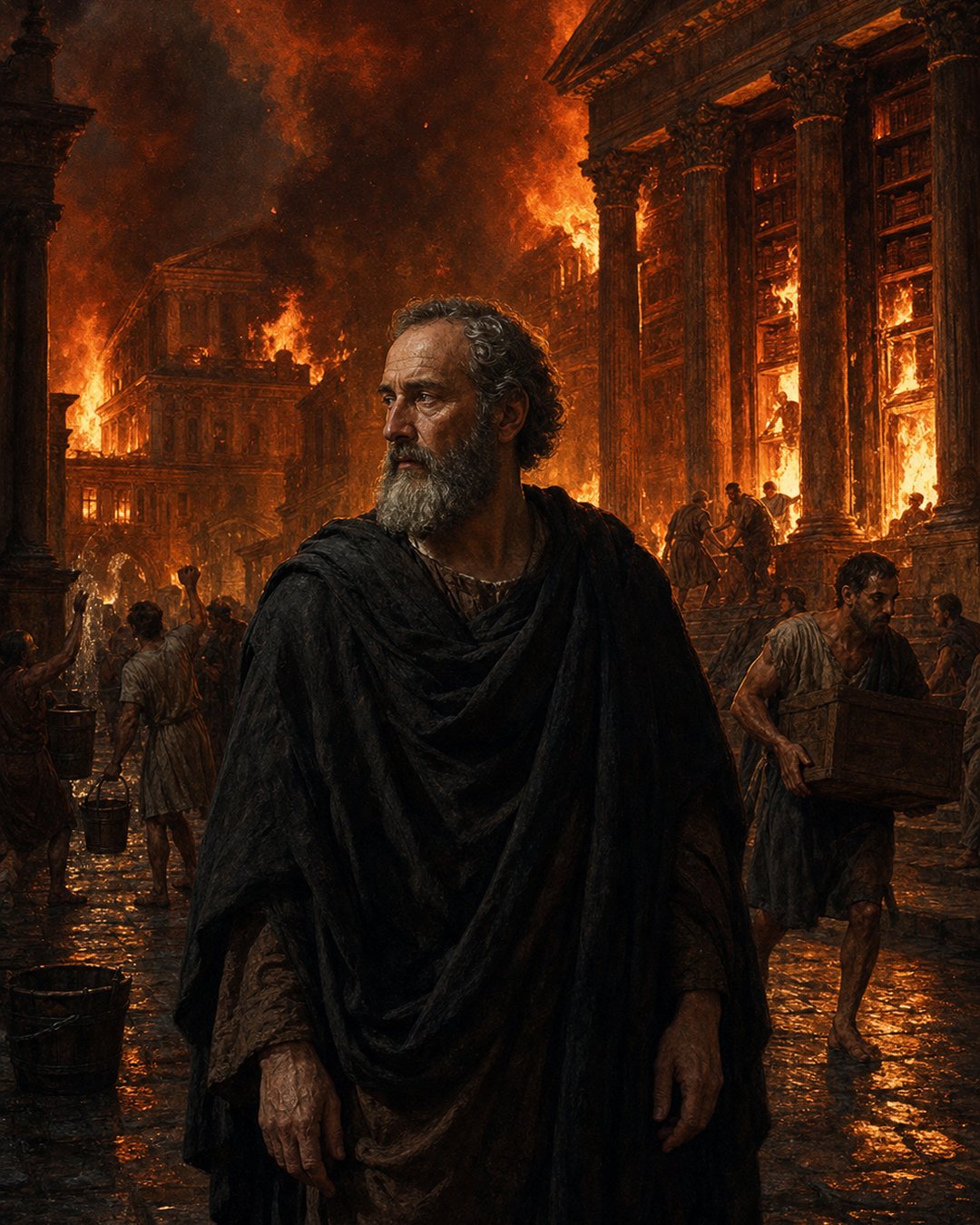
Galen did not need someone to explain what a burned library meant. In 192 CE, fire tore through central Rome and destroyed three imperial libraries near one another on the Palatine. It also reached the rented storerooms where scholars kept personal books, copies and work in progress. Galen lost both the sources he trusted and the material he had made from them.
His description survives in a work commonly called On Avoiding Distress or On Consolation from Grief. For centuries that text was believed lost. Its rediscovery in a Greek monastery in 2005 gave historians an unusually direct view of Rome’s scholarly neighborhood before the flames: libraries with catalogues, shelves open to browsing, guarded books that could not leave and streets busy with scholars and booksellers.
The disaster exposed a hidden architecture of knowledge. Rome had concentrated authoritative manuscripts, specialist readers, copying space and private storage within walking distance. That concentration made research possible. It also allowed one fire to erase public originals, private duplicates and unfinished thought in the same night.
A Lost Work Returned from a Monastery in 2005
Galen wrote after the fire, but the work in which he reflected on the loss did not travel safely through every later century. Scholars long treated it as missing until a manuscript was unexpectedly identified in a Greek monastery in 2005. The survival of his account therefore carries the same contingency as the losses it describes.
The text is often known by the Greek title Peri Alupias and translated with phrases such as On Avoiding Distress or On Consolation from Grief. Its purpose was not to produce a municipal damage report. Galen used his own reaction to loss to discuss how a person might resist being mastered by sorrow.
Yet personal reflection preserved institutional detail. Galen named libraries, described how collections worked and explained why his own books were stored nearby. A work about emotional discipline became evidence for rooms, rules, catalogues, guards, copying habits and the geography of Roman scholarship.
That double value matters. An official inscription might celebrate a library’s founder, while a literary anecdote might praise learning in general. Galen instead shows what a demanding user did inside the system—and what vanished when the system’s physical neighborhood burned.
Three Palatine Libraries Held Authoritative Versions
The three libraries Galen discusses stood close together on the Palatine. According to the scholarship summarized by JSTOR Daily, they shared an essential function: they safeguarded authoritative versions of important Greek and Latin texts, ideally even an author’s original manuscript.
An authoritative copy was not merely another scroll. Hand copying introduced mistakes. A missing line, changed word or repeated phrase could travel into later descendants. Scholars needed a trusted exemplar against which an uncertain copy could be checked. Destroy that reference point and surviving copies became harder to correct.
Some holdings formed special collections assembled by notable individuals; others appear to have been arranged by subject. Galen boasts that he found errors and inconsistencies in library catalogues. His confidence suggests close familiarity with both finding aids and shelves, not occasional ceremonial access.
The libraries may have permitted patrons to browse without constant supervision by a librarian. That freedom made the room a working research environment. It also made cataloguing accuracy consequential: a scholar who knew a text existed could still lose hours if its title, author or shelf location had been recorded badly.
Books Stayed Inside, So Scholars Made Their Own
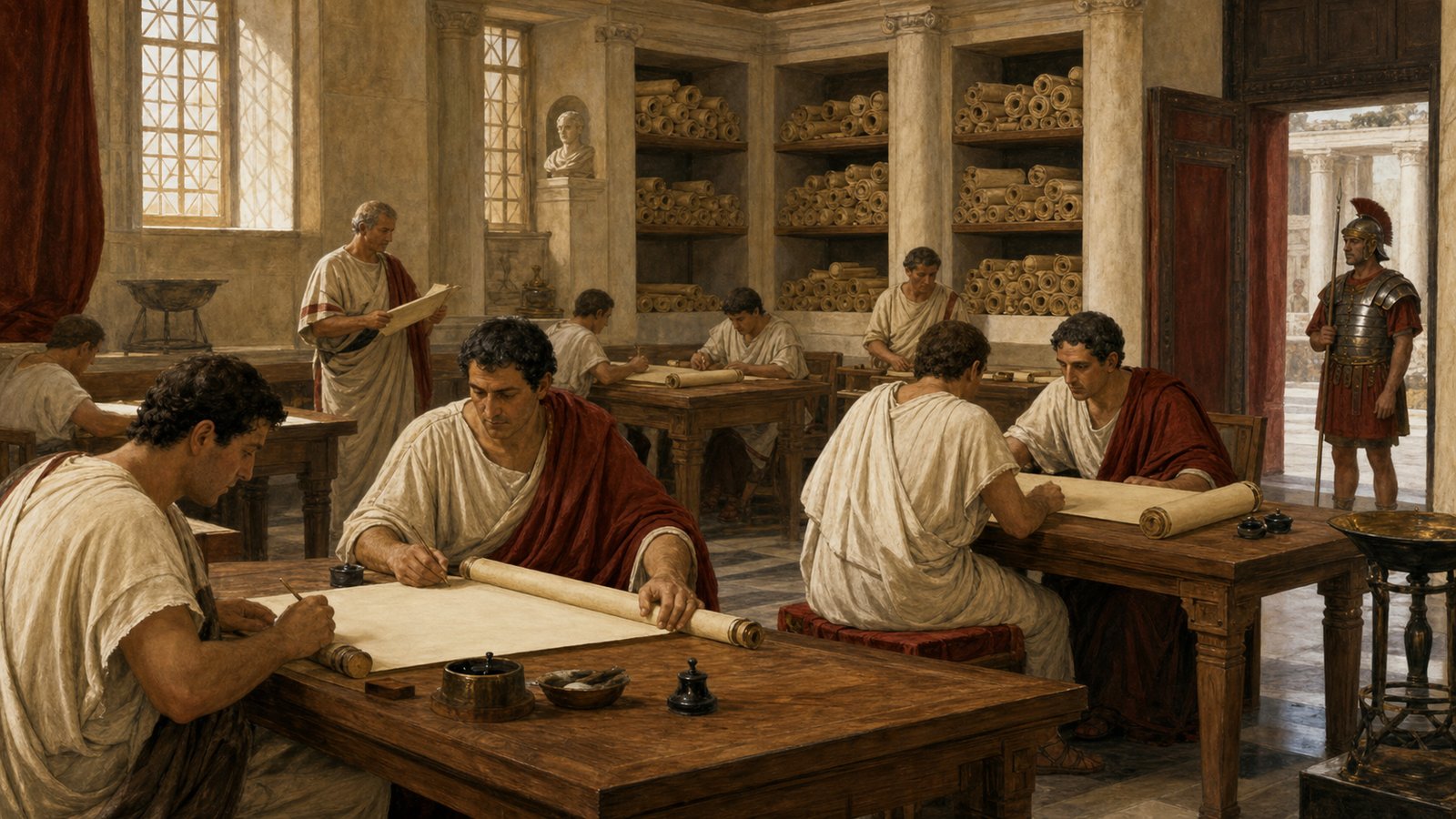
The Palatine collections did not normally let books leave. One guard, Galen says, could be bribed to ignore patrons pilfering texts, but the anecdote proves the rule rather than cancelling it. Holdings were supposed to remain in the building where other readers and the institution could still find them.
A serious user therefore had two choices: work in the library or make a private copy. Both demanded time, light, a stable surface and control of materials. The reed pen made ink responsive to the hand, but speed never removed the need to compare line after line against an exemplar.
Copying was not mechanical in the modern sense. A scholar could annotate, compare variants or commission another hand, yet every result had to be checked. The physical act of duplication was how knowledge escaped a no-loan collection without the institutional scroll itself leaving.
The restriction protected access while creating private labour. A library preserved authority collectively; each scholar bore the cost of turning that authority into a usable personal text. Rome’s system depended on both halves, and the fire reached both.
Storage Rooms Turned the Streets into a Scholarly District
Because scholars could not check out the books they needed, many rented storage space near the libraries. Proximity reduced the friction of moving between an authoritative exemplar and one’s own copies, notes and unfinished projects. A short walk connected consultation with private work.
The surrounding neighborhood filled with related activity. JSTOR Daily’s account describes scholars debating and booksellers hawking their wares in the streets. Intellectual life did not stop at a library threshold. It drew commerce, conversation and storage into an urban cluster.
Galen’s storeroom belonged to this ecology. It held his personal collection and notes for works still in progress. These were not interchangeable luxuries. A finished copied text represented hours of access and checking; notes preserved decisions, observations and routes through material that might never be reconstructed exactly.
Writing technologies shaped what could be stored. Papyrus rolls, temporary notes and bound forms organized knowledge differently. The codex made separated passages easier to reach, but no format solved the deeper problem: a physical collection remained vulnerable wherever scholars concentrated it.
The Fire Destroyed Originals and Corrections Together
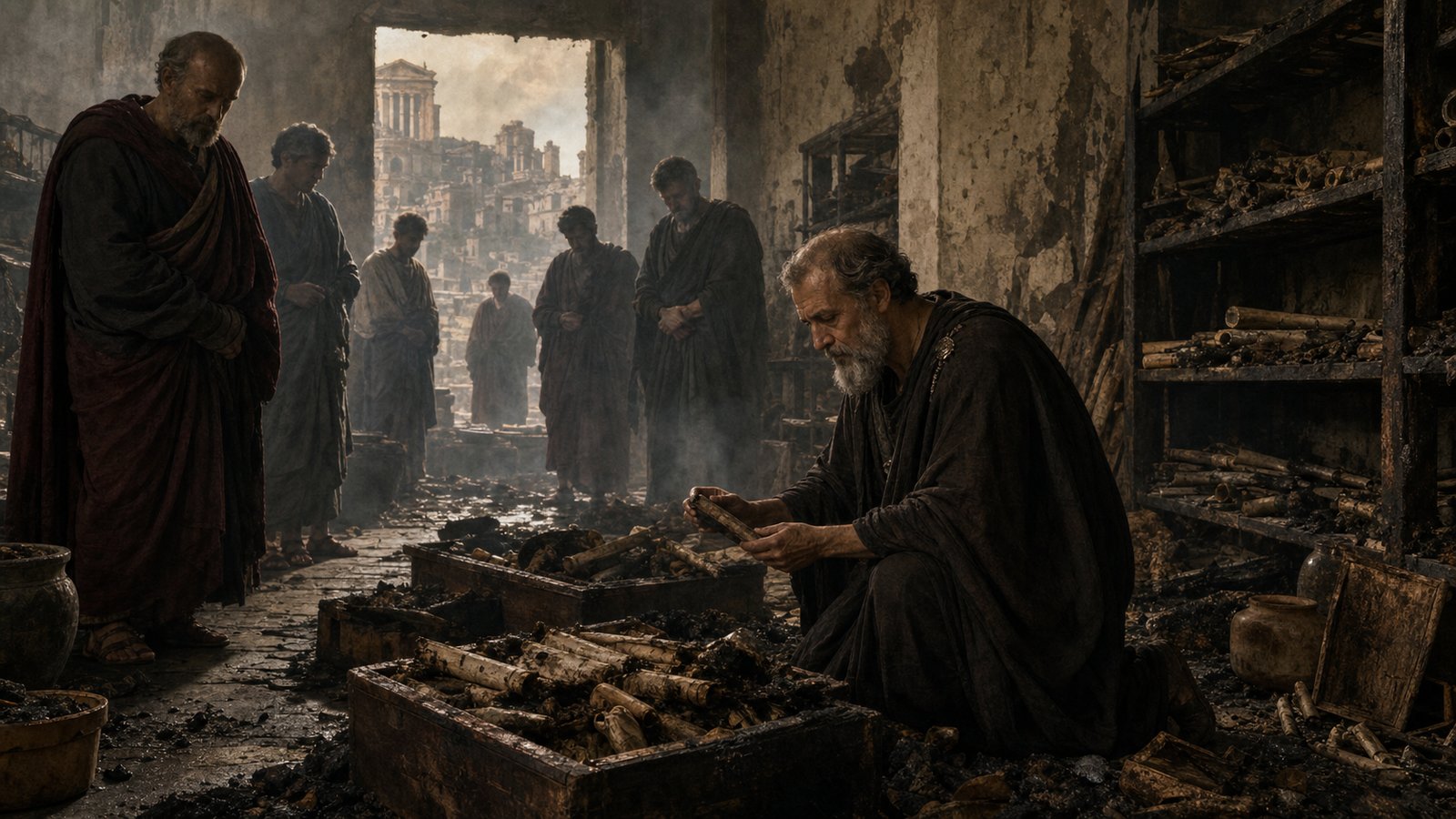
When fire swept through central Rome in 192, it did more than reduce the number of surviving copies. Rare works disappeared permanently. Other texts remained somewhere else, but their surviving versions could no longer be checked against the authoritative manuscripts that had burned on the Palatine.
That second loss is less visible and perhaps more damaging than it first appears. A copied text may look complete while carrying errors. Before the fire, a scholar could return to a trusted version and resolve doubt. Afterward, uncertainty remained embedded in every descendant for which no equivalent exemplar survived.
The nearby storage facilities burned too. Galen lost his personal books and notes for ongoing work in the same disaster that destroyed the public sources from which much private scholarship drew authority. Recreating his collection would not simply mean purchasing replacements. Some references were gone; some corrections could no longer be verified; some notes existed only in his lost copy.
This is the difference between redundancy and apparent redundancy. Rome possessed many copies, but the copies did not all have equal authority, and several layers of the system occupied the same danger zone. Concentration made the libraries useful every day and catastrophic on one night.
Black Cloaks Made Scholarly Grief Visible
Galen presents himself as handling the loss with relative control, in keeping with a work about resisting distress. He also records reactions that reveal the scale of the blow. One grammarian who had stored books nearby died after the fire, consumed, Galen says, by despair and pain.
Others wandered for a long time in black cloaks, thin and pale like people in mourning. The physical details matter. Lost books were not treated as replaceable office supplies. Collections could embody decades of labour, personal wealth, professional identity and access to texts that no market could supply again.
Galen’s self-command should not be mistaken for indifference. He catalogued what had vanished and understood the layers of damage. Emotional discipline was a response to irreversible loss, not evidence that the losses were small.
His recovered work now completes an unlikely chain. A fire destroyed libraries and personal papers in 192; a separate manuscript carrying Galen’s response survived elsewhere; centuries later it vanished from scholarly awareness; then a monastery copy restored his testimony in 2005. The text teaches the lesson its own history demonstrates: preservation is never one building, one copy or one generation’s achievement.