
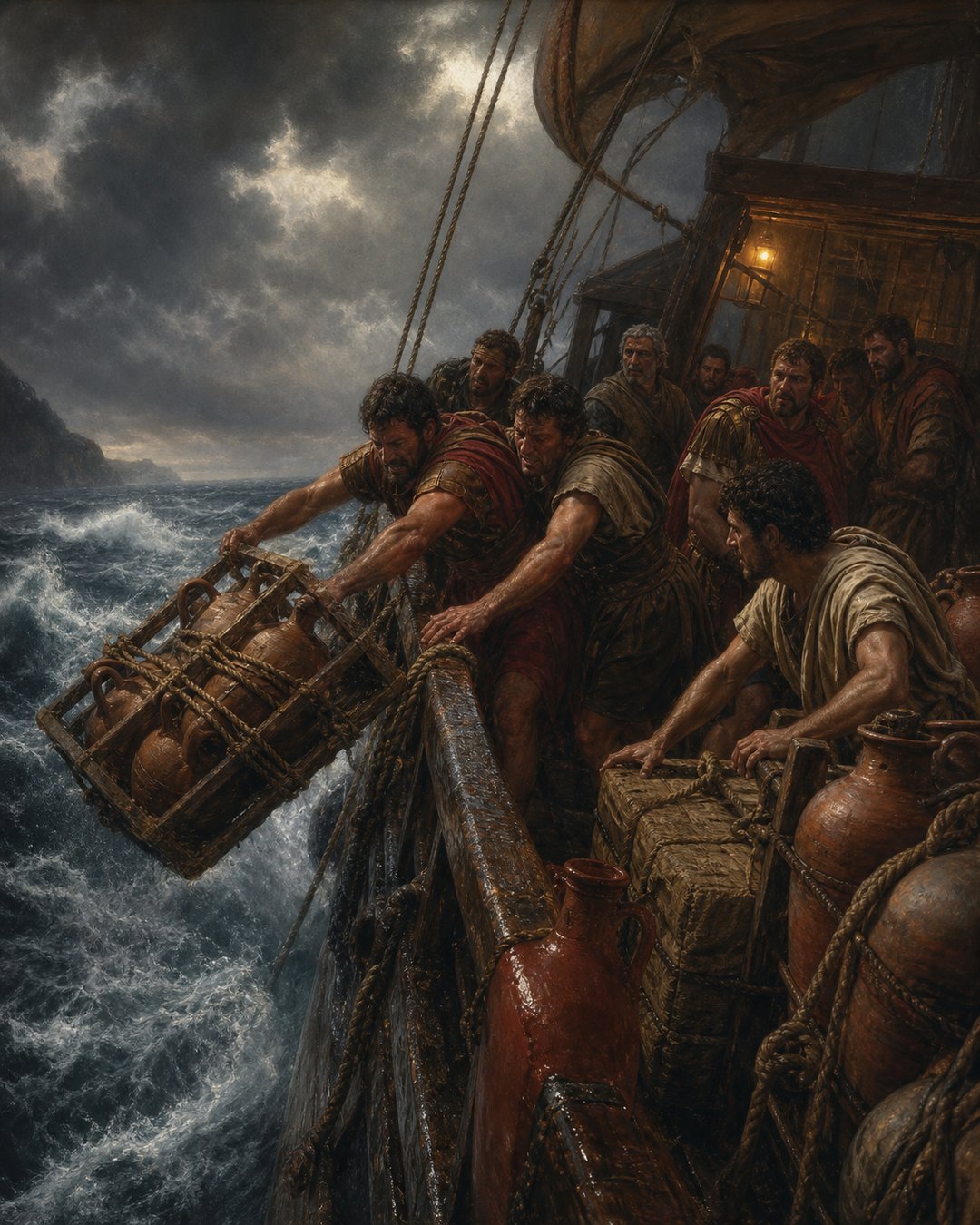
The first decision came before any calculation. A ship in danger had to become lighter, so merchandise went over the rail. Roman law began its work after that deliberate sacrifice: one owner’s cargo was gone, other cargo remained aboard, and the vessel had escaped the danger that made the throw necessary. Who should arrive poorer?
Digest 14.2 preserves a blunt answer attributed to the jurist Paulus. What had been given for everyone’s benefit was to be repaired by everyone’s contribution. Yet the pages that follow are not a single slogan about fairness. They test storms, damaged rigging, wet goods, pirates, overloaded harbor approaches, recovered jetsam and even a ship struck by lightning. Each variation asks whether the loss truly served a common rescue.
The result is a practical anatomy of shared risk. The Lex Rhodia de iactu did not erase loss, and it did not make the sea safe. It decided when a private sacrifice had created a debt among the survivors—and when an unfortunate merchant or shipowner still had to bear the damage alone.
The Rule Starts with a Sacrifice, Not a Shipwreck
Paulus states the core in one compact proposition: when merchandise is thrown overboard to lighten a ship, the loss made for all must be restored by contributions from all. The decisive facts are active. Property is deliberately surrendered, the reason is to relieve the vessel, and the benefit reaches beyond the owner whose bales or jars disappear into the water.
That structure separates jettison from the ordinary hazards of transport. A merchant did not earn a contribution merely because waves ruined his cargo. Nor did a shipowner automatically charge passengers whenever hull or equipment needed repair. The rule addressed a sacrifice chosen under common danger, not every expense that happened during the same voyage.
The distinction becomes clearer beside the surviving Muziris cargo-loan papyrus. That document exposes credit, customs and valuable freight across a long route. Digest 14.2 looks at another moment in maritime commerce: not financing before departure, but allocating a loss after survival depended on destroying part of what the voyage carried.
It is tempting to call this insurance and stop there. That comparison is useful only with care. No insurer stood outside the voyage collecting a premium under a modern policy. The contributors were people and property already joined in the maritime venture, and their duty emerged because one interest had been sacrificed to preserve the others.
Pearls, Rings and Provisions Complicate the Arithmetic
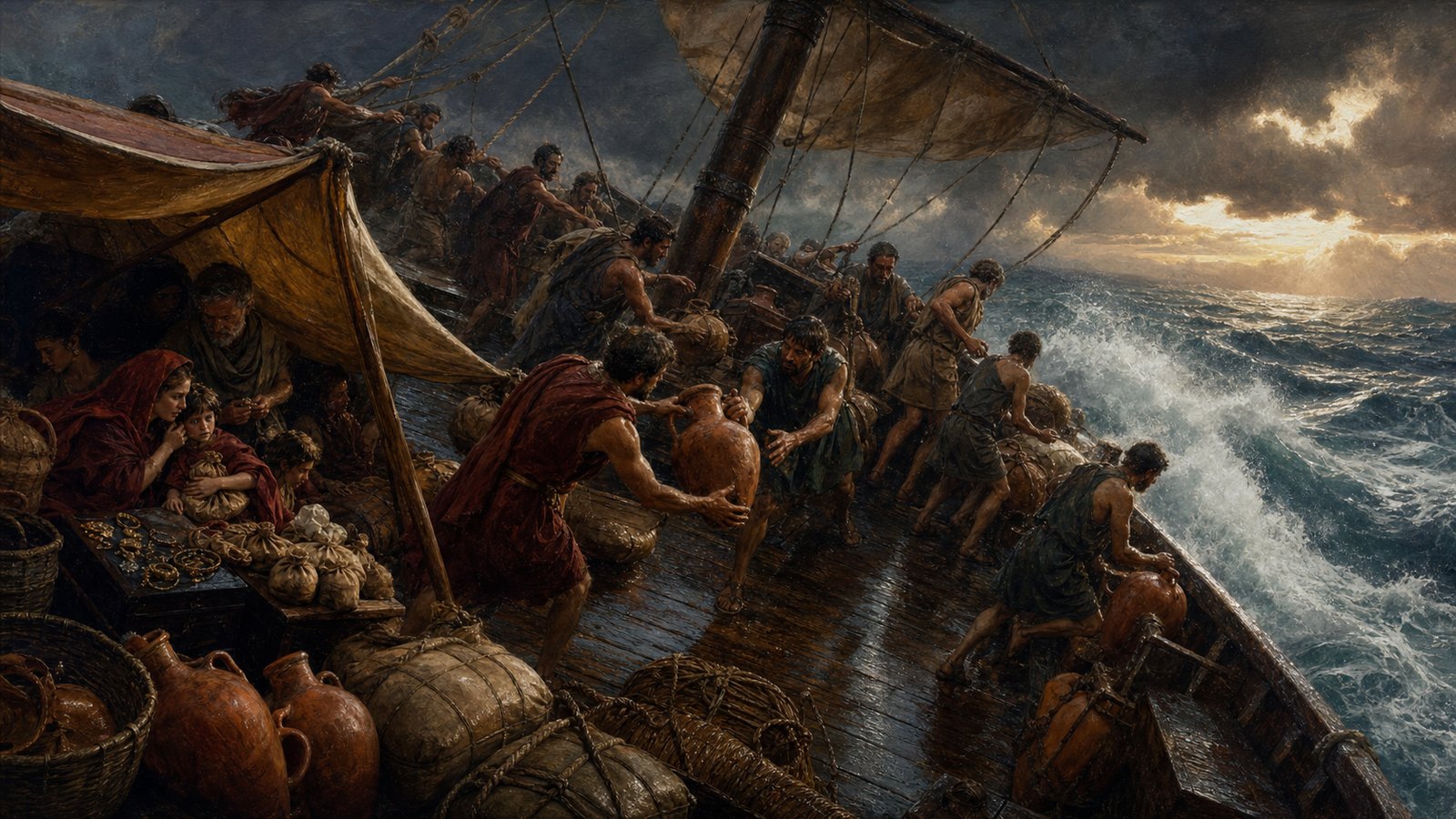
One problem imagined a ship carrying several merchants, different kinds of merchandise, many passengers, enslaved people and free people when a great storm forced cargo overboard. The jurists asked whether even light, high-value objects such as pearls and precious stones should count. Their answer followed benefit rather than weight: saved wealth contributed because its owner had gained from the sacrifice.
The proposed account included clothing and rings. Provisions brought for consumption were treated differently, since food aboard served the voyage and could enter a common stock if supplies ran short. Free people were not assigned a monetary appraisal. The passage therefore does not offer a neat cargo manifest; it shows lawyers sorting unlike things according to the kind of value the contribution could recognize.
Valuation was proportional. Lost goods were assessed as loss rather than imagined profit, while saved goods were considered according to what they could be sold for rather than simply what they had cost. A small parcel could therefore carry a large share, and a bulky object could carry less. The rule followed economic value preserved, not deck space occupied.
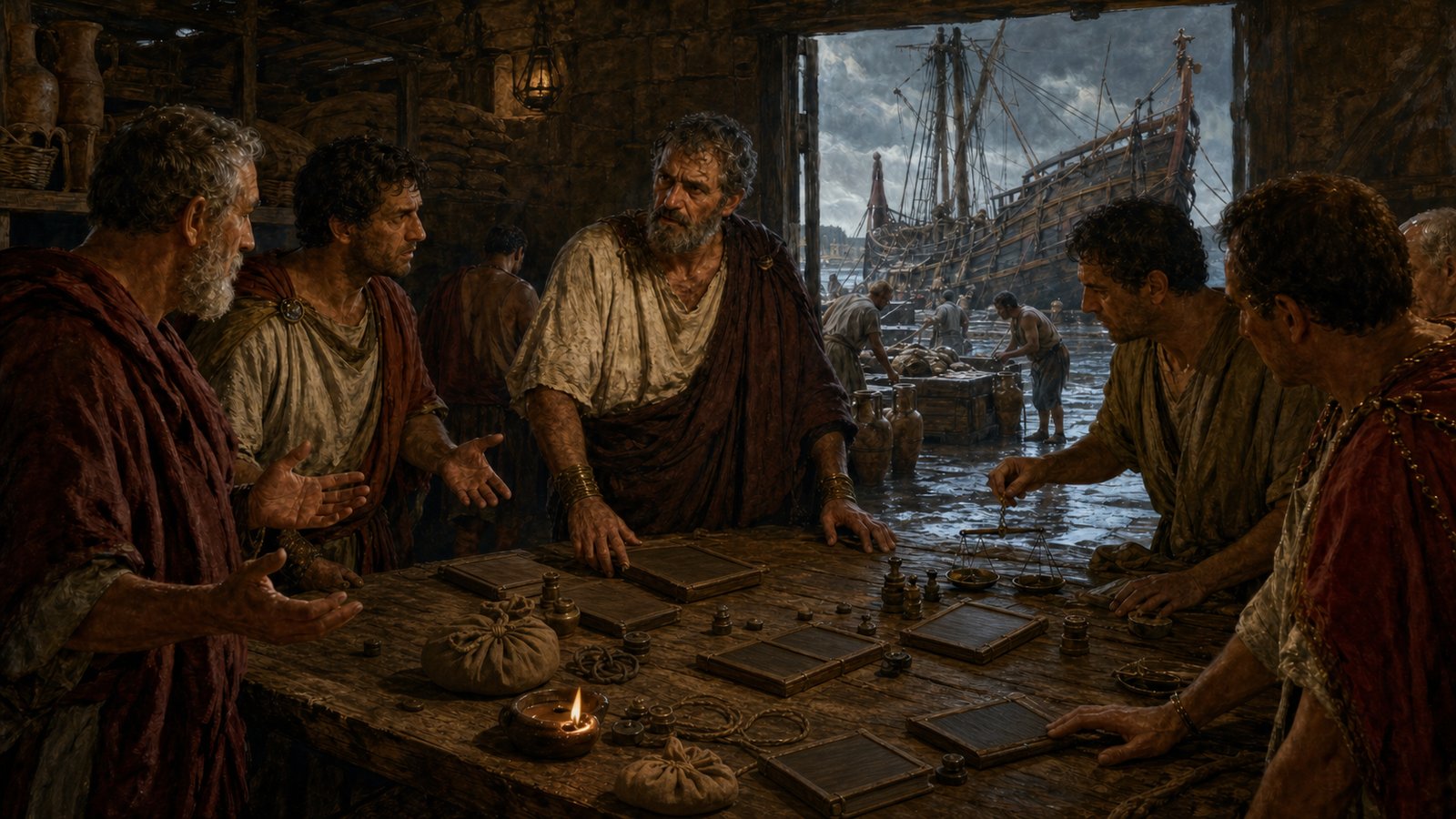
This is where the moral sentence became administrative work. Someone had to identify what was saved, estimate what was sacrificed and calculate each share. Roman jurists did not pretend that fairness arrived automatically with the ship. They supplied a sequence of claims and valuations capable of carrying a storm’s unequal damage into a court.
The Shipmaster Connects the Owners Who Never Contracted Together
The merchant whose goods were jettisoned could proceed against the shipmaster through the contract for carriage. The master, in turn, could use the corresponding hiring action against those whose goods survived so the loss was shared proportionally. The arrangement mattered because the cargo owners might have made separate agreements with the vessel rather than one agreement among themselves.
The shipmaster thus became a legal hinge. He was not simply declared personally responsible for the whole disaster. He faced the owner of the sacrificed cargo and then collected from the beneficiaries. The contract network converted a group linked physically by one hull into a group that could be made to account for a common rescue.
That chain also explains why Roman lawyers kept testing consent and purpose. Damage to ordinary ship equipment was generally the shipowner’s affair, just as a blacksmith did not charge a customer because his own hammer or anvil broke. But if a mast or another part of the vessel was thrown overboard to remove a danger common to all, contribution could be required.
Papinian and Hermogenian describe the sacrificed mast as a shared case because it was cut away for rescue. Julian supplies the counterexample: a storm-beaten ship whose rigging, mast and yards were burned by lightning reached Hippo, received temporary equipment, sailed to Ostia and discharged its cargo safely. The cargo owners did not contribute, because the expense equipped the ship rather than constituting the shared sacrifice that preserved their goods.
A Sunken Boat and Wet Cargo Reveal the Rule’s Boundaries
Callistratus considers an overloaded ship unable to enter a river or harbor. Some merchandise is transferred into a smaller boat to lighten the vessel; the boat sinks while the main ship and its cargo survive. The owners whose property remained safe must account with those whose goods were lost in the boat, as though the goods had been thrown directly into the sea.
Reverse the ending, however, and the result changes. If the small boat and its cargo survive while the main ship is lost, there is no contribution from the survivors in the boat for the property that went down with the ship. The transfer did not save the lost property. Common danger by itself was insufficient; the claimed sacrifice had to produce preservation.
The jurists pressed the causal question further when retained cargo became wet during jettison. One example compares lots originally worth twenty aurei, with one reduced to ten after damage. The discussion asks whether the damaged owner should both suffer deterioration and contribute, and whether it matters if waves reached a corner independently or if exposure caused by the jettison produced the harm.
These hypotheticals are not decorative puzzles. They prevent the rule from becoming a machine that rewards whoever can point to the same storm. The court had to ask what action was taken, whose property it protected, what damage followed from that action and how much value remained. Shared loss depended on a chain of consequences, not merely on being aboard together.
Recovery, Pirates and Ownership Refuse a Simple Formula
Property thrown overboard was not treated as abandoned. If the owner found it again, the owner could reclaim it; a stranger who obtained it did not become owner merely because emergency had sent it into the sea. If the jettisoned property was recovered, the need for contribution ended, and payments already collected could be unwound through the same contractual machinery.
The pirate cases draw another sharp line. Servius, Ofilius and Labeo said everyone should contribute when ransom saved the ship. Goods individually carried away by robbers remained the loss of their owner, and a person who paid only to ransom private property did not receive a common contribution. One payment released the shared venture; the other protected a particular interest.
The distinction resembles the practical logic behind Roman anchors and emergency seamanship: an object or act mattered through what it did in a specific danger. Digest 14.2 applies that attention to legal cause. A cut mast, a cargo transfer or a ransom could qualify, but only when the act addressed the collective peril and preserved the interests later asked to pay.
Roman jurists left disagreements and awkward edges visible. They debated wet goods, insolvency and equipment; they distinguished rescue from repair and common ransom from theft. That complexity is the point. The Lex Rhodia survived in the Digest not as a romantic law of the sea, but as a demanding method for proving why one person’s deliberate loss had become everyone else’s obligation.