
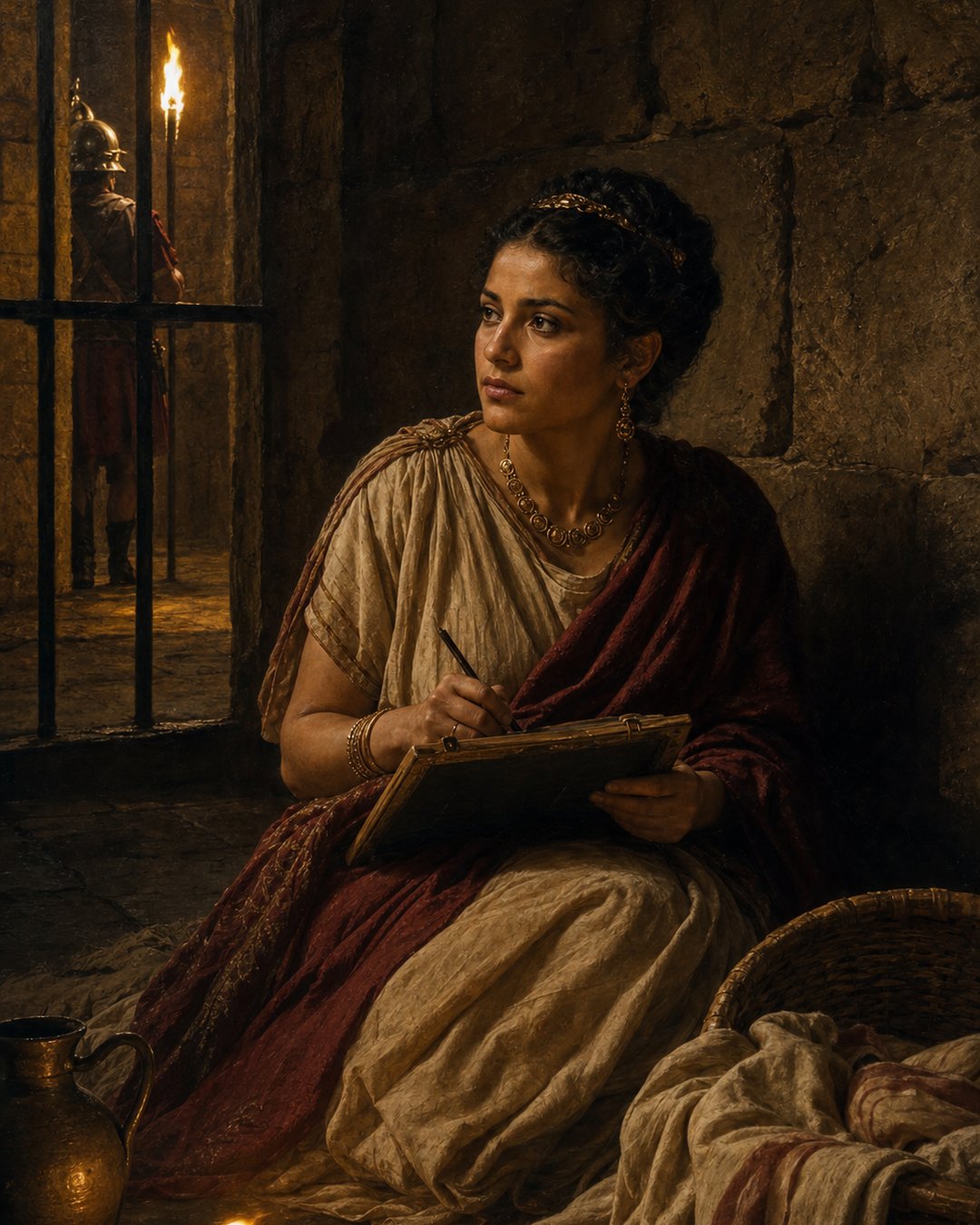
The account stops before the spectacle begins. Perpetua has described the darkness of prison, her hungry infant, her father at her feet, the crowded tribunal and a dream in which weapons bristled from a bronze ladder. Then she draws a boundary around her own voice. She has written as far as the day before the games; what happened in the arena, she says, must be written by someone else.
That sentence makes the Passion of Saints Perpetua and Felicity unlike a smooth legend told entirely from hindsight. An editor introduces the prisoners and later resumes the narrative, but the central section announces itself as Perpetua’s account, written in her own hand and words. The seams remain visible. A young woman condemned at Carthage in 203 CE appears both inside the story and among the people who shaped how it would survive.
Her pages do not offer a detached chronicle. They move through heat, fear, nursing, argument, dreams and legal confrontation. That closeness is precisely their historical force. The text lets us watch a Roman family and an imperial tribunal compete for obedience while Perpetua insists on naming herself.
The Editor Gives Perpetua the Centre of the Page
The framing narrator identifies the arrested catechumens as Revocatus, Felicity, Saturninus, Secundulus and Vibia Perpetua. Perpetua is described as nobly born, liberally educated, honourably married and about twenty-two years old. She has living parents, two brothers and a son still at the breast. Those details establish the social world that her decision will disrupt before her first-person voice begins.
The introduction then makes an unusually specific claim about authorship: the order of her martyrdom that follows was left written by her own hand and in her own words. Modern readers cannot inspect an autograph, and the surviving Latin has passed through copying and editing. The responsible conclusion is therefore narrow. The work presents its central prison narrative as Perpetua’s testimony and deliberately distinguishes it from the editor’s frame.
That distinction matters because ancient accounts of prosecutions often reach us through governors, historians or later admirers. The Lost Eagles article on Pliny and Trajan’s Christian trial procedure follows questions from the official side of the tribunal. Perpetua’s section reverses the angle. Procedure appears as interruption: guards seize a meal, a crowd gathers, a magistrate demands sacrifice and a sentence is pronounced.
The text is not a diary with a dated entry for every day. It is arranged memory, selecting exchanges and visions that explain identity under pressure. Yet the editor does not absorb that material into one anonymous voice. He preserves the handoff, allowing the reader to know when Perpetua is supposed to be speaking and when another witness has taken over.
Darkness, Heat and a Hungry Child Enter the Record
Perpetua’s prison begins with sensory shock rather than doctrine. She says she had never known such darkness. The day is bitter; the press of bodies creates great heat; soldiers handle the prisoners harshly. Her sharpest torment is anxiety for her infant. The setting is experienced through a young mother’s body and responsibilities, not described as a neutral stone room.
Two deacons, Tertius and Pomponius, pay so that the group can spend a few hours in a better part of the prison. There Perpetua nurses the child, who has grown faint with hunger. She speaks with her mother, strengthens her brother and entrusts her son to them. The passage records a small economy around confinement: money buys temporary movement, visitors carry care across the boundary and family members absorb work the prisoner can no longer perform alone.
She later obtains permission for the child to remain with her. Her health and anxiety improve so dramatically that she says the prison became a palace. Read carelessly, that line can flatten the scene into cheerful piety. Its force comes from what precedes it: darkness, heat, rough handling and a starving infant. “Palace” marks a change in her relation to the cell after the child arrives, not a claim that the dungeon itself became humane.
This bodily specificity also limits grand abstractions. Perpetua does not write as though conviction erased attachment. She pines because her family pines; she worries about nursing; she later grieves when the child is withheld. Resolve and distress occupy the same pages. The narrative’s authority grows from refusing to make courage emotionally simple.
A Bronze Ladder Converts Fear into a Route
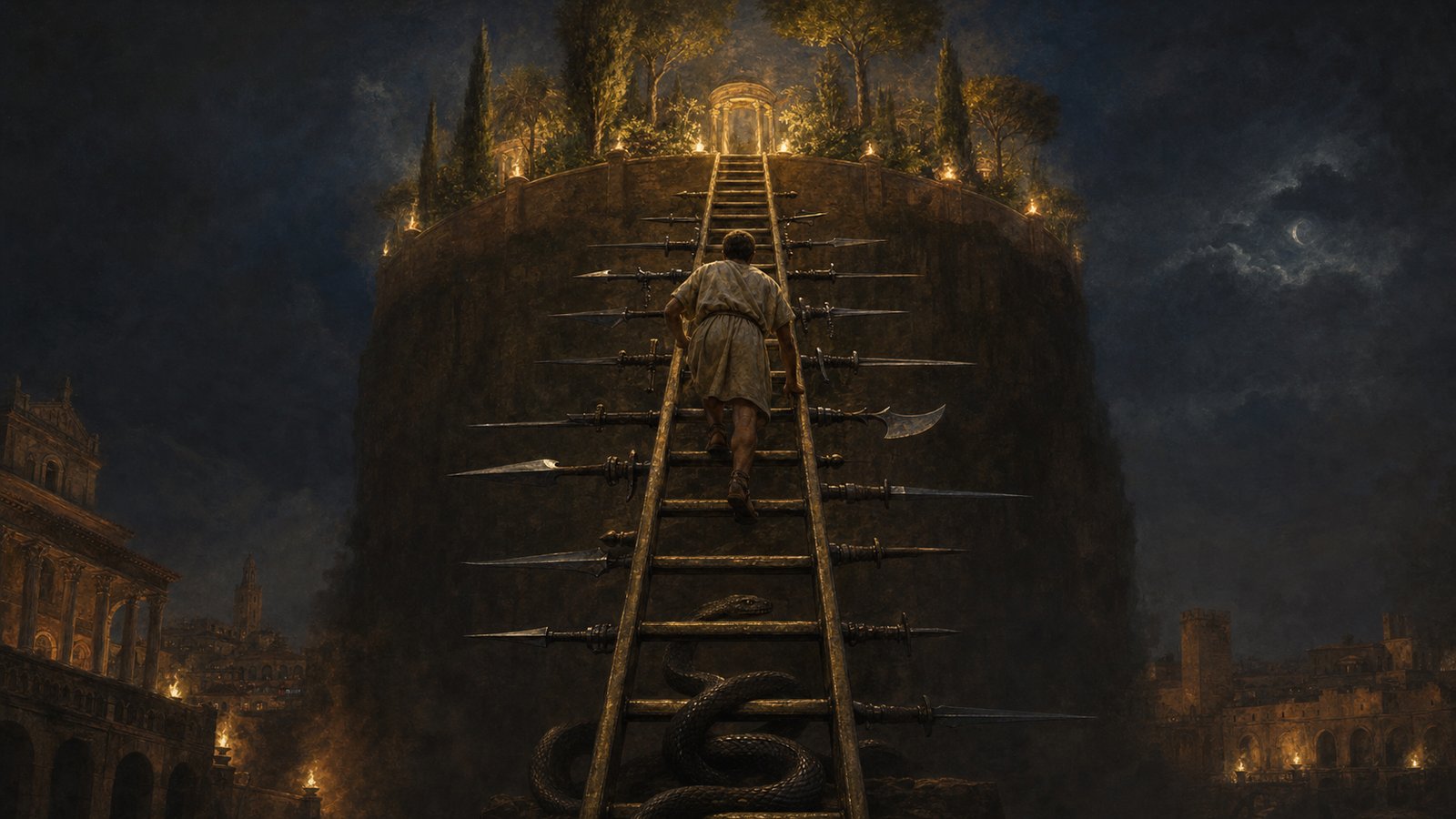
After her brother asks whether a vision might reveal deliverance or suffering, Perpetua reports a ladder of bronze reaching toward heaven. It is so narrow that only one person can climb at a time. Swords, spears, hooks and knives project from its sides. At the foot waits an enormous serpent, positioned to frighten anyone who attempts the ascent.
Saturus goes first and warns her about the serpent. Perpetua steps on its head, climbs past the iron and reaches a garden. There an elderly shepherd welcomes her and gives her a morsel of curd from the milk of his sheep. The surrounding multitude says amen, and she wakes with sweetness still seeming to remain in her mouth. She and her brother interpret the dream as confirmation of coming suffering rather than release.
The dream does not hide danger behind a vague glow. It gives danger edges, sequence and direction. The weapons punish anyone who looks away from the destination; the serpent blocks the first step; the ladder admits no crowd. A legal process controlled by soldiers and magistrates is recast as a route that she must climb deliberately. The vision cannot change the sentence, but within her narrative it changes who understands the journey.
Perpetua records other dreams, including two about her dead brother Dinocrates. In the first, the seven-year-old is thirsty beside a fountain whose rim is too high for him. After repeated prayer she sees him clean, comfortably dressed and able to drink from a cup that does not empty. These scenes are theological testimony, not evidence that a modern historian can use to map an afterlife. Historically, they show the images through which she organized grief, expectation and agency in confinement.
Her Father and the Tribunal Demand the Same Gesture
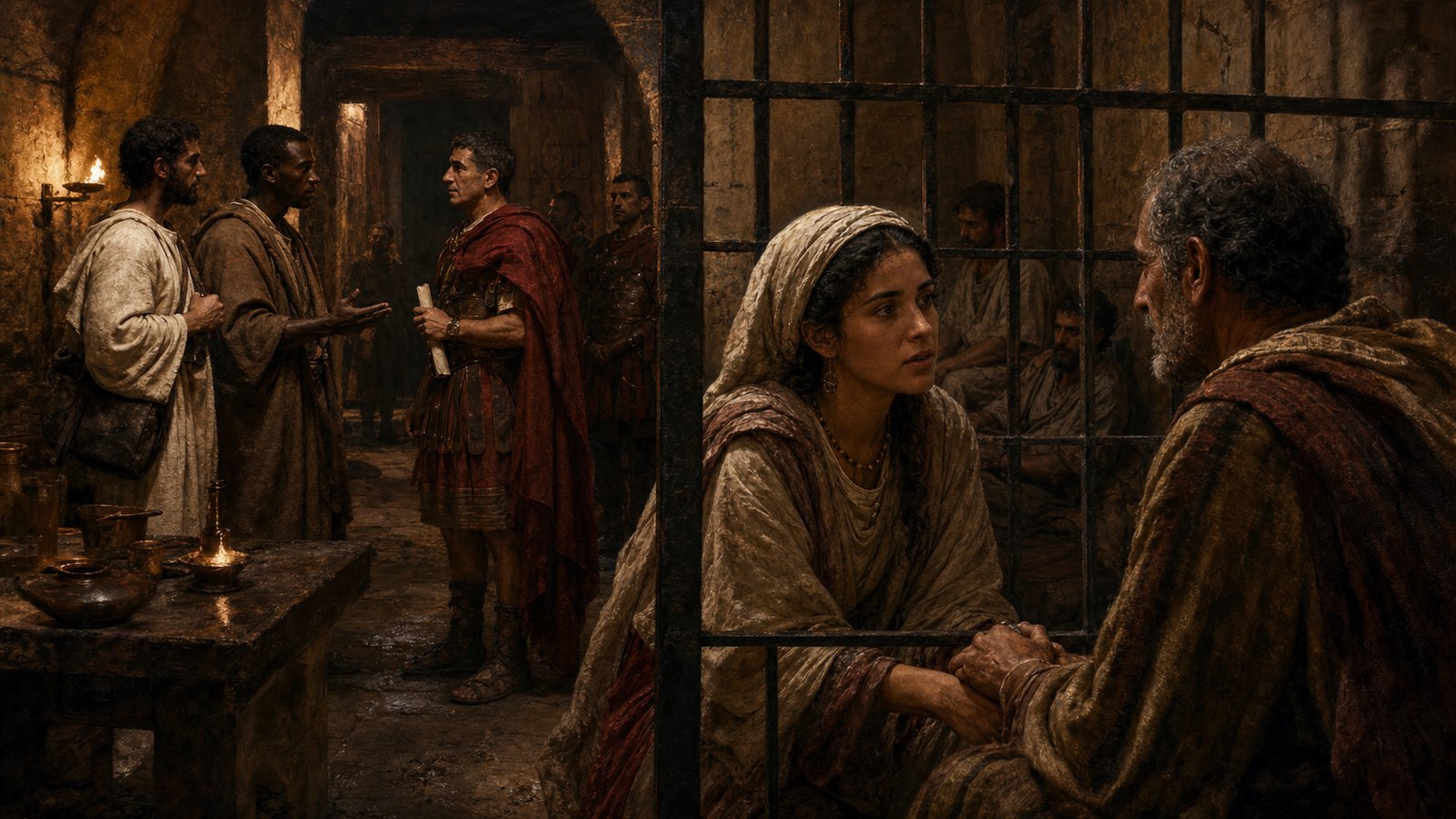
Perpetua’s father appears repeatedly, and the text gives his case emotional weight. He asks her to pity his grey hair, her mother, her brothers and the son who may not survive without her. He kisses her hands, falls at her feet and calls her “lady” rather than daughter. Perpetua says she is grieved because he cannot rejoice in what she believes is about to happen. The conflict is not written as indifference to him; it is painful because his love is real.
At the forum, private pleading and public authority converge. Her father arrives with the child and urges her to sacrifice. Hilarian, the official exercising judicial power, tells her to spare her father’s age and the infant’s youth, then orders sacrifice for the emperors’ welfare. Perpetua answers with the same identity formula that shapes the earlier family argument: she is a Christian.
The demand was politically legible as well as religious. Sacrifice for imperial welfare offered a public act by which the accused could demonstrate compliance. The magistrate does not need to settle every belief inside Perpetua’s mind; he needs the gesture. In the text, however, the gesture cannot be detached from the name she claims. The trial becomes a collision between an administrable action and an identity she will not rename.
Hilarian orders her father struck when he continues to intervene. Perpetua writes that the blow hurts her as though she had received it herself. He then condemns the group to the beasts. This sequence denies an easy opposition between a fearless believer and a disposable family. Roman authority reaches her through both judgment and the humiliation of a parent, and her account records both injuries.
The Last Line Preserves the Change of Witness
The day before the games, Perpetua narrates a final vision. Pomponius leads her through rough country to an amphitheatre, where she expects beasts but instead faces an Egyptian opponent. Helpers prepare her like an athlete, a master of gladiators offers a branch as the prize and she reaches the Gate of Life after victory. She interprets the opponent as the devil. The arena has become a contest whose meaning she can state before entering the real one.
Then her account ends on purpose. She says she has written up to the day before the games and leaves the deeds of the games to whoever will write them. The editor next includes a vision attributed to Saturus and eventually resumes in a third-person narrative of the executions. That architecture should make readers cautious. Perpetua’s reported experience, Saturus’s vision and the editor’s spectacle are connected, but they are not the same testimony.
The explicit boundary also places Perpetua beside other rare Roman voices that survive because a larger manuscript tradition carried them. The article on Sulpicia’s six short poems asks how a woman’s first-person speech persists inside a collected literary book. Perpetua’s case is different in genre and circumstance, yet both require attention to framing: whose “I” is speaking, who preserved it and where another voice begins.
Her legacy does not depend on pretending the document escaped all editing. It depends on noticing that the work itself wants the reader to see an authored centre. Inside it, prison is not merely the waiting room for an arena death. It is where Perpetua chooses episodes, names fear, interprets dreams and reports the pressure placed on her body and family.
The arena narrator can tell readers how she died. Perpetua’s section tells them how she understood the days before that death, and it stops before another person’s sight replaces her own. The seam is not a defect to be smoothed away. It is the feature that preserves her as more than a figure viewed from the crowd.