

Pliny the Younger had governed, prosecuted and pleaded cases, yet one set of hearings stopped him. Christians were being brought before him in Bithynia-Pontus, and he did not know what the governing rule was. Should age matter? Was renouncing the faith enough? Was the name itself punishable, or only crimes attached to it?
His answer was to interrogate the accused three times, threaten punishment and write to the emperor Trajan. The surviving exchange, Letters 10.96 and 10.97, is unusually revealing because neither man presents a polished law code. Pliny reports what he did, admits what he does not know and asks for direction. Trajan replies in a few compressed sentences.
The result was not religious toleration in a modern sense. People who persisted could be punished. Yet Christians were not to be hunted out, anonymous accusations were to be rejected and anyone who demonstrated that he was not Christian by worshipping Rome’s gods could obtain pardon. The procedure held severity and restraint in the same administrative frame.
A Governor Began by Admitting That He Did Not Know the Rule
Pliny opens his letter by saying that he had never attended examinations of Christians. That admission matters. He was not asking Trajan to confirm a familiar checklist. He was confronting a practice whose boundaries were uncertain even to an experienced senator serving as the emperor’s representative.
His questions were procedural before they were theological. He wondered whether distinctions should be made for age, whether repentance should protect an accused person and whether punishment attached to the Christian name or to offenses associated with it. Each uncertainty could change a verdict.
Roman provincial government often depended on this kind of judgment. Statutes, edicts, precedents and local custom provided frameworks, but governors still had to decide what a case in front of them required. Roman courts made disputes public through magistrates and procedure; they did not eliminate discretion.
Writing to Trajan moved the uncertainty upward. A decision made in one hearing could become guidance for the province, while the emperor could shape policy without issuing an exhaustive general code.
Three Questions Made Persistence Visible
Pliny describes a blunt test. He asked accused Christians whether they were Christian. Those who admitted it were questioned a second and third time, with punishment threatened. If they persisted, he ordered them punished. Roman citizens were marked for transfer to Rome rather than handled in exactly the same way locally.
The repeated question did more than collect information. It created opportunities to retreat. Persistence became an observable act performed before the governor, not merely a belief hidden in private. Pliny says that whatever the nature of their confession, stubbornness and inflexible obstinacy deserved punishment in his view.
That reasoning reveals the administrative problem. A governor expected an accused person to respond to lawful authority. Refusal made the hearing itself part of the alleged offense. The process could therefore punish defiance even while Pliny remained uncertain about what criminal act the Christian name proved.
His method also left room for denial. Some people on an accusation list said they had never been Christians; others said they had once belonged but had stopped. Pliny needed a way to distinguish a usable renunciation from a convenient answer.
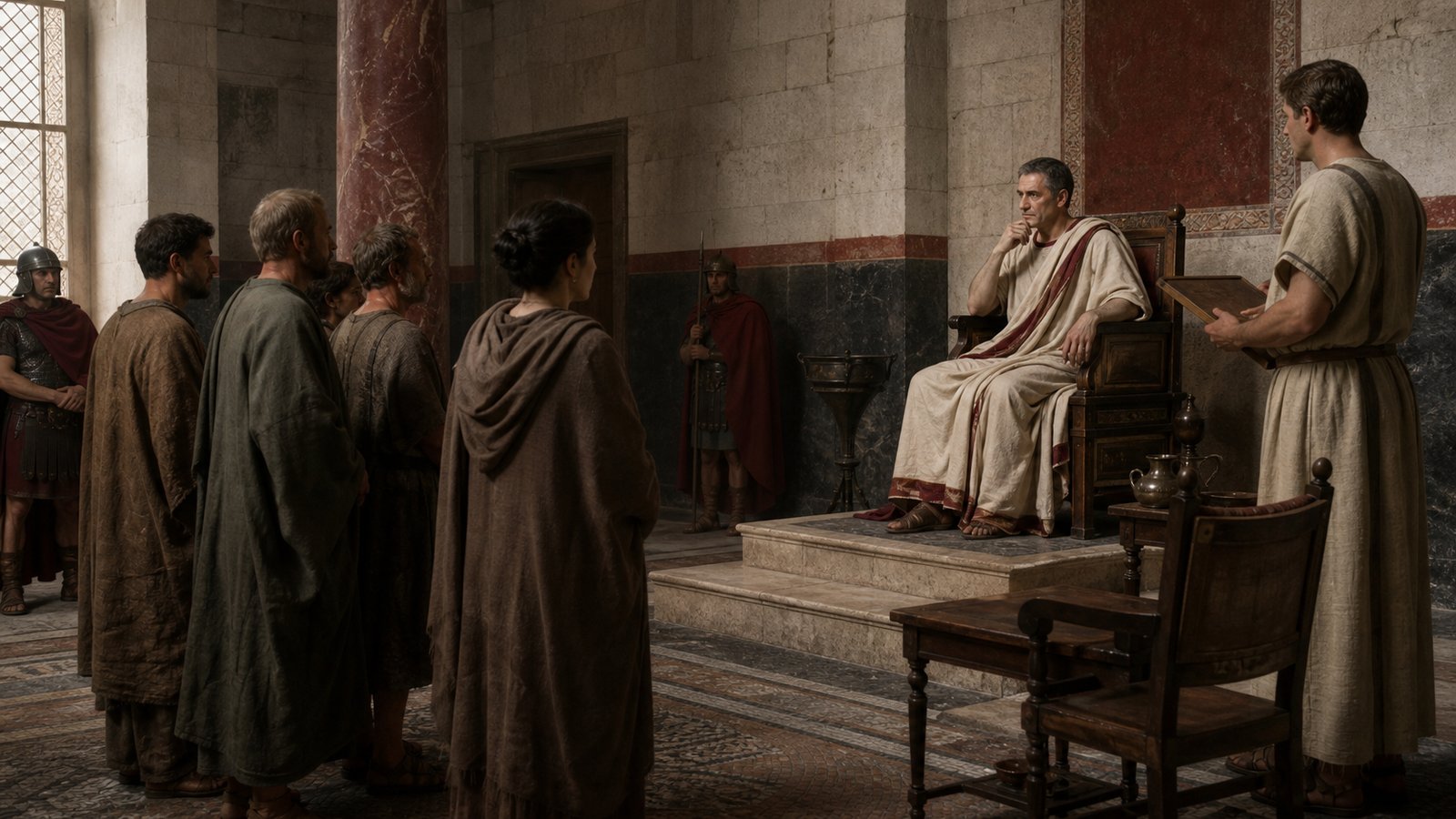
Incense, Wine and a Curse Became the Test of Renunciation
Pliny ordered those who denied the accusation to invoke the Roman gods, offer incense and wine before images he had arranged—including an image of Trajan—and curse Christ. He had been told that genuine Christians could not be compelled to perform those acts, so ritual became evidence.
This was not a private questionnaire about conscience. Bodies, words and offerings made loyalty visible in the hearing room. A person who completed the test was dismissed. The governor treated public action as more administratively useful than an invisible claim about inner belief.
The imperial image added a political dimension, but the letter does not say that every Christian had been accused of plotting against Trajan. Rather, reverence before the image was one component of a broader demonstration that the accused could participate in authorized cult.
The episode belongs beside other Roman systems that turned status into a public act. Official communication relied on visible forms and recognized authorities. Here, sacrifice and speech converted disputed identity into a decision the governor could record.
Pliny Investigated Meetings Before Dawn
Former adherents told Pliny that their practice had been to meet on a fixed day before dawn and sing responsively to Christ as to a god. They bound themselves by an oath, they said, not to crimes but to avoid theft, robbery, adultery, broken promises and refusal to return entrusted property.
Afterward they separated and later gathered to eat ordinary, harmless food. Pliny connects changes in their meetings with his own edict restricting associations. The account is filtered through people trying to satisfy a governor, so it cannot be read as an untouched transcript of worship. It still gives rare administrative testimony about what officials heard Christians say they did.
To test the evidence further, Pliny says he tortured two enslaved women called ministers or deaconesses. The detail exposes the violence inside the inquiry. Their gender, enslaved status and community role made them available for coercive examination in a way elite citizens were not.
Pliny concluded that he found what he called a depraved and excessive superstition. Even so, the large number of people implicated across towns, villages and countryside persuaded him to suspend proceedings and seek the emperor’s judgment.

Trajan Refused Both a Hunt and an Anonymous Shortcut
Trajan praised Pliny’s handling of the cases but immediately warned that no universal rule could be laid down for every circumstance. His answer was practical: Christians were not to be sought out. If formally accused and proven guilty, they were to be punished. If they denied the identity and proved it by worshipping the gods, repentance brought pardon.
The rule did not remove danger. A known Christian who persisted still faced punishment. Nor did it recognize freedom of religion as a general right. The restraint lay in enforcement: no official search and a path out through public renunciation.
Trajan was firmer about anonymous accusations. Unsigned lists were not to be accepted in any charge, he wrote, because they set a bad example and did not belong to the spirit of his age. The statement protected procedure from a tool that could turn private hostility into punishment without an accuser accepting responsibility.
That concern echoed a wider Roman fear of accusation becoming a political weapon. The prosecution of Verres showed how names, testimony and public responsibility shaped a Roman case. Trajan’s answer did not make accusation safe, but it rejected anonymity as a legitimate foundation.
A Short Rescript Left a Long Administrative Shadow
The exchange survives because Pliny’s tenth book preserves correspondence from his governorship. It captures government in motion: a local docket becomes a letter, the letter reaches the emperor and a brief reply returns as a rule for future handling.
It would be a mistake to treat Trajan’s response as a complete legal settlement for every later persecution. Provincial conditions, emperors and enforcement changed. Trajan himself said that no fixed universal formula could cover all cases. The value of the exchange is precisely that it preserves limits and improvisation rather than a timeless code.
Pliny’s letter also warns against reading administration as neutral paperwork. His procedure included threats, executions and torture. The clean sequence of questions and written answers imposed order on coercion; it did not remove coercion from the system.
Yet the correspondence did restrain two routes to escalation. Officials were not instructed to conduct a hunt, and anonymous denunciation was excluded. Between those boundaries stood the accused person, required to perform loyalty or persist at grave risk. One governor’s uncertainty had become an imperial procedure, but not a comfortable resolution.