
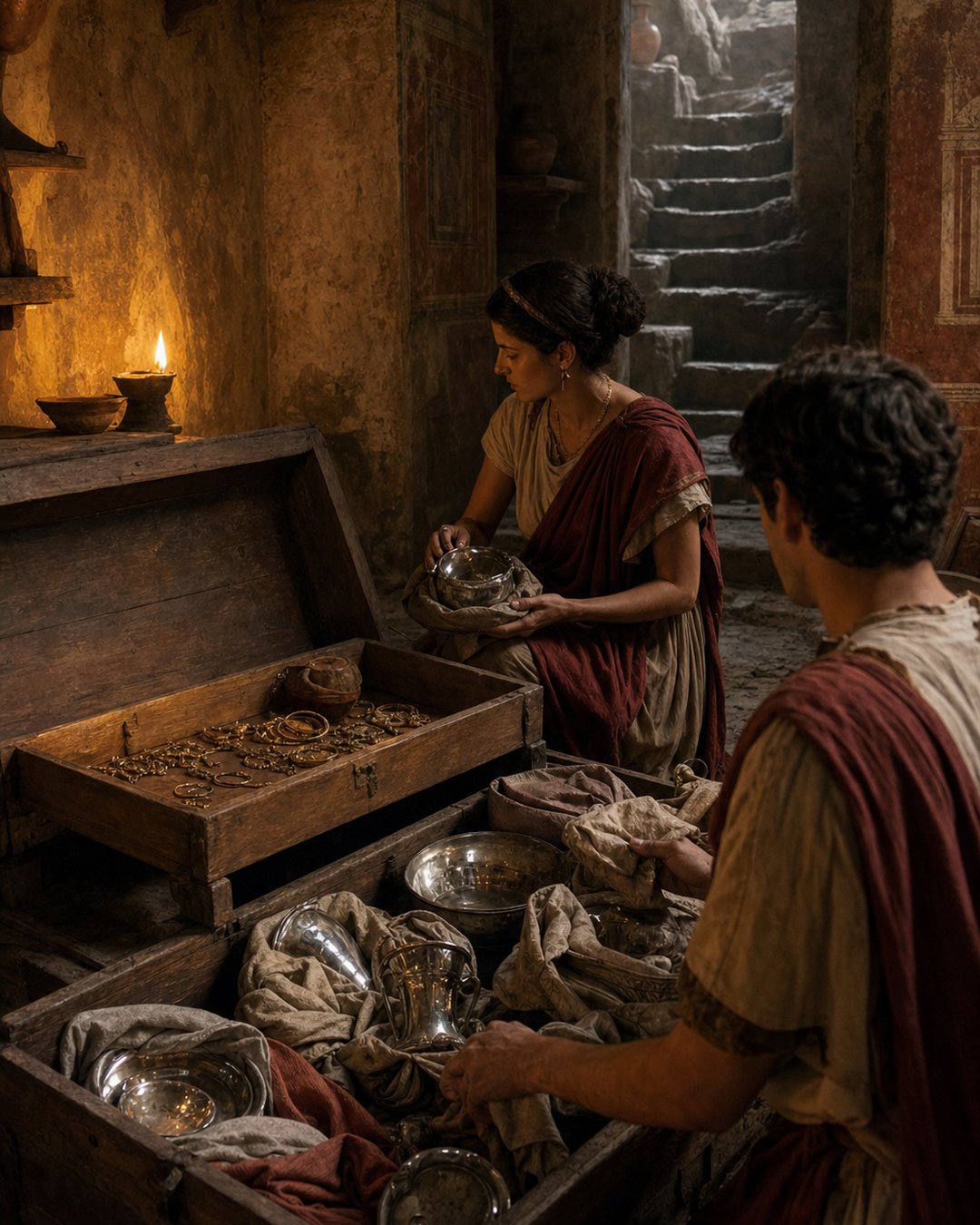
The silver did not glitter when excavators reached it in December 1930. In a cellar of Pompeii’s Casa del Menandro, 118 pieces of plate had been wrapped in textiles and lowered into the bottom of a wooden chest. A second box rested above them. It held gold jewellery, precious stones, wire and coins. The arrangement looked intimate enough to invite a family story—and orderly enough to make that story dangerously easy to overstate.
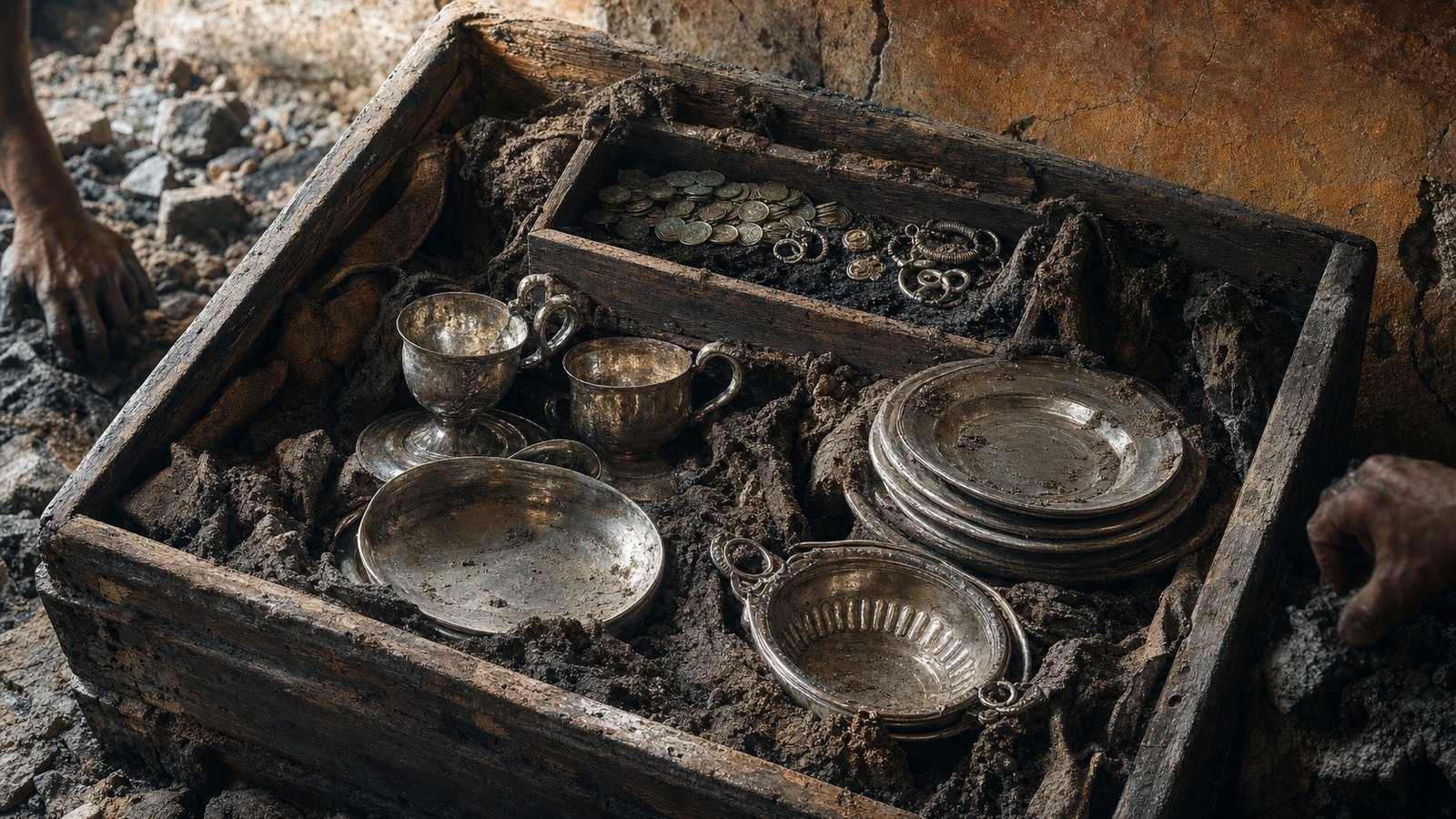
The numbers are extraordinary. The plate had a bullion value above 35,000 sesterces. The smaller box contained 20 pieces of jewellery and 46 coins worth 1,432 sesterces, including thirteen gold aurei from the Neronian or Vespasianic periods. Cups and plates repeated in pairs and groups. One modern reconstruction asks whether these vessels formed a complete dining service for eight.
Yet the treasure does not disclose a single owner. Adult and child sizes appear among the jewellery; some rings could fit a man. Names on cups may belong to earlier owners. Even the moment when the small box entered the larger chest is unknown. Proper excavation made the questions sharper, not the answers automatic.
The Cellar Preserved a Nested Deposit
The House of Menander is a large Pompeian residence named for a painted image of the Greek playwright. Its decoration and scale create an immediate impression of elite life, but the treasure’s archaeological force comes from a less theatrical room. Excavators found the plate in a cellar, enclosed by a wooden chest rather than arranged in a dining room.
Textiles wrapped the 118 silver vessels at the bottom. Above them sat a separate container holding jewellery, gold wire and coins. That nested placement establishes physical association at discovery: the boxes occupied one deposit. It does not prove that every object had always belonged together or that one person owned them all.
This distinction separates the Menander silver from treasures whose findspots were poorly recorded or disturbed. The modern study reviewed by Bryn Mawr Classical Review stresses that the objects were properly excavated, unlike several other famous assemblages of early Roman plate. Location, packaging and relative placement survived as evidence alongside the metal.
Pompeii often tempts us to treat AD 79 as a perfect freeze-frame. Herculaneum’s sewer preserves consumption only after archaeology sorts deposits by context. The Menander cellar demands the same discipline. Burial by eruption explains survival; it does not explain every decision that placed each cup, ring and coin inside the chest.
Repeated Cups and Plates Suggested Eight Places
The plate was not a matched modern dinner service purchased at one moment. It contained vessels of different ages and styles. Roman households could combine inherited, acquired and replaced pieces, so completeness cannot be judged by identical decoration alone. The useful patterns lay instead in quantities and functional groups.
Scholars identified seven pairs of cups plus a singleton probably once paired. A heavier eating service contained twelve plates divided by size into three groups of four. A lighter group included a large serving plate and sixteen additional plates arranged in four size-groups of four. Smaller bowls and shared serving vessels added other repeated units.
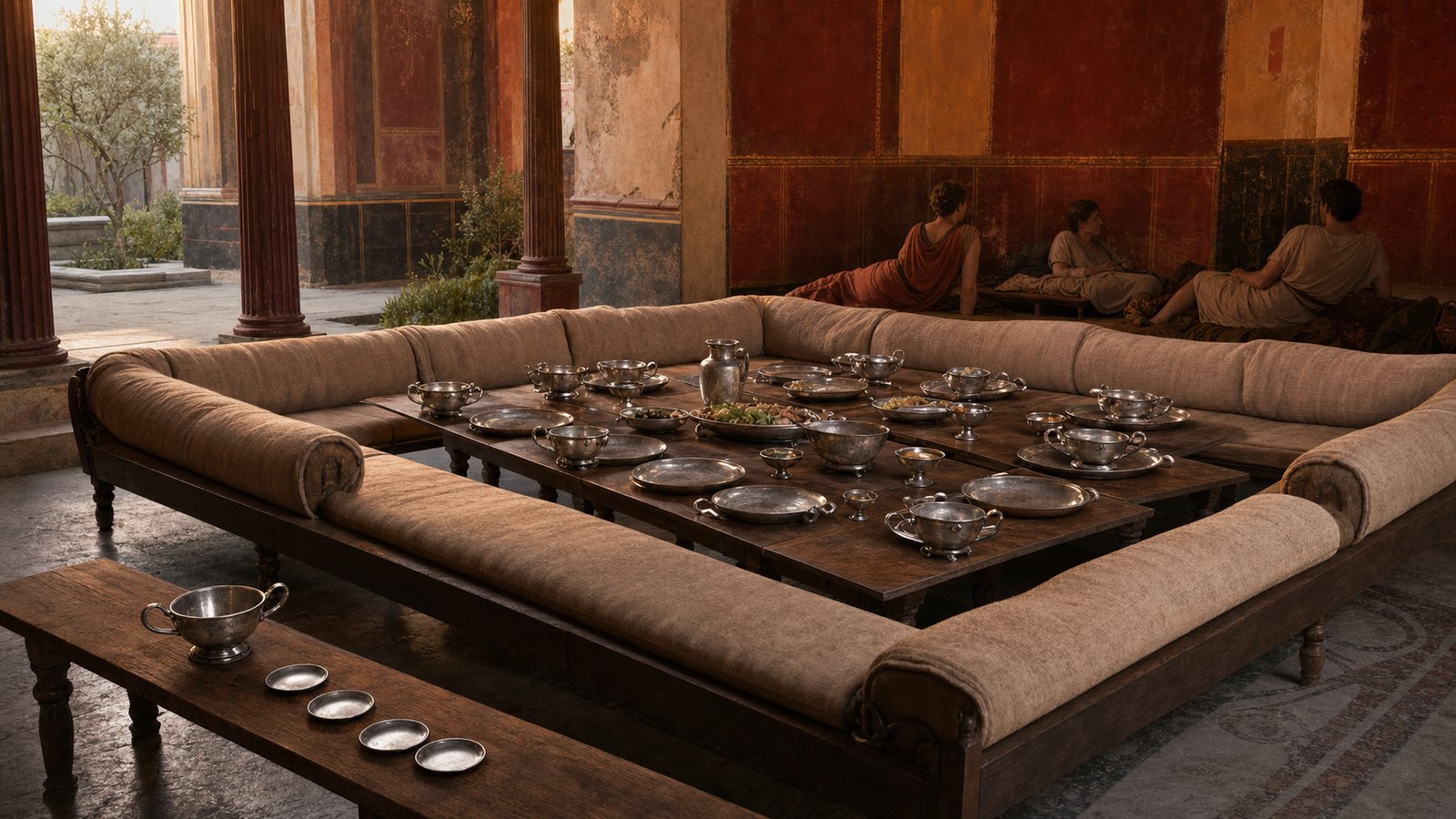
Kenneth Painter proposed that the assemblage could serve eight diners. In that model, each person received two cups and three plates—small, medium and large—while serving and sauce vessels were shared by pairs or groups of four. Eight small stemmed bowls might have given every diner an individual sauce dish.
The proposal solves much but not everything. Four tiny plates must be treated as saucers to reach the expected total of 24 dining plates. One pair of cups differs notably in size and design. The path imagined for wine—from mixing vessel through larger and smaller containers to drinking cups—may involve an unnecessary transfer. A coherent reconstruction remains a hypothesis tested against awkward pieces.
Bullion Measured Wealth Better Than Identity
The silver’s bullion value exceeded 35,000 sesterces before any value for workmanship was added. That figure establishes a major concentration of wealth. Engraving, shaping and artistic labour would have increased the real cost, but cannot be calculated with the same confidence. Metal can be weighed; prestige is harder to price.
Earlier interpretation attached the house and treasure to the gens Poppaea and imagined a relative of an emperor’s wife. Later study retreats from that precision. The strongest responsible description is an unknown rich Campanian, perhaps of the social level that produced municipal magistrates. A grand assemblage supports status without supplying a name.
The caution is not pedantry. Names inscribed on vessels need not identify their final owner. Silver passes through gifts, inheritance, purchase and resale. A bronze seal found elsewhere had helped construct the Poppaean connection, but it did not come from the plate itself. Even ownership of a house does not logically guarantee ownership of every valuable stored inside it.
Eumachia’s building in Pompeii made a woman’s public name architectural evidence. The Menander silver works differently. Its wealth is unmistakable while its personal attribution remains unstable. One monument announces identity; one cellar assemblage warns how quickly identity can be projected onto expensive things.
The Smaller Box Refused a Single Family Portrait
The jewellery initially seemed to offer a shortcut. Twenty pieces made of gold and precious stones lay with wire and money. Earlier scholarship assigned them to a woman in Quintus Poppaeus’s family and treated the coins as her modest funds. Measurements and comparison weakened that tidy portrait.
Some pieces fit adults, some children, and some rings are heavy enough for a man. They could represent one woman retaining childhood ornaments and family mementos, one man preserving pieces associated with a wife and child, or several owners. The objects establish a household range of bodies more readily than one biography.
The 46 coins also resist gendered interpretation. Their total of 1,432 sesterces placed the group toward the high side of money hoards found in Pompeian houses, though not beyond comparison. Thirteen were aurei; most of the rest were Republican or Imperial denarii. Value does not transform currency into a label saying “woman’s money” or “household head.”
Nor can excavators prove when the jewellery box entered the silver chest, where the chest stood at that moment, or when it moved to the cellar. The owners of box and plate may have been the same, related, or merely connected by safekeeping. Physical nesting records the final arrangement before burial, not the entire history of possession.
A Dinner Service Can Be Complete While Its Story Is Not
The proposed service for eight creates one final puzzle. A conventional triclinium accommodated nine diners on three couches. Eight settings fit imperfectly. Painter suggested that the silver may instead have served diners on a curved stibadium, possibly in a more informal outdoor setting where groups of five to nine were workable.
Other explanations remain open. Vessels made from different materials could have filled gaps. The plate may not have been in current use at all; it could have awaited resale, redistribution or reworking. The cellar position may reflect security during disruption, ordinary storage or a late decision made before the eruption. No surviving instruction selects one option.
This uncertainty makes the find more valuable, not less. The plate reveals how a wealthy Roman service accumulated across styles, how repeated numbers can imply dining practice and how bullion stores value. The jewellery and coins reveal multiple ages, currencies and possible owners. The excavation reveals how those groups were packed together at one recoverable moment.
The Casa del Menandro chest therefore offers no effortless photograph of a Pompeian family’s final meal. It offers a disciplined reconstruction with visible seams. Eight settings are plausible; an affluent Campanian owner is plausible; intentional cellar storage is certain only at the point of discovery. Archaeology succeeds here by preserving the difference between what 118 silver objects demonstrate and what even the richest assemblage cannot say.