
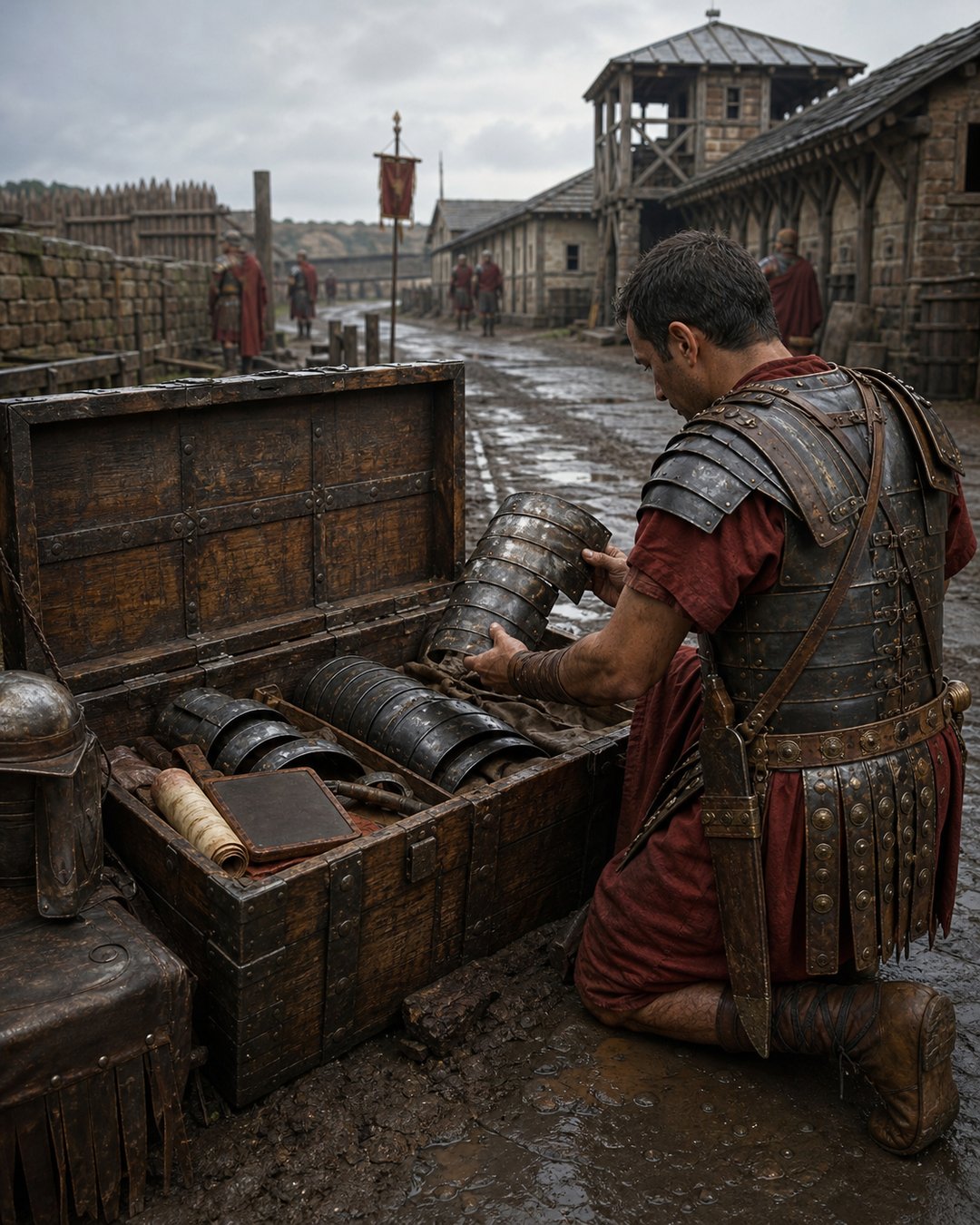
In 1964, excavators beside the headquarters building at Roman Corbridge met iron before they understood the object around it. The metal belonged to a chest whose timber and leather had mostly yielded to the ground. Inside lay armour plates, weapons, tools, writing materials and the compressed traces of things that ordinarily disappear. It did not resemble a soldier standing ready for inspection. It resembled a workshop interrupted and packed away.
The most consequential pieces were fragments of articulated plate armour now called lorica segmentata. Sculptures had long shown banded defences on Roman soldiers, yet an image cannot explain every hinge, strap and fastening hidden beneath an arm or shoulder. Corbridge preserved those engineering relationships. Rust also mineralised scraps of leather and rope beside the iron, retaining evidence that bare plates alone could never provide.
The chest dates to roughly AD 122–138, the first decades after work began on Hadrian’s Wall. Its owner never returned, if English Heritage curators are right that burial was intended as safekeeping. Nearly two millennia later, the failure to retrieve one box gave archaeologists enough physical grammar to assemble a type of Roman armour for the first time.
The Find Looked More Like Storage Than a Display
Corbridge, the Roman Coria, was more than a fort at the edge of empire. English Heritage records more than 50,000 objects from a settlement occupied for about 350 years, with soldiers and civilians, workshops, imported goods and religious dedications sharing the same landscape. The hoard came from a road beside the principia, the military headquarters, in a phase when a fort still occupied the site.
The container was an iron-bound wooden chest covered in leather. That construction mattered twice. It made the box strong enough to receive a dense mixture of metal objects, and its iron fittings helped preserve neighbouring organic material as mineralised traces. Wood, rope and straps usually vanish in British soil; at Corbridge, corrosion captured portions of their forms.
English Heritage dates the contents to approximately AD 122–138. That range belongs to a frontier being reorganised around Hadrian’s Wall rather than to the wall’s most familiar later ruins. The date makes the chest evidence for soldiers and craftspeople living through a period of construction, supply and institutional change, not a timeless display of “Roman kit.”
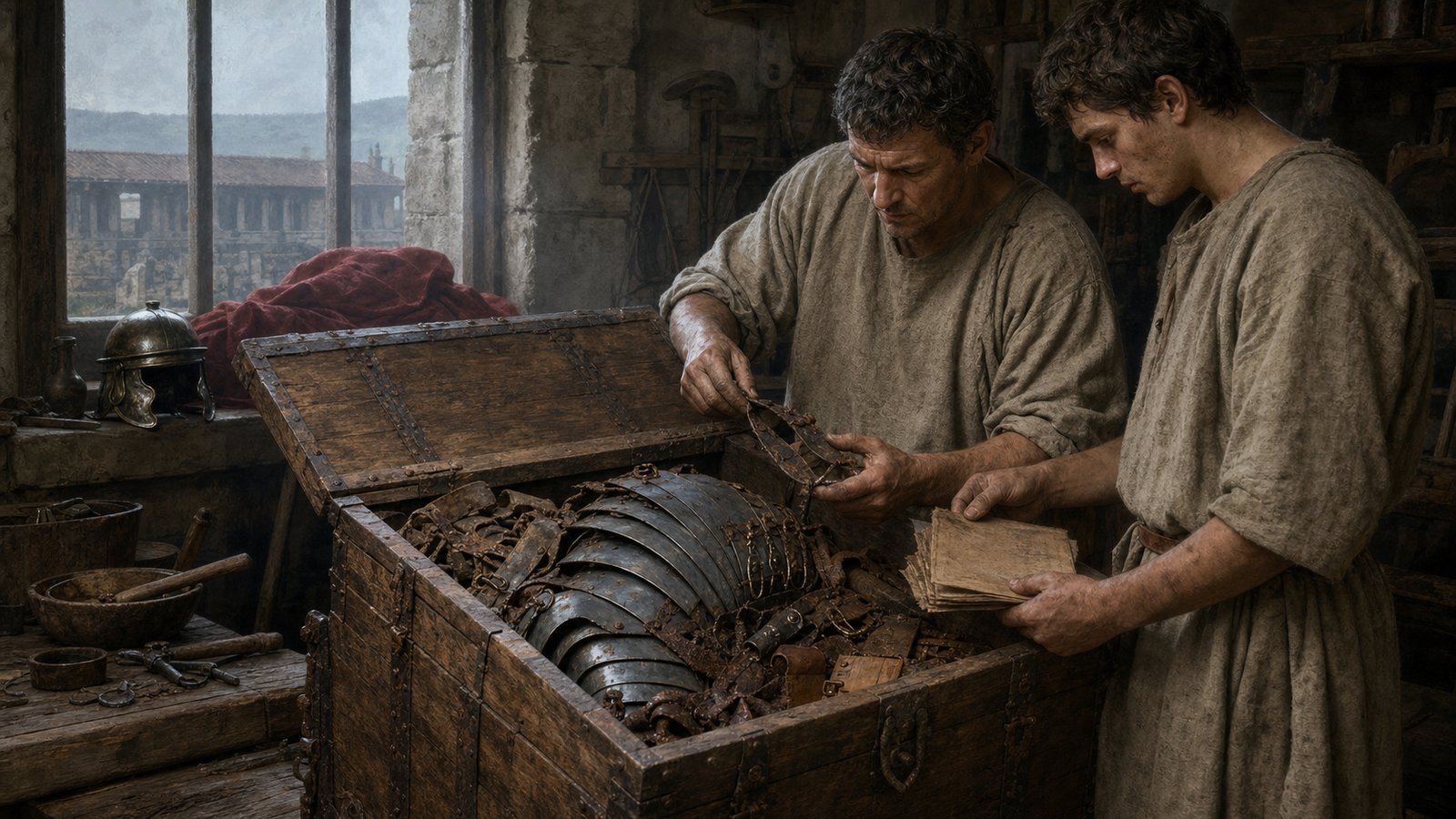
Its contents were heterogeneous: armour, tools, weaponry, wax writing tablets and papyrus, described by the site’s curators as both workshop material and a soldier’s worldly goods. The mixture resists the tidy categories of a museum case. Writing sat with fighting equipment; repair tools sat with personal possessions. The box records a working environment where maintenance, administration and military readiness touched one another.
Articulated Plates Needed the Missing Soft Parts
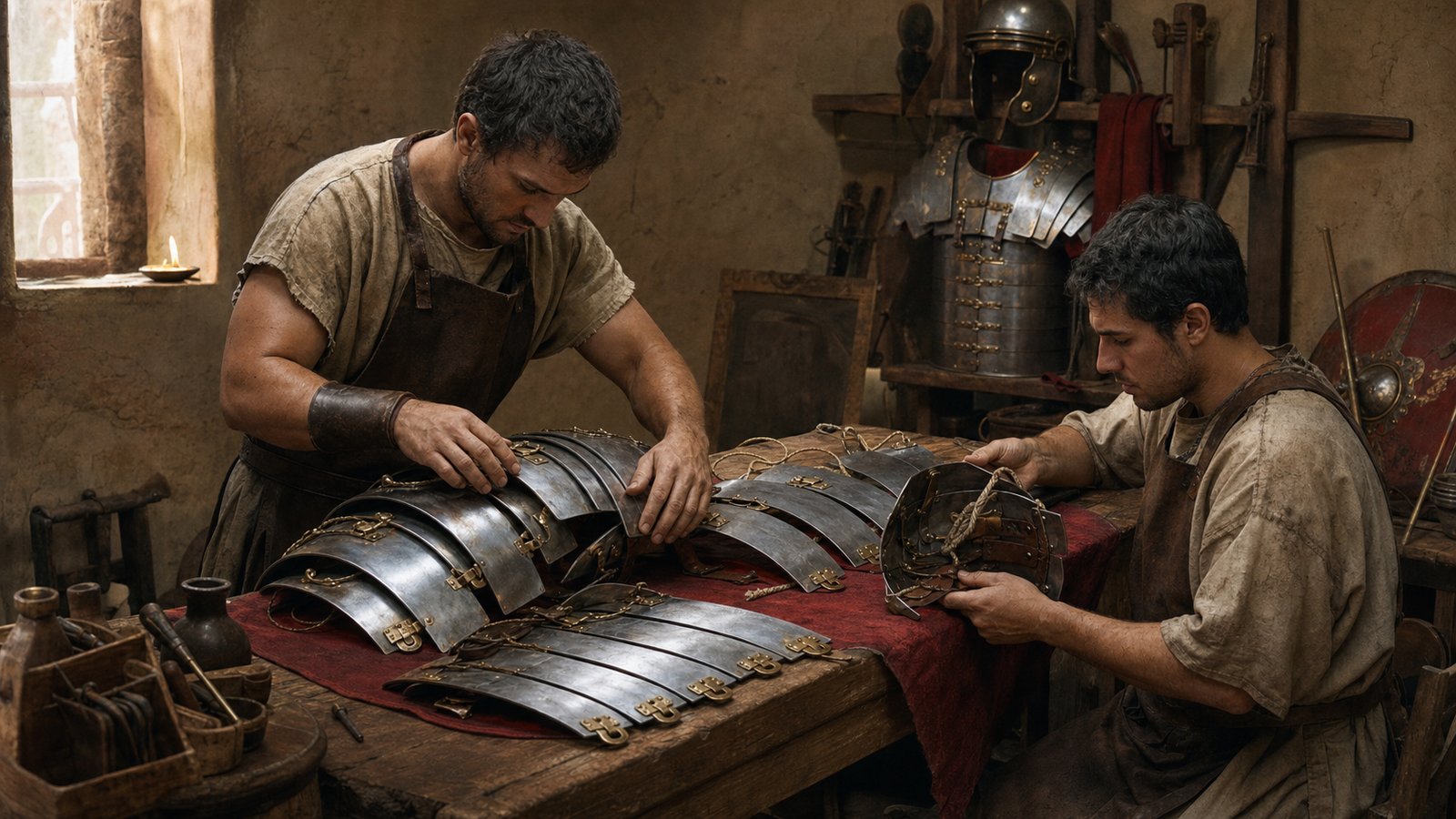
Lorica segmentata is built from curved iron plates arranged to overlap while allowing the torso and shoulders to move. The surviving metal can suggest the broad silhouette, but plates do not articulate by themselves. Their positions depend on internal leather, hinges, buckles, hooks and ties. Lose those relationships and a pile of iron offers several plausible but incompatible reconstructions.
The Corbridge armour retained intricate fittings and traces of leather and textile. According to English Heritage, those remains showed how the components had been assembled and made accepted reconstructions possible. The crucial discovery was therefore relational. A hinge mattered because of the plates it joined; a mineralised strap mattered because it fixed spacing and movement; repeated fittings showed where separate sections behaved as one system.
This is why a chest of dismantled material could be more informative than an artistic image of complete armour. A relief presents the surface chosen by a sculptor. Excavated hardware exposes the concealed decisions of armourers: where weight was carried, how a shoulder section opened, and which connections needed flexibility rather than rigidity. Corbridge supplied evidence at the scale of manufacture.
The frontier has preserved similarly intimate military evidence in other forms. The Vindolanda tablets retain requests, lists and private messages that official monuments omit. Corbridge performs the same correction for equipment. Instead of an ideal legionary, it gives us plates taken apart, fittings under strain and objects waiting for another working day.
Rust Preserved What Excavation Usually Loses
Iron corrosion is destructive, but under particular conditions it can replace or coat organic fibres with mineral products. English Heritage notes that iron from the armour and weapons preserved rare traces of leather and rope. The process did not save supple straps that could simply be buckled again. It saved enough structure for excavators and conservators to recognise materials and positions.
That distinction guards against an easy fantasy. The suit visible in a modern reconstruction is not the object exactly as it left the soil. It is an argument built from excavated plates, surviving fittings, mineralised organics and comparison. Corbridge’s strength lies in constraining the argument. It reduced the number of ways the evidence could responsibly be assembled.
The original excavation context adds further value. The armour did not arrive through the art market stripped of its surroundings. Film from the 1964 work survives, and the findspot beside the headquarters road is recorded. Container, contents and location can therefore be studied together. Context turns a collection of attractive fragments into evidence for an action: objects were gathered, enclosed and placed underground.
Even so, archaeology cannot identify every motive. A buried box may represent emergency concealment, planned storage, disposal or material reserved for repair. English Heritage curators favour safekeeping until the owner could retrieve it. Their conclusion remains an interpretation rather than a recovered note. What the chest establishes securely is the deliberate concentration and protection of useful material.
A Workshop Chest Complicates the Standard Legionary
Modern illustrations often turn Roman armour types into fixed uniforms: one century, one soldier, one complete suit. The Corbridge chest points toward a messier system. Parts could be disassembled. Fittings and organic supports could fail. Metal remained valuable even when a complete defence was not ready to wear. A frontier garrison required people who could inspect, sort and restore equipment.
The broader Corbridge collection supports that industrial setting. Evidence survives for metalworking, pottery, bone working, glass production, masonry and carpentry. Imported pottery from North Africa, olive oil from Spain and figurines from France show that this was not an isolated camp living only from local scraps. Repair took place within a settlement tied to long-distance supply and specialised labour.
The chest’s writing tablets and papyrus belong inside this picture rather than outside it. Equipment had to be counted, issued, requested and moved. Roman tablets made records portable, while a box such as this made tools and material physically portable. Administration and maintenance were different operations, but the same frontier depended on both.
Nor should the armour be treated as the sole valuable object while everything else becomes packing. The mixed contents explain the armour’s world. Tools indicate work; weapons indicate military use; writing material indicates transactions or memory; personal possessions indicate an owner whose life exceeded one battlefield role. Archaeological significance emerges from the assemblage, not just its most recognisable plates.
The Owner Vanished, but the Assembly Logic Remained
English Heritage’s current interpretation is that the material was buried for protection and meant to be reclaimed. No owner returned. The statement is appropriately cautious: the chest contains no readable label explaining the decision, and the range of objects does not reveal one named individual. Safekeeping fits the robust container and useful contents, but absence prevents certainty.
Whatever caused that absence, it froze a practical moment. Armour was not posed on a body. It was stored among the means of repair and the paperwork of frontier life. The resulting disorder became analytical order only after careful excavation, conservation and comparison. Plates that were useless as a costume became exceptionally useful as evidence.
The siege deposits beneath Dura-Europos preserve warfare through bodies, tunnels and residue. Corbridge preserves another scale of military history: the bench, strap, box and inventory behind a soldier’s protection. Both sites are powerful because material remains interrupt the clean narratives written after events.
The chest ultimately taught archaeologists how to rebuild armour by showing what rebuilding had to respect. Curved plates alone were never the answer. Their hinges, internal supports, sequence and flexibility formed the defence. One forgotten deposit beside a headquarters road preserved those dependencies long enough for modern hands to read them—and turned an abandoned repair stock into the clearest lesson in how legionary plate armour held together.