
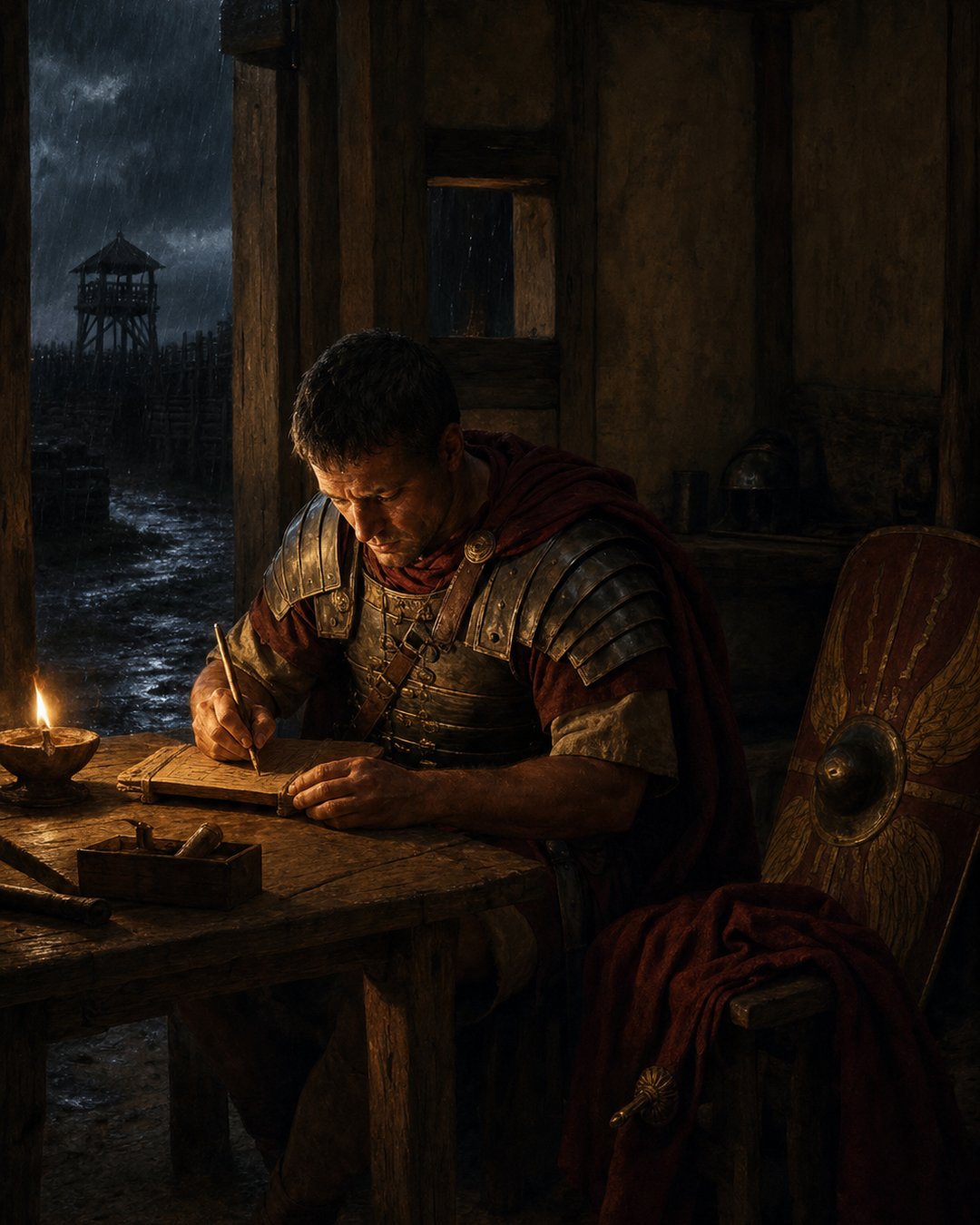
Vindolanda changes the scale of Roman history. From far away, the northern frontier looks like walls, forts, roads, and imperial policy. Up close, it becomes ink on thin wood: a birthday invitation, a supply request, a name, a greeting, a complaint, a list. The tablets from Vindolanda reveal Rome at the edge not as an abstract machine, but as a community that had to write things down to keep itself alive.
Vindolanda was a Roman fort and settlement south of Hadrian’s Wall in northern Britain. The famous writing tablets survived because damp, oxygen-poor conditions protected scraps that normally would have vanished. Their survival is almost accidental, but their meaning is enormous. They let us hear the frontier in the small administrative and social sounds that stone ruins cannot preserve.
The frontier was made from messages
Armies do not live by swords alone. They need shoes, grain, beer, animals, assignments, leave, reports, and relationships. The Vindolanda tablets show that frontier life depended on writing because distance creates friction. A commander needed information. A household needed supplies. A friend needed an answer. A soldier needed routine to become order.
This makes the edge of empire feel less empty. Hadrian’s Wall, begun after Hadrian’s visit to Britain in AD 122, is the monumental image. Vindolanda’s tablets are the working texture around that image. Before stone and turf become symbols, people have to move messages through mud, weather, and military hierarchy.
A birthday invitation makes the empire intimate
One of the most famous tablets is the invitation from Claudia Severa to Sulpicia Lepidina. It asks Lepidina to come to a birthday celebration. The reason this small document matters is not that birthdays were unusual. It matters because it brings domestic life into a place modern imagination often fills only with soldiers and wind.
The tablet also gives names and relationships. Sulpicia Lepidina was connected to the household of Flavius Cerialis, a commander at Vindolanda. Claudia Severa’s invitation shows elite women participating in the social life of the frontier. Rome’s edge was not simply a masculine line of shields. It contained households, visits, handwriting, hospitality, and expectation.
Thin wood preserved what stone usually hides
Stone inscriptions often tell us what people wanted to make permanent. The Vindolanda tablets preserve what was ordinary enough to be discarded. That difference is crucial. A public inscription polishes memory. A writing tablet can catch administration in motion: a list before it is archived, a note before it is forgotten, a request before it is answered.
The material itself matters. These were not grand books. They were thin wooden leaves, practical and portable. In the wet ground of northern Britain, they became accidental witnesses. The empire appears there as something handled, scratched, folded, sent, read, and thrown away.
Administration made remote rule possible
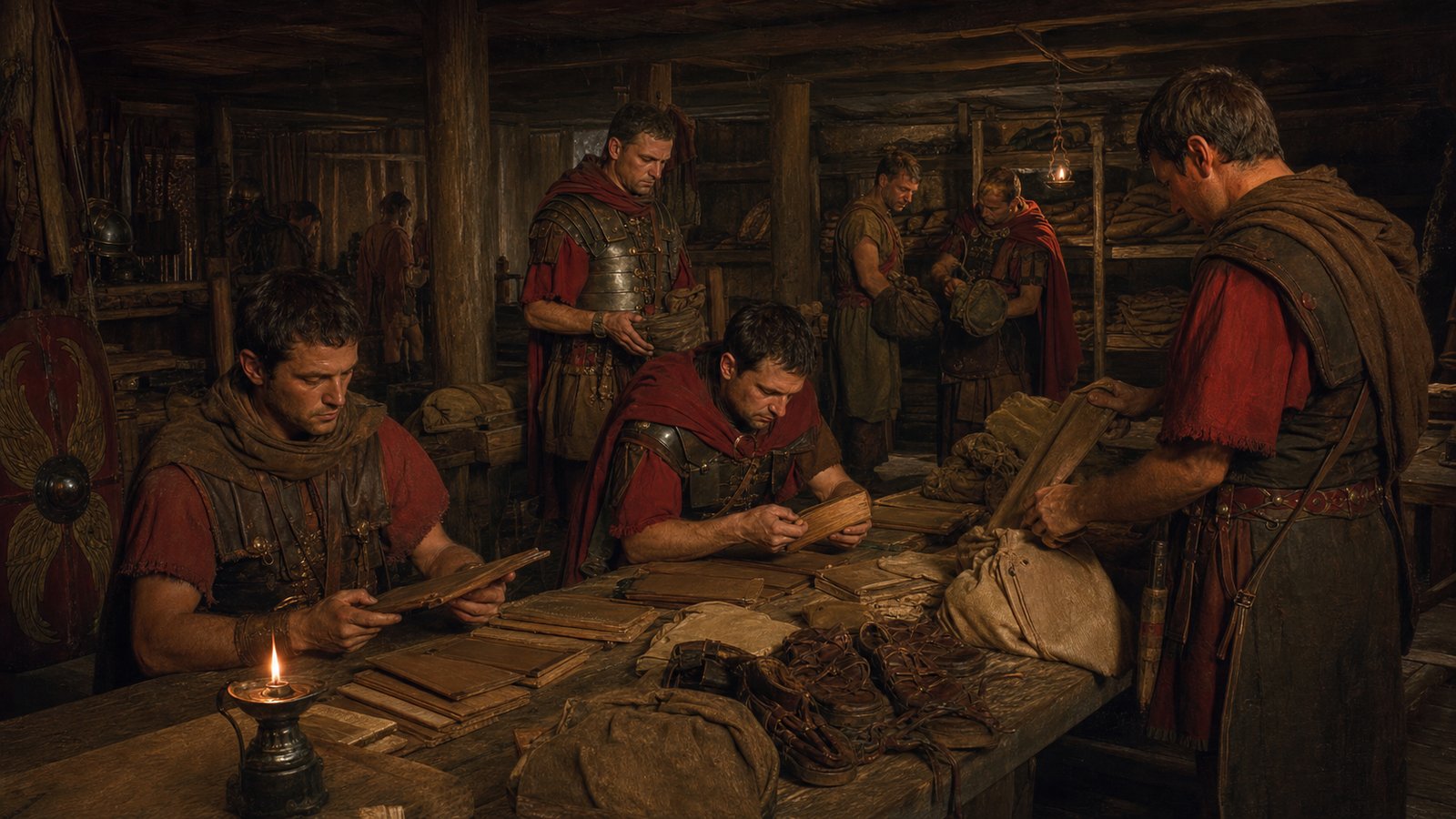
Rome’s frontier power depended on more than courage. A fort had to know who was present, what supplies existed, what had been sent, and what needed repair. The tablets mention soldiers, officers, supplies, clothing, food, and social relationships. Those details are not trivial. They are the daily grammar of occupation.
This is where Vindolanda connects to the larger Roman habit of making space governable. Roads, forts, documents, and routines turned distance into an administrative problem. The northern frontier remained difficult, but writing helped transform difficulty into tasks that could be assigned and tracked.
The tablets also show dependence
Every list reveals need. If a fort records supplies, it admits that supplies can fail. If officers send messages, they admit that information is incomplete until someone carries it. If households exchange invitations, they admit that social life must be maintained deliberately in a place far from old centers of status.
That dependence makes the frontier more human. Rome at the edge was not a solid block pressing against barbarism. It was a living arrangement that required cooperation among soldiers, commanders, families, locals, merchants, animals, roads, and weather. A missing shipment or delayed message could matter more on a frontier than in a comfortable city.
Hadrian’s Wall is louder, but Vindolanda is closer
Hadrian’s Wall dominates the landscape and the memory. It is easy to look at it and think of imperial will: an emperor, a boundary, a line across Britain. Vindolanda asks for a different kind of attention. It shows the lived infrastructure behind the monument. A wall can declare control. Tablets show how much work control required.
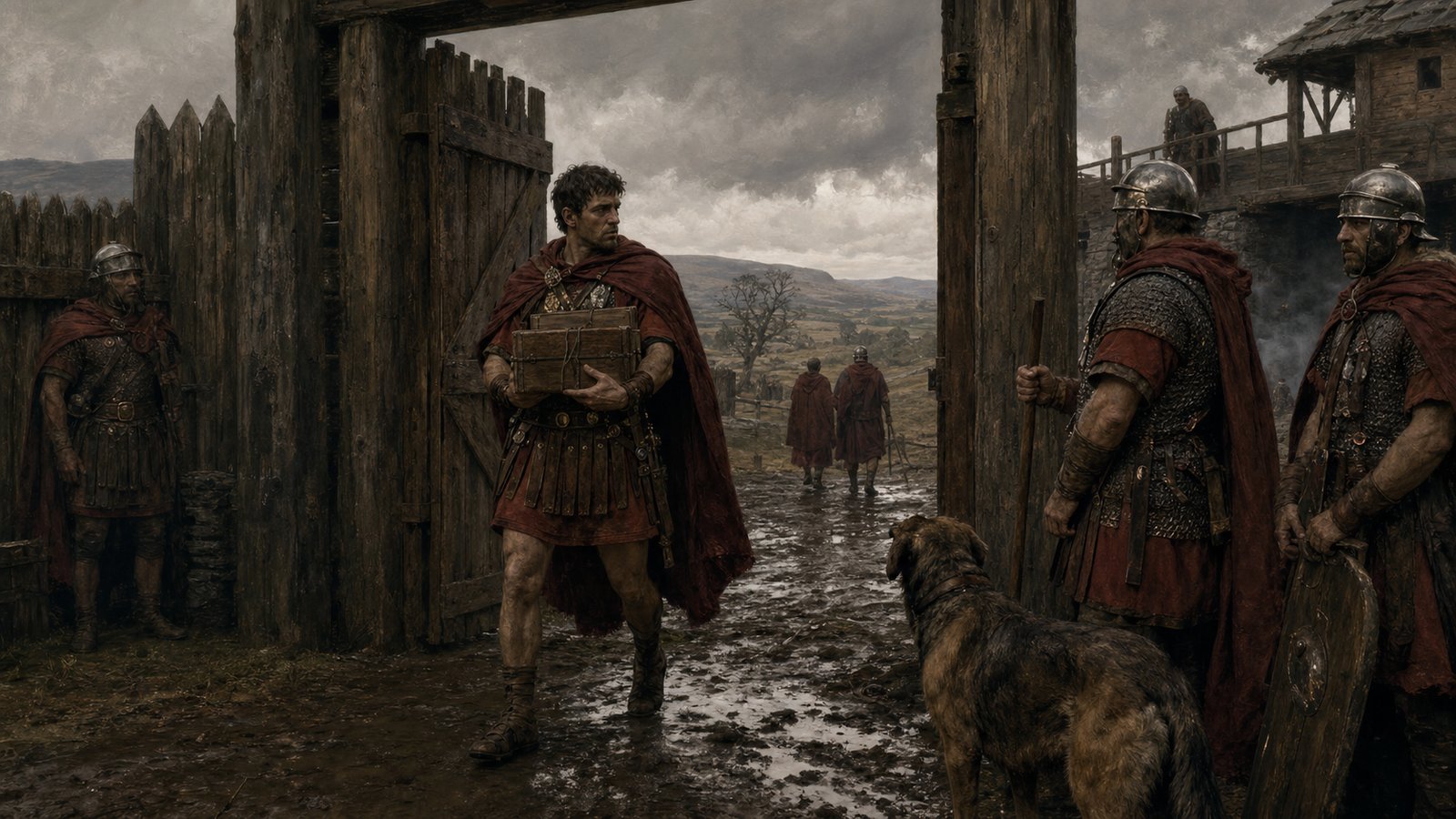
This is why the Vindolanda evidence is so valuable. It gives Roman Britain handwriting, not just architecture. It lets a reader imagine a damp room, a stylus, a courier at the gate, a commander’s household, and a request waiting for an answer. The frontier becomes not only where Rome ended, but where Roman life had to be improvised every day.
The edge of empire wrote back
The tablets survive as scraps, yet they resist simplification. They show discipline and vulnerability, distance and intimacy, army administration and private friendship. They remind us that empire was never only made in Rome. It was remade wherever people tried to keep orders, food, rank, and relationships moving.
At Vindolanda, the edge of the Roman world did not fall silent. It wrote. The handwriting is the surprise. In those thin pieces of wood, Rome becomes less marble and more breath: a soldier waiting, a woman inviting, a commander managing, a courier stepping into northern weather with someone else’s words in his hand.
Small evidence changes large history
The tablets also force humility. A frontier fort can look simple when reduced to a line on a map, but the writing reveals layers of dependence that a map cannot show. People needed favors, materials, confirmation, companionship, and news. They needed the empire to function in ordinary sentences before it could function as a strategy.
That is why a birthday invitation can sit beside military administration without feeling trivial. Both belong to the same world. A commander’s household, a soldier’s duty, a shipment of clothing, and a social visit all helped make Roman presence durable in a wet northern place where distance from the Mediterranean world was felt every day.
The frontier was therefore not merely a hard edge between Rome and non-Rome. It was a zone of translation. Orders became journeys, relationships became messages, and imperial policy became the practical question of who had what, who needed whom, and who could carry the next tablet through the gate.
That practical question keeps the evidence from becoming romantic. The tablets are moving because they are ordinary, but their ordinariness belonged to an occupying military world. Supplies, commanders, households, and soldiers all sat inside Roman power. Vindolanda lets us see that power not as a marble slogan, but as daily dependence written in ink and delivered across a cold yard.
The result is a frontier that feels closer and less simple. It was defended by walls and weapons, but it was also held together by handwriting fragile enough to disappear almost anywhere except the wet ground that saved it.
Sources & Further Reading
- Vindolanda Charitable Trust, Vindolanda
- British Museum, Vindolanda tablets
- Vindolanda Tablets Online
- Vindolanda Tablets Online, Tablet 291
- Britannica, Hadrian’s Wall
- Vindolanda Charitable Trust, History
- Britannica, Roman Empire
- Vindolanda Tablets Online, Tablets of Flavius Cerialis