
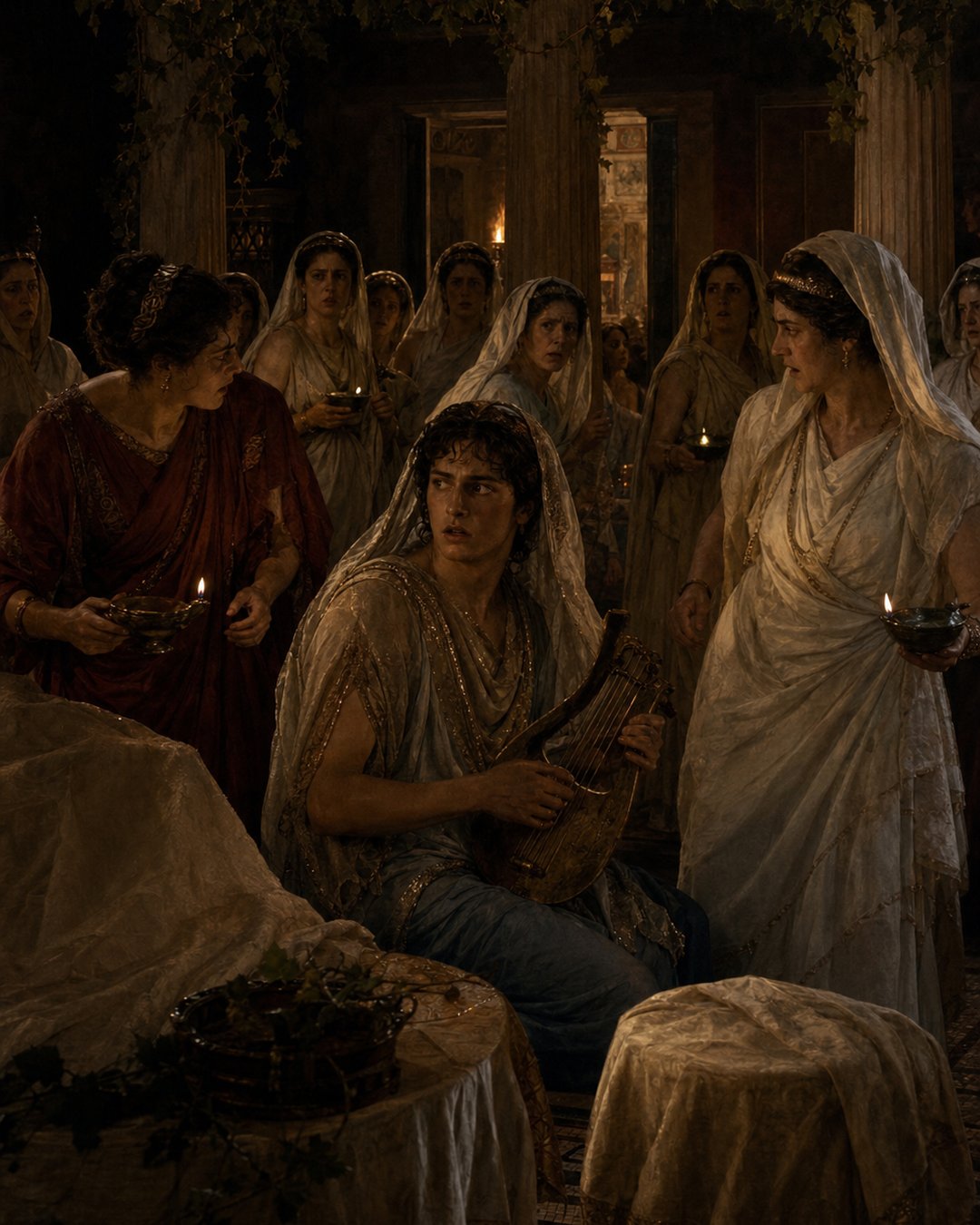
The disguise survived the doorway. It survived the servants who admitted a young female musician into Julius Caesar’s house. Then the intruder spoke. A maid heard a man’s voice in a building cleared of men for the secret rites of the Bona Dea, screamed, and turned a private corridor into the most dangerous room in Roman politics.
Publius Clodius Pulcher had entered the festival dressed as a lute-player. Caesar’s wife Pompeia was presiding, Caesar’s mother Aurelia supervised the house, and Vestal Virgins were present for ceremonies men were forbidden to witness. When the women found Clodius hiding in the chamber of the servant who had helped him enter, they drove him out and reported the violation before morning.
The episode in 62 BC is usually remembered through Caesar’s remark that his wife had to be above suspicion. That line is only the cleanest fragment. The full story moves from women controlling sacred space to a male-dominated court, from a failed alibi to an acquittal under pressure, and from Cicero’s testimony to the enmity that helped send him into exile.
One Roman House Had Been Formally Cleared of Men
The Bona Dea ceremony was not an ordinary dinner party with a religious theme. Plutarch says the annual rites were performed by women and that no man could lawfully attend or even remain inside the house. When the ceremony was hosted by a senior magistrate, he and every male member of the household left while his wife took possession of the premises.
In 62 BC, the host was Caesar, then praetor, and Pompeia directed the observance in his house. Aurelia, Caesar’s mother, was also present. The festival unfolded at night with music, enclosed sacred objects and rites ancient male authors admitted they could not fully describe because exclusion was part of the institution.
The Vestal Virgins made this more than a household gathering. Their attendance connected the home to Rome’s public religion. Vestal service made the city’s safety visible, and their presence meant that an intrusion could be treated as an offense against civic order and the gods, not merely against Caesar’s privacy.
That boundary explains the force of what followed. Clodius did not simply enter the wrong reception room. He crossed into a space that had been deliberately remade for women’s authority and ritual secrecy. Every man had been removed so the ceremony could exist. One disguised man therefore threatened the condition on which the entire night depended.
The Lute-Player Lost His Way Before He Lost His Alibi
Plutarch describes Clodius as young and still beardless, a feature that made the disguise plausible at a glance. He put on the clothes and carried the equipment of a female lute-player. A maid who knew the plan admitted him and went ahead to alert Pompeia, leaving him to wait in a large and unfamiliar house.
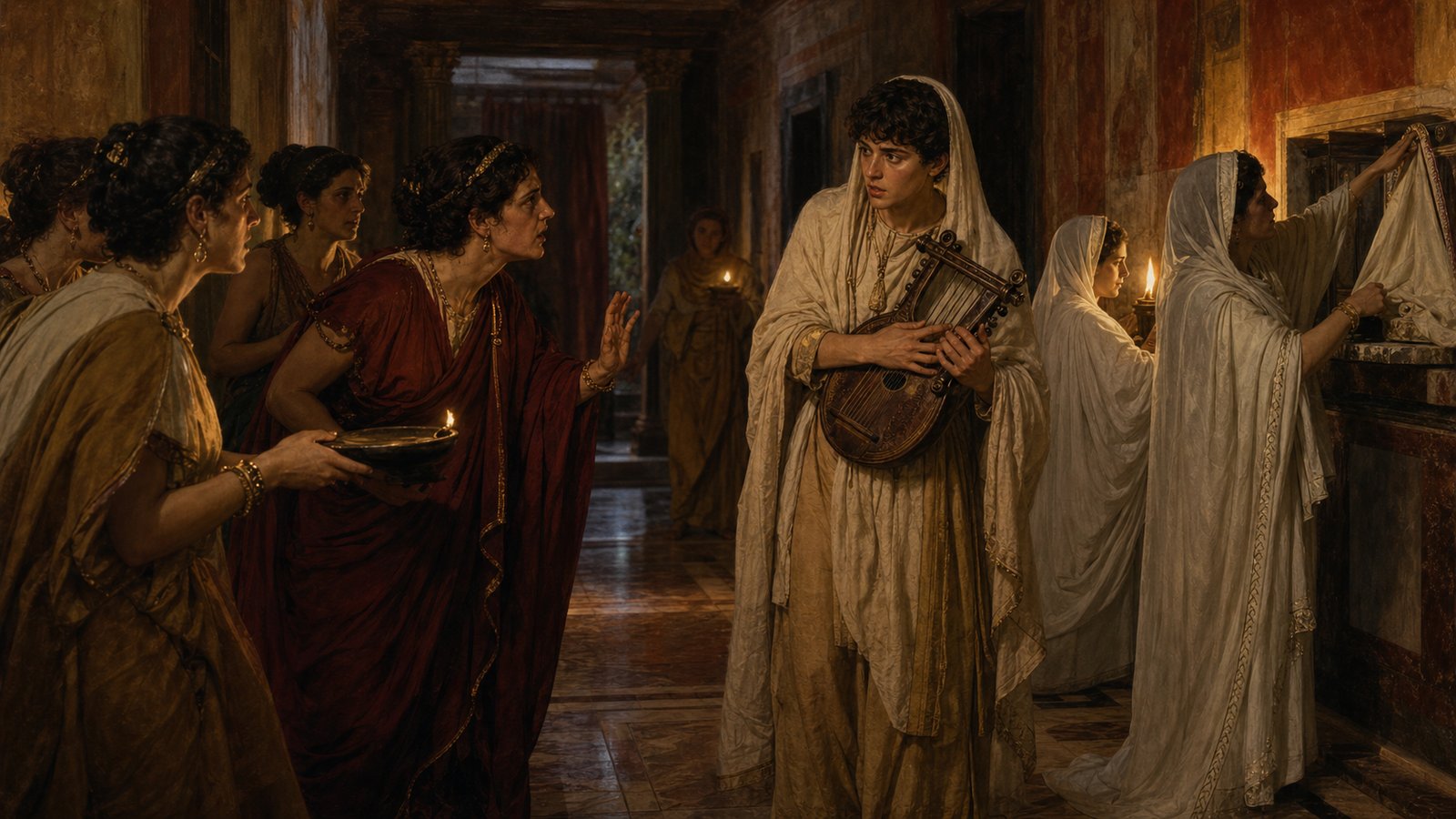
Impatience turned concealment into exposure. Clodius wandered through corridors while trying to avoid the lamps. One of Aurelia’s attendants met him and invited him forward as one woman might address another. When he resisted, she asked who he was and where he had come from.
Clodius answered that he was waiting for Abra, a servant of Pompeia. The content of the answer did not save him. His voice betrayed the disguise. The attendant ran toward the lights, shouting that she had found a man, and the ceremony stopped in an instant.
Aurelia covered the sacred emblems, ordered the doors closed and organized a search with torches. Clodius was found in the chamber of the maid who had brought him inside. The women expelled him, then went during the night to tell their husbands. By daylight, according to Plutarch, the report had spread through Rome.
A Household Search Became a Case of Sacrilege
The accusation was sacrilege. One of the tribunes brought the charge, while senators treated the violation as an insult requiring satisfaction to the city and gods. What had happened behind Caesar’s walls now entered the machinery of a public trial.
Roman courts made elite conflict visible rather than keeping it inside private negotiations. A prosecution assembled witnesses, jurors and political factions in one arena. The Bona Dea case was especially volatile because its best evidence came from women and household servants, while the verdict belonged to male jurors exposed to public pressure.
Clodius answered with an alibi: he claimed he had not been in Rome. Cicero broke it. Although the two men had previously cooperated during the Catilinarian crisis, Cicero testified that Clodius had visited his house that day to discuss business. Plutarch calls the statement true while also recording gossip that Cicero’s wife Terentia pushed him to testify for reasons rooted in her hostility toward Clodius’s family.
The distinction matters. An ancient source can preserve both an evidentiary claim and the motives later attached to the witness. Cicero’s testimony placed Clodius in Rome; rumors about Terentia explained why Cicero chose to say so publicly. The first attacked the alibi. The second reveals how Romans interpreted political action through households, marriages and rivalries.
Caesar Divorced Pompeia but Refused to Convict Clodius
Caesar moved quickly in one direction and cautiously in another. He divorced Pompeia, yet when called to testify he said he knew nothing about the charges against Clodius. The prosecutor asked the obvious question: if Caesar knew nothing, why had he ended the marriage?
Plutarch gives Caesar’s answer in the form that made it famous: his wife ought not even to be under suspicion. In the Life of Cicero, the standard becomes freedom not only from shameful conduct but from shameful report. The wording turns reputation into a political asset with a threshold stricter than legal proof.
The decision did not establish Pompeia’s guilt. It protected Caesar from remaining tied to a scandal he could not control. Divorce severed the household connection; withholding testimony avoided a direct attack on Clodius and the popular support gathered around him. Caesar could therefore present himself as exacting about his family while staying flexible in public politics.
This was not moral consistency in a modern courtroom sense. It was a separation of arenas. A marriage could be ended because suspicion damaged standing, while a criminal accusation still required evidence Caesar declined to provide. Reputation, religion and legal strategy overlapped, but they did not produce identical obligations.

The Acquittal Created an Enemy Who Remembered
The jury asked for protection, a sign of the atmosphere around the trial. Plutarch says supporters of Clodius frightened the jurors and that many marked their voting tablets illegibly. He also reports accusations of bribery. Clodius was acquitted, but the verdict did not make the intrusion disappear from political memory.
Cicero later mocked the result with numbers. He said twenty-five jurors had believed his evidence because they voted against Clodius, while thirty had distrusted Clodius enough to require payment before acquitting him. The joke is partisan, not a neutral audit of bribery. It nevertheless preserves how opponents represented an acquittal that looked procedurally complete and morally contaminated.
The quarrel outlived the courtroom. Clodius later became tribune and attacked Cicero, helping drive the orator into exile. Cicero’s authority after confronting Catiline did not protect him once Clodius could mobilize popular legislation and street pressure. Testimony given in one scandal became a debt collected in another political season.
The Bona Dea intrusion endured because each participant controlled only part of the story. Women discovered and expelled Clodius. Priests and magistrates defined the violation. Cicero damaged the alibi. Caesar guarded his reputation without supporting a conviction. Jurors acquitted under a cloud, and Clodius survived to become more powerful. A single voice in a dark corridor exposed the intruder; Rome’s institutions could not agree on what his exposure should cost.