
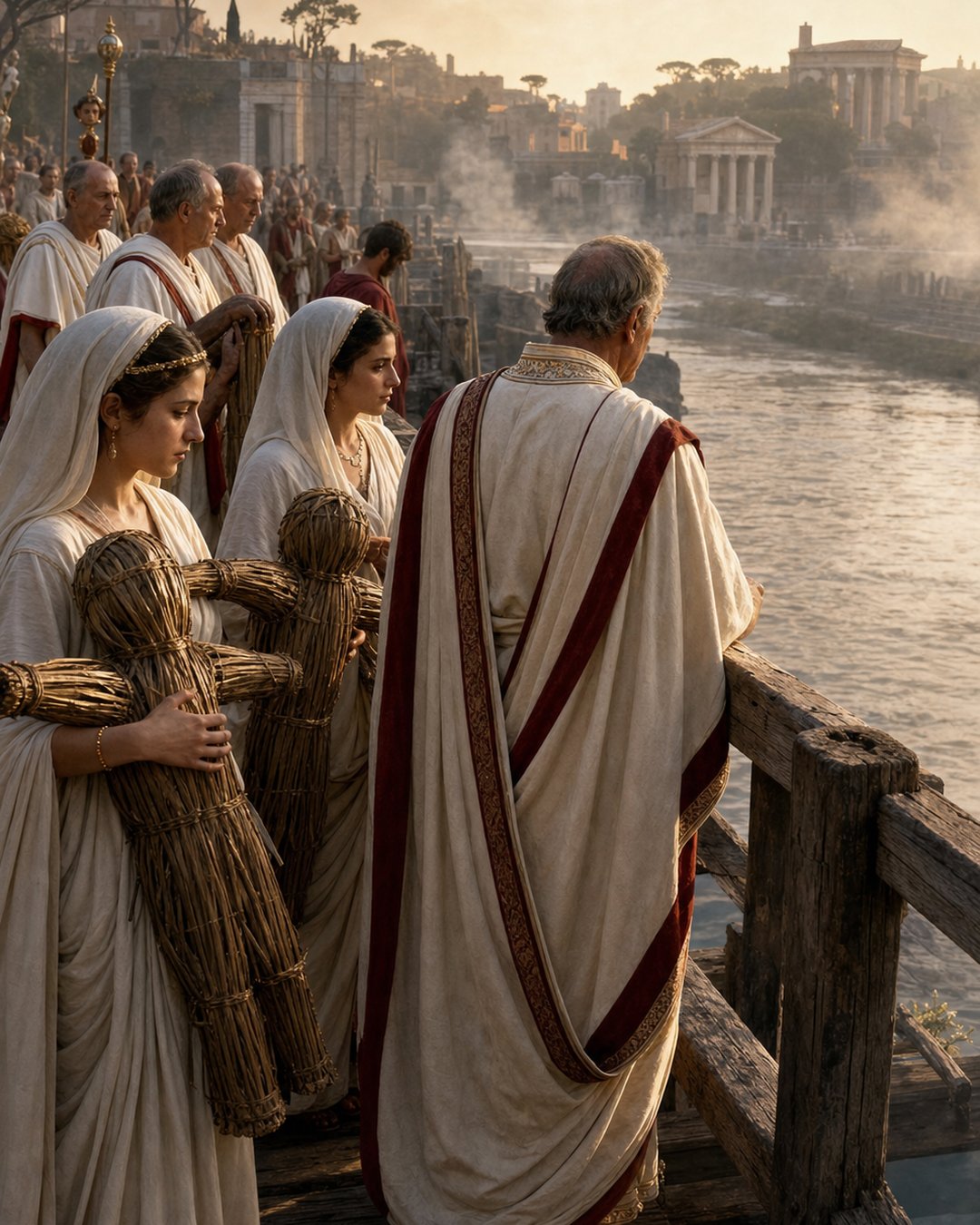
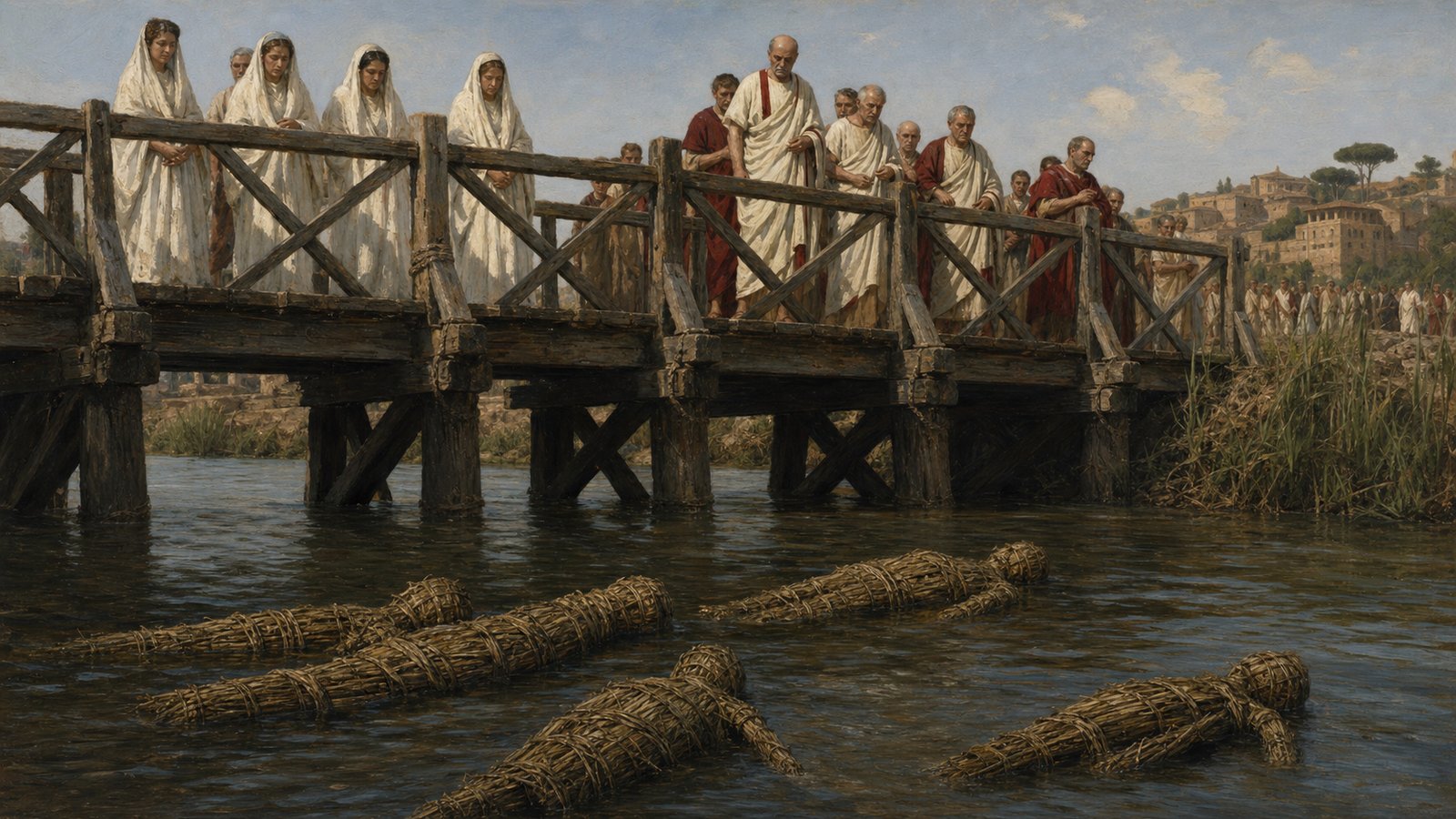
On the Ides of May, a procession reached Rome’s oldest wooden bridge carrying bodies that had never lived. They had heads, trunks and limbs, but they were bound from river rushes. Pontiffs, Vestal Virgins and magistrates stood above the Tiber as the human-shaped bundles were cast into the current.
The figures were called the Argei, the same name used for a set of sacred places distributed through the city. Dionysius of Halicarnassus counted thirty effigies. The antiquarian tradition attached to Varro counted twenty-seven, matching the number of Argei shrines. The disagreement is not a minor bookkeeping problem. It is evidence that Romans kept performing a rite whose original logic had become difficult to recover.
Ancient authors filled that silence with stories about Hercules ending human sacrifice, Greeks once killed by local people, old men displaced by the young, or exiles who wanted their distant homeland remembered. None can be proved as the first explanation. The secure core is stranger: a public ritual could remain precise in its route, personnel, date and materials while its meaning became an argument.
The Calendar Brought Rome to the River
The main ceremony took place in May. Dionysius puts it on the Ides, the Roman midpoint marker that fell on 15 May in that month. Plutarch describes the same occasion as the time of the full moon in May. Ovid places his discussion in the sequence of the Fasti for the middle of the month. Three different authors therefore anchor the event in Rome’s public calendar even when they do not agree on why it existed.
That calendar was not only a list of dates. It coordinated law, worship, markets and political life by declaring which actions belonged to which days. The Argei returned because offices and priesthoods knew when to assemble and what to do. Roman calendars turned time into public authority; here, a recurring date carried an opaque tradition forward.
The setting was equally specific. The effigies went from the Pons Sublicius, the ancient timber bridge near the Forum Boarium, into the Tiber. Dionysius calls it the sacred bridge. Plutarch names it directly. The rite did not permit any convenient crossing or stretch of river to substitute for that place.
Rome’s oldest bridge carried unusual restrictions and memories because it joined the city to the western bank without ceasing to be a religious object. A bridge made a river feel governable, but the Argei reversed the ordinary direction of control. For a moment, civic order delivered carefully made figures to the current and let the river take them away.
Rushes Made a Human Shape Without a Human Death
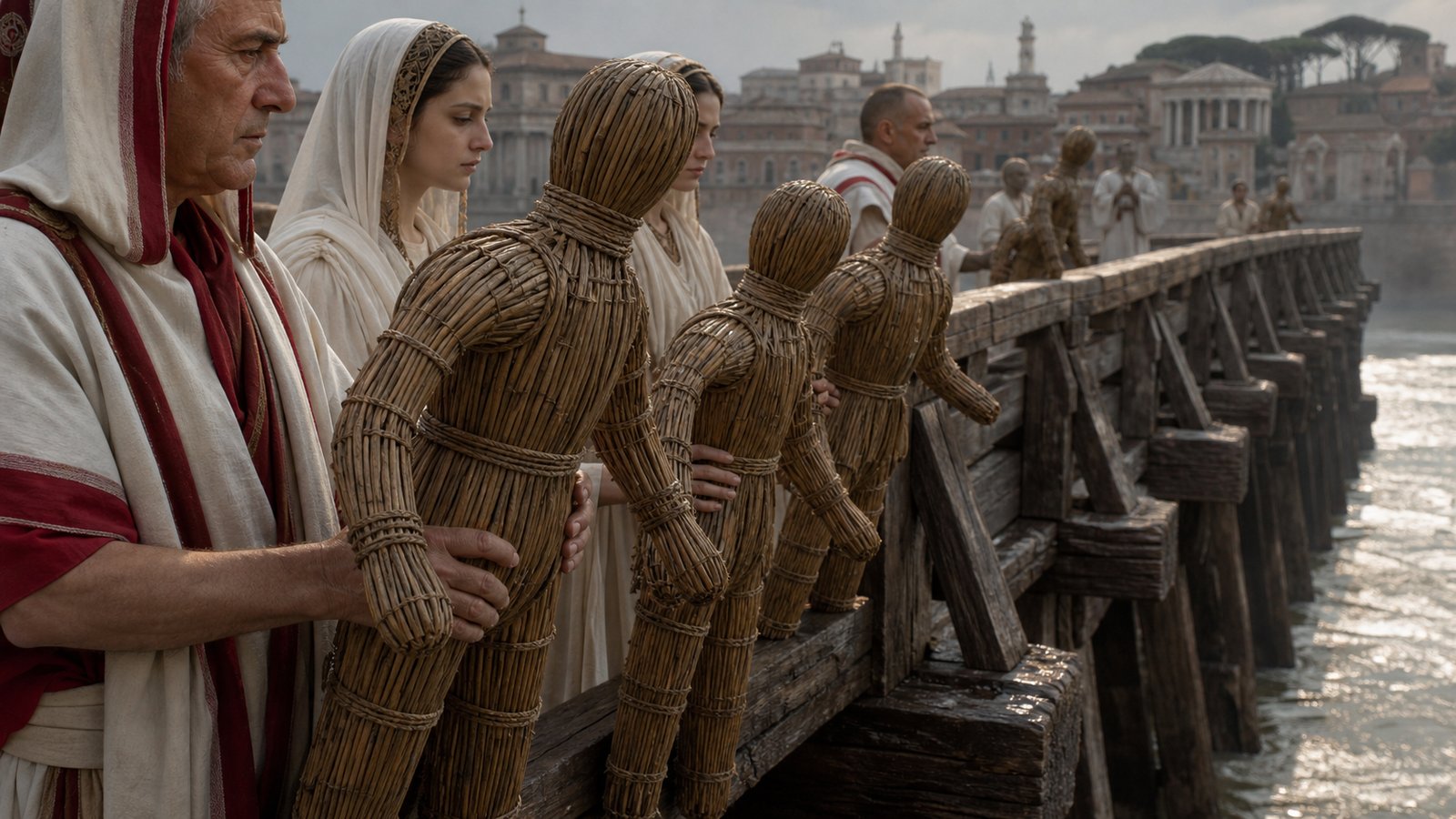
Dionysius describes effigies made in the likeness of men. The note preserved with his account identifies bulrushes as their material. Ovid calls them straw figures or rush images, depending on translation, and says that dummies were thrown in his own explanation of the custom. The physical substitute is the one feature every origin story needs.
The substitution mattered because the figures were recognizably human. A shapeless sheaf would not support stories about Greeks, old men or sacrificial victims. Bound heads and limbs created resemblance while the dry stalks made the difference unmistakable. The rite approached the visual grammar of a killing but stopped at an object.
That does not prove that real victims once preceded the effigies. Ancient writers often explained puzzling customs by inventing a harsher early stage and a civilizing hero who softened it. Dionysius says Hercules replaced human sacrifice with images. Plutarch asks whether Hercules ended the murder of captured Greeks. Ovid offers a similar heroic substitution before presenting other theories. Repetition shows that the explanation was popular, not that it was historical reportage.
The woven bodies nevertheless made controlled ambiguity possible. Spectators saw a human outline go over the rail, heard the splash and watched it move downstream. At the same time, nobody in the ceremony could mistake reed for flesh. Rome could dramatize removal, surrender or expiation without disclosing which of those ideas had first shaped the act.
Twenty-Seven or Thirty Reveals a City of Overlapping Maps
The number of figures is one of the clearest fractures in the evidence. Dionysius says thirty. The antiquarian discussion derived from Varro says twenty-seven, equal to the number of sacred places also called Argei around Rome. Both numbers offered a way to make the effigies represent the city rather than a random group of dummies.
Thirty could evoke Rome’s thirty curiae, the old civic divisions through which citizens had once been organized. Twenty-seven connected the river rite to the distributed Argei shrines. The nineteenth-century Dictionary of Greek and Roman Antiquities lays out both possibilities but refuses to turn conjecture into certainty. Its caution is useful: symbolic arithmetic is tempting precisely because almost any old institution can make a number look meaningful.
The shrines add a second movement to the ritual system. Varro’s evidence says they were spread through different districts, and later summaries connect them with a formal visitation. The city was first encountered as a network of sacred stations and then represented by human-shaped bundles at one bridge. Movement gathered a scattered sacred geography into a single riverside act.
No surviving source lets us reconstruct every stop or prove that every May effigy corresponded one-for-one with a particular shrine. The numerical disagreement blocks that tidy map. What remains defensible is the relationship of scale: the Argei existed both as places across Rome and as figures carried to the Tiber. One name linked urban territory to perishable bodies.
The Vestals and Magistrates Made Uncertainty Official
Dionysius lists the participants with unusual care. The pontiffs led, joined by the virgins who guarded the perpetual fire, the praetors and other citizens lawfully permitted to attend. This was not a prank, a neighborhood superstition or a private household charm. Rome placed central religious and civic officers around the bridge.
The Vestal Virgins gave the procession a special kind of continuity. Their public duties tied the safety of Rome to disciplined ritual action, and their presence at the Argei made the handling of the figures part of that protected sphere. The Vestals made protection visible through repeated service, not by offering explanations for every ceremony they performed.
The praetors brought another register of authority. These were elected magistrates associated above all with jurisdiction, yet they appeared beside priests at a rite whose meaning writers debated. Roman religion did not occupy a sealed compartment outside government. Correct public action often required priestly knowledge, magistrates and a lawful audience to converge.
This personnel also explains how a ritual can outlive agreement about its origin. Institutions do not need every participant to share an interpretation; they need offices, dates, materials and procedures to be transmitted. Dionysius could watch the rite continue in his own era while admitting that he would discuss its broader religious context elsewhere. Observation preserved the choreography even when explanation remained plural.
Ancient Explanations Tell Us More About Memory Than Origins
Ovid turns the mystery into a miniature debate. He mentions a Leucadian-style rite, Hercules replacing people with straw, young men supposedly casting weak old men from bridges so that only the young retained the vote, and an account in which early settlers longed for the Argive homeland they had left. He finally lets the river itself speak. The abundance of answers is the point: no uncontested answer controlled the tradition.
Plutarch also frames the issue as a question. He asks why figures called Argives were thrown from the Pons Sublicius and offers possibilities involving captured Greeks, Hercules and hostility carried from Greece by the followers of Evander. His form preserves uncertainty honestly. He is recording the explanations available to an educated ancient reader, not certifying one of them as an archival fact.
Dionysius prefers the story of Hercules abolishing sacrifices to Saturn and substituting effigies. It suited a broad account in which Greek heroes helped civilize early Italy. That narrative gave the ritual a moral trajectory: violence belonged to an older world, while the enduring Roman action remembered reform. It was an elegant story and therefore one that demands caution.
The Argei is most revealing when the stories are not forced into a verdict. A city crossed its calendar, priesthoods and magistracies at a wooden bridge; shaped river plants into men; and consigned them to the Tiber. Romans could preserve that sequence for centuries while arguing about Greeks, elders, sacrifice and memory. The rite survived not because everyone knew what it meant, but because Rome knew exactly when, where and by whom it had to be done.