
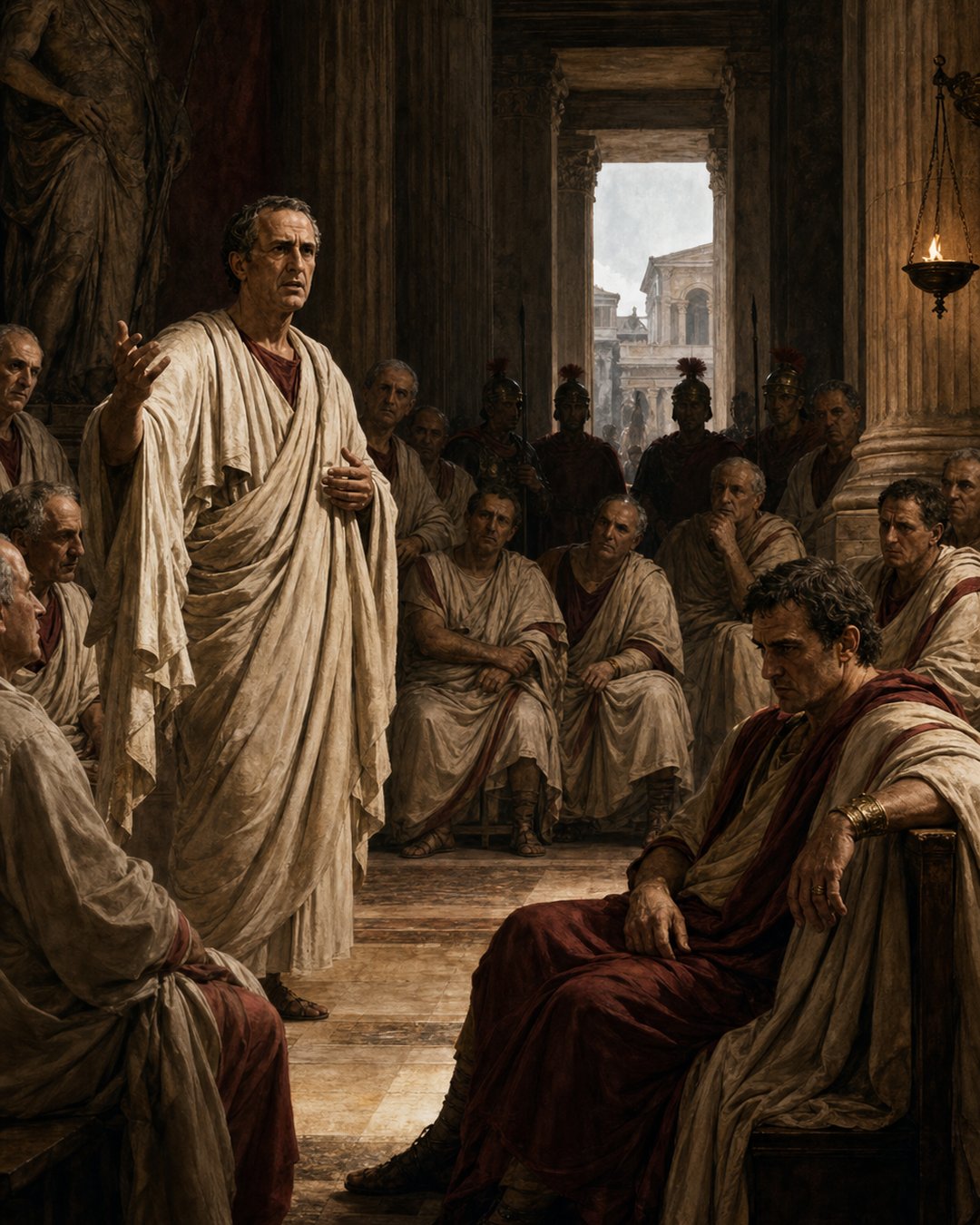
On 8 November 63 BCE, Lucius Sergius Catilina walked into a meeting of the Roman Senate and found isolation waiting for him. Senators who might normally have greeted a former praetor moved away. The bench around him was left conspicuously empty. Across the chamber stood the consul Marcus Tullius Cicero, prepared to turn intelligence about a conspiracy into a witnessed political rupture.
The scene is remembered for Cicero’s opening challenge: how long would Catiline abuse Roman patience? Yet the speech did not magically uncover a hidden plot. Guards were already posted, an armed force under Gaius Manlius had gathered in Etruria, and Cicero had received reports about meetings and a planned attack on his house. The oration gave those scattered dangers a single face.
Catiline’s decision to attend was not simple madness. He was a senator, a defeated candidate for the consulship and a noble with supporters. Leaving before a public confrontation could look like confession; appearing allowed him to test whether Cicero possessed proof or only rumor. Roman politics made presence a weapon, until the room itself answered against him.
A Defeated Candidate Still Possessed a Senator’s Place
Catiline came from an old patrician family and had held the praetorship. That biography placed him inside the governing class, not outside it. He had also sought the consulship and lost. Electoral defeat could damage a Roman aristocrat, but it did not erase his networks, rank or expectation that he could speak among peers.
Ancient accounts connect his following with debtors, ambitious young aristocrats, veterans and men whose fortunes had collapsed. Those groups were not one coherent modern party. Their interests overlapped around dissatisfaction and the hope that a violent change might cancel obligations or reopen blocked careers.
Cicero’s position was equally unusual. He was a novus homo, a “new man” without consular ancestors, defending a Senate whose oldest families could regard him as socially inferior. Exposing Catiline allowed the consul to present vigilance and service as stronger claims to authority than inherited name.
The confrontation belongs beside the Senate’s longer struggle to preserve authority. Institutions did not fail only when laws disappeared. They also depended on whether rivals still accepted debate, elections and prosecution as the boundaries of political competition.
Night Meetings and an Etruscan Camp Changed the Question
By early November, the crisis had moved beyond angry speeches. Gaius Manlius was gathering armed supporters near Faesulae in Etruria. Cicero’s information also described a meeting at the house of Marcus Porcius Laeca, where conspirators allegedly divided tasks and discussed killing the consul.
Two men were said to have volunteered to visit Cicero early in the morning under the pretense of paying respects and murder him at home. A warning reached Cicero before they arrived, and his doors were closed to them. The domestic threshold became the first physical barrier in the day’s political drama.
The Senate had already issued the senatus consultum ultimum, urging the consuls to ensure that the Republic suffered no harm. This emergency decree did not supply a modern code of powers. It placed enormous responsibility on magistrates while leaving the legality of lethal measures dangerously contestable.
Rome’s public procedures could therefore sharpen rather than remove uncertainty. As in Roman law courts, accusation gained force through setting, audience and response. Cicero needed senators to see Catiline confronted, and Catiline needed to learn whether the political class would still sit beside him.
The Temple of Jupiter Stator Became a Defensive Chamber
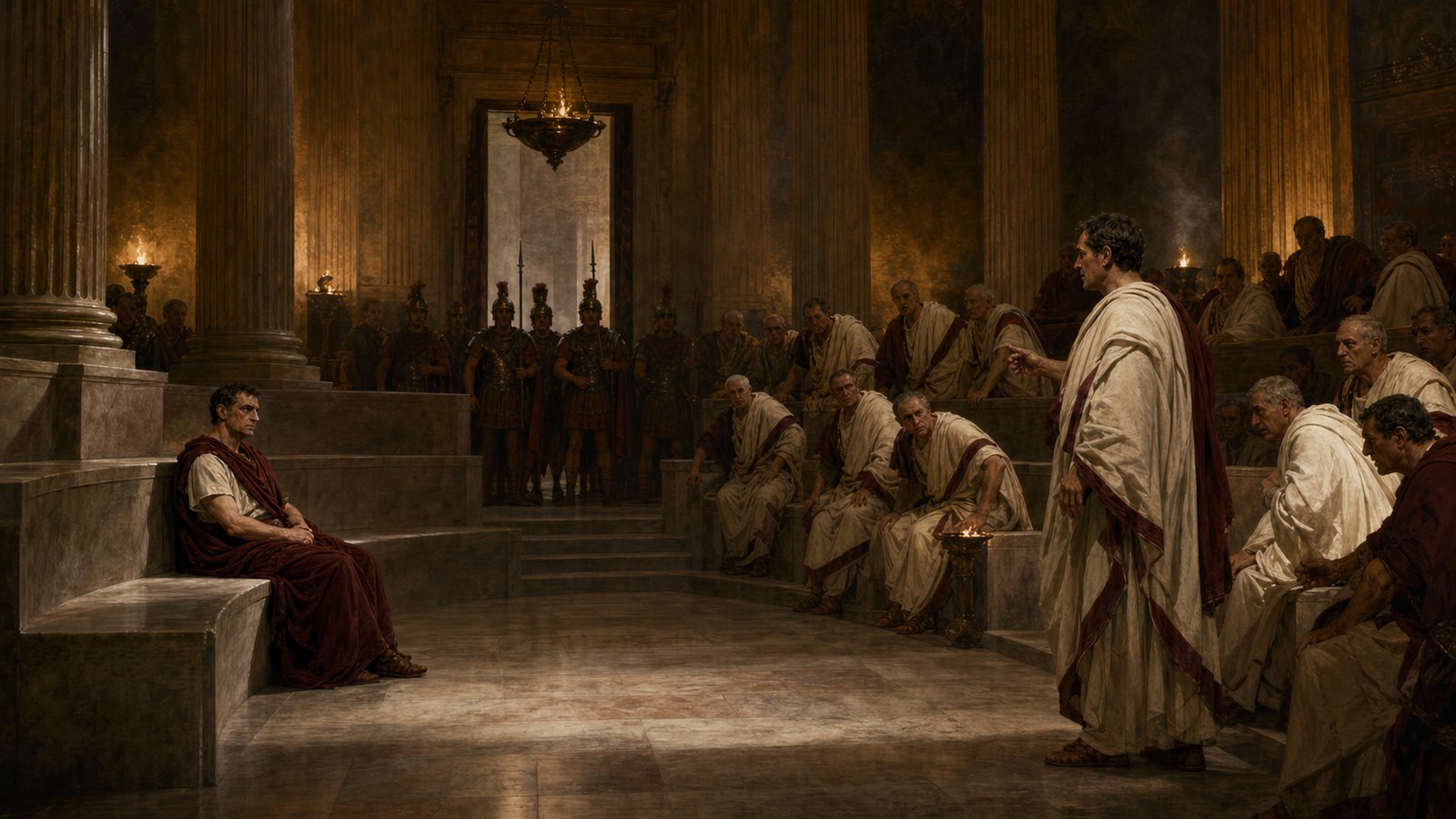
Cicero summoned the Senate to the Temple of Jupiter Stator. The location near the Palatine carried a protective association: Jupiter the Stayer was the god credited with halting flight and making a Roman line stand. A guarded temple was both a practical meeting place and an argument made in architecture.
The consul began without a neutral summary. He addressed Catiline directly and described watches on the Palatine, guards throughout the city, public alarm and the fortified meeting. Each detail told the listeners that ordinary civic space had already been altered by the threat.
Then Cicero claimed intimate knowledge. He referred to the timing of meetings, intended movements and assigned acts. Whether every element was equally proven is difficult to determine because the surviving text is Cicero’s polished publication, not a transcript taken in the room. Its precision nevertheless forced Catiline to respond under collective observation.
The empty seats supplied another kind of evidence. Senators avoided the accused man before a verdict or trial. Their movement did not prove every charge, but it demonstrated political abandonment. In an elite culture of greetings, proximity and precedence, refusing physical company could announce that trust had already collapsed.
Cicero Wanted Departure More Than an Arrest
The first speech repeatedly urged Catiline to leave Rome and join the force associated with Manlius. That can seem strange: if Cicero knew a traitor stood before him, why not arrest him? The answer lies in evidence, authority and the danger of appearing to crush a political opponent without a completed legal case.
Catiline’s departure would clarify the conflict. Remaining in Rome let him pose as a persecuted senator; joining an armed camp would connect his person with open rebellion. Cicero sought an action that would convert inference into visible alignment while sparing the consul an immediate and controversial seizure.
Catiline reportedly answered by contrasting his ancient family with Cicero’s lesser ancestry and described the state through a bodily metaphor: a strong body with a weak head. The response tried to reverse the charge. Cicero, in this telling, was not saving the Republic but presuming to command men born to lead it.
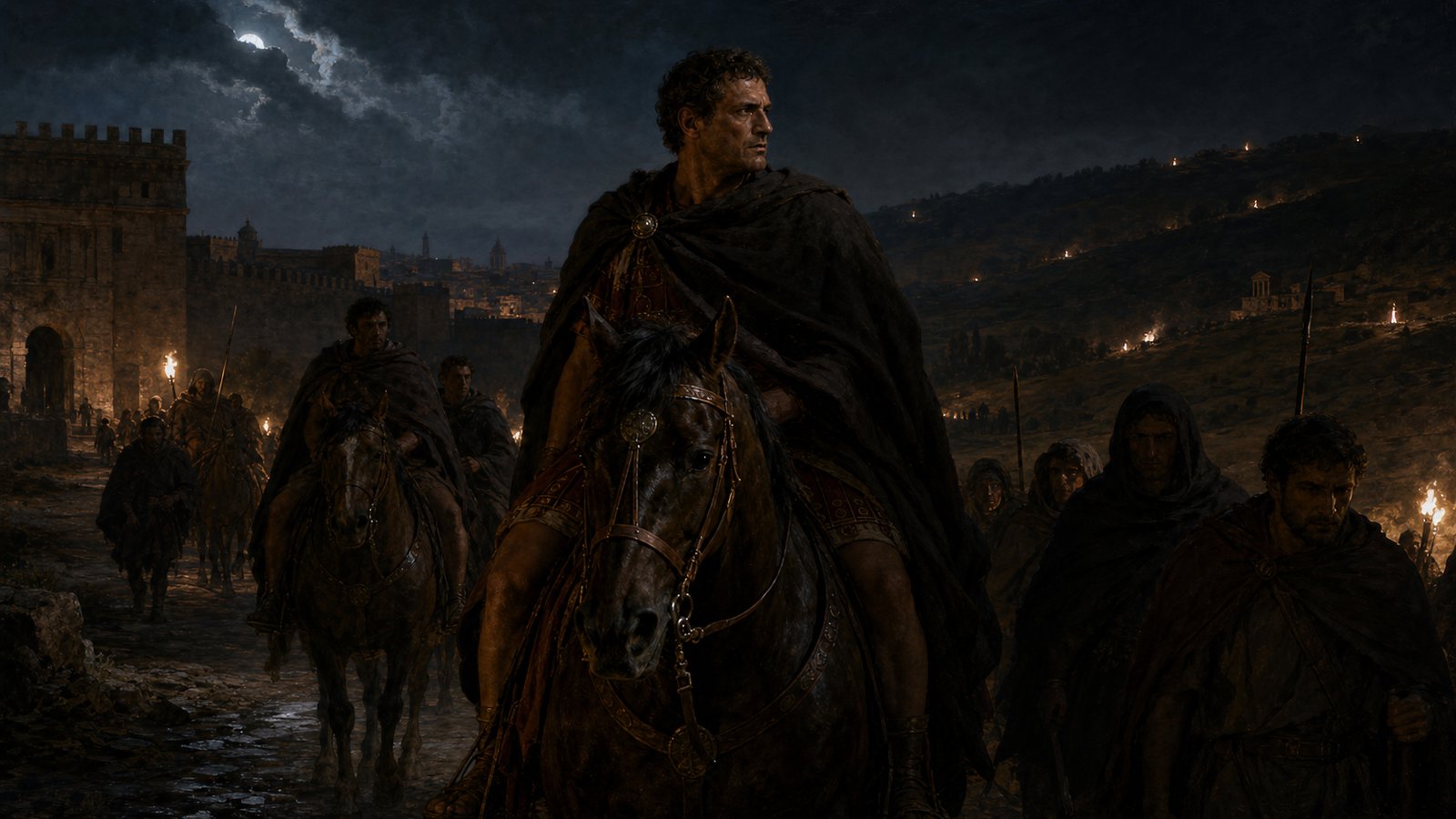
The Senate did not accept that defense. Catiline left the city that night and went to Manlius. Cicero then addressed the people, presenting the departure as relief while insisting that the danger remained. One chamber’s social rejection had pushed a political contest toward an unmistakably military phase.The timing also let Cicero split his audiences. Senators witnessed the direct accusation; the next public address explained Catiline’s absence to citizens who had not entered the chamber. The consul was not merely reporting events. He was managing the sequence by which an elite confrontation became a citywide understanding of emergency.
A Famous Speech Concealed the Harder Constitutional Problem
The conspiracy did not end with Catiline’s exit. Evidence obtained through envoys of the Allobroges implicated leaders who remained in Rome. Several were arrested, and the Senate debated punishment. Julius Caesar argued against execution without trial; Cato pressed for death. Cicero oversaw the executions in December.
That decision later helped drive Cicero into exile because citizens had been killed without a regular trial. The man celebrated as savior of the state could also be accused of violating the protections he claimed to defend. Emergency action solved an immediate problem while leaving a legal wound available to enemies.
Catiline died in battle near Pistoria in early 62 BCE with the rebel army. Sallust, writing later, described the bodies found with wounds in front and Catiline discovered far among the enemy, details shaped to give a ruined aristocrat a grim consistency in death.
The 8 November meeting mattered because it staged the moment between suspicion and rebellion. Catiline still held a senator’s seat, but no one wished to share it. Cicero possessed warnings, guards and rhetoric, but not yet the later documentary evidence. Before armies settled the crisis, proximity, departure and a speech decided how Romans would understand who had left the Republic first.
Sources & Further Reading
- Cicero, First Oration Against Catiline
- Sallust, The War with Catiline
- Encyclopaedia Britannica, Catiline