
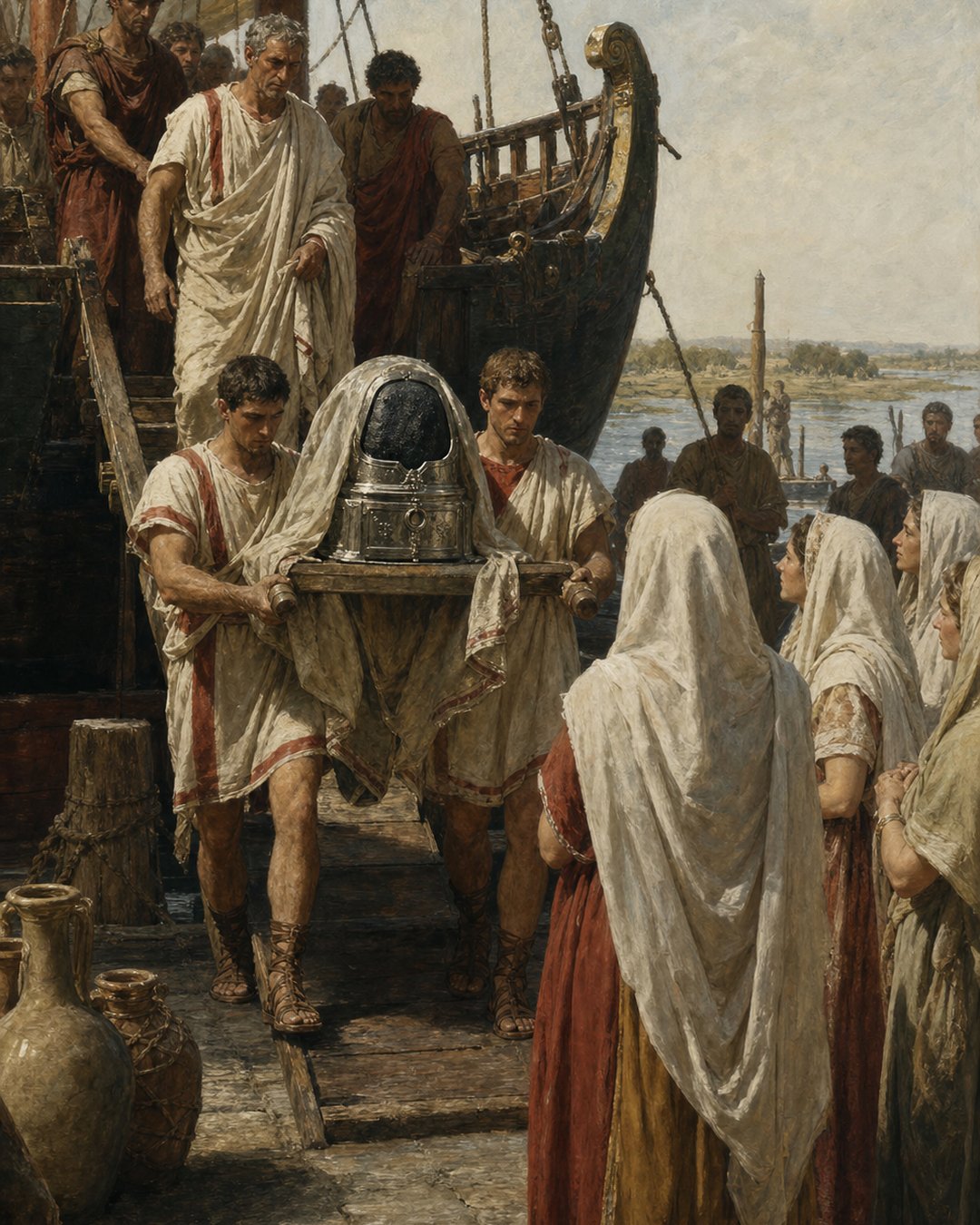
In 204 BCE, the Second Punic War had lasted fourteen years. Hannibal no longer threatened Rome’s walls, but he remained in Italy, harvests and alliances had been tested, and Romans wanted the war’s end to become thinkable. Their answer included a small dark object carried across the sea: the sacred stone of the Great Mother from Pessinus.
The goddess was called Magna Mater, the Great Mother, and identified with Cybele. Livy says consultation of the Sibylline Books produced a prophecy that a foreign enemy in Italy could be driven out if the Idaean Mother were brought from Pessinus to Rome. An embassy sought confirmation at Delphi, negotiated in Asia Minor and returned by ship.
The episode looks like religious import, but every stage was controlled by Roman institutions. Books were consulted by authorized keepers. The Senate sent envoys. An oracle advised how reception should occur. A leading man and matrons met the goddess. The foreign sacred object became Roman through procedure, public movement and a carefully assigned place on the Palatine.
Fourteen Years of War Made a New Answer Plausible
The Second Punic War began in 218 BCE. By 204, Rome had survived Cannae, rebuilt armies and carried war into multiple theaters, but Hannibal was still on Italian soil. Long emergencies change what counts as a reasonable remedy. A state that had mobilized unprecedented manpower also searched its religious archives.
Romans did not separate military and divine security into modern compartments. Defeat could signal failed command, broken alliances, improper ritual or an unfavorable relationship with the gods. Investigation and expiation were public responsibilities because the pax deorum—the workable peace with divine powers—belonged to the community.
The Sibylline Books were not opened for ordinary curiosity. Roman officials consulted them in crisis under senatorial authority. Their verses did not operate like a tactical manual; priests interpreted prescriptions that could introduce ceremonies or cults intended to repair danger at a religious level.
The process recalls Rome’s guarded use of the Sibylline collection. In 204 the resulting instruction reached beyond a temporary sacrifice. It required movement: a powerful goddess associated with Mount Ida had to cross political and geographic boundaries into Rome itself.
The Prophecy Named an Idaean Mother and a Foreign Enemy
Livy reports that the Books foretold victory over a foreign enemy in Italy if the Idaean Mother were brought from Pessinus. “Idaean” linked the goddess with Mount Ida and the Trojan landscape as well as with the Anatolian cult centered on the Great Mother. Roman readers could therefore perceive both foreignness and ancestral resonance.
Rome’s Trojan foundation traditions made that ambiguity useful. A goddess from the region associated with Aeneas could be welcomed as ancient kin rather than adopted as an arbitrary novelty. The cult came from abroad, yet story supplied a route by which arrival could resemble return.
The Senate sent an embassy that included Marcus Valerius Laevinus to King Attalus at Pergamum. Livy says Attalus led the Romans to Pessinus and gave them the sacred stone that local people said was the Mother of the Gods. Diplomacy and religion moved together across allied territory.
The object itself is described as a stone, often characterized in later tradition as black. It condensed divine presence into something portable enough for ship and procession. Rome was not importing a carved Greco-Roman body. The strangeness of the material made custody, reception and interpretation more important.
Delphi Turned Reception into a Test of Roman Character
The envoys consulted Apollo at Delphi during the mission. The oracle approved the plan and instructed that the goddess should be received by the best man in Rome. That phrase created a civic problem: a religious command now required Romans to identify exemplary character among themselves.
The Senate judged Publius Cornelius Scipio Nasica to be the vir optimus, the best man. He was young and had not yet held the highest offices. Selection therefore displayed moral reputation rather than simply assigning the task to the serving consuls or the oldest senator.
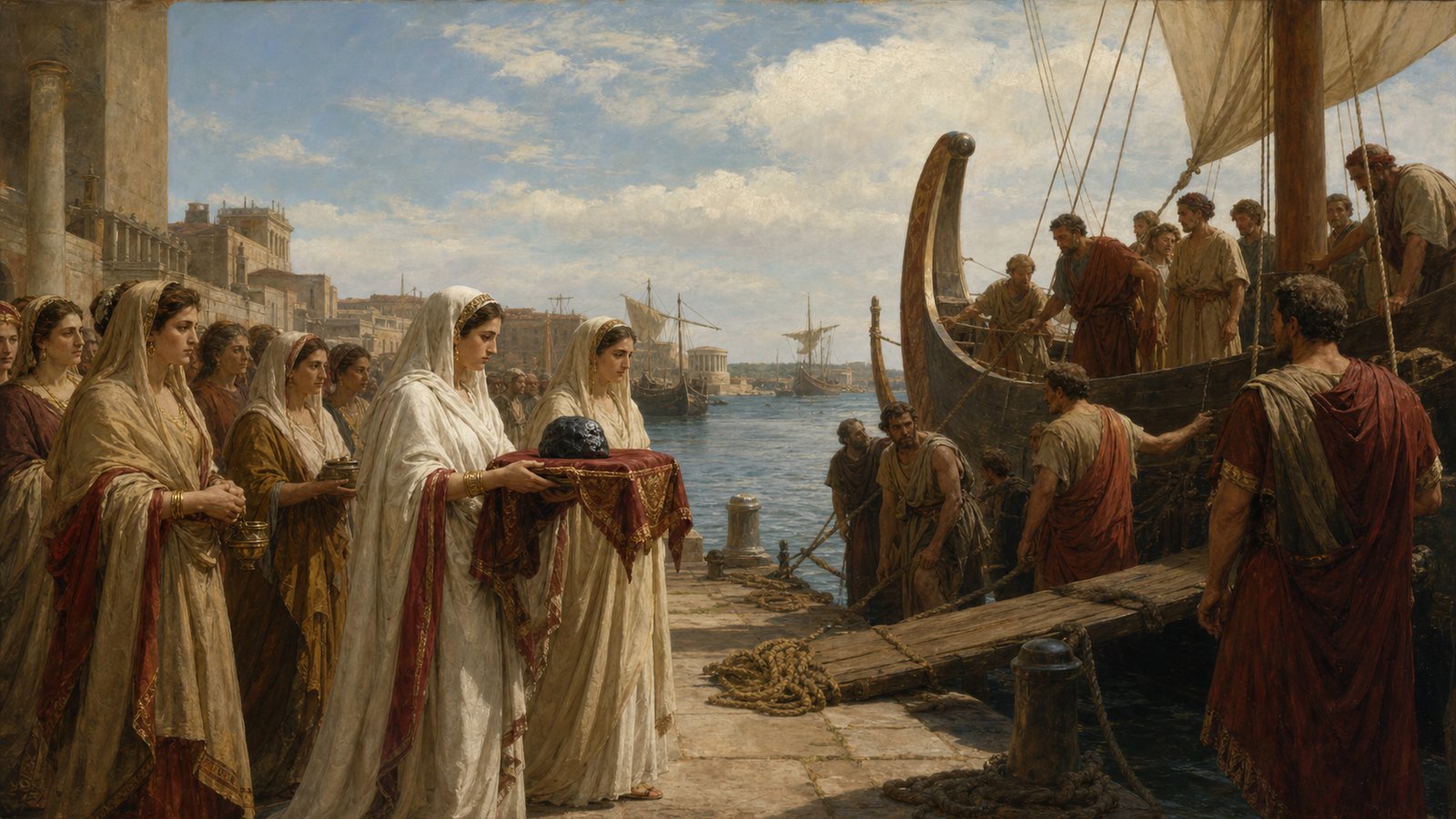
Livy’s narrative pairs him with the city’s matrons. Scipio received the goddess when the ship reached the Italian approach, then handed her to the women, who carried the sacred object in relays toward Rome. Male senatorial judgment and elite female ritual labor joined at the point of entry.
The scene made character visible through bodies and movement. “Best” was not left as an inscription. Scipio had to stand before the community and accept the object; matrons had to bear it hand to hand. Roman virtue became the human vehicle by which an overseas power crossed into civic space.
Matrons Carried the Goddess from the River to Victory’s Temple
Livy places the reception at the mouth of the Tiber and describes crowds pouring out to meet the goddess. Censers burned before doorways, and people prayed that she would enter Rome willingly and favorably. Smell, smoke, river traffic and dense spectators turned theological acceptance into an urban event.
The matrons carried the stone to the Temple of Victory on the Palatine. The location was temporary because Magna Mater’s own temple had not yet been built. Yet the placement already joined her with victory and with one of Rome’s most symbolically charged hills.
The procession resembled other ceremonies in which Roman religion moved through public streets. A route linked shore, river, households and hill. Residents could witness that the goddess had passed lawfully from foreign custody into Roman care.
The arrival date was commemorated with a lectisternium, a ritual banquet for the gods, and games. What had traveled as a compact stone immediately generated a calendar, gatherings and repeated obligations. Reception was not one dramatic afternoon; it established a relationship that the city had to maintain.
The Palatine Temple Took Thirteen Years to Complete
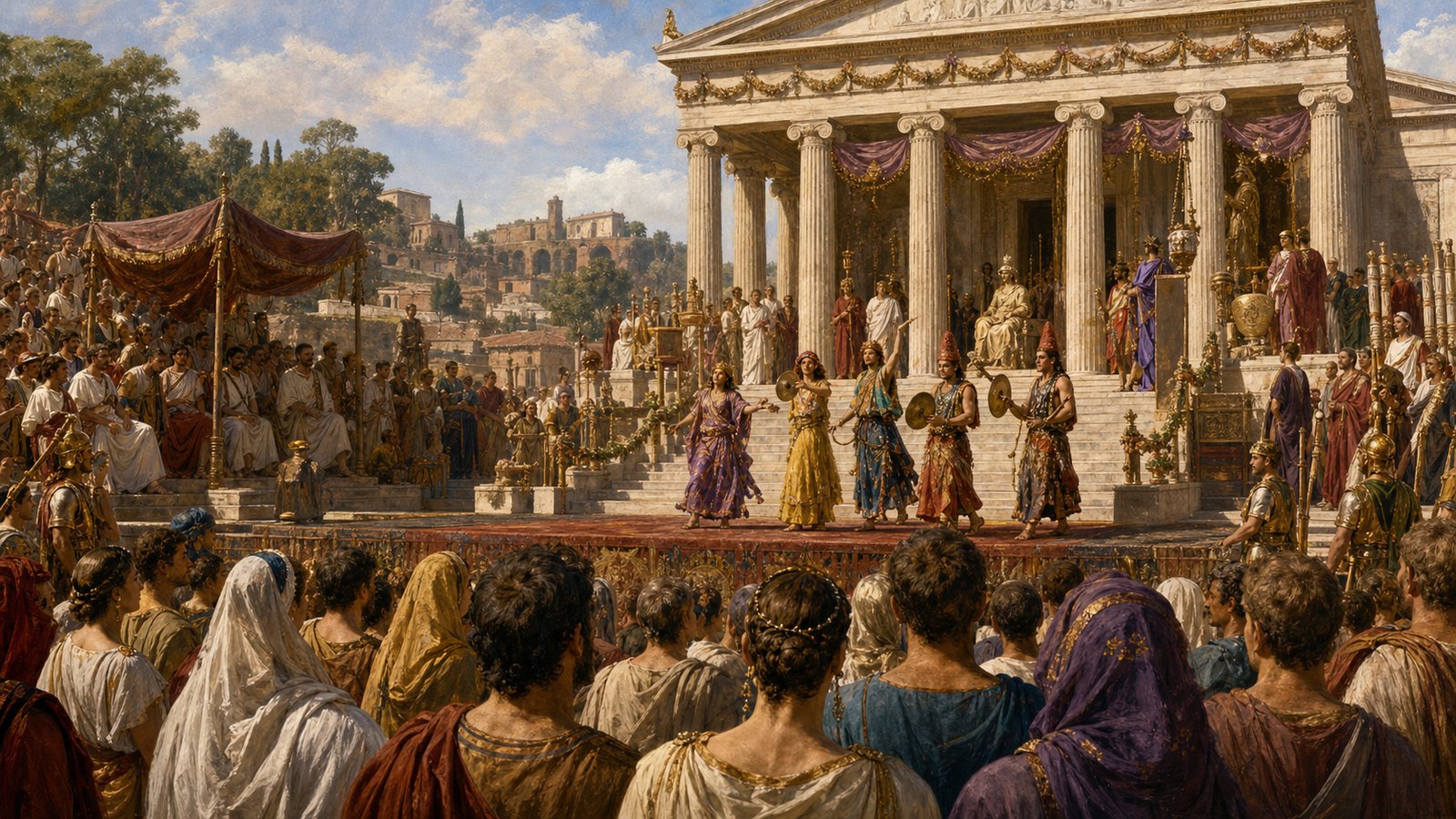
The Senate vowed a temple for Magna Mater, but the dedicated building on the Palatine was completed in 191 BCE. The interval shows the difference between emergency reception and permanent institutional settlement. For years the sacred object was present while architecture, finance and ritual arrangements caught up.
The temple stood near elite houses and the political-symbolic center later associated closely with imperial residence. Its location did not hide the imported cult at the urban edge. Rome placed the goddess inside a landscape of victory, ancestry and authority.
The Megalensia became her annual festival in April, with games and theatrical performances. Aristocratic hospitality and public spectacle formed part of its Roman expression. Repetition normalized what had arrived as a wartime intervention: each year the city restaged belonging rather than treating origin as forgotten.
Fire damaged and rebuilding altered the temple over time, but the cult persisted into the imperial period. Endurance did not erase the story of Pessinus. Instead, foreign origin became part of Magna Mater’s authority. The goddess could remain recognizably Phrygian while her festival and temple were administered as Roman public religion.
Rome Accepted the Goddess but Regulated Her Difference
Magna Mater’s eunuch priests, the galli, wore distinctive clothing and were associated with ecstatic music and self-castration. Roman citizens faced restrictions on participating fully in those priestly practices, especially in the Republican period. Acceptance of the goddess did not mean unrestricted imitation of every ritual attached to her homeland.
This boundary reveals Rome’s method of incorporation. The Senate could authorize a foreign cult, place its object on the Palatine and fund public games while marking certain roles as non-citizen or foreign. Roman control operated through selective inclusion rather than complete cultural flattening.
Later stories made the reception even more dramatic, especially the tale of Claudia Quinta proving her chastity by pulling the goddess’s grounded ship. That version became important in art and literature, but it is absent from Livy’s basic account of the 204 arrival and should not displace the earlier institutional sequence.
The black stone arrived because Romans interpreted war through religion, diplomacy and ancestry at once. Hannibal was recalled to Africa in 203 and defeated in 202; no source can isolate the goddess as a military cause. What the episode proves is political-religious craft: Rome answered fear by importing power, then surrounded it with rules until foreign sanctity could guard a Roman future.
Sources & Further Reading
- Livy, History of Rome, 29.10–14 and 36.36
- Ovid, Fasti, Book 4
- Metropolitan Museum of Art, Cybele and Attis
- Encyclopaedia Britannica, Great Mother of the Gods