
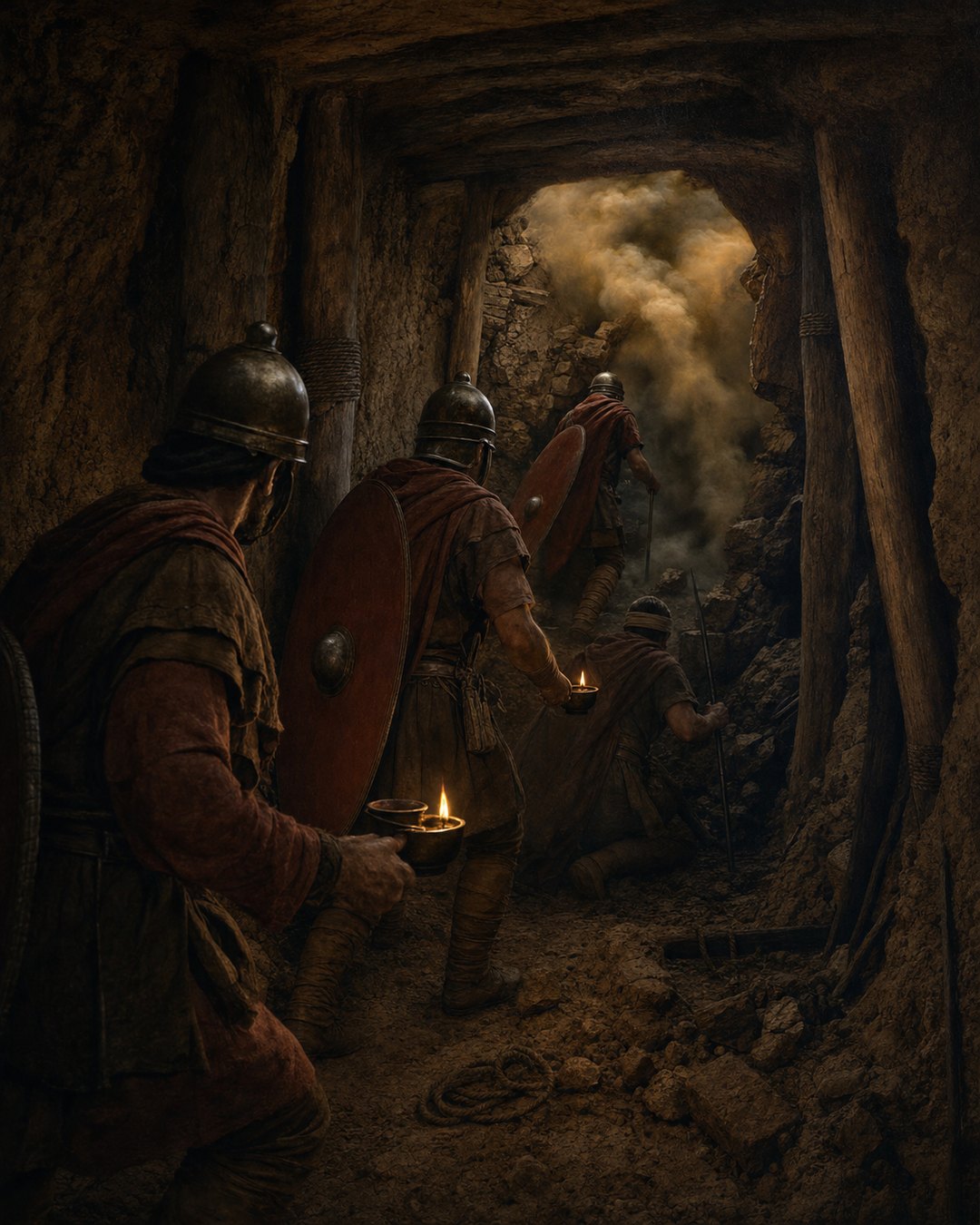
The Roman soldiers did not meet their enemy on an open wall. They crawled into a tunnel beneath Tower 19 at Dura-Europos, lamps and shields squeezed between timber and earth. Ahead lay Sasanian miners trying to bring down the city’s defenses. In the confined darkness, the first decisive blow may have been a cloud.
Excavators in the 1930s found a dense pile of Roman bodies in the countermine, along with one Sasanian casualty. The original interpretation imagined close fighting followed by collapse. Decades later, archaeologist Simon James returned to plans, photographs and field records and found that the positions, residues and tunnel layout told a different story.
His reconstruction argues that the Sasanians burned sulfur and bitumen to create choking gases, using the draft itself against the approaching Romans. At least nineteen defenders died, their bodies were stacked near the breach, and the attackers resumed their effort to damage the wall. Underground, air became a weapon.
Tower 19 Stood Above a Battle No One Could See
Dura-Europos occupied a commanding position above the Euphrates in what is now Syria. By the middle of the third century it was held by Rome and threatened by the expanding Sasanian Empire. Around AD 256, attackers surrounded the city and used mining as one part of a wider siege.
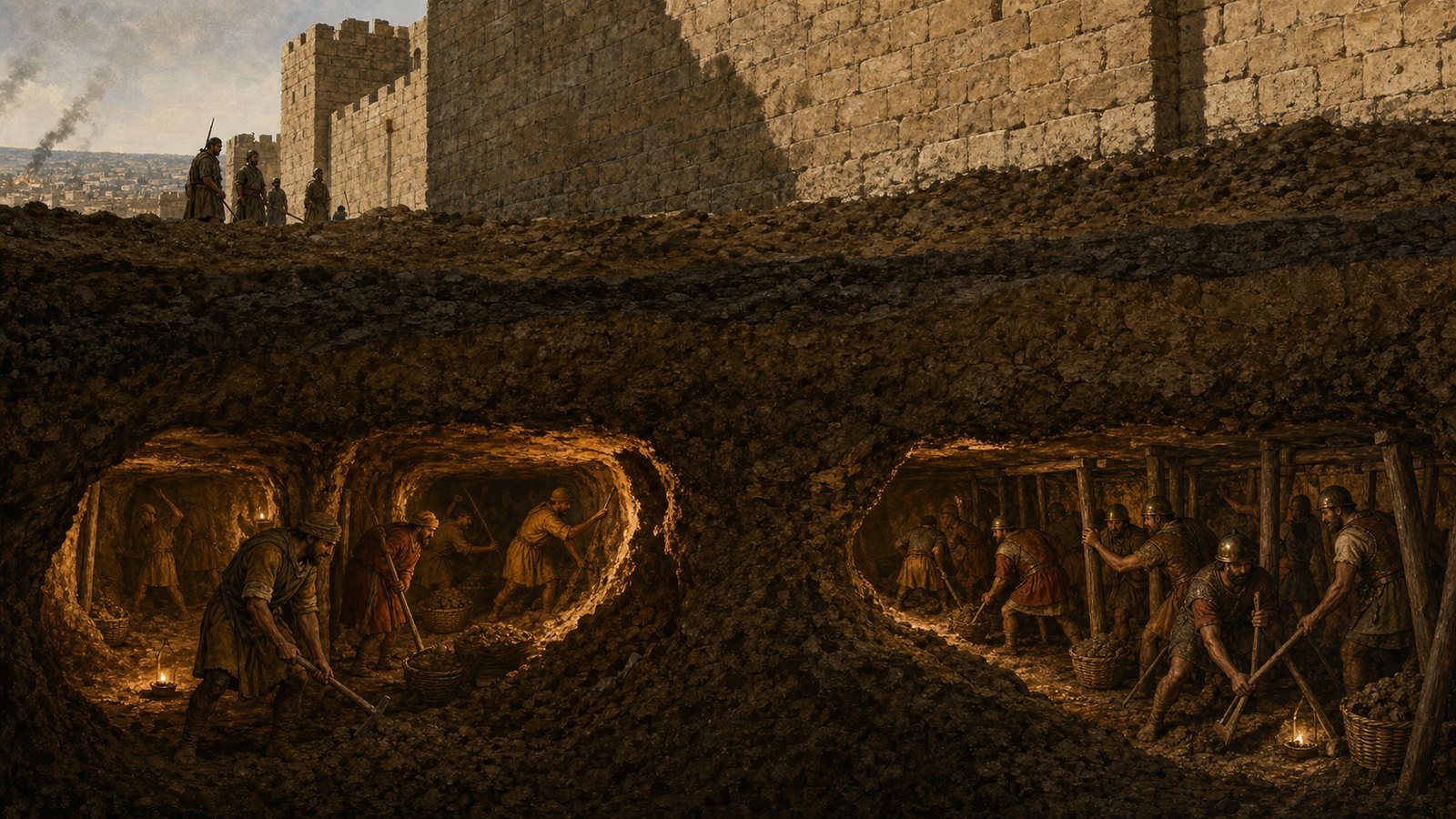
Miners aimed beneath the western wall near Tower 19. Their purpose was structural: remove or burn supports so that masonry above would settle, split or collapse. The city’s defenders could hear digging through earth and stone, but they could not see the line of attack from the battlements.
The Romans answered with a countermine. They dug outward beneath their own fortification to intercept the approaching gallery. Countermining turned engineering into combat because the two crews were moving toward a meeting point where tools, darkness and narrow space limited ordinary formation fighting.
This was a different mechanical problem from Roman artillery storing force in twisted rope. A bolt-thrower released energy across open distance. A countermine offered almost no distance at all, making ventilation and tunnel geometry as important as weapons.
Nineteen Romans Entered a Space Too Narrow to Deploy
The excavated deposit contained at least nineteen Roman soldiers and one Sasanian. Equipment identified the larger group as defenders. Shields, weapons and armour entered the tunnel with men who expected to confront miners, but the gallery was too cramped for a normal battle line.
The Roman bodies were concentrated near the junction of the mines. They were not spread along a route as a retreating group might be, and the pile appeared deliberate. James concluded that the Sasanians moved and stacked the dead to create a barrier between themselves and the Roman passage.
One Sasanian body lay separately near the area where the fire was prepared. He may have been the soldier who ignited the materials and failed to escape the fumes, although archaeology cannot recover his exact orders or final movement. His presence shows that the method was dangerous to its users as well as its targets.
The dead were neither scientifically studied nor retained after the early excavation. That loss limits modern testing. The case therefore depends on the surviving archive: sketches, photographs, notes, artifact locations and the physical relationship between the Roman and Sasanian galleries.
Sulfur and Bitumen Turned the Draft into an Attack
Excavators recorded sulfur crystals and bitumen in the tunnel. Both substances could be burned, and together they would produce dense, toxic fumes. Sulfur combustion creates sulfur dioxide, which attacks eyes, lungs and moist tissue; bitumen adds thick smoke and other irritating compounds.
Fire alone does not explain a mass death so quickly. Airflow does. A rising draft from the Roman side could pull combustion products from the Sasanian gallery toward the defenders. In a narrow passage, soldiers behind the first men would have little room to turn, pass one another or reach cleaner air.
James proposed that the Sasanians prepared the fire when they heard the Roman countermine nearing the breach. Once the connection opened, they fed the reaction and let pressure and draft carry fumes forward. The method required anticipation of how air behaved underground, even without modern chemical theory.
The label “chemical warfare” can sound more technologically modern than the act itself. The attackers needed obtainable materials, fire and practical mining knowledge. Its sophistication lay in combining them at the right location and moment, not in manufacturing an exotic laboratory poison.
The Body Pile Was Part of the Engineering
After the Romans died, the Sasanian miners still had a wall to undermine. James read the stacked bodies as a temporary barricade that screened the attackers while they resumed work. The defenders’ mass became part of the tunnel’s structure, a grim reuse of the obstacle their arrival had created.
The attackers then set fire to timbers supporting the Roman gallery. Burning supports could damage the countermine and help collapse the space, denying another approach. Archaeological traces of intense heat fit an operation that continued after the lethal fumes had done their work.
Above them, the wall did not simply fall in the way the attackers may have intended. Excavation suggests the Romans had strengthened the defenses with an earthen rampart. The mine caused damage, but the reinforcement helped the fortification settle rather than open into an easy breach.
The episode therefore contained two contests at once. Below ground, the Sasanians seem to have won the encounter and killed the counterminers. At the level of the wall, Roman reinforcement frustrated the larger engineering objective. Tactical success did not automatically produce a usable entrance.
A 1930s Excavation Needed a Twenty-First-Century Rereading
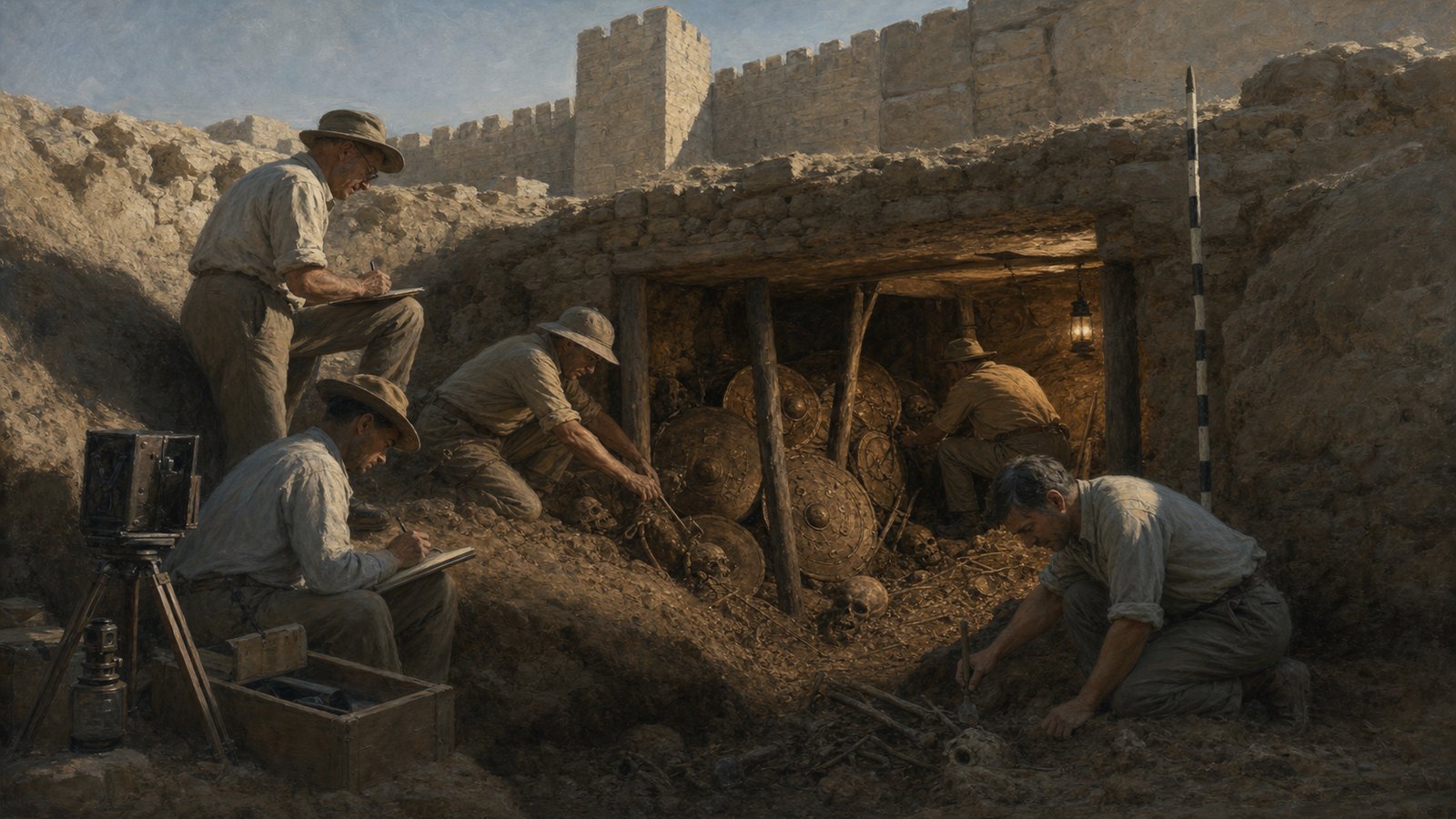
Robert du Mesnil du Buisson’s team exposed the mines during the Yale-French excavations. Faced with bodies, burned remains and a violent siege context, the first account understood the soldiers as casualties of combat or fire. That reading was reasonable but did not explain every spatial detail.
James approached the archive like a crime scene. He asked why the Roman bodies were stacked, why one Sasanian lay elsewhere, where the fire residues appeared and which direction gases would travel. The new interpretation emerged by treating positions and absences as evidence rather than adding a dramatic weapon to an old story.
This method resembles the caution needed when a surviving shield from Dura-Europos is used to explain Roman equipment. One exceptional deposit can reveal construction or action, but it must not be turned automatically into a universal rule for every army and siege.
Reexcavation might test parts of the reconstruction, but the original galleries and casualties are no longer available in their first recorded state. Conflict and looting at Dura-Europos have created further losses. The documentary archive has consequently become an archaeological site in its own right.
The Siege Ended the City but Preserved Its Last Defenses
Dura-Europos fell to the Sasanians around AD 256 and was not restored as a thriving Roman city. Military catastrophe helped seal rooms, ramparts and deposits that later made the site unusually informative. The siege destroyed an urban community while preserving evidence of how its final defense worked.
Tower 19 offers no heroic duel and no named commander. Its protagonists are mostly anonymous miners and soldiers whose choices survive through soil. They listened, dug, shored passages, calculated direction and entered a tunnel where armor offered little protection against the air itself.
The strongest conclusion is carefully limited. At least nineteen Romans and one Sasanian were entombed in the mining complex. Sulfur and bitumen were present, the bodies formed an unusual pile, and a specialist reconstruction argues that deliberate fumes best explain the pattern. Absolute certainty is impossible because the remains cannot now be retested.
Even with that caution, the deposit changes the picture of ancient siegecraft. Walls were attacked from below, defenders pursued the sound, and a prepared enemy turned ventilation into an ambush. The fatal mechanism at Dura-Europos was not a futuristic gas. It was practical knowledge of fire, minerals, confined space and human panic.