
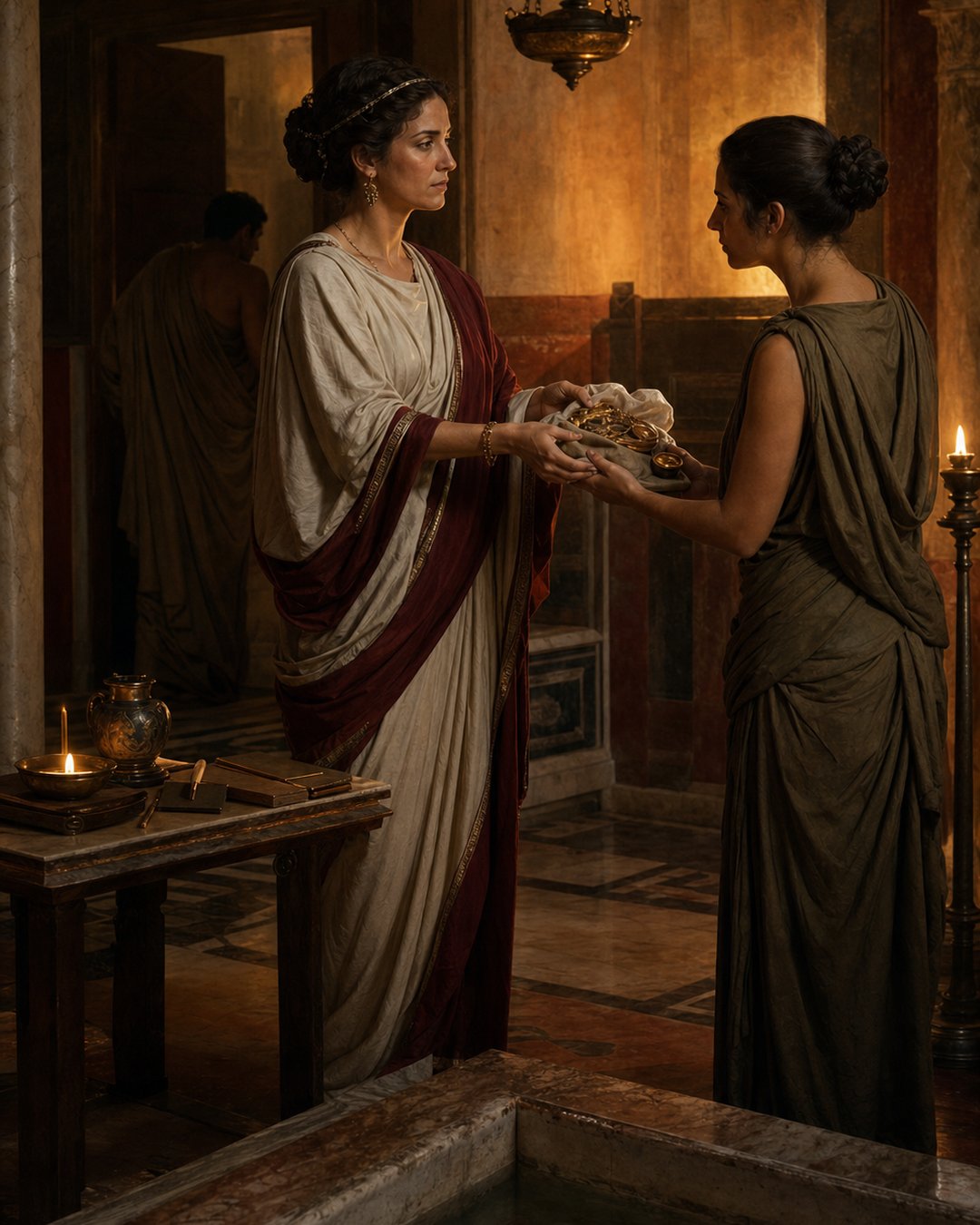
Around the end of the first century BC, a Roman widower had an extraordinary account of his marriage cut into stone. The surviving slabs do not preserve his name or his wife’s with certainty. What they preserve is a sequence of emergencies: murdered parents, a contested will, civil war, guards, hiding places, a violent petition and a husband marked for death.
The inscription is conventionally called the Laudatio Turiae, although the identification with a woman named Turia is debated. Its speaker praises familiar Roman virtues, including modest dress, wool work, family loyalty and careful household management. Then he says those qualities are not the point. Other respectable women possessed them. His wife had been tested by circumstances that almost no one encountered.
What follows is not a passive portrait. While male relatives were overseas, she pursued her parents’ killers and defended their will. When her husband fled, she sent him jewelry, money, servants and provisions through hostile guards. She found him a hiding place, faced Marcus Lepidus and kept their household together. The stone makes marriage look like an alliance built for survival.
Murder Before the Wedding Forced Her to Act Alone
The eulogy begins its surviving narrative before the couple married. The woman and her sister were suddenly orphaned when both parents were murdered in the countryside. Her future husband had gone to Macedonia, while her sister’s husband, Cluvius, was in the province of Africa. The women could not wait for the men to return before seeking a legal response.
The speaker credits his future wife with insistent demands and a determined pursuit of justice. The guilty were punished. He shares some praise with her sister, but emphasizes that his wife carried the effort while he was absent. That detail matters because the inscription repeatedly measures her deeds against moments when ordinary protection had vanished.
After securing punishment, she left her own house and waited in the home of her future mother-in-law. The move joined personal safety, sexual reputation and kinship. In a society where enemies could turn vulnerability into rumor, choosing the household in which to wait was itself a defense of the coming marriage.
The widower is shaping memory, not writing a neutral court record. Even so, his choice of episodes is revealing. He does not merely call her brave. He specifies distance, absent men, murdered parents and a case pursued to punishment. Praise becomes credible through obstacles and results.
A Disputed Will Turned Kinship into a Legal Battlefield
The next crisis concerned her father’s will. Opponents argued that a form of marital transaction called coemptio had invalidated it. If they prevailed, the woman could fall under their guardianship with the property, while her married sister might receive nothing. The claim threatened inheritance and personal legal control together.
She answered that the will remained valid and that the claimants lacked the required kinship right over her. More strikingly, she announced that even if the document failed, she would share the inheritance with her sister. The strategy defended the father’s written wishes while closing off the advantage that opponents hoped to gain by dividing the sisters.
The challengers abandoned the case. The husband presents that outcome as one victory serving three loyalties: duty to her father, devotion to her sister and faithfulness to him as an heir. Property here was not a private heap of wealth. It defined who could command a woman, which branch of a family benefited and whether a planned household could begin intact.
This legal episode makes a useful counterpoint to the public ambitions expressed at Roman funerals. A family’s continuity depended not only on display before a crowd, but on documents, inheritance rules and someone willing to resist an opportunistic reading when the expected defenders were away.
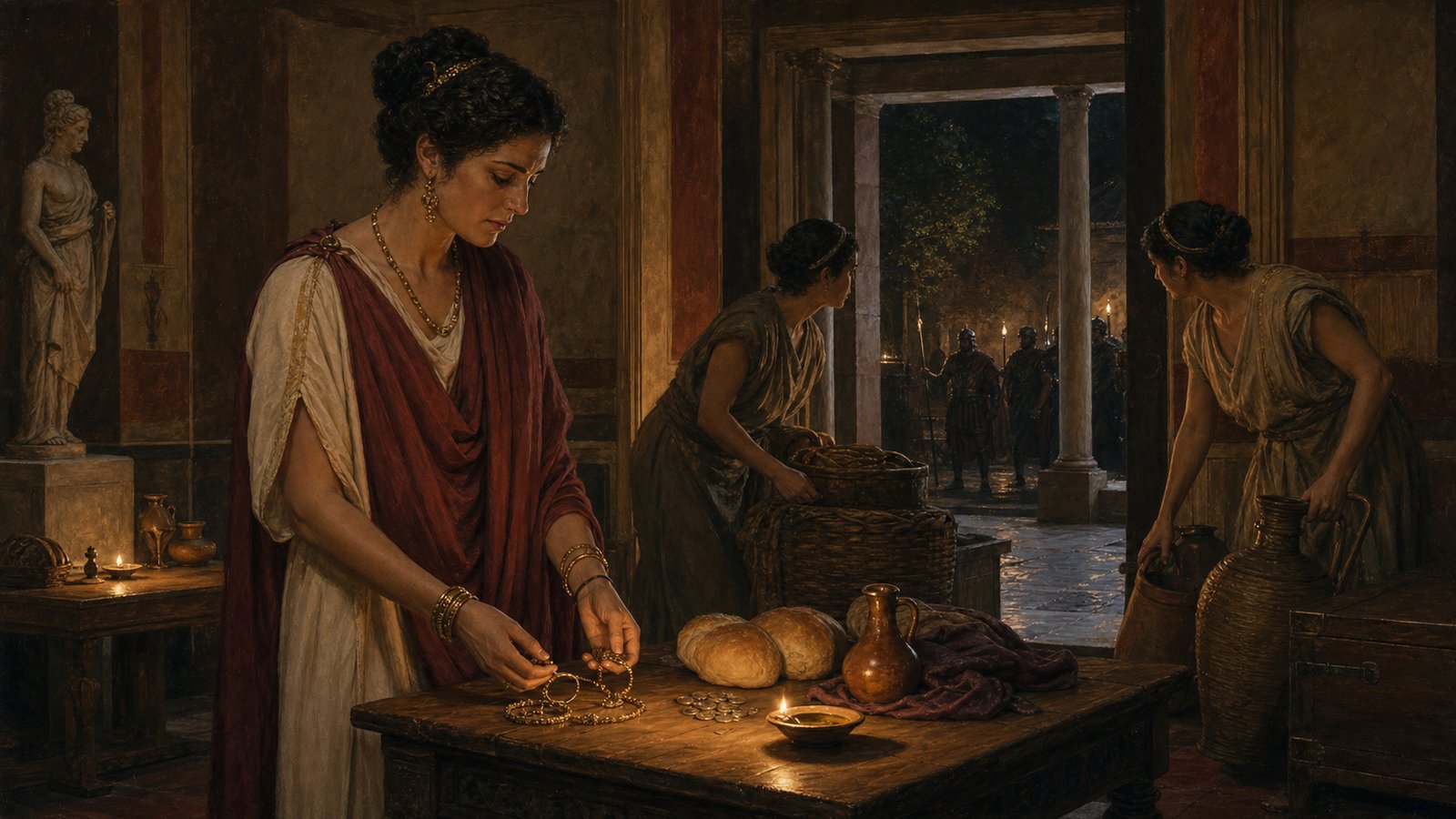
Gold Left Her Body and Crossed the Guards
Civil war later drove the husband into flight. The inscription does not preserve every step cleanly, but its practical details are sharp. His wife stripped gold and jewelry from her own body and sent the valuables to him. She also supplied money, servants and provisions, repeatedly finding ways to deceive guards set by their adversaries.
Jewelry in this scene stopped being ornament and became portable survival capital. A ring, chain or bracelet could cross distance more readily than land. Servants could carry information and necessities. Food and money sustained a fugitive whose civic standing and access to ordinary resources had collapsed.
The wife also organized a hiding place when alarming reports tempted him toward a dangerous move. Her sister and Cluvius joined the plan, sharing its risk. The account shows a network rather than a solitary heroine: sisters, in-laws, servants and household spaces could do work that formal institutions no longer performed safely.
The husband later says that he owed his life no less to her devotion than to Caesar Augustus. Imperial clemency could restore a citizen on paper, but it mattered only if the condemned person remained alive long enough to receive it. The eulogy places domestic logistics beside the act of a ruler and refuses to treat the first as merely private.
At Lepidus’s Feet, a Petition Became a Public Accusation
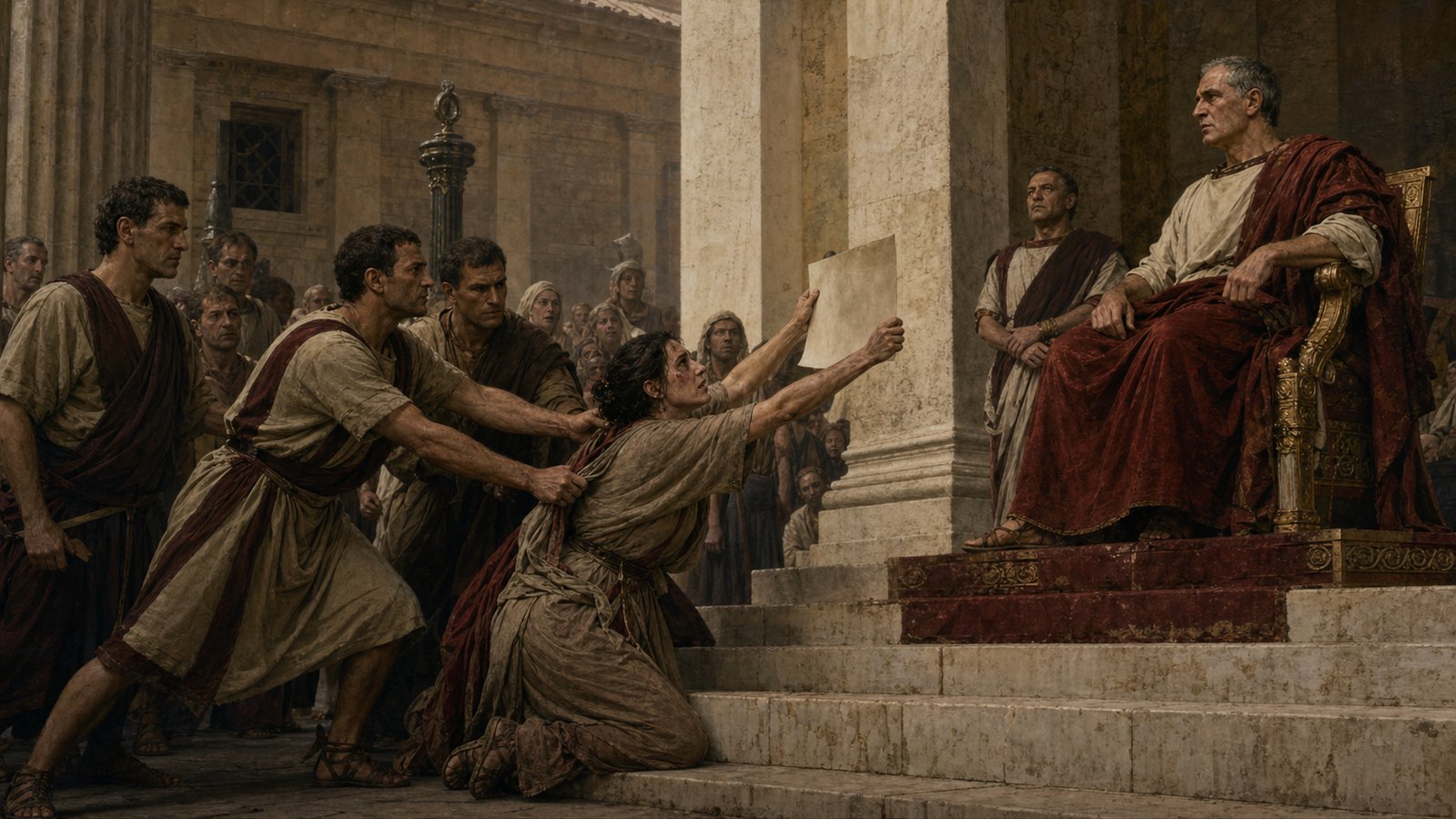
The most physical mini-scene occurs after Augustus had approved the husband’s restoration while absent. The wife approached Marcus Lepidus, the triumvir who was present, and lay at his feet to plead. Instead of raising her, Lepidus’s men dragged her away as though she were a slave. The inscription says her body was bruised.
She continued to recite Augustus’s edict in a loud voice. That choice changed the petition. By making the wording audible, she identified the authority that had favored her husband and the official obstructing that decision. Her injured body and the repeated edict turned private supplication into a public contrast between clemency and cruelty.
The speaker claims the episode later harmed Lepidus. We should hear the rhetoric in that line: a grieving husband knows the political outcome and arranges the confrontation as moral proof. Yet the core action is concrete enough to resist abstraction. She went to a powerful man, endured removal and kept speaking the text that supported her case.
Roman ideals often praised a quiet and modest wife, but this story praises controlled publicity at the necessary moment. She did not seek office or deliver a general political program. She used the posture of a petitioner, the exact words of an edict and a crowd’s ability to witness mistreatment. Domestic loyalty acquired a public voice.
Forty Years Ended with an Offer He Refused
When peace returned, the marriage continued without children. The couple had been together for fully forty years, the husband says, without divorce or disharmony. His wife eventually proposed that he divorce her so another woman might bear his children. She offered to find a suitable bride herself and to treat future children as though they were shared.
Her proposal also kept their property together under his control or her administration. She imagined a changed household in which she would assume the loyalties of a sister and mother-in-law rather than disappear as a discarded spouse. It was an attempt to solve dynastic failure without dissolving the practical partnership built across earlier crises.
The husband reacted with anger and horror. He rejected separation while both remained alive. His response supplies the emotional hinge of the eulogy: the woman who had protected his future now offered to erase her position for that future, and he refused to convert gratitude into replacement.
Childlessness also links this elite memorial to the risks managed by Roman midwives and households around childbirth. In the eulogy, the missing child is not a statistic. It becomes a problem of inheritance, affection and the limits of what even a resourceful couple could repair.
The Missing Names Keep the Evidence Honest
The traditional title can mislead. Scholars have associated the woman with Turia, wife of Quintus Lucretius Vespillo, but the surviving text does not securely give those names. Calling it the so-called Laudatio Turiae preserves a convenient label while acknowledging that the biography cannot be pinned down as confidently as its events.
The monument is also incomplete. Lines are missing, and the husband controls every surviving judgment. We hear the woman’s proposals and words through his memorial voice. His praise follows the conventions of a funeral eulogy and enlarges episodes into examples of virtue. None of that makes the inscription useless; it tells us what evidence it is.
Its exceptional power lies in the meeting of formula and detail. The widower lists wool work and modest appearance because audiences recognized those virtues. He then moves beyond them to guards, jewelry, a legal claim, bruises and an unwanted divorce plan. Conventional praise becomes the frame for memories that are too specific to be interchangeable.
The wife’s achievement was not simply that she behaved like an ideal Roman matron. She read danger, mobilized kin, moved resources and persisted when her husband could not act openly. The stone lets him recover authority as narrator after years of dependence. In doing so, it preserves the uncomfortable truth that his survival had rested on her decisions.