
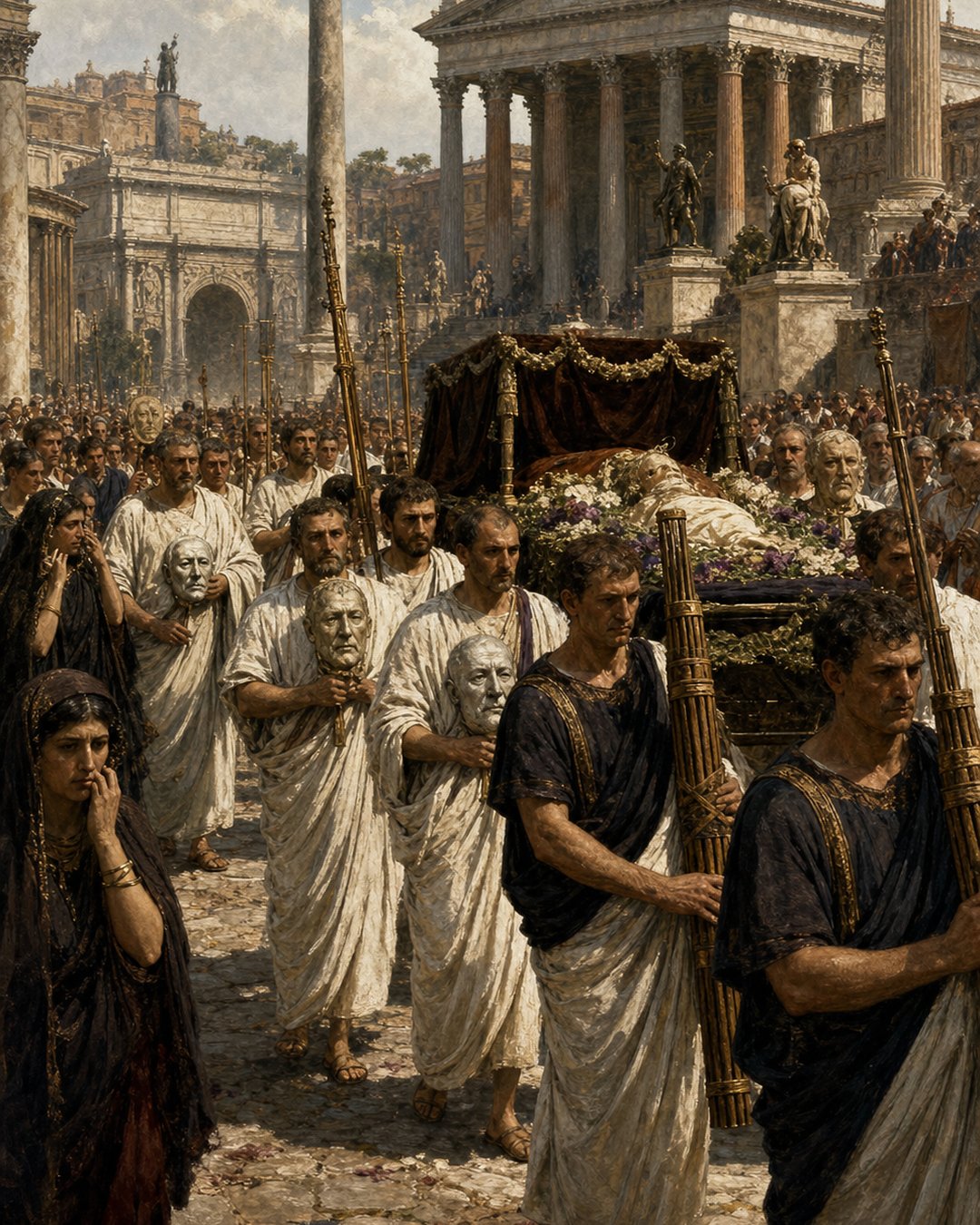
A Roman elite funeral was grief with an audience. The dead person mattered, but so did the family standing around the bier, the ancestors invoked, the offices remembered, and the crowd watching memory become performance. Mourning moved through the streets, and ambition moved with it.
Roman funerals mattered because they made family ambition public. They turned private loss into civic theater. In the most famous aristocratic rituals, ancestor masks, processions, and speeches taught spectators that a living family had a long claim on honor.
The dead did not travel alone
Polybius describes a striking aristocratic custom: masks of ancestors could be displayed in public funeral processions, worn by men resembling the dead in stature and appearance. The result was not only remembrance. It was the return of a family’s past to the city.
The procession made lineage visible. Ancestors who had held office seemed to accompany the newly dead. Family history walked through public space and asked the crowd to see continuity.
The atrium stored political memory
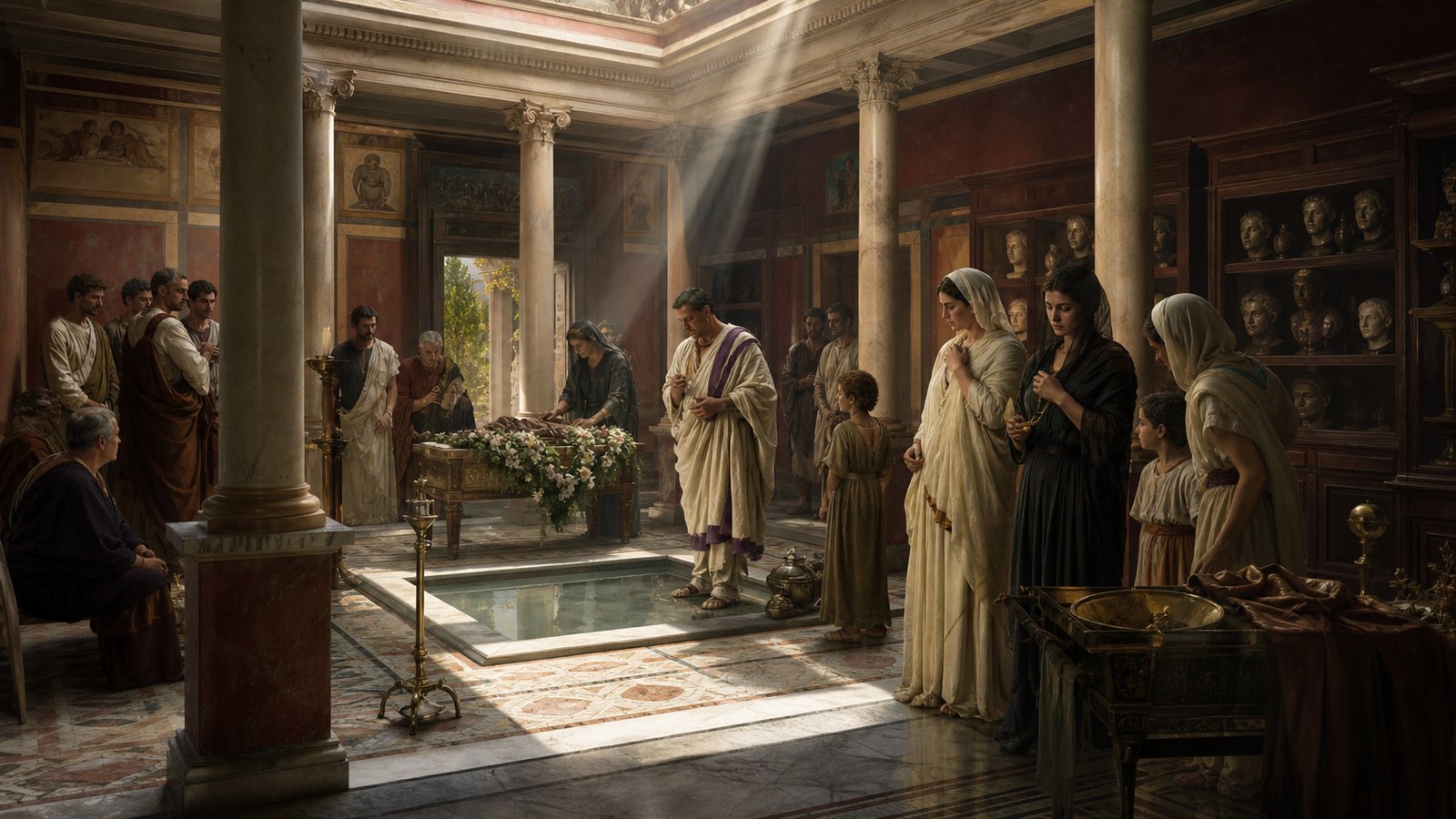
Before the street, there was the house. Aristocratic houses could preserve ancestral images in the atrium, where visitors encountered family memory as part of domestic architecture. The home was private, but its memory was ready for public use.
Picture the morning before a funeral: masks arranged, clients gathering, relatives preparing, the household quiet but alert. Grief exists there, but so does choreography. The family is about to carry its archive into the city.
The procession turned loss into proof
A funeral procession could include mourners, musicians, attendants, family, clients, the bier, and images of ancestors. The point was not simply to announce death. It was to stage a relationship between the dead, the family, and Rome itself.
This staging mattered because Roman competition depended on memory. Offices held by ancestors could become arguments for descendants. Public grief became a reminder that this family had served, ruled, sacrificed, or at least claimed to have done so.
The funeral speech taught the crowd
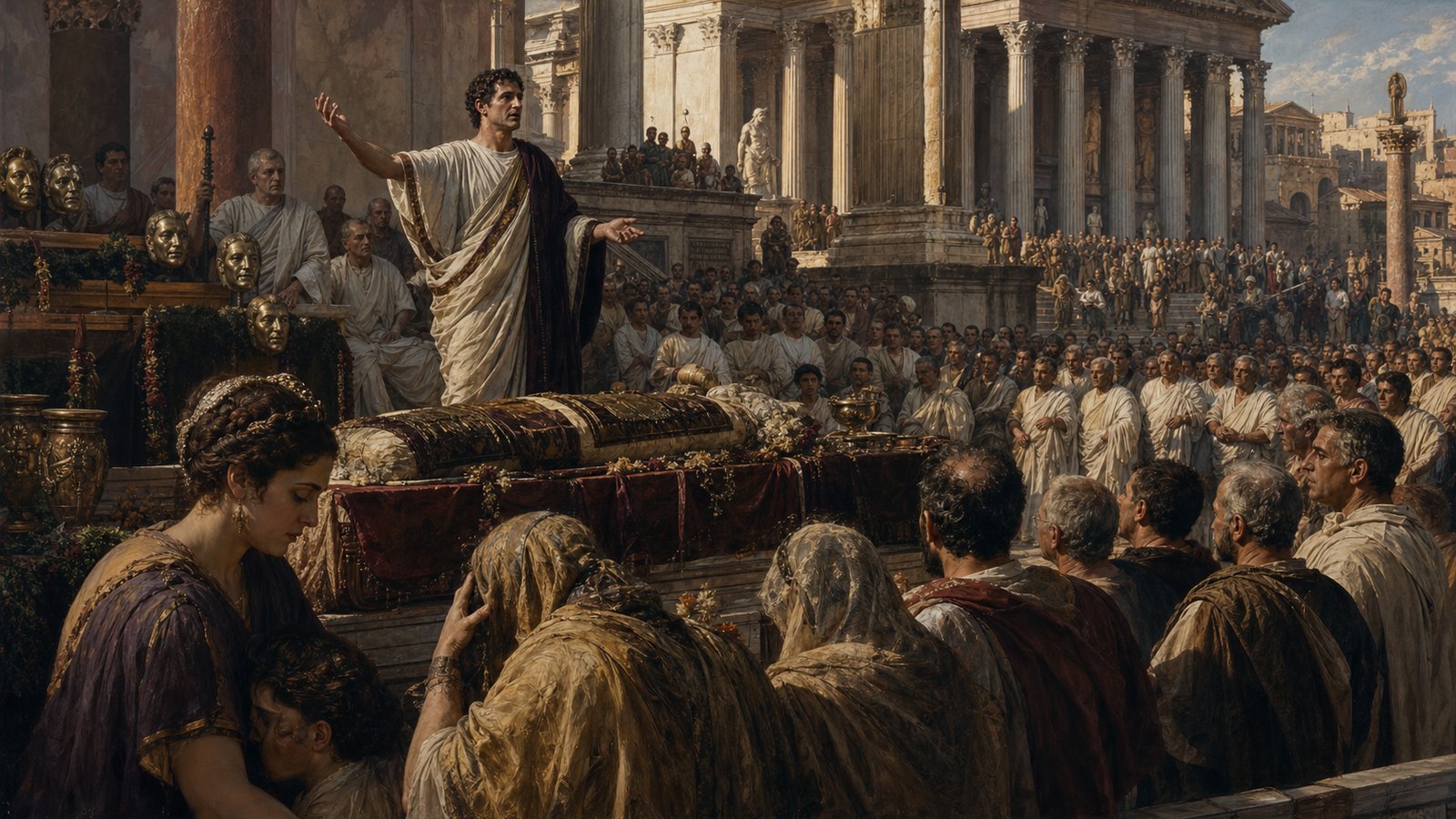
The laudatio funebris praised the dead, but it also instructed listeners. A speaker could connect virtues, offices, wars, magistracies, and ancestors into a usable story. The dead became a lesson about what the family represented.
That lesson was not neutral. Praise selects. It arranges a life into a pattern useful to the living. In a political culture obsessed with honor, the funeral speech could become a carefully shaped inheritance.
Masks made time collapse
The ancestor mask is powerful because it makes time visible. The living wearer, the dead ancestor, the newly dead, and the watching crowd all share one scene. The past appears to stand beside the present.
That visual compression gave aristocratic memory emotional force. A list of offices might be forgotten. A procession of faces, bodies, and names could be felt. Rome learned through spectacle as well as through records.
Family grief became civic theater
The ritual did not make sorrow fake. Roman families could grieve deeply. But elite mourning also had public consequences, because a noble funeral asked the city to recognize the dead person and the family behind them.
This is why Roman funerals made family ambition public. They converted loss into reputation, memory into political capital, and ancestors into witnesses for the living. In Rome, even grief could speak to the future.
The brilliance of the ritual was that it did not need to say ambition openly. A family could mourn, honor the dead, and display pedigree in the same act. The crowd supplied the political meaning because everyone understood the language of offices and ancestors.
Polybius’ account is especially valuable because it shows the educational force of the spectacle. Young men could see examples of public service embodied before them. The ritual taught imitation through emotion.
That teaching was selective, of course. Every family memory leaves things out. Failure, cruelty, debt, faction, and scandal could be softened by the solemnity of the occasion. A funeral is never only a mirror; it is also an arrangement.
The procession also made status spatial. To move through the Forum with attendants, masks, and a watching crowd was to occupy the city with family memory. Streets and squares became temporary extensions of the house.
For clients and dependents, attendance mattered. Being seen near a great family at a funeral could signal loyalty and connection. The dead drew the living into visible networks of obligation.
For rivals, the same spectacle could be irritating or threatening. A powerful family did not stop competing because one member had died. The funeral might remind everyone how much symbolic capital remained.
The material objects sharpen the scene: wax masks, dark clothing, bier, incense, instruments, ancestral names, and the raised voice of the speaker. Roman politics often worked through such tangible forms.
The ritual also explains why ordinary funerary inscriptions matter by contrast. Not every Roman family had ancestor masks in a noble atrium, but many families still sought some public mark of identity. Memory was a broad Roman hunger.
Elite funerals simply intensified that hunger into civic theater. They made memory walk, speak, and look back at the crowd through borrowed ancestral faces.
The result was emotionally complicated. A son might grieve a father while also inheriting a political story. A widow might mourn while the family’s alliances gathered around her. A crowd might pity the dead and assess the living at the same time.
That is the Roman lesson hidden in the ceremony. Public life did not pause for death; it absorbed death into its language of honor. A funeral could close one life while opening another family argument about status.
The masks therefore did more than preserve faces. They preserved claims. They told spectators that this family had a past worth remembering and, by implication, a future worth trusting.
In that sense, the funeral was one of Rome’s most powerful memory machines. It joined household, street, speech, body, and crowd. It made ancestry audible and visible just when emotion made people most attentive.
The pattern is useful because it ties a visible object to a much larger system. A stamp, ditch, mask, road, wall, or speech did not stand alone. It connected property, labor, authority, memory, and spectators in ways that Romans could recognize without needing a modern explanation.
The human scale is just as important as the institutional one. Someone pressed the clay, pulled the rope, lifted the mask, counted the cart, watched the gate, or listened from the crowd. Roman power often became durable through exactly those repeated gestures.
This is also why the topic should not be reduced to a charming detail. The detail matters because it opens the machinery behind the larger story. It shows how Rome converted ordinary materials and routines into public confidence.
If we follow that machinery closely, the monument becomes less distant. It is no longer only an impressive ruin or a famous custom. It becomes a working system made of hands, tools, names, fear, ambition, timing, and memory.
Sources & Further Reading
- Polybius, Histories, Book 6
- Smith Dictionary, Imagines
- Smith Dictionary, Funus
- Oxford Classical Dictionary, laudatio funebris
- Metropolitan Museum of Art, Roman Domestic Architecture
- Cicero, Brutus
- British Museum, Roman tombstones
- Cambridge Companion to the Roman Republic
- World History Encyclopedia, Roman Funerary Practices
- Polybius, Histories, 6.53–54