
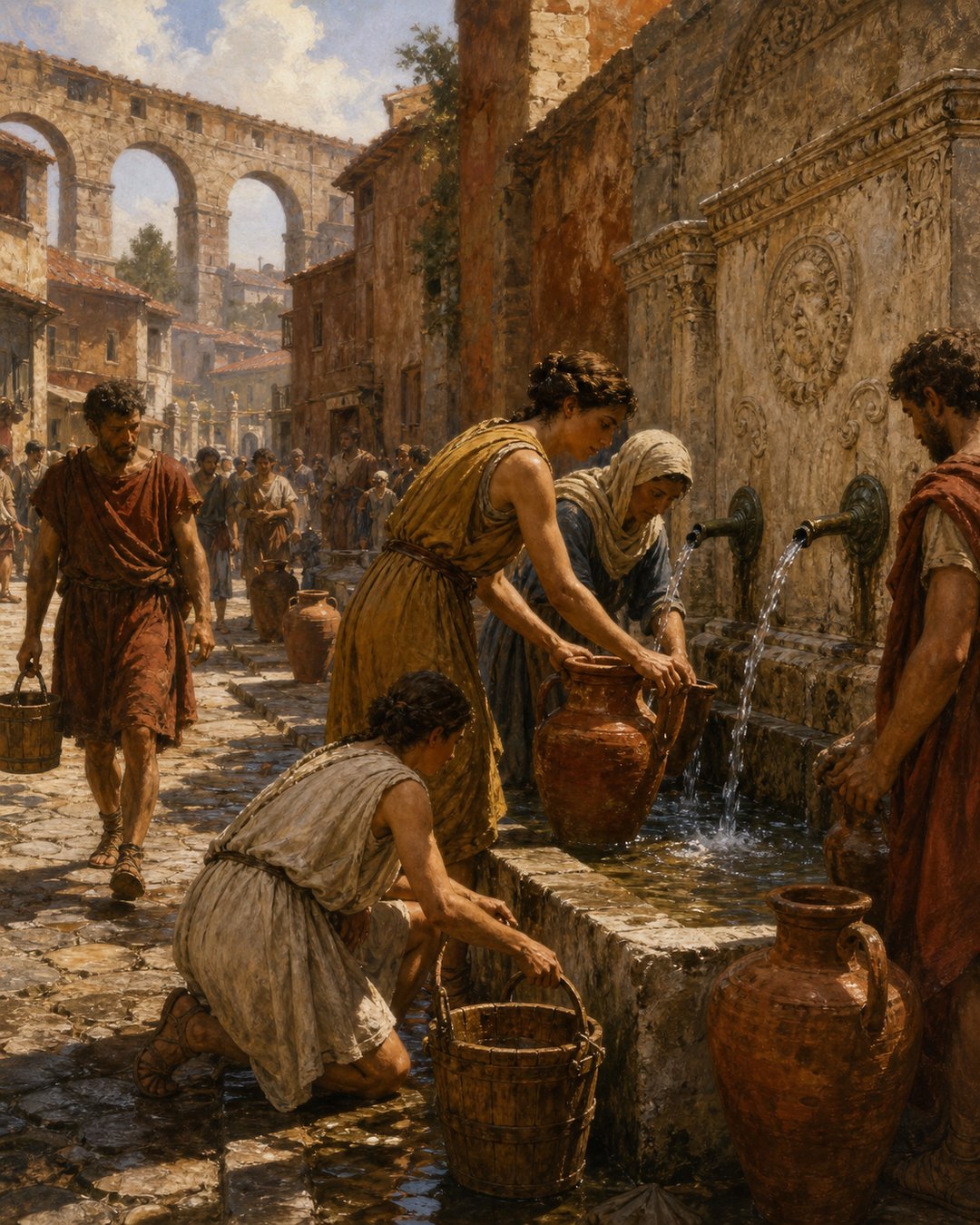
A Roman aqueduct could look like a monument from a distance, but its real test came at street level. Water had to arrive where people could use it: at basins, fountains, baths, workshops, and neighborhoods whose daily routines depended on a reliable flow.
Street fountains mattered because they made water public. They turned distant engineering into a visible promise that the city could provide. A basin full of water was not only convenient. It was government, maintenance, measurement, and social order made wet and noisy.
The aqueduct ended in a crowd
The famous arches were only part of the system. The public experience of water often happened around basins where people filled jars, washed hands, waited their turn, and watched whether the flow was strong or weak.
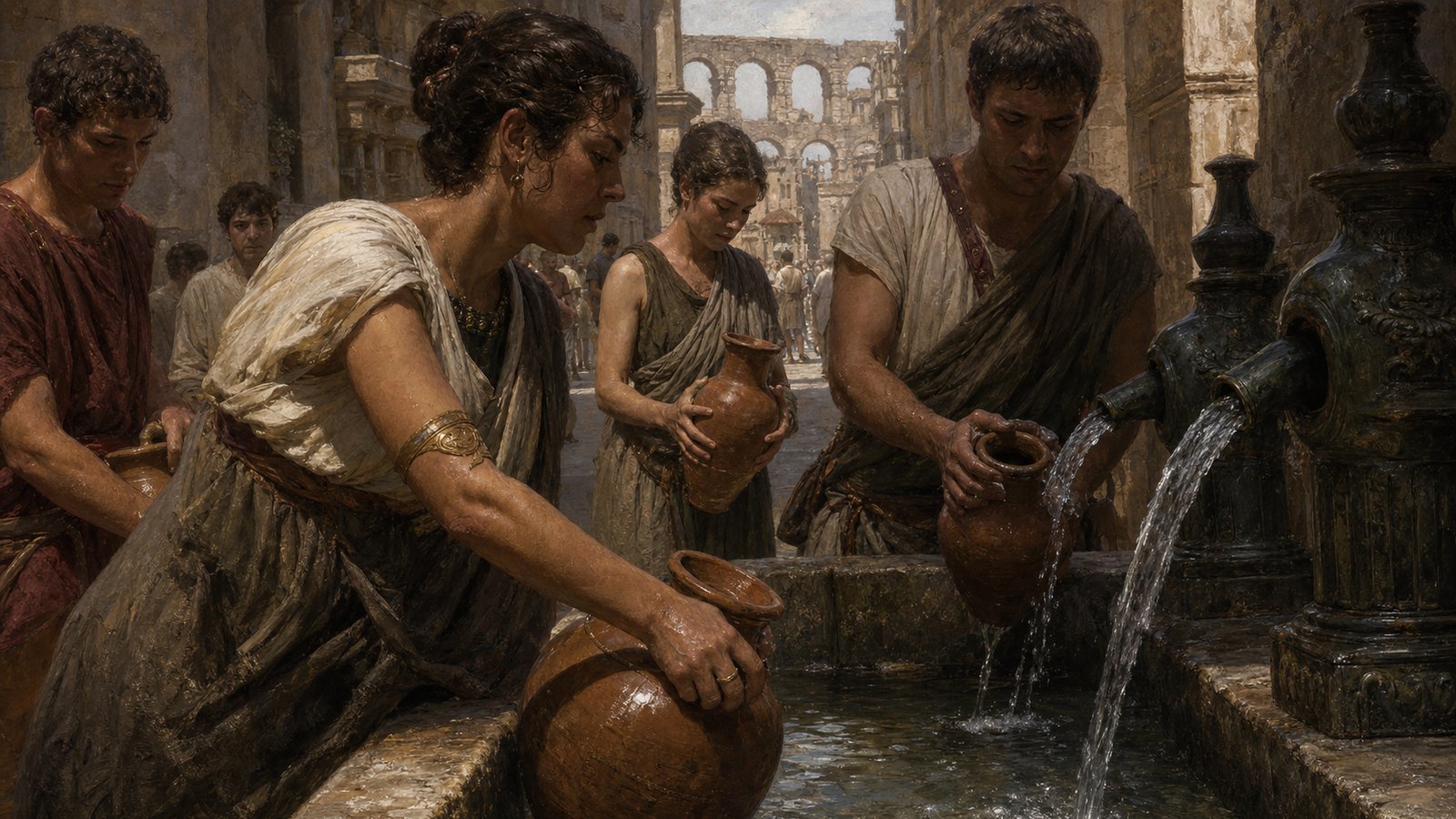
Imagine a hot afternoon in a dense street: amphorae set down on worn paving, a bronze spout splashing into stone, children sent with jars, and neighbors noticing at once if the water slowed. Infrastructure became conversation.
Frontinus saw water as administration
Frontinus did not describe Rome’s water as magic. He wrote about channels, measurements, maintenance, illegal tapping, and distribution. His account makes clear that water had to be governed before it could feel abundant.
That administrative detail matters. A fountain was the public face of a hidden argument over supply: how much water entered the city, where it went, who was entitled to it, and who was stealing or wasting it.
A basin made provision visible
Romans could admire aqueducts as symbols of power, but a street fountain proved the point more intimately. It put water within reach of people who did not own private pipes or grand houses.
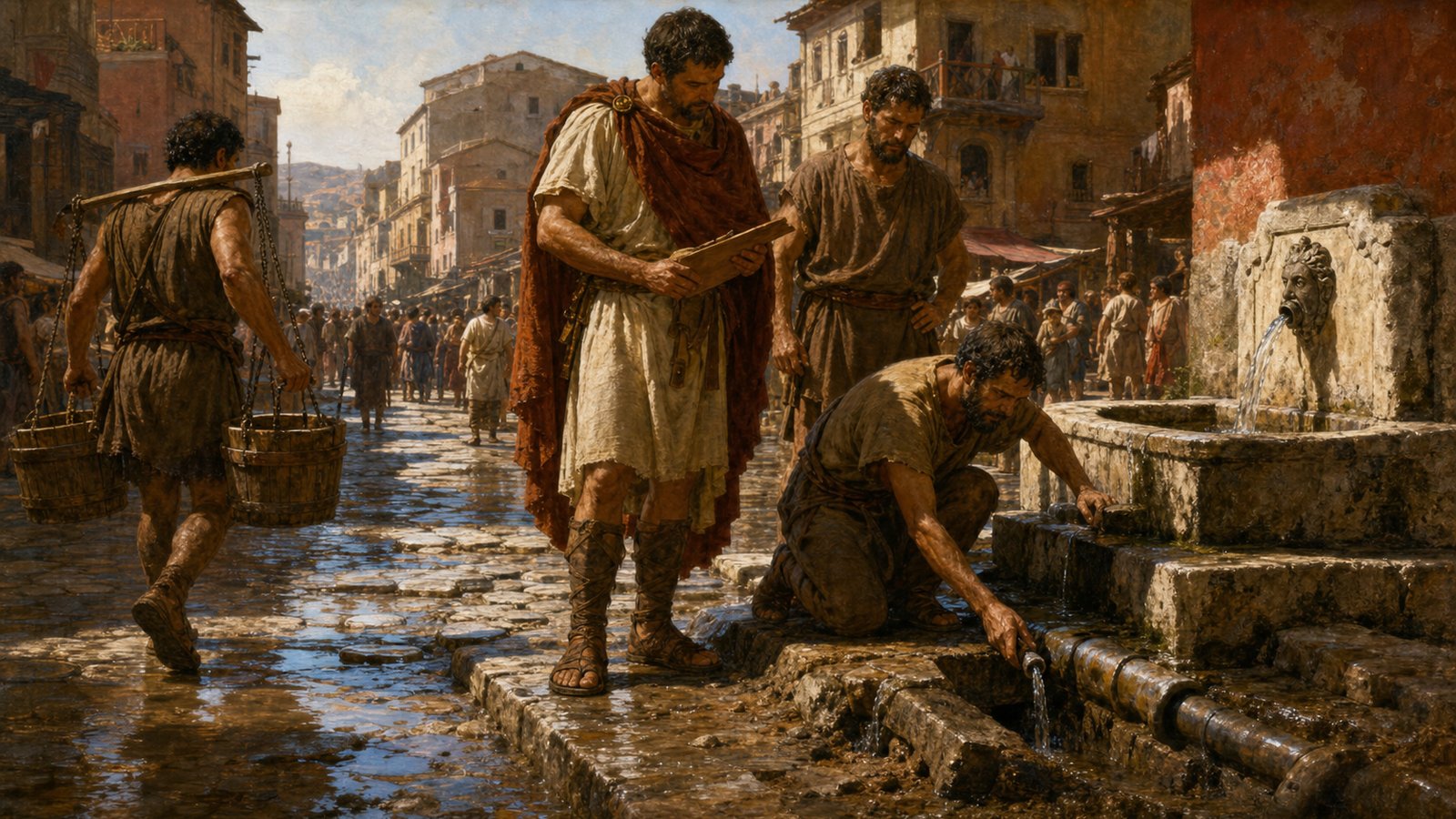
The fountain also made failure visible. If a conduit broke, a pipe was tapped, or maintenance slipped, ordinary users knew immediately. Public water created public expectations.
The street organized daily movement
Water shaped the routes of the day. People moved toward fountains with containers, paused near basins, exchanged news, and made domestic work depend on a public place. The city’s social geography bent around supply.
That physical routine gave the fountain a political edge. A government that could supply water could appear competent; a government that let water fail invited anger in the most ordinary corners of life.
Display and necessity met in the same flow
Roman water was both practical and theatrical. Monumental fountains and baths displayed abundance, but the same culture needed working basins and channels. Prestige and necessity were not separate worlds.
The sensory detail is easy to miss in ruins: wet stone, clay jars knocking together, splashes in the gutter, mineral stains on the basin, and voices rising over the sound of water. That was where engineering became daily life.
Public water required constant work
No fountain stayed public by itself. Channels had to be cleared, leaks found, abuses checked, and distribution defended. The visible basin depended on labor most users never saw.
This is why Roman street fountains made water public. They transformed a controlled resource into a shared urban experience, while also revealing how much work was needed to keep that experience alive.
A fountain could therefore carry more meaning than its size suggested. It was a point where state capacity, neighborhood routine, and social expectation met. People did not need a technical treatise to know whether the system served them. They could see and hear the answer.
The arrangement also shows why Roman infrastructure was political even when no one gave a speech. A working basin gave authority a calm face. A dry basin made failure impossible to hide.
Private privilege still mattered. Wealthier households might seek special connections or better access, and Frontinus’ concern with illegal use shows that water created temptations. The public fountain stood in the middle of those inequalities.
Yet the basin also gave ordinary residents a claim. The city had made water appear in a public place. Once that happened, access could become an expectation rather than a favor.
That expectation helps explain the care given to measurement and repair. Water was too important to leave only to appearance. Its route through the city had to be watched, counted, defended, and restored.
The result was a public service with a human face. Not an abstract budget, not only an aqueduct line on a map, but a stone basin where someone could lift a jar and carry the city’s promise home.
In that sense, Roman water was never just water. It was proof that the city could reach into daily life. It arrived by engineering, but it survived by administration.
The fountain is the detail that brings the whole system down to scale. Arches made power impressive; basins made it usable. Rome needed both if abundance was to become believable.
The public character of the fountain also depended on repetition. A single successful day meant little if the basin ran dry the next week. Roman water felt reliable because channels, workers, and rules made the same act possible again and again.
It also created a civic habit. People learned where to go, when the flow was strongest, which neighbors gathered there, and what a normal basin sounded like. That ordinary knowledge turned infrastructure into part of the neighborhood.
The fountain could expose inequality without abolishing it. Some users had more power, better containers, closer houses, or private connections. Even so, a public basin gave the poor a visible place in the city’s promise of provision.
The administrative side sharpened the point. Frontinus cared about fraud because stolen water was not a small abstraction. A diverted flow could mean less water at a public outlet, a weaker bath supply, or a neighborhood that noticed neglect.
For the historian, the basin is valuable because it connects magnificent engineering to an everyday body. Someone had to bend, lift, balance the jar, and carry its weight home. Empire entered the muscles of ordinary people.
That physical burden also reminds us that abundance was uneven. Water might be public and still require labor to collect. The fountain reduced distance, but it did not remove the work of daily survival.
Rome’s water system therefore joined grandeur and inconvenience. The same system that amazed visitors also depended on wet streets, clogged channels, and arguments over priority. The city’s greatness passed through practical mess.
What survives in stone can look silent. In use, the fountain would have been loud: splashes, sandals, cart wheels, voices, animals, and the scrape of clay against pavement. Public power had a sound.
The basin’s importance lies in that mixture. It was not only a utility, not only a symbol, and not only a social meeting point. It was all three at once, which is why it belonged at the center of urban life.
The point becomes clearer when the object is treated as part of a system rather than as a curiosity. It connected people, rules, space, labor, and memory in ways that shaped behavior after the first moment had passed.
Sources & Further Reading
- Frontinus, De Aquis
- Frontinus, De Aquis, Book 1
- World History Encyclopedia, Roman Aqueducts
- Lanciani, The Ruins and Excavations of Ancient Rome
- Metropolitan Museum of Art, Roman Architecture
- Frontinus, De Aquis, Book 2
- World History Encyclopedia, Roman Baths
- Oxford Classical Dictionary, aqueducts
- Cambridge Companion to Ancient Rome