
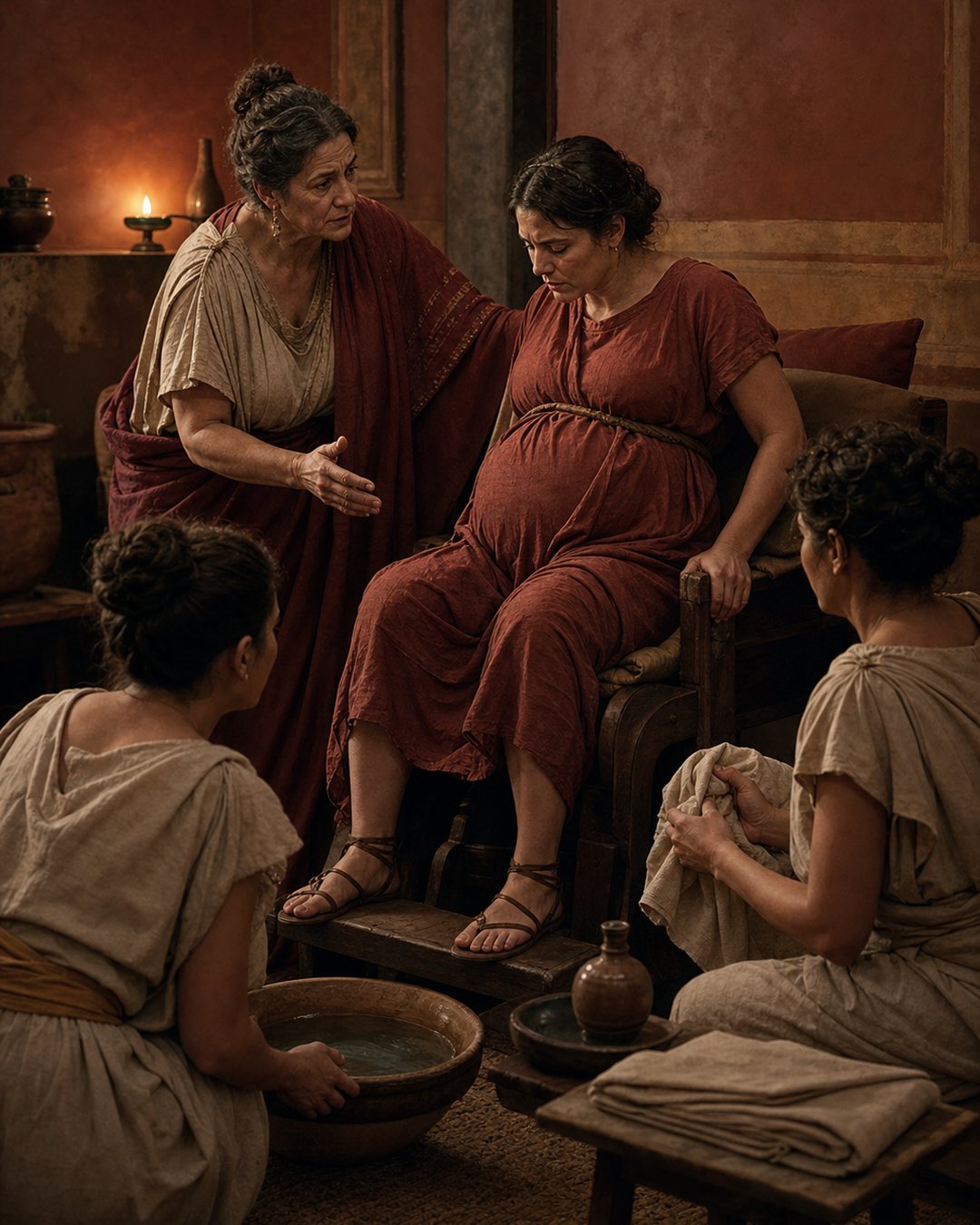
A Roman woman in labour did not need a philosopher beside her. She needed someone who could read a changing body, keep frightened people useful, prepare the room, and know when an ordinary birth had become dangerous. The person expected to hold that responsibility was the midwife. Her work happened inside households, but it was neither casual nor invisible to ancient medical writers.
Soranus of Ephesus, a Greek physician active in the Roman world around the early second century, devoted substantial attention to pregnancy, birth, the qualities of a good midwife, and care of the newborn. His instructions are not a transcript of every Roman birth. They preserve an educated medical viewpoint shaped by its own theories and prejudices. They also show that childbirth demanded practiced judgment rather than goodwill alone.
The surviving picture joins intimate trust to physical technique. A midwife needed clean hands, controlled movements, memory, discretion, endurance, and assistants who followed instructions. She worked with oil, warm water, cloth, a birthing stool, and sometimes instruments. Rome placed the beginning of a life in a domestic room, then depended on a specialist woman to make that room function under pressure.
Training Began with Character as Well as Technique
Soranus listed qualities for the ideal midwife before describing difficult procedures. She should be literate enough to understand theory, possess a good memory, be industrious, respectable, and not driven by greed. Her hands mattered too: long, delicate fingers and short nails reduced the risk of injury during examination. The list reveals how competence was judged through body, conduct, and reputation together.
Literacy did not mean that every working midwife read medical books. Skills could pass through observation and apprenticeship, and local practice varied across a vast empire. The written ideal nevertheless placed the occupation inside learned medicine. A practitioner was expected to distinguish normal changes from alarming ones and to explain what she was doing without becoming captive to superstition.
Reputation was practical protection. Families admitted a midwife into a private space at a vulnerable hour and trusted her with information about sex, fertility, legitimacy, and household continuity. The social network described in our article on Roman patronage had a domestic counterpart here: a trusted name brought recommendations, access, and authority before the labour began.
The Birth Room Had to Be Prepared
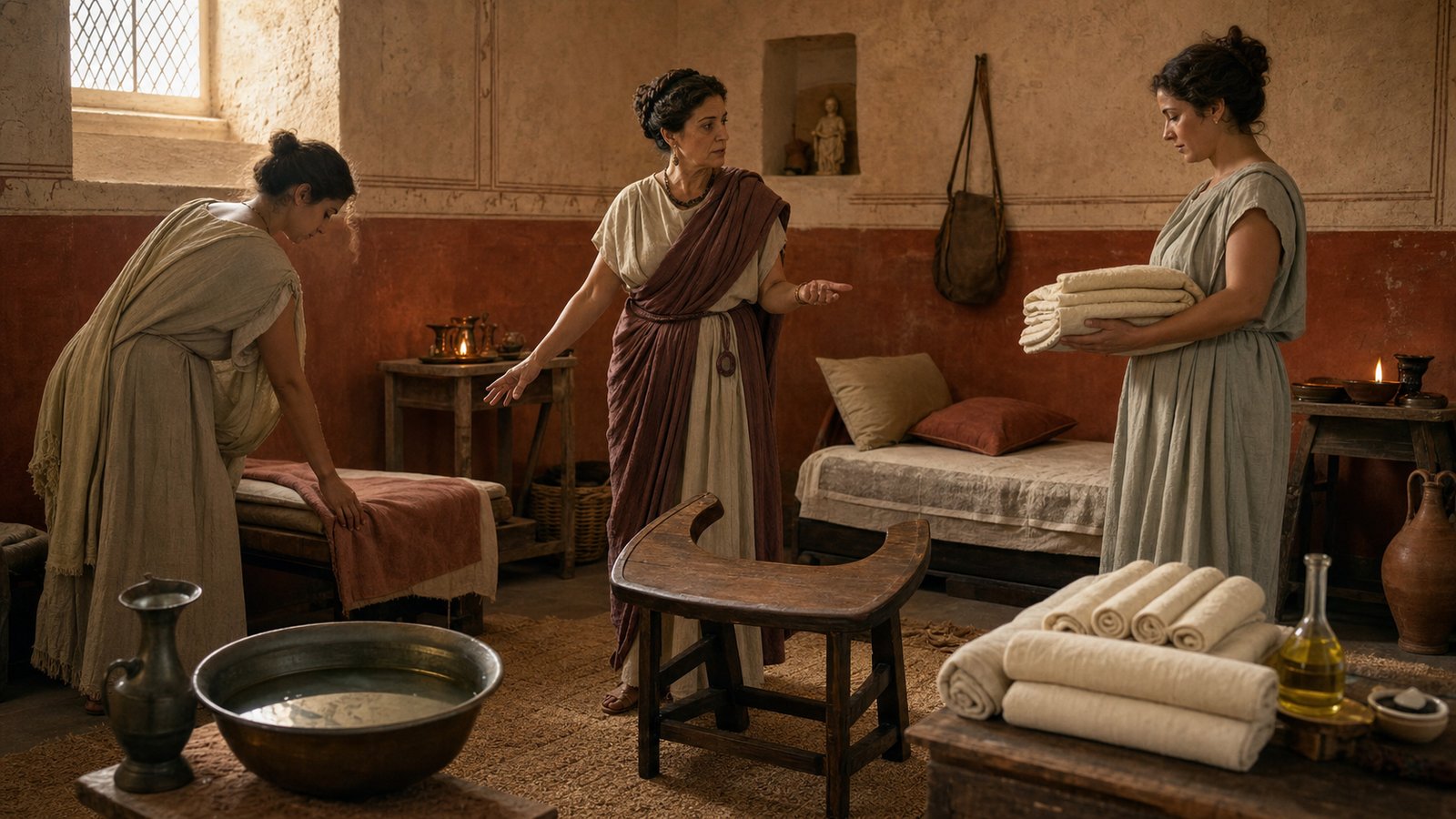
Ancient instructions treated the room as working equipment. Warmth, water, oil, soft cloths, bandages, cushions, and places for assistants had to be ready. The point was not luxury. Labour could change quickly, and searching for a missing object while the mother was exhausted wasted time and attention.
Soranus described a birthing stool with a crescent-shaped opening and supports that allowed the woman to sit while the attendant worked in front of her. If no purpose-built stool was available, another arrangement could support a similar posture. The mother might move between bed and stool as labour progressed rather than remaining fixed in one modern hospital position.
Assistants stabilized the mother, supported her back and sides, carried water, and responded to the midwife. Their presence made childbirth collective labour without making every participant equal. One person directed the sequence. The household became a temporary team organized around her voice.
Observation Determined When to Intervene
A skilled attendant watched contractions, the mother’s strength, bleeding, the position of the presenting child, and the progress of labour. Soranus warned against forcing delivery before the body was ready. Oil and gentle handling could reduce friction, while encouragement and changes of posture helped the mother use her own effort.
This restraint matters because ancient medicine possessed few reliable ways to reverse infection, hemorrhage, or internal injury. An aggressive hand could turn difficulty into catastrophe. The midwife’s most important action might be waiting while continuing to observe, a form of work that leaves little archaeological trace.
Roman medical theory explained the body through frameworks that modern physiology rejects, including balances of qualities and humours. Practical observations could still be valuable. Repeated exposure taught attendants that some positions, rhythms, and signs led toward delivery while others announced obstruction. Useful pattern recognition did not require a correct cellular explanation.
A Difficult Presentation Tested the Whole Craft
Soranus discussed births in which a hand, foot, or another part presented badly. He described manual attempts to reposition the fetus and reserved instruments for desperate circumstances involving a dead fetus and danger to the mother. Such passages are disturbing, but they record the choices created by obstructed labour before safe surgery and blood transfusion.
The aim in an ordinary birth was not dramatic intervention. It was alignment, space, lubrication, coordinated effort, and protection of tissue. A midwife had to know anatomy by touch because the crucial work occurred beyond sight. Short nails and sensitive fingers were therefore not cosmetic preferences in the ideal job description.
Roman surgical instruments discussed in our article on Roman surgery remind us that metal tools existed within a larger hierarchy of action. The trained hand came first. An instrument could extend it, but could not supply judgment about when force would save or destroy.
The Newborn Became a Second Patient
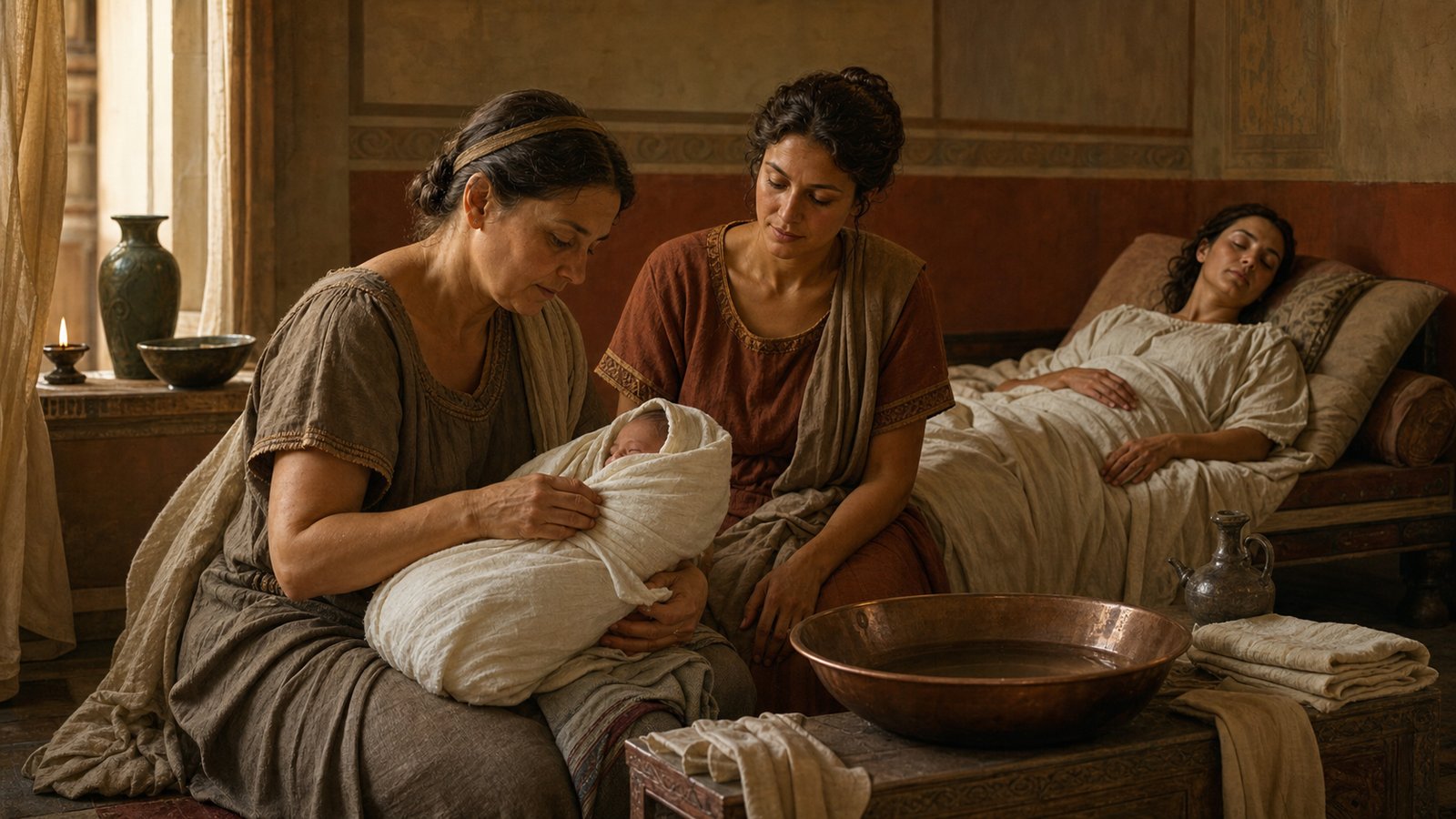
After delivery, attention shifted without leaving the mother. The cord had to be managed, the infant cleaned and wrapped, and the mother watched for bleeding and exhaustion. Soranus offered criteria for judging whether a newborn appeared fit to rear, reflecting both medical observation and the harsh social values of antiquity.
Ideas about swaddling, bathing, feeding, and wet nurses varied and were argued over. Ancient advice could be precise while still being wrong by modern standards. What matters historically is the recognized continuity of care: birth did not end when the child emerged. Temperature, breathing, feeding, and maternal recovery created a new sequence of risks.
The family calendar explored in our article on Roman family memory began with people whose survival at birth had never been guaranteed. Midwives stood at that threshold. Their successful work often disappeared into the ordinary fact that mother and child were still present the next morning.
Skilled Work Could Still Meet Hard Limits
No description should romanticize Roman childbirth. Maternal and infant death were familiar realities, infections were poorly understood, pain relief was limited, and social rank determined what help and space a family could summon. A wealthy household might gather experienced attendants and supplies; an enslaved or poor woman could face labour with far fewer choices.
Yet danger does not make the craft meaningless. It explains why experience mattered so much. The midwife organized preparation, interpreted signs, limited reckless action, managed helpers, and carried practical knowledge from one household to another. Her authority was earned in repeated moments when confidence had to remain calmer than the room.
Roman medicine often enters history through famous male authors. Childbirth reveals another structure: women performing embodied work, transmitting skills, and becoming locally indispensable even when their own words rarely survive. A capable attendant also carried knowledge between generations and households: how to arrange supports, recognize exhaustion, direct an assistant, and keep supplies ready before panic scattered attention. That cumulative memory was a form of medical infrastructure housed in a person rather than a building.
Soranus gives us a physician’s ideal, not the midwives’ own voices. Through that imperfect frame, the Roman midwife still appears as what the household needed her to be—a specialist whose hands, memory, and reputation could change the odds.
Sources & Further Reading
- World History Encyclopedia, “Medicine in the Ancient World”
- Encyclopaedia Britannica, “Midwifery”
- World History Encyclopedia, “Soranus”
- World History Encyclopedia, “Childhood in Ancient Rome”