
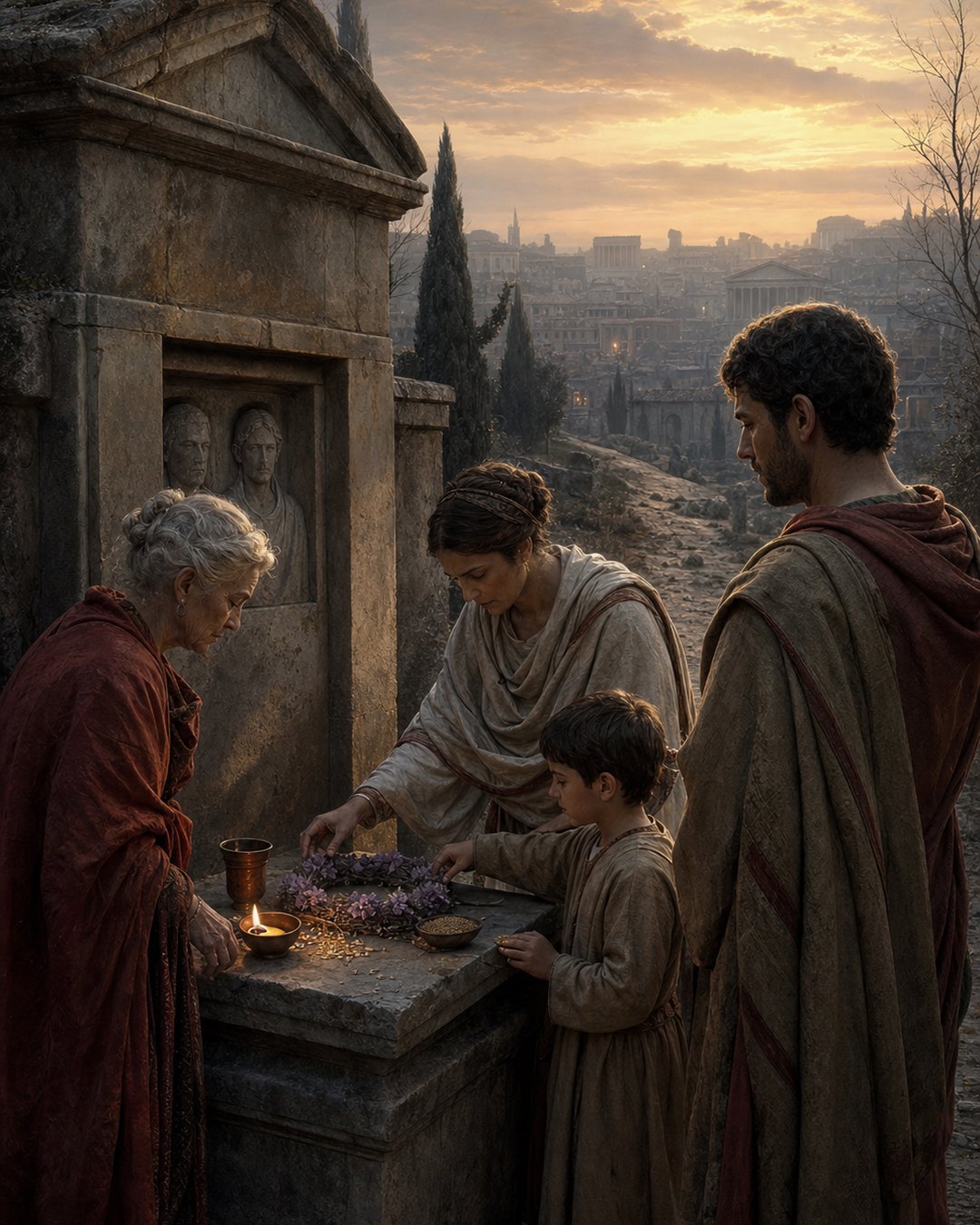
On a cold February morning, a Roman family could leave the occupied streets and follow a road lined with the houses of the dead. Their destination was not a grand state altar. It might be a familiar tomb whose stone carried names, portraits and relationships already known within the household. Violets, grain, salt, wine-soaked bread and a small cup were enough. For nine days, from February 13 through February 21, Parentalia gave this journey a recognized place in Roman time.
The festival did not turn ancestral memory into one spectacular procession. Its force came from repetition across households. Families visited, offered and remembered while other kinds of public and religious activity receded. Ovid’s Fasti insists that the dead wanted piety more than luxury, yet he also imagines the danger of forgetting them. The calendar solved both problems. It made care modest enough to repeat and difficult to postpone forever.
A road of tombs became a route back into the family
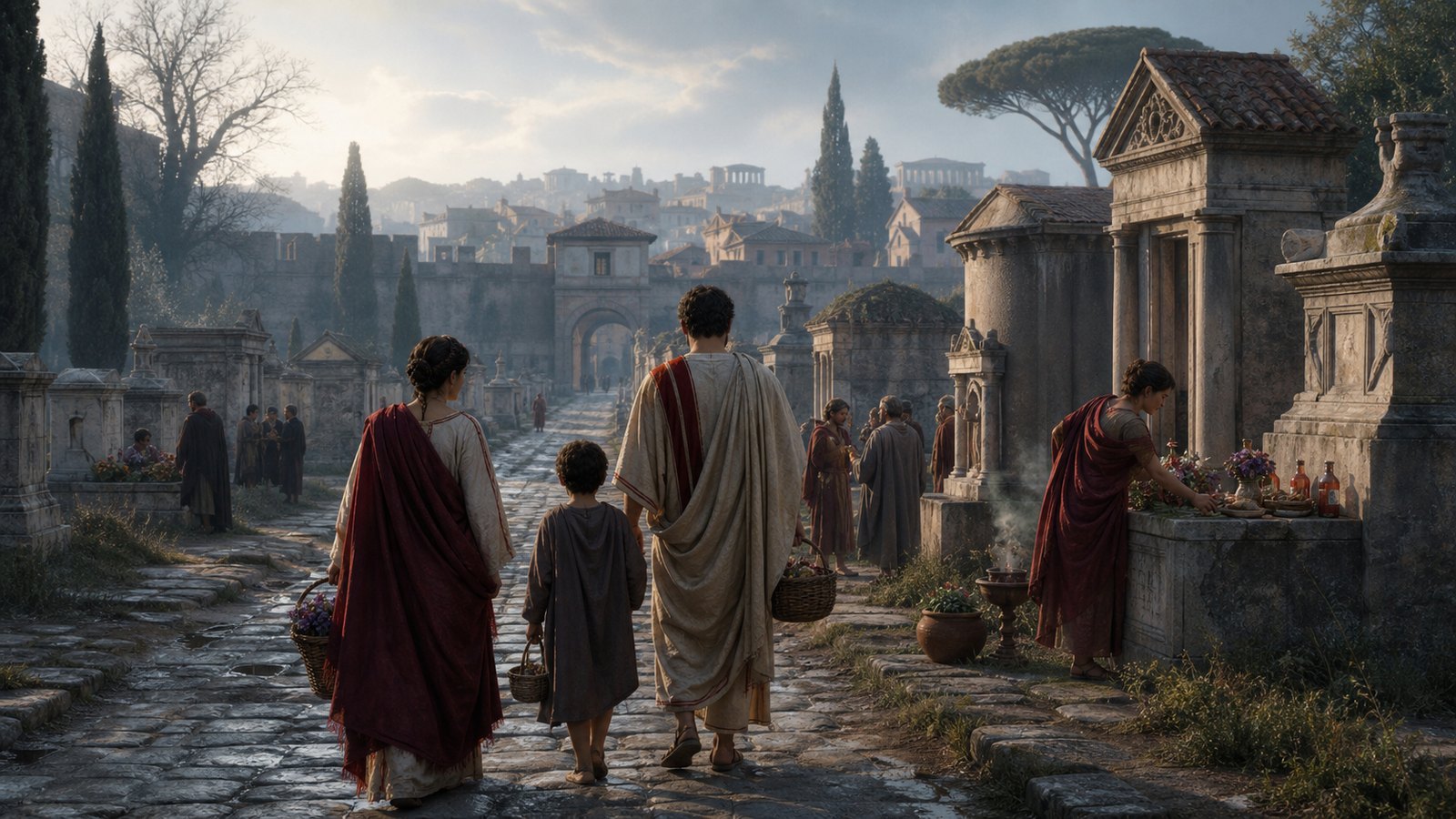
Roman burial normally took place beyond the inhabited city, and funerary monuments accumulated along roads leading toward and away from urban gates. The arrangement placed the dead outside ordinary domestic space without making them unreachable. A family approaching its tomb moved through a landscape where other households had also written names, displayed portraits and fixed relationships in stone. Memory had an address, and the road provided a recurring path to it.
Those monuments were public-facing even when the relationship they preserved was intimate. A passer-by could read a name or see a carved likeness, but kin brought knowledge the stone could not contain: voices, obligations, disputes and the place of one person within a household. The archive’s account of roadside tombs as public memory explains the setting. Parentalia explains what happened when families returned to that setting on an appointed day.
The journey itself separated remembrance from vague sentiment. Food and flowers had to be gathered; people had to leave the house; the right tomb had to be reached. Rome’s dead were therefore not recalled only inside the mind. Bodies moved toward monuments, hands cleaned or touched stone, and objects crossed from the world of the living onto a tomb table. The festival made memory physical before anyone spoke a formal prayer.
Ovid’s offering list kept devotion deliberately small
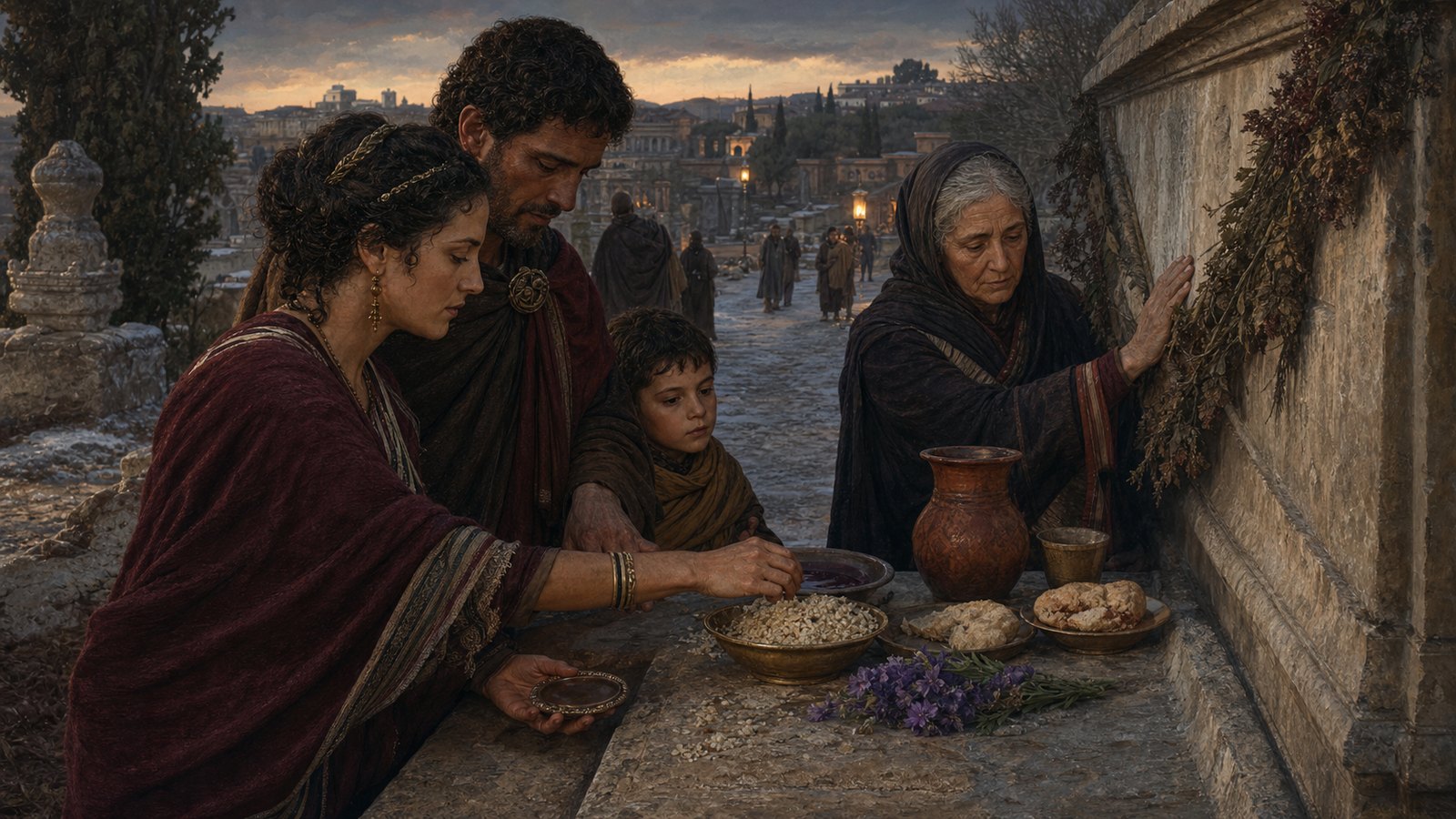
Ovid, writing about the February rites in Fasti Book II, lists wreaths, scattered grain mixed with salt, bread softened in wine and loose violets. The details are striking because none requires elite wealth. Grain can be pinched between fingers; wine can darken a piece of bread; violets can be laid against cold stone. An earthen vessel could hold the gift. These were tangible offerings, but they did not demand a banquet large enough to advertise a family fortune.
The poet makes the principle explicit: the shades ask for little, and piety is more valuable to them than costly gifts. That claim disciplined competition. Funerary monuments could display status, and Roman funerals could stage family ambition, but Parentalia’s recurring duty was not supposed to become ruinous theater. A modest standard allowed households to return each year without making remembrance depend entirely on abundance.
Simplicity also sharpened the meaning of neglect. If the required materials were familiar and inexpensive, forgetting could not easily be excused as inability to mount a great sacrifice. The moral weight fell on attention: bringing something, reaching the tomb and acknowledging the relationship. The smallest offering became sufficient when it was given, and conspicuous absence became harder to disguise behind the claim that proper honor was unaffordable.
Nine days changed the rhythm around the living
Parentalia occupied February 13 through 21 rather than a single hurried morning. A nine-day interval gave different households time to carry out observances, but it also changed the atmosphere around them. Ovid describes temples as closed and altar fires as absent. He tells marriage torches to wait, marking the period as unsuitable for weddings. The dead did not seize every street, yet the usual signals of divine and social business were muted.
This pause matters because a calendar does more than name events. It tells people which actions fit a moment and which should be delayed. A wedding pushes a family toward a new household and future descendants; Parentalia pulled attention backward toward those from whom the household claimed descent. Setting the two moods apart protected each from the other. Celebration did not have to compete directly with obligation at the tomb.
The interval also gave private rites a civic frame. No official needed to supervise every flower or cup of wine for the days to be publicly intelligible. Neighbors saw families on tomb roads; closed ritual spaces signaled a changed season; postponed marriages acknowledged the same boundary. Parentalia coordinated many separate acts by making them happen under one shared label and within one recognized stretch of February.
Neglect turned memory into a warning story
Ovid interrupts his instructions with a story about what happened when the ancestral rites were once neglected during war. The dead, deprived of their expected honors, were said to leave their tombs and move through the night with cries until the ceremonies were restored. The tale is not evidence that corpses literally walked Roman streets. It is evidence that omission could be narrated as a breach dangerous enough to disturb the city.
The warning gives ritual failure a sequence: urgent living concerns displace the observance, the forgotten dead become visible through disorder, and restored offerings return them to quiet. Such a story converts an easily postponed family duty into a lesson about consequences. Ancestors were not passive decorations for moments of pride. They remained members of a moral relationship whose claims could be ignored only at a cost imagined in fear, noise and sleepless streets.
Rome had institutions that made burial possible for people without elite resources. Burial clubs pooled dues and obligations so members could receive funerary care. Parentalia addressed the time after burial. A grave created the place, but an annual return kept the social bond active. Ovid’s restless shades embody the gap between possessing a monument and continuing to honor the person associated with it.
Feralia closed the claim of the dead
February 21 brought Feralia, the final day of the nine-day period. The name marked a conclusion rather than an endless extension of mourning. By the time families reached this boundary, offerings and visits had acknowledged the ancestors, while the broader pause had separated their season from normal civic and domestic momentum. A ritual interval needed an ending as clearly as it needed a beginning.
Closure protected the living from two opposite failures. One was neglect: refusing the dead any recognized claim. The other was allowing death to dominate household time without limit. Feralia answered both by concentrating final observance on a known date. The ancestors received their due, and the calendar then permitted attention to move. The tomb remained beside the road, but the special obligation of these February days was complete.
This made remembrance renewable rather than permanent in intensity. A family did not have to sustain the emotional pitch of a funeral throughout the year. It could return at anniversaries and festivals, carrying familiar materials to a familiar place. The predictability did not empty the act of feeling. It supplied a structure in which grief, duty and family identity could be revisited without requiring a new crisis to summon them.
Caristia turned the household toward the living again
The calendar pivoted quickly. Caristia followed on February 22, a day associated with family affection and reconciliation among living kin. The sequence is as important as either observance alone. Romans moved from tombs and ancestral obligation toward a meal and the repair of relationships still open to argument, apology and companionship. The family was imagined across generations, then gathered in its present form.
Placing these days together made memory practical. Ancestors could support household identity, but invoking them meant little if living relatives allowed resentment to consume the group they had inherited. Caristia redirected the seriousness of Parentalia. After honoring people who could no longer answer, families faced people who could. The calendar linked reverence for origins with responsibility for relationships that would shape the next generation.
For nine February days, Roman families made room for the dead by changing where they walked, what they carried and which celebrations they postponed. The gifts were small because the central resource was attention. Tomb roads supplied the place, Ovid’s grain and violets supplied the texture, Feralia supplied the boundary, and Caristia supplied the return. Parentalia kept memory alive not by making every day funerary, but by refusing to let a year pass without one shared interval for going back.
Sources & Further Reading
- Ovid, Fasti, Book II
- Parentalia overview
- Roman funerary art and architecture
- Roman funerary practices