
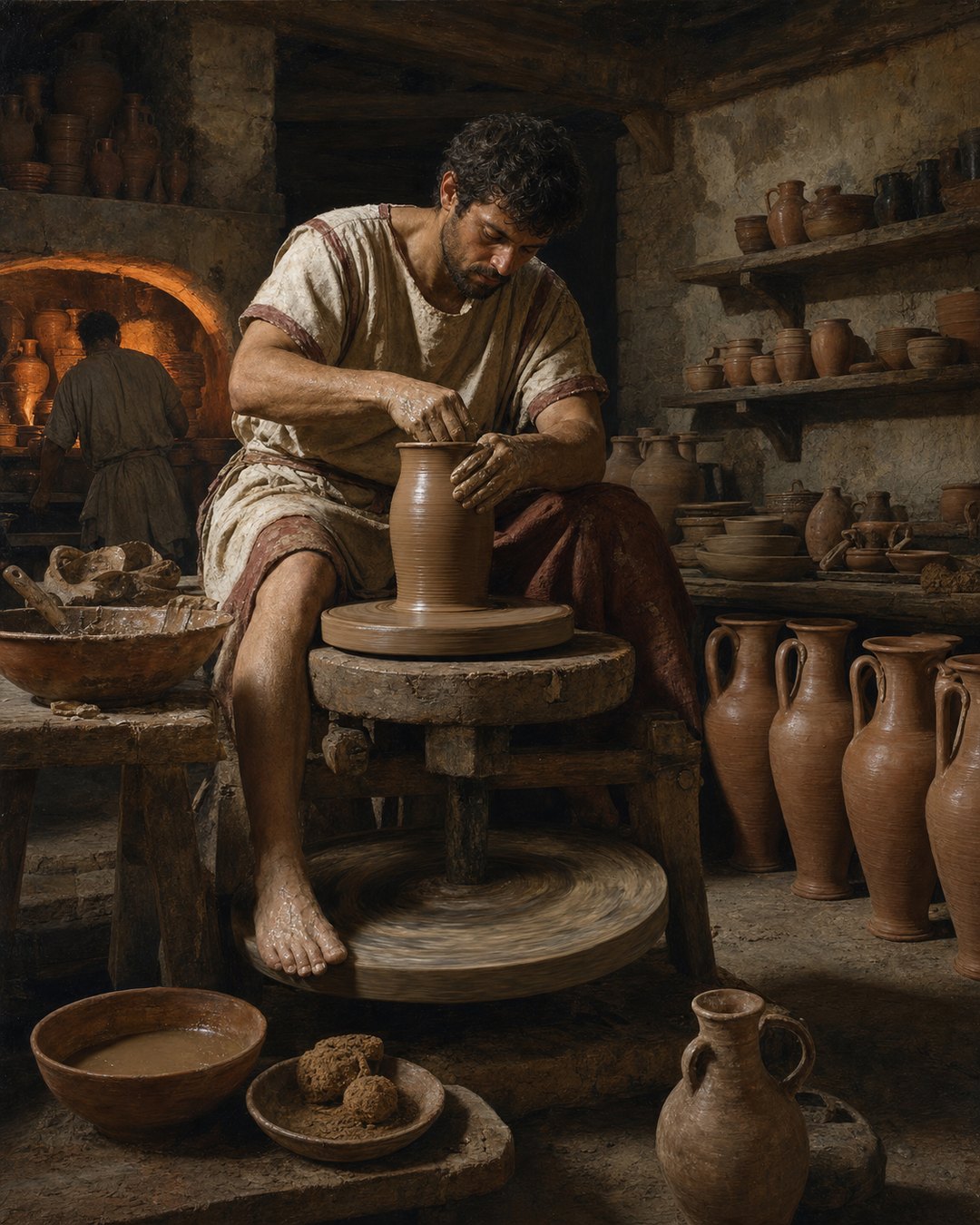
A Roman potter could begin with a squat lump and finish with a vessel whose wall rose evenly around an empty centre. Nothing lifted the clay from above. The decisive action happened at the potter’s fingertips: one hand supported the inside, the other answered from outside, and the wheel carried every part of the circumference between them. A narrow band of pressure compressed the clay and redirected it upward. Repeated over several turns, that moving band became a taller, thinner wall.
The wheel made this controlled repetition possible, but rotation did not replace skill. The clay first had to share the wheel’s axis. The potter then opened a cavity without piercing the floor, established a usable base and raised the sides without letting one sector run ahead of another. Archaeological research also warns against calling every rotational trace “wheel-thrown.” Pots could be assembled in stages or partly shaped on a wheel. The mechanism is clearest when we follow the operations rather than the finished silhouette.
Centring made one axis govern the clay
Before a wall could rise evenly, the clay had to rotate without wandering. The potter pressed a prepared mass down on the wheel head, wetted the hands and constrained the turning lump until its high and low excursions disappeared. Centring did not make the material motionless. It made the motion regular: the outside revolved concentrically around the same vertical line that would pass through the vessel’s cavity.
An off-centre mass repeatedly pushes into the hands and retreats from them. Any attempt to open or pull it carries that unevenness upward, producing a wall that is thick on one side and thin on the other. With the clay centred, a steady hand meets the same radius throughout each revolution. Rotation turns one stable hand position into work performed around a complete ring.
This is the wheel’s fundamental bargain. The potter gives up the freedom to shape one isolated patch and instead controls a moving circumference. Roman workshops could use that repeatability alongside the varied organization described in Roman craft production. Yet the wheel itself guaranteed nothing about quality or scale. It supplied an axis and repeated motion; trained hands converted those conditions into a vessel.
Opening preserved a floor beneath the hollow
Once centred, the solid mass still had no inside. The potter pressed fingers or thumbs into its top while the other hand stabilized the exterior. That depression had to stop before reaching the wheel head. The remaining clay became the floor, so depth was judged through touch rather than by seeing the hidden distance beneath the fingertips.
The central depression was then widened. Fingers drew its base outward while the wheel turned, converting a narrow hole into a circular interior floor. The outer hand contained the mass so the spreading clay did not simply slump away from the centre. At the floor’s edge, the direction of work changed: horizontal widening had to turn upward into the first low wall.
This operation separates a thrown hollow form from a solid object merely spun for finishing. It also helps explain why rotation alone is an incomplete diagnosis. Roux and Courty distinguish full wheel throwing from wheel-fashioning, in which a vessel built by another method is reshaped during rotation. A pot can carry circular traces without having begun as one centred lump.
Opposed fingers turned thickness into height
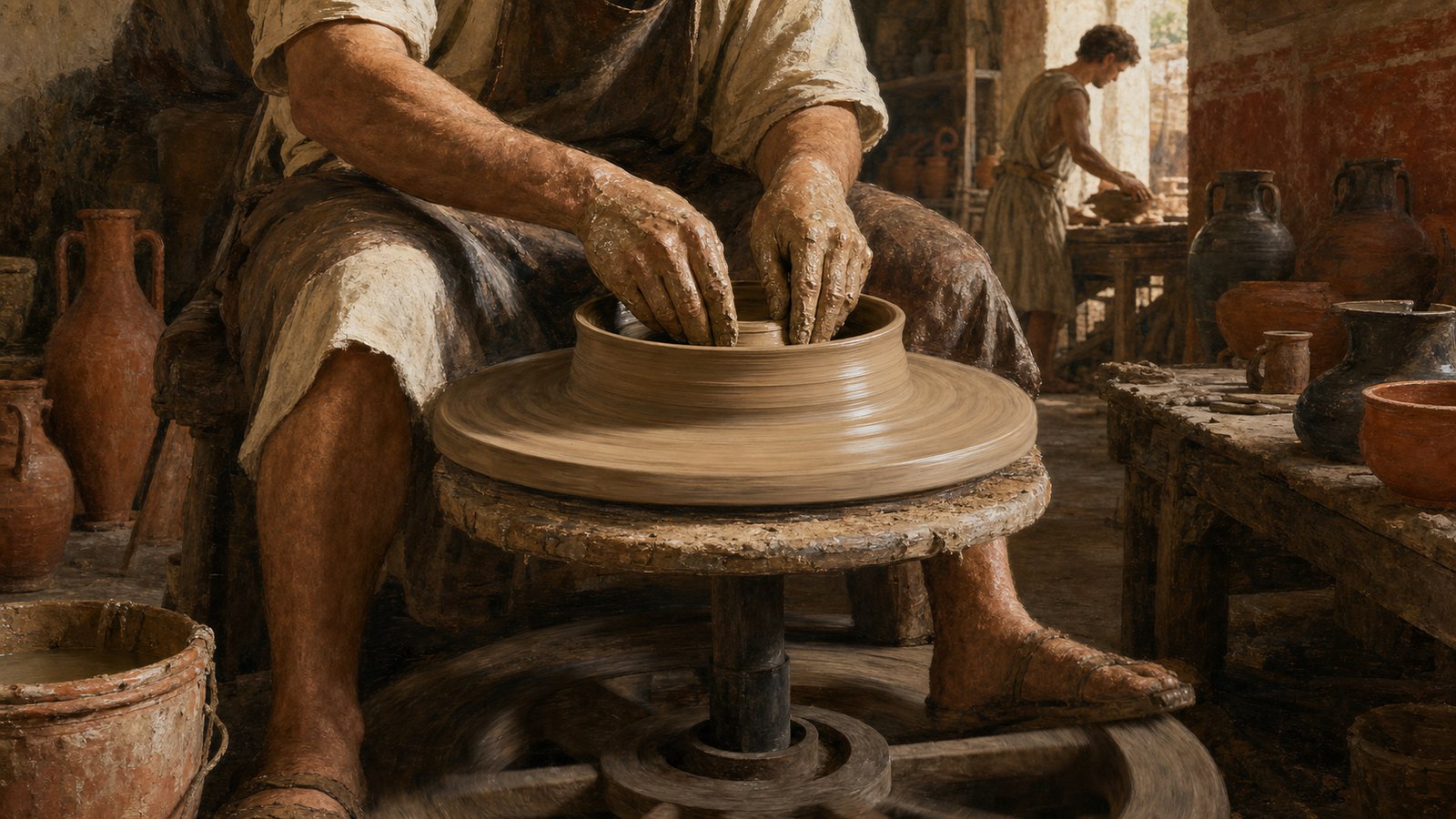
The wall rose through compression, not through an upward tug on its rim. One hand entered the cavity and the other met it outside. Beginning near the base, the potter closed the gap between fingers enough to squeeze a band of clay. As that contact moved upward, material was guided from a thicker lower zone into a taller, thinner cylinder.
Rotation multiplied the gesture. The hands could climb slowly while the wheel brought fresh clay through the pressure point, creating a shallow spiral of work around the vessel. Several lighter pulls were safer than one severe squeeze. If the inner finger advanced too far, it made a bulge; if the outer hand dominated, it narrowed the form; if the gap closed abruptly, a weak thin ring could buckle above the heavier clay below.
The process resembles neither carving nor the abrasive rotation used to shape other materials. A Roman bronze vessel made through lost-wax casting inherited its surface from a model and mould. Thrown clay remained directly responsive beneath the hands. Pressure changed both surfaces at once because the inner and outer fingers defined the wall between them.
Water managed friction but could not supply strength
Wet hands slid over the rotating surface instead of dragging it. That lubrication allowed the potter to hold a steady position while clay passed continuously beneath the fingers. The water did not perform the shaping. It reduced disruptive friction so that pressure could be applied smoothly, particularly during centring and the upward movement of a pull.
The clay still had to support its own growing height. A broad base began with enough material for a floor and lower wall, while the upper portion became progressively lighter. The potter could compress the rim between fingers to regularize its thickness and reduce small fissures. A rim left uneven would advertise every fluctuation because it turned at eye level around the vessel’s axis.
Speed and pressure belonged together. Faster rotation repeated corrections quickly during centring, while a taller, thinner form demanded gentler handling. The wheel stored rotational kinetic energy; the hands supplied selective force. That division, identified by Berg as the technology’s defining combination, explains how a simple rotating head could increase output without making the craft automatic.
A cylinder held many possible profiles
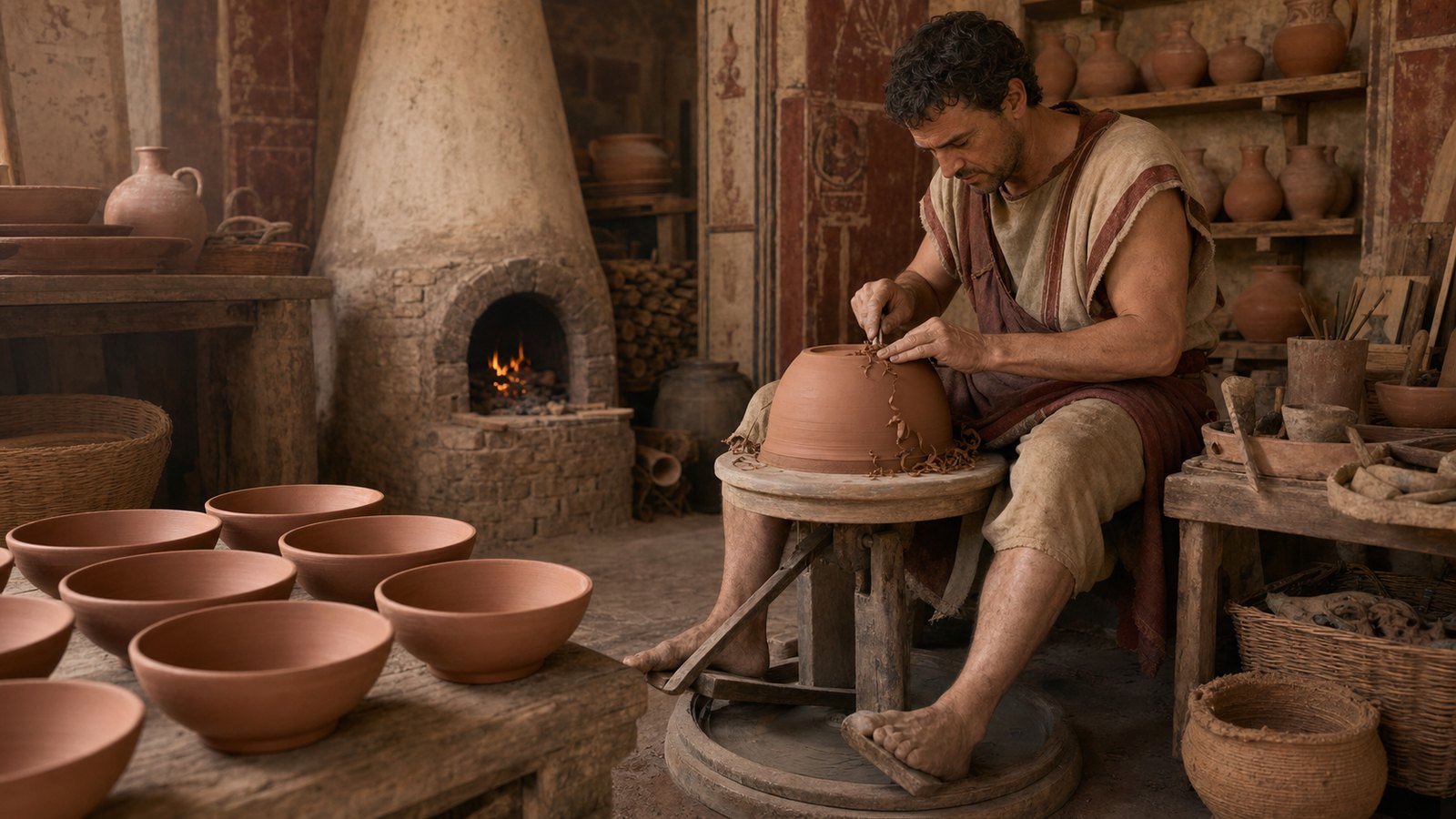
A straight-sided cylinder was not necessarily the intended final form. It was a reserve of evenly distributed clay. With support inside, pressure on the exterior could collar the upper wall inward toward a neck. Pressure from within could expand a lower zone into a belly, provided the clay was not stretched beyond what its thickness could carry. The same initial geometry could therefore lead toward cups, jars or bottles.
The sequence constrained those choices. It was easier to preserve wall thickness before creating a strong shoulder than to recover clay after one area had been thinned too far. Handles, feet or other additions could involve separate operations, and some vessels combined multiple forming methods. Berg notes that hybrid and staged uses belong to the wheel’s long history, a useful warning against imagining every Roman pot rising in one uninterrupted performance.
Roman ceramic production ranged far beyond small table vessels. The archive’s great storage dolia show why scale matters: not every huge container should be pictured as a single lump thrown rapidly at centre. Rotation could assist different stages, while coils, sections and finishing gestures shared the work. Technique must be reconstructed from traces, fabric and sequence.
The fired wall kept a record of moving hands
After drying and firing, the wheel and wet fingerprints were gone, but the vessel could retain clues to manufacture. Surface undulations, spiral ridges, changes in thickness and the orientation of pores or inclusions within the clay may preserve how deformation travelled. Courty and Roux therefore combined macroscopic surface study with microfabric analysis rather than trusting one conspicuous ring as a complete technical biography.
That caution protects the Roman potter from a modern simplification. Rotation may have centred a lump, raised a wall, joined separately made parts or merely regularized an existing body. A finished symmetrical profile proves controlled circular work more readily than it proves one exclusive recipe. Archaeologists reconstruct chains of operations, asking what happened first, where material moved and which marks survived later smoothing.
At full use, the wheel accelerated production because each revolution extended a controlled gesture around the vessel. Its deeper achievement was consistency through return. The same axis brought every sector back between the hands; the same opposed pressure converted thickness into height; the same opening remained centred as the wall climbed around it. Roman pottery could look effortless after firing, but its evenness began as a carefully balanced contest among rotation, water, clay and touch.
Sources & Further Reading
- Ina Berg, “The Potter’s Wheel,” Encyclopedia of Global Archaeology
- M.-A. Courty and V. Roux, “Identification of wheel throwing on the basis of ceramic surface features and microfabrics”
- V. Roux and M.-A. Courty, “Identification of Wheel-fashioning Methods: Technological Analysis of 4th–3rd Millennium BC Oriental Ceramics”
- Jacqui Atkin, Throwing Clay: Basic Techniques