
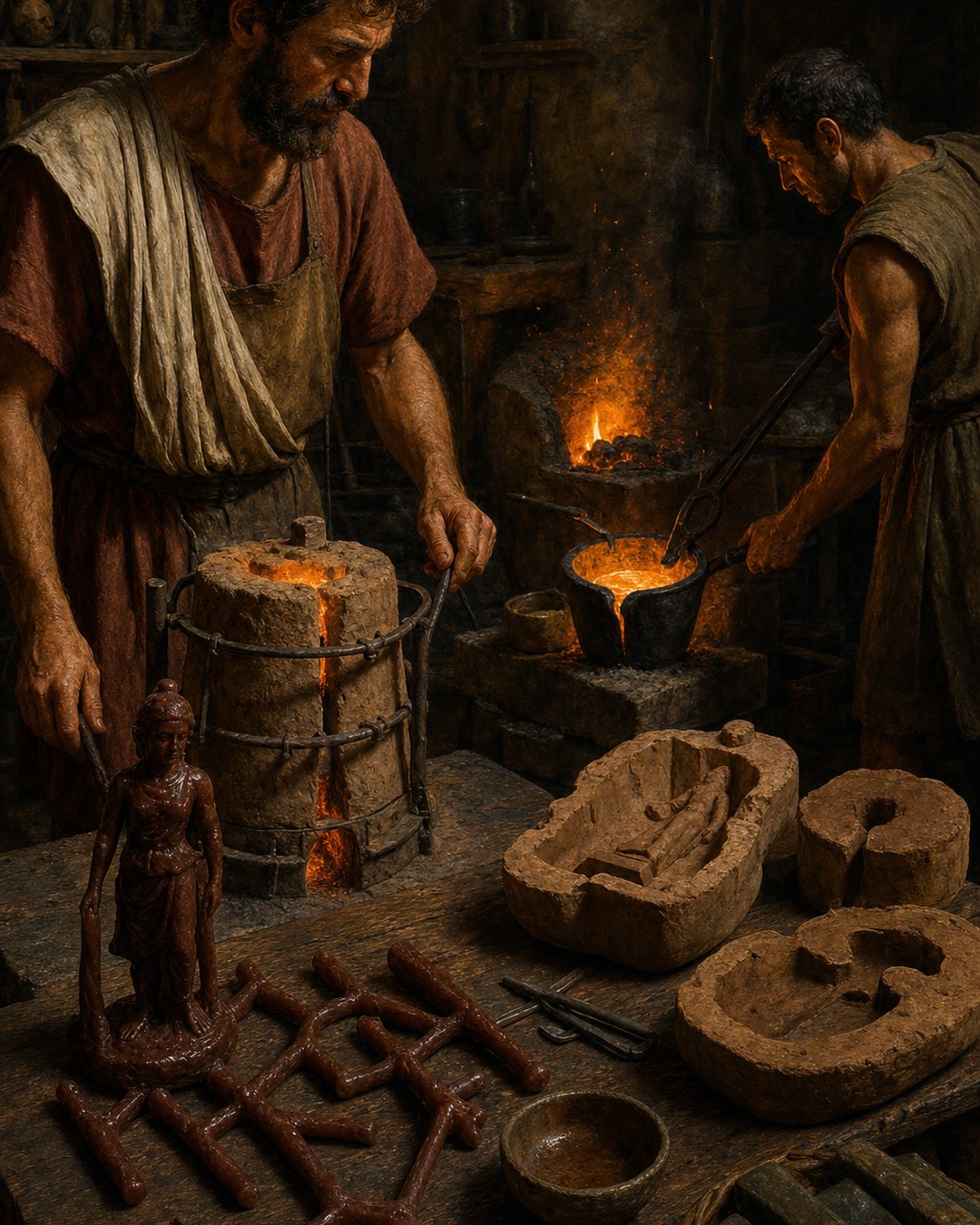
The first complete version of a cast bronze object could be soft enough to cut with a warm tool. Wax accepted small folds, sharp edges and corrections that would be far harder to carve into cooled metal. Yet the wax original was not destined for display. Once enclosed inside refractory material, it had to leave. Heating emptied its shape, and molten bronze entered the cavity it surrendered.
This is why “lost wax” names a mechanism rather than a workshop accident. The model organized detail, thickness and the future route of the pour. Added wax channels created entrances for metal and exits for wax and gas. Investment captured the exterior. Burnout made negative space. Cooling fixed bronze where wax had been, after which the mold was broken and the channels cut away. Durability emerged from a sequence designed around destruction.
Wax held corrections before bronze held permanence
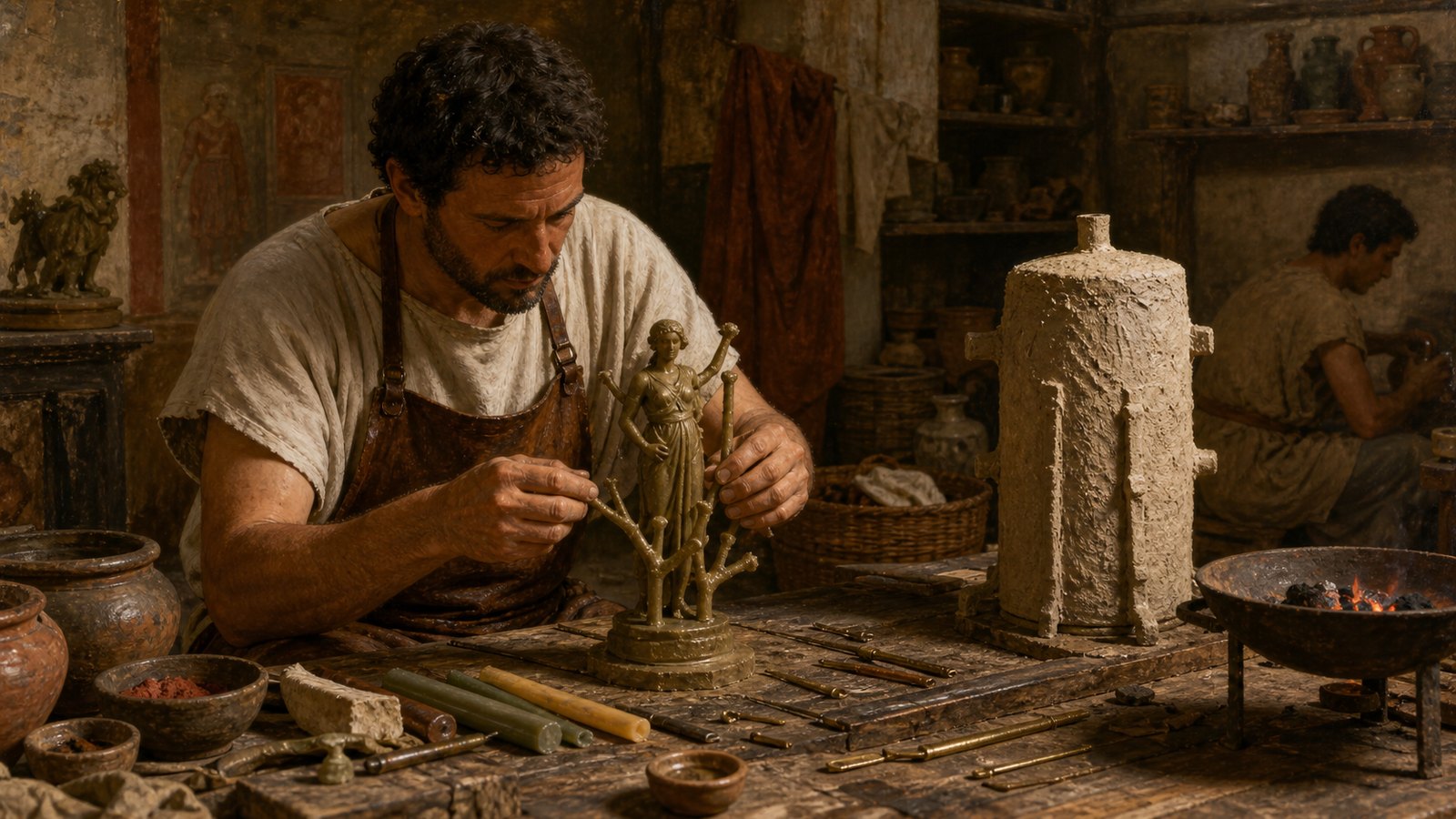
Wax gave the maker a responsive modeling surface. Detail could be pressed, incised, added or removed while proportions were still open to revision. A fold of drapery, strand of hair or edge of ornament existed first as a physical decision in wax. The later bronze could preserve that information because the investment touched and recorded the model’s surface before the model disappeared.
This stage separated design from the hazards of molten metal. The artisan could inspect the complete form without standing over a pour. Roman bronze objects ranged across sculpture and decoration, and their visible finish began with decisions made in a temporary material. The wax was not a rough placeholder whose flaws would vanish. Every wanted mark risked becoming part of the cavity and therefore part of the casting.
Thickness was another decision carried by wax. A section too slight risked incomplete metal flow or weakness; unnecessary mass demanded more bronze and changed cooling. The modeler therefore shaped an object that had to work both as an image and as a future casting. Surface beauty and manufacturability occupied the same temporary material.
Sprues turned the model into a flow plan
A finished-looking wax model was not ready to invest until it had channels. Wax rods attached to the form created sprues for molten bronze and routes through which wax could leave. Vents allowed displaced gases to escape. These additions looked unlike the intended object, but they anticipated how liquid and air would move through enclosed space.
Channel placement was an engineering judgment. Bronze had to reach narrow and distant areas before cooling blocked the route. Gas trapped ahead of the advancing metal could leave a void. A sprue too slight might freeze early; a badly placed connection could scar an important surface. The maker therefore read the sculpture as a network of filling paths, not only as a figure to be viewed from outside.
Sprues eventually became bronze too, even though they were never intended to remain. Their wax forms created cavities continuous with the model, and the pour filled both. This sacrificial metal gave liquid access and could help feed the casting as it solidified. Finishing later removed it, but the successful object depended on those temporary branches during its most vulnerable stage.
Investment recorded a surface and built a furnace-safe wall
Refractory investment surrounded the wax assembly and captured its detail. It had to reach the model closely enough to reproduce the surface while becoming strong enough to contain hot, heavy bronze. Drying and building the mold demanded care because hidden cracks or retained moisture threatened the pour. What looked like a solid shell was the future boundary of every visible bronze plane.
This belonged to the coordinated labor of Roman workshops. Modeling, mold preparation, furnace operation and finishing called for different judgments, even when one craftsperson understood several stages. The investment joined those stages. It preserved the modeler’s marks, endured burnout, received the caster’s metal and finally yielded to the finisher’s tools.
The refractory material faced opposite demands. It had to copy minute wax detail yet resist fracture when wax departed and bronze arrived at far greater temperature. Dryness mattered because moisture exposed to molten metal could become dangerous vapor. Preparing the investment was therefore a controlled material process, not merely packing clay around a figurine.
Burnout made an exact absence
Heating transformed the invested model. Wax softened, flowed through channels and burned away, leaving a cavity with the model’s dimensions and texture. The stage also prepared the refractory mold thermally for molten metal. An incomplete burnout could leave residue where bronze needed to flow; uncontrolled heating could damage the mold. Empty space had to be produced as carefully as the original surface.
The paradox is practical. Nothing visible in the final object is made of wax, yet wax determines where bronze can exist. The process resembles the labor behind a Roman bronze mirror in one respect: the admired surface depends on stages a viewer may never see. Lost-wax casting makes that hidden sequence especially stark because its central model survives only through the cavity it leaves.
Burnout also tested the channel network before bronze made correction impossible. Wax needed routes to drain as it softened, while remaining material had to be removed by heat. A blocked or poorly oriented path could preserve unwanted residue. The empty mold was not passive nothingness; it was a connected interior prepared for flow in the opposite material.
The pour replaced air with bronze under time pressure
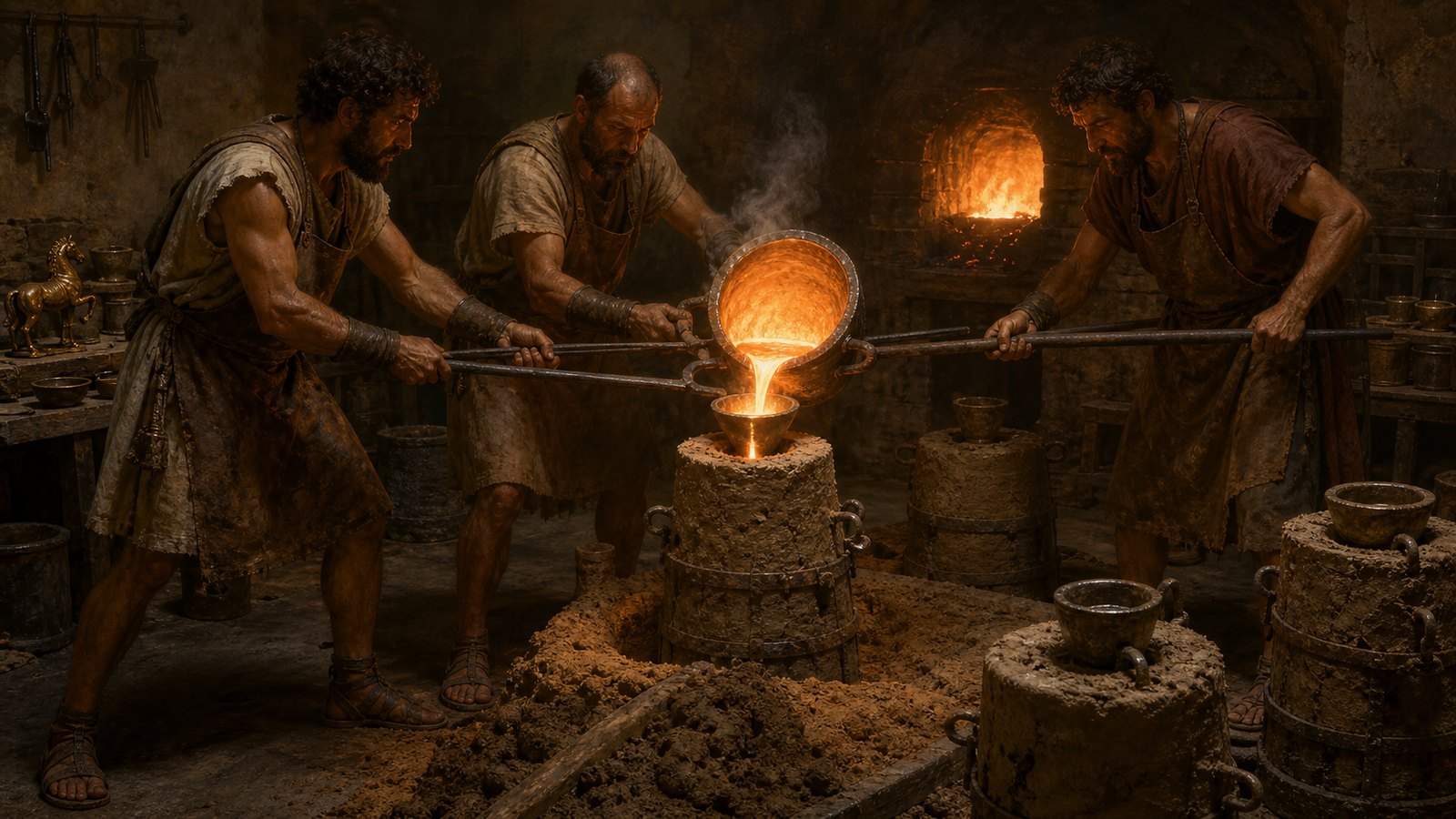
Molten bronze entered through the prepared channel system while gases escaped through vents. Gravity and the arrangement of sprues carried metal into the cavity. The pour had to continue coherently enough to fill connected spaces before parts cooled and stopped flowing. Furnace, crucible, mold support and several people’s movements converged in a short, hazardous interval.
No ornament could compensate for a cavity that failed to fill. The casters needed enough hot metal, a stable mold and clear routes. Yet excessive turbulence or trapped gas could also damage the result. The glowing pour often dominates modern imagination because it is dramatic, but its success had been constrained much earlier by wax thickness, vent placement, investment quality and burnout. Fire revealed whether that planning agreed.
Vents mattered because bronze could not occupy space already sealed with air or combustion gases. As metal advanced, those gases needed an escape path. The channel system therefore managed two movements at once: dense liquid entering and lighter gases leaving. A complete fill depended on both, even though only the glowing metal drew the eye during the pour.
Breaking the mold exposed work still unfinished
After the bronze cooled and solidified, the investment was broken away. Unlike a reusable mold for repeated simple forms, this shell had given itself to one casting. The revealed metal still carried the attached sprues and surface traces of the process. Workers cut away channels, chased defects, refined detail and finished the exterior. The first sight of bronze was an intermediate result rather than an unveiling of perfection.
Before Roman bronze could last, its wax original had to vanish, and then its mold had to be destroyed as well. The durable object was produced through expendable structures that controlled shape and flow for only as long as needed. Wax preserved intention, channels organized movement, investment held the cavity, heat exchanged one material for another, and finishing removed the evidence that had made the exchange possible.
Chasing after mold removal restored intended edges and surfaces where channels had been cut. Abrasion and polishing could alter the final appearance, but they could not fully rescue a major void or incomplete section. Finishing was skilled transformation, not concealment of any failure. The quality of the revealed bronze still carried the consequences of every earlier disposable stage. Even a successful pour preserved decisions about thickness and channels in places later hidden by finishing. The polished object was durable, but its manufacture remained legible to anyone who knew where casting seams, repairs and removed sprues tended to leave traces.
Sources & Further Reading
- Lost-wax casting
- Lost-wax process
- Roman sculpture