
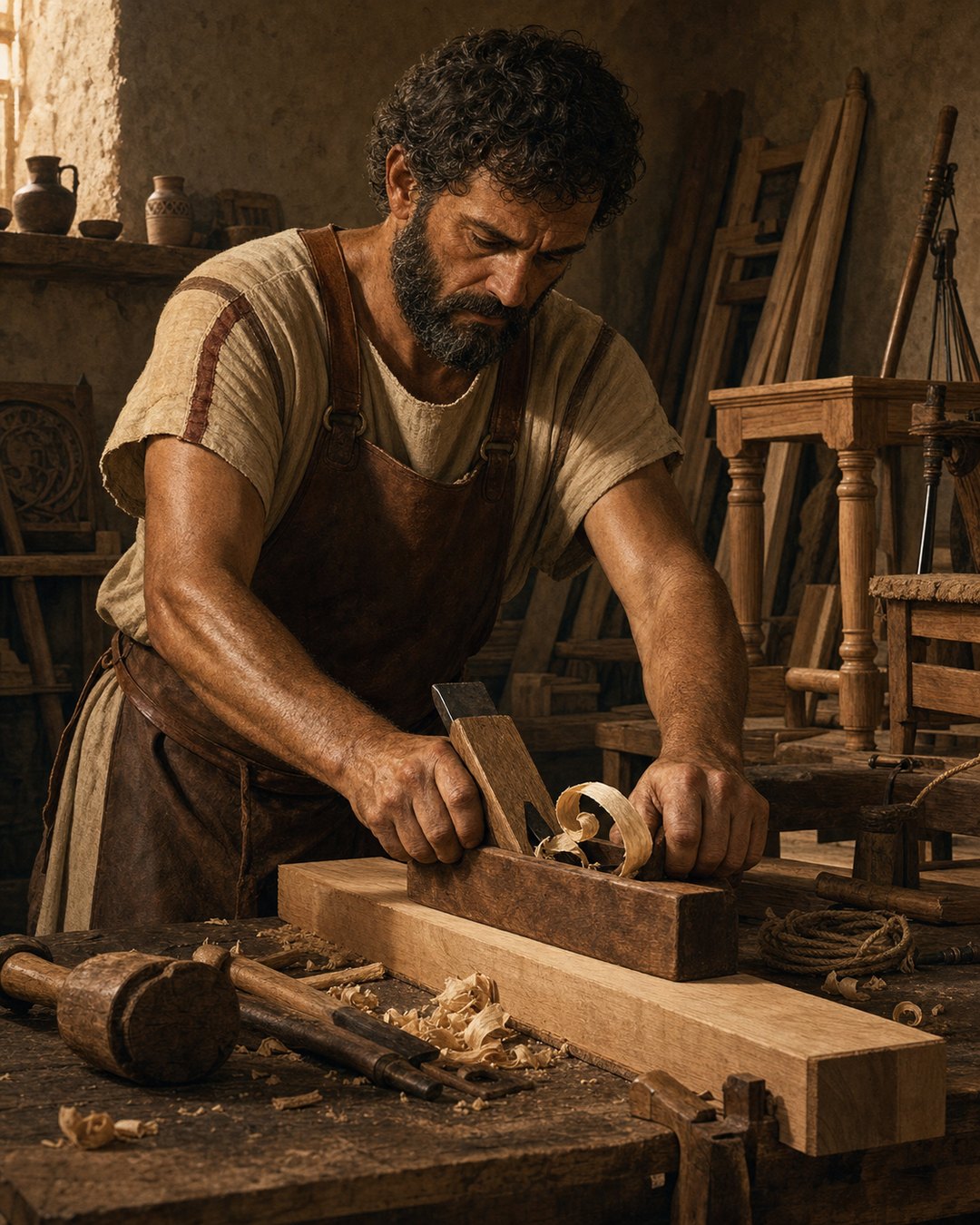
A plank can look level while still rocking beneath a joint or admitting light under a straightedge. Axes, adzes and saws reduced a tree but did not automatically leave a controlled finishing surface. The plane answered that problem. Its iron edge projected through a body whose sole slid over the timber. High fibres left as a shaving; lower areas remained for later strokes. The tool carried a reference surface forward.
A fourth-century plane from Silchester preserves ironwork and traces of its wooden body. A shaped blade from Vindolanda exposes how a smith combined steel and softer iron. Pompeian finds show the craft setting, while an ivory-bodied plane from Goodmanham challenges the idea of every body as a plain block. None supplies a workshop manual. Together they show how a fixed blade, stable sole and forward motion made flatness less dependent on sight.
A sole turned one flat patch into a longer one
The plane’s crucial surface was the sole around the blade. It bridged small hollows while the projecting edge reached the highest fibres. The carpenter pushed; the edge severed a thin layer; the sole advanced onto the newly cut area. Repetition enlarged the guiding surface. An axe removed bulk and an adze brought a face near level, but neither carried a continuous reference beside its edge.
This feedback imposed limits. A short body could follow broad undulations rather than bridge them; an iron projecting too far could bite, tear or stall. A long, sound sole favoured a straighter result because its ends contacted more work before the blade removed the high point. Flatness emerged from geometry, sharpness and restrained depth. Each shaving showed that the blade had met a local rise.
Museo Galileo summarizes wood’s use in buildings, ships, vehicles, doors and furniture. The plane belonged late in production, after trunks were quartered with adzes or cut into planks with a frame saw. Its controlled finish complements the repeated overlaps of Roman roof tiles: both depended on predictable contact, although timber demanded grain-aware corrections.
The iron had to project without wandering
A plane iron works only when fixed under resistance. Sim and Ridge note that Roman planes wedged it against a pin or bar, unlike the later wedge sliding within the body. A fitted blow created holding pressure. Too little let the blade retreat or change depth; too much complicated adjustment. The setting had to raise a shaving and survive denser fibres and knots.
The reviewed Roman irons sat at a consistent 50 to 66 degrees. Edge shape, clearance, mouth, timber and grain direction still affected the cut. The Vindolanda blade’s 41-degree clearance suited that setting. Its scalloped edge identifies a moulding iron rather than the straight cutter expected for a broad flat face.
Adjustment moved work from coarse correction toward a finer finish. A deeper projection attacked high spots; a finer setting lifted less per pass. The sole referenced what remained. This was controlled subtraction, unlike adding curvature through layers in Roman wooden shields. A plane could not restore an overcut edge, so the carpenter took less near the intended line.
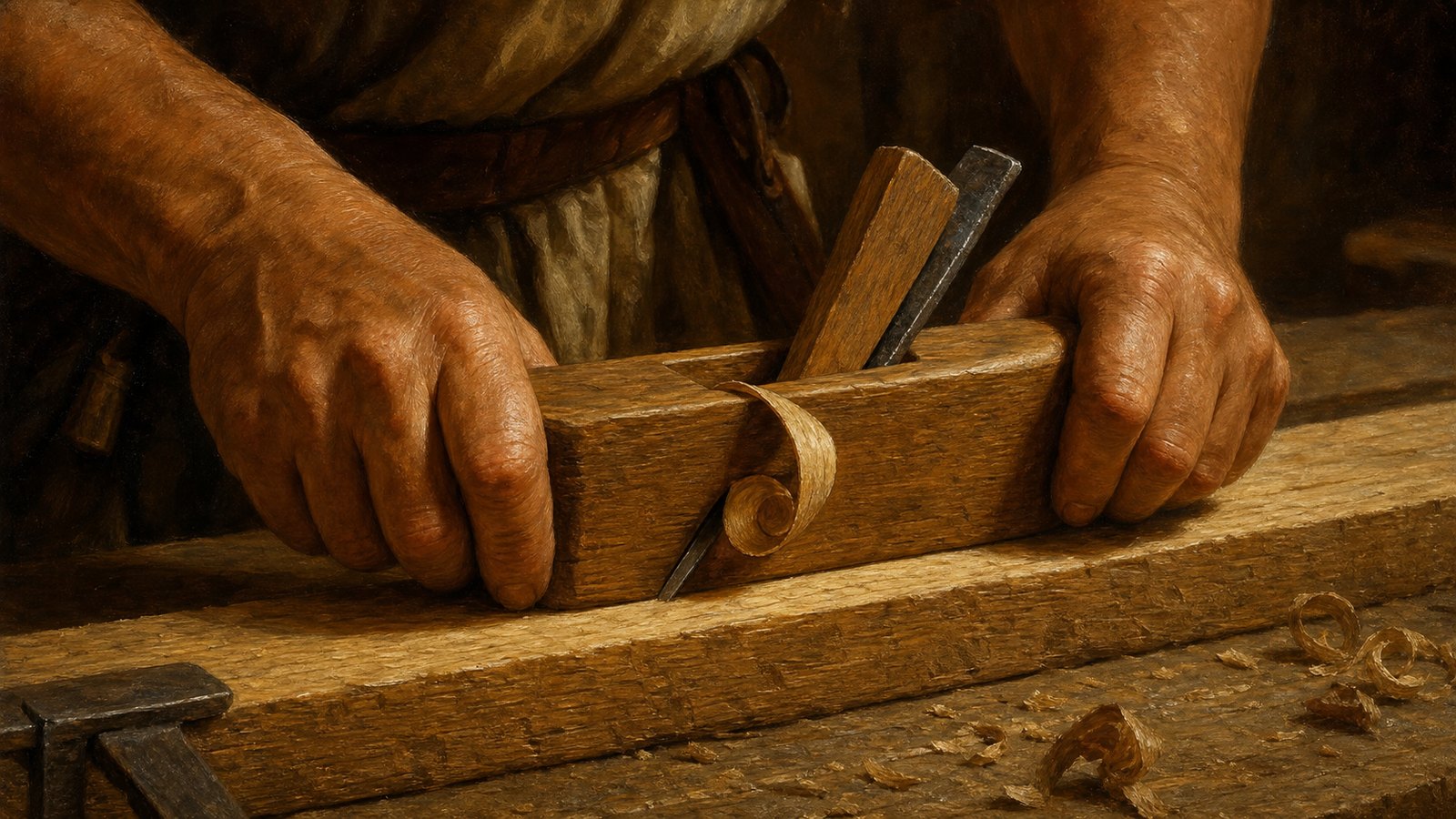
Vindolanda preserved a blade built in layers
The Vindolanda moulding iron is 122 millimetres long, 20 wide and 3 thick. It dates to AD 160–180 and came from ditches near a fort and military annexe. Mushrooming opposite the edge agrees with striking during use or adjustment. Its scalloped profile indicates a specialized task: repeating a shaped channel or ridge rather than flattening an entire board.
Metallography revealed three forge-welded layers. The outer layers were medium-carbon steel, about 0.4–0.5 percent carbon, around a softer iron core of about 0.1–0.2 percent. Sim and Ridge interpret this as a deliberate combination: harder material where a better edge was useful, ductile iron where robustness mattered. The laminated blade demanded more work than forging one wrought-iron billet, yet it could last longer and hold a better cutting edge.
The cutting tip was not hardened, yet remained hard enough for wood and easier to maintain. A file could restore it directly; a hardened edge would need annealing before reshaping and hardening again. A moulding iron preserved a particular contour as well as sharpness. Maintenance repeated the blade’s geometry, just as the blade repeated its contour in furniture.
Flat planes and moulding planes solved related problems
A smoothing plane aimed to create a uniform surface with a flat, symmetrical sole. A moulding plane used the same basic sequence—sole travelling, iron cutting, wedge holding—but its edge and supporting sole followed a profile. Sim and Ridge explain that such a tool also needed guidance along a fixed edge. A lip, fence or separate strip clamped to the work could keep the cut on a straight path instead of allowing each stroke to drift sideways.
Guidance changed ornament from a line drawn anew into one mechanically followed. Once a fence established the offset, the shaped iron revisited that route to the intended depth. No surviving Roman moulding-plane body proves every proposed feature; wooden bodies rarely survive. Blades and furniture establish the capability more securely than one universal design.
Museo Galileo states that furniture planks were smoothed with planes before they were glued or assembled by fitting. That order matters. A glue line closes more reliably when adjoining faces meet; a fitted joint depends on surfaces agreeing rather than merely appearing close. Fine mouldings on furniture from Pompeii and Herculaneum show another use after basic preparation. In the public-facing environment of Roman workshops, a straight joint could demonstrate control quietly, while a moulding made the same control visible.
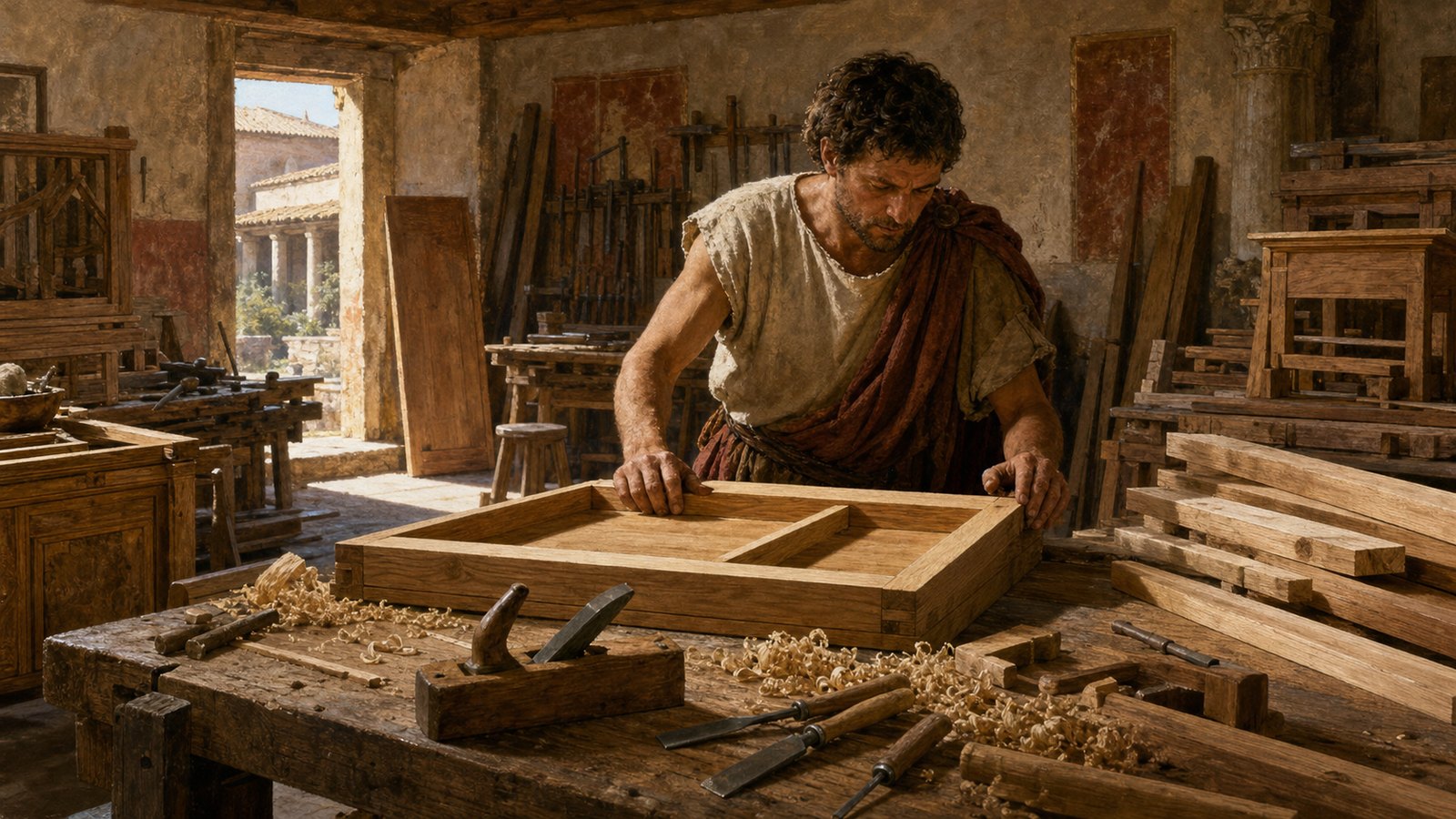
Rare bodies and numerous irons distort survival
Complete Roman planes are rare because wood decays and composite tools separate. Sim and Ridge cite only thirteen planes or parts across the empire, including Silchester, Caerwent and Verulamium. Their review mentions roughly fifty-nine detached blades from posts and settlements in Gaul and Germany. Corrosion can make an isolated blade resemble a chisel, complicating identification.
The Silchester example shows what partial survival can retain. It came from an ironwork hoard discovered in 1890 at Calleva and dates to the fourth century. Reading Museum records an originally wooden body, mostly iron remains and small fragments of wood held by corrosion. The deposit may have been votive, but that interpretation is presented as a possibility. Its findspot preserves a tool after use without necessarily identifying the bench where a carpenter once pushed it.
Goodmanham supplies an exceptional contrast. Its plane combines iron with an elephant-ivory body and was recovered from an enclosure ditch in a Romano-British village, in a fourth-century context. Beverley Guildhall’s account suggests possibilities including display, import or later collection as scrap, but does not settle among them. The safe conclusion is narrower and more striking: Roman plane bodies could be made from a material far more costly than ordinary workshop wood. Function had room for conspicuous craftsmanship.
Repeatability still required a skilled hand
The plane did not erase judgement. Grain reversed, edges dulled and a misaligned iron cut deeper on one side. The carpenter selected direction, kept the sole seated and noticed resistance. Yet the tool constrained the result. Instead of estimating each high point independently, the sole compared neighbouring areas while the blade removed what projected into its path.
A simple hand tool could affect an assembly. One face became the reference for thickness; one straight edge guided another board; moulding strokes carried a profile along furniture. The plane did not guarantee perfection, and the sources preserve no Roman tolerances. It made error manageable by turning flatness into contact, cut and renewed contact.
Roman planes survive as a scattered system of evidence: a composite carcass, a rare luxury body, loose irons, shaped furniture and microscopic welds. Read together, they describe a disciplined process. Rough tools approached the form; the sole bridged what was uneven; the wedged edge shaved the rise; the next stroke tested the result against a longer reference. Flatness became repeatable not because every board was identical, but because the same mechanical comparison could be performed again and again.
Sources & Further Reading
- David N. Sim and Isabel M. L. Ridge, “Examination of a moulding plane blade from Vindolanda,” Historical Metallurgy 34(2)
- Reading Museum, “Carpenter’s plane” (Silchester Collection)
- Museo Galileo, “Wood and woodworking”
- BBC and Beverley Guildhall, “Romano-British woodworking plane”