
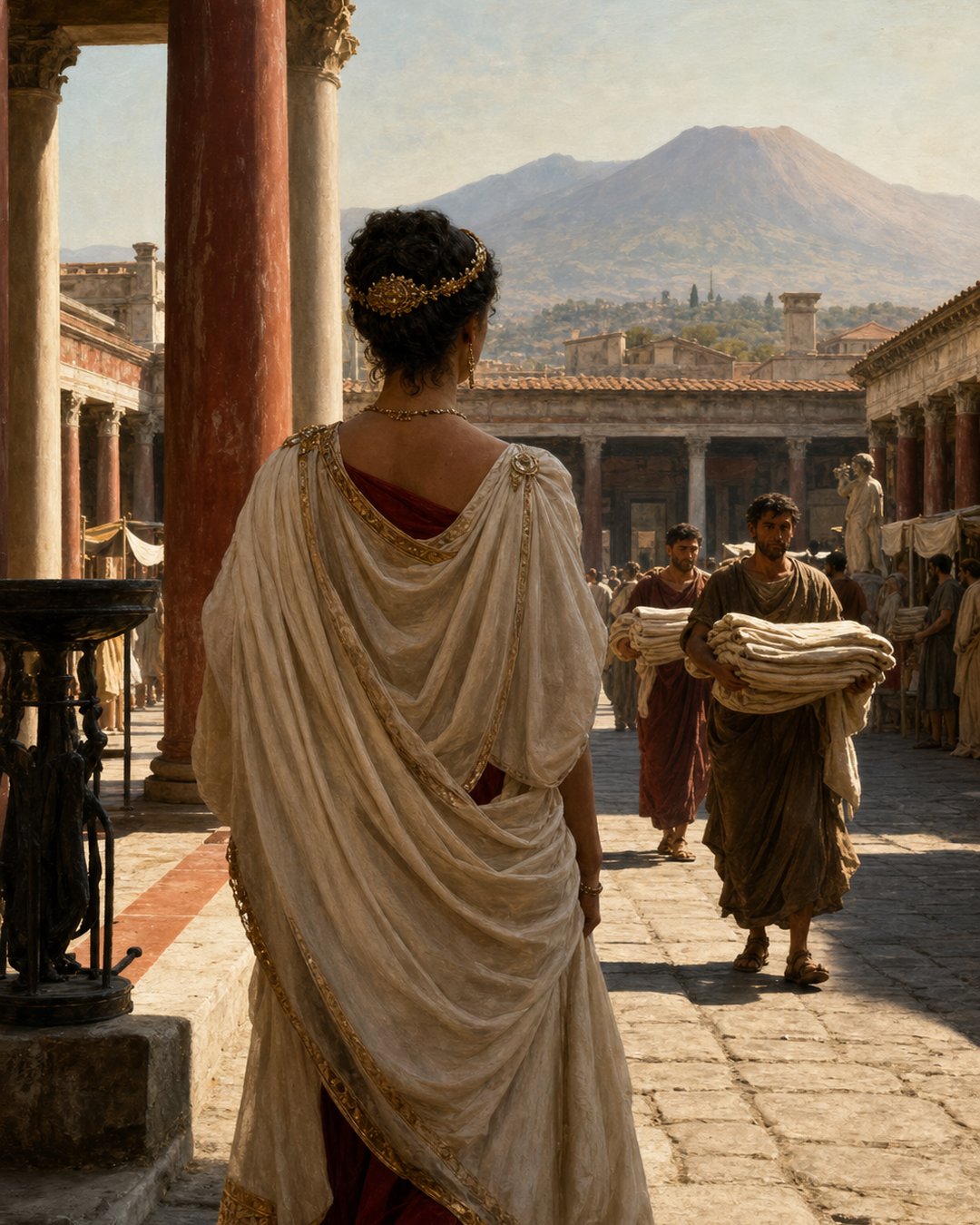
Pompeii preserved very few ancient women at monumental scale. Eumachia is the startling exception. Her name ran across the façade of a vast building beside the Forum, appeared again at a side entrance, and stood beneath a marble portrait placed in the rear portico. She did not survive merely as someone’s wife. She survives as a public priestess, donor and remembered patron.
The building conventionally called hers occupies the east side of the Forum. Its long colonnaded court, deep rear hall and ceremonial front made it one of the city’s largest civic complexes. An inscription says that Eumachia, daughter of Lucius, public priestess, built the chalcidicum, crypt and portico in her own name and that of her son Marcus Numistrius Fronto, dedicating them to Concordia Augusta and Pietas.
Those words do not reveal a private personality. They show a carefully constructed civic identity. Family wealth, priestly office, imperial language, architecture and the wool-working community all meet around one Pompeian woman. Her monument is therefore less a modern tale of individual triumph than evidence for the channels through which elite female power could become publicly durable.
A Daughter of Lucius Entered Pompeii’s Public Record
Eumachia identified herself through her father: Eumachia, daughter of Lucius. The formula anchored her in a local family whose wealth is commonly associated with brick, tile and amphora production. Pompeian status did not float free of kinship. A donor’s name brought a lineage, commercial resources and accumulated reputation into the Forum.
Her marriage connected her to the Numistrii, another prominent family. The building inscription names her son, Marcus Numistrius Fronto, beside her own act of construction. That choice made the monument serve two generations at once. Eumachia displayed her own capacity while preparing a visible civic inheritance for a male descendant.
Widowhood may have helped place property under her control, but the surviving text does not narrate a domestic transfer. It gives the public result: she could sponsor a project of exceptional size. Roman law and custom constrained women’s formal political office, yet money, family and priesthood created other routes into a city’s competitive culture of giving.
The scale separates her from the everyday transactions preserved in Pompeii’s crowded wall writing. Graffiti catches fleeting voices. Eumachia’s inscription occupied carved stone at the civic center, designed to keep one family’s contribution legible through repeated public use.
Public Priesthood Gave Her a Civic Role Without an Election
The inscription calls Eumachia a sacerdos publica, a public priestess. This was not a casual statement of private devotion. A civic priesthood carried ceremonies, status and privileged visibility. It offered elite women an institutional identity in a community whose magistracies and council remained male domains.
Her dedication joined Concordia Augusta, Augustan Harmony, with Pietas, dutiful devotion. These were moral and political virtues as well as divine figures. In the early imperial city, invoking them aligned family benefaction with the language of the ruling house without requiring Eumachia to hold a magistrate’s powers.
The dedication also had a living dynastic reference. Livia, wife of Augustus, was strongly associated with public piety and with Concordia in imperial representation. Scholars have therefore read Eumachia’s program against elite female models at Rome, while remaining cautious about turning every architectural feature into a direct copy.
Priesthood made the gift intelligible. The donor was not presented as a private merchant buying prestige. She appeared as an authorized religious figure serving the civic community. Office, virtue and construction reinforced one another, allowing a woman’s name to stand where decrees, statues and public business taught Pompeians how honor worked.
The Forum Façade Announced a Gift Larger Than a House
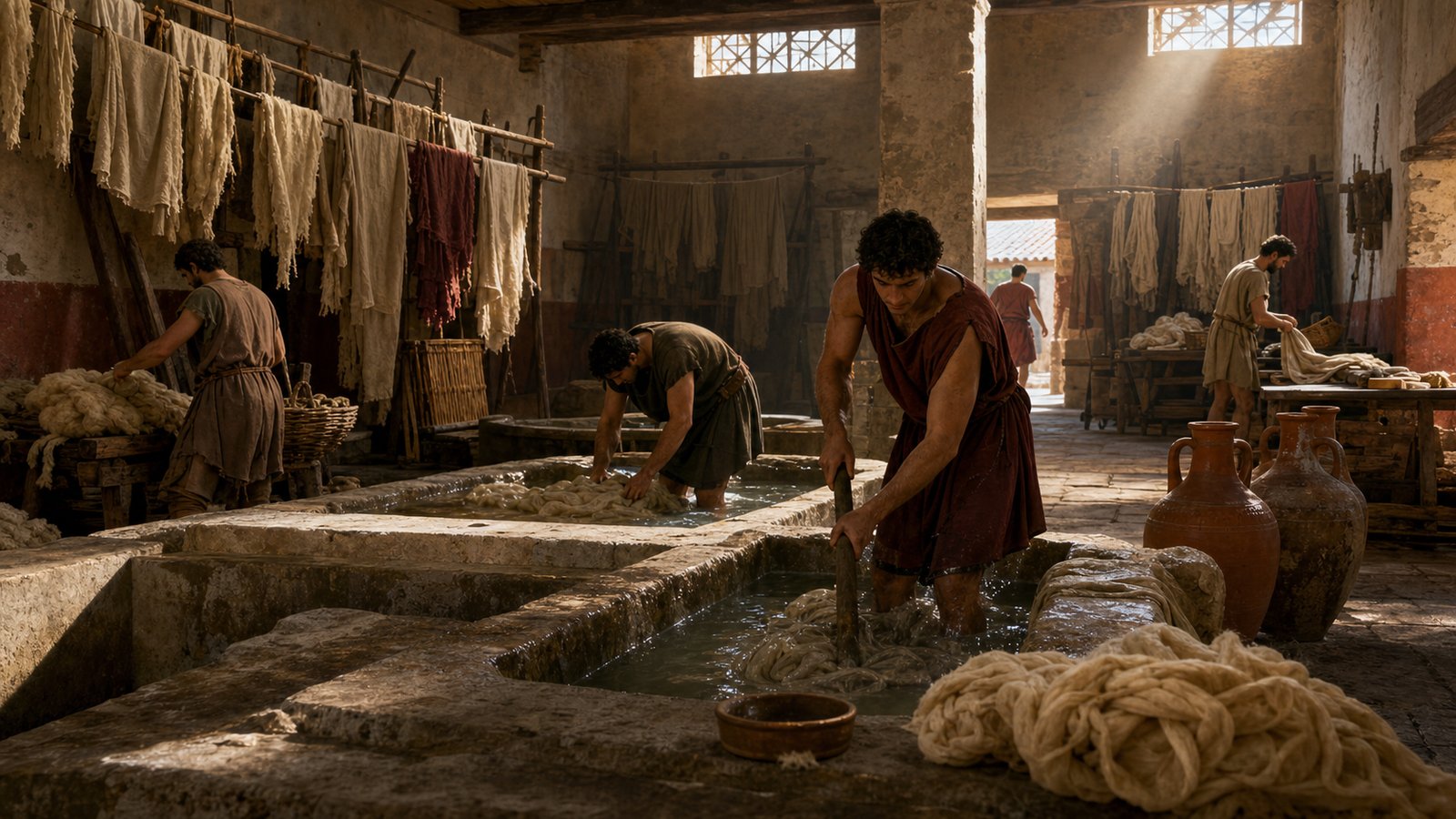
The complex faced Pompeii’s Forum from the east. Its monumental doorway opened behind a façade articulated with niches and architectural decoration. Visitors crossing the city’s principal public space encountered Eumachia’s name before entering the long court. Location transformed expenditure into a repeated civic fact.
The inscription lists a chalcidicum, crypt and portico. Their precise functions remain debated, partly because ancient labels do not map neatly onto every surviving wall. The safer point is architectural: the project combined multiple connected spaces rather than one commemorative room, and its long porticoes could organize circulation, display and assembly.
Inside, a colonnaded court led toward a deep rear exedra. A covered cryptoporticus ran around much of the complex. Shade, changing sightlines and the rhythm of columns made movement ceremonial even when the building hosted ordinary civic or commercial activity. Monumentality was experienced by walking, not only by reading.
The building’s size also changed the visual balance of the Forum. Like Roman porticoes elsewhere, it turned shelter and circulation into public architecture. Here that transformation remained attached to the donor’s female name and to a son whose future status benefited from her gift.
A Second Inscription Complicated the Official Story
A duplicate dedicatory text stood near the side entrance from the Via dell’Abbondanza. It repeated Eumachia’s office, the named parts of the building, her son and the dedication. Repetition mattered in a city approached from more than one direction: the gift could announce itself to Forum traffic and to people arriving from a major street.
The two inscriptions insist that Eumachia acted in her own name and that of Marcus Numistrius Fronto. They do not name a husband as builder. The grammar places the public priestess at the center of the completed act, while family continuity remains visible through the son.
Inscriptions are selective. They record the ideal public explanation, not accounts, labor contracts or workshop disputes. Nothing in the formula proves that Eumachia personally designed the building or managed every payment. It does prove that Pompeii accepted her as the person whose resources and status warranted public credit.
That distinction protects the history from a modern biography invented between stones. We can see the identity she projected: daughter, priestess, mother, donor and devotee of Augustan virtues. Her private opinions remain inaccessible. The monument is powerful precisely because its evidence is formal, repeated and geographically fixed.
The Fullers Claimed Her Statue and Part of Her Afterlife
At the rear stood a marble statue of Eumachia. Its base says that the fullers dedicated it to Eumachia, public priestess. The statue found at Pompeii is now in Naples; a copy occupies the niche. This separate dedication introduces a community of cloth workers into her memorial landscape.
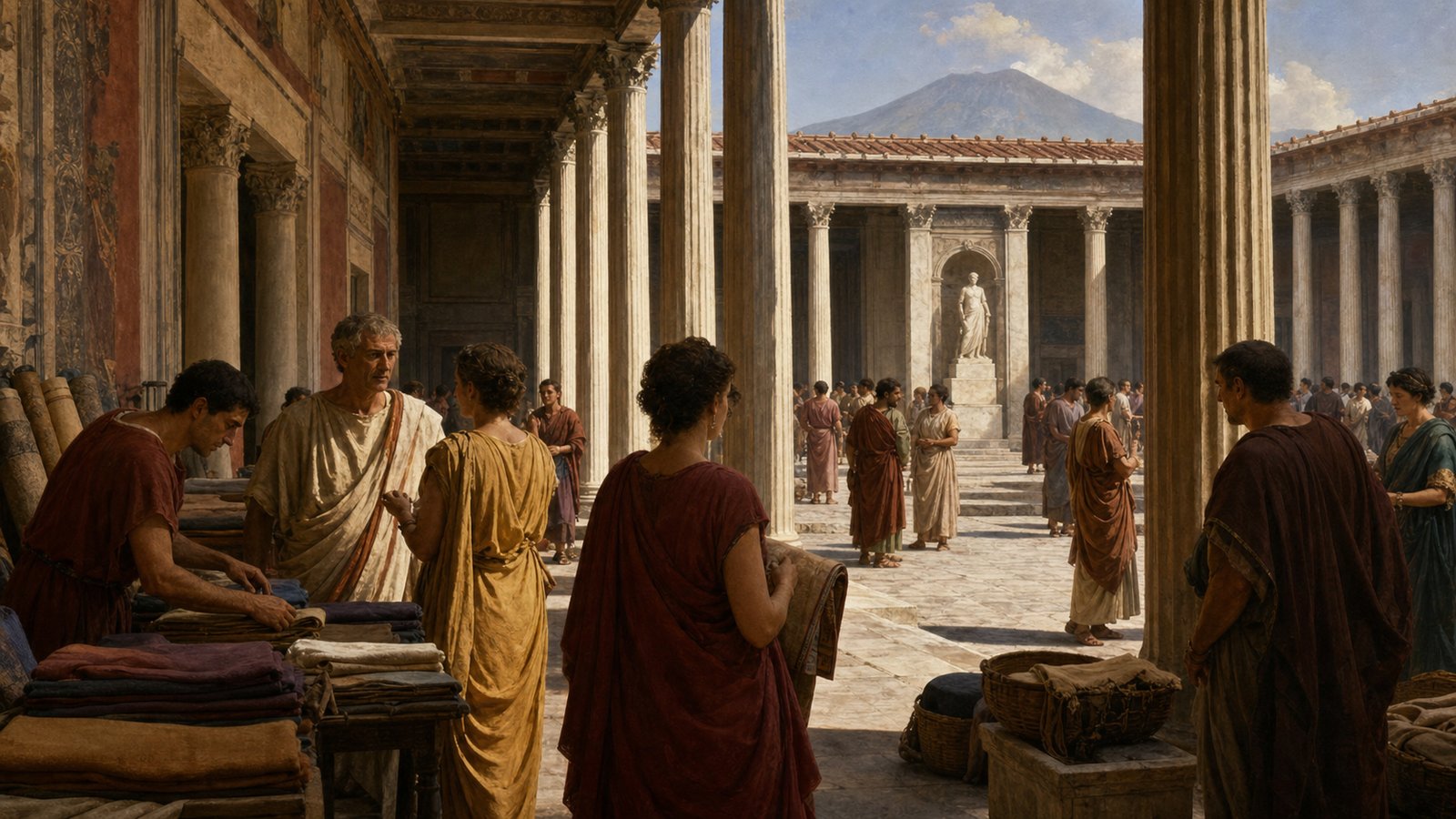
Fullers cleaned and finished cloth, an important business in Pompeii’s economy. Their dedication has encouraged the traditional view that the complex served as a wool market or guild building and that Eumachia was their patron. The connection is real at the level of honor, but the building’s exact commercial function remains debated.
The caution improves rather than weakens the story. The fullers chose to honor her in the complex, and that act establishes a relationship of memory. It does not by itself tell us whether every portico stored wool, whether formal guild meetings occurred there, or whether patronage followed a single modern institutional model.
Cloth work linked humble bodily labor to elite civic display. In a Pompeian fullonica, workers trod and treated fabric in basins. In Eumachia’s portico, members of that economic world placed an idealized marble body and named the woman they wished the public to remember.
The Monument Preserved Several Kinds of Power at Once
Eumachia’s building joined resources that Roman public life usually kept in productive tension. Family wealth paid for construction. Priesthood authorized moral visibility. Augustan virtues connected Pompeii with imperial language. A son received dynastic benefit. Fullers asserted a relationship through their own statue dedication.
No single label contains all of that. Calling Eumachia merely a businesswoman ignores her priestly and familial presentation. Calling her only a priestess hides the material scale of the gift. Calling the complex simply a guild hall turns a debated function into certainty. The evidence instead shows overlapping claims assembled in one place.
The eruption of 79 CE froze the building before later urban change could erase or radically repurpose it. Archaeology preserved walls, inscriptions and statue base together. Their survival gives Eumachia unusual density: name, office, kinship, deities, architecture and community honor can be read against one another rather than reconstructed from a solitary reference.
Her achievement was not participation in Pompeian elections. It was the conversion of wealth and religious office into durable civic presence. Every entrance repeated the donor. Every visitor crossed her architecture. The fullers added their own marble answer. In a political landscape dominated by male officeholders, Eumachia made public memory take a different legal and monumental route.
Sources & Further Reading
- Pompeii Archaeological Park, Eumachia Building
- Mary Beard, Pompeii: The Life of a Roman Town
- Corpus Inscriptionum Latinarum X 810 and 813
- National Archaeological Museum of Naples, Statue of Eumachia