
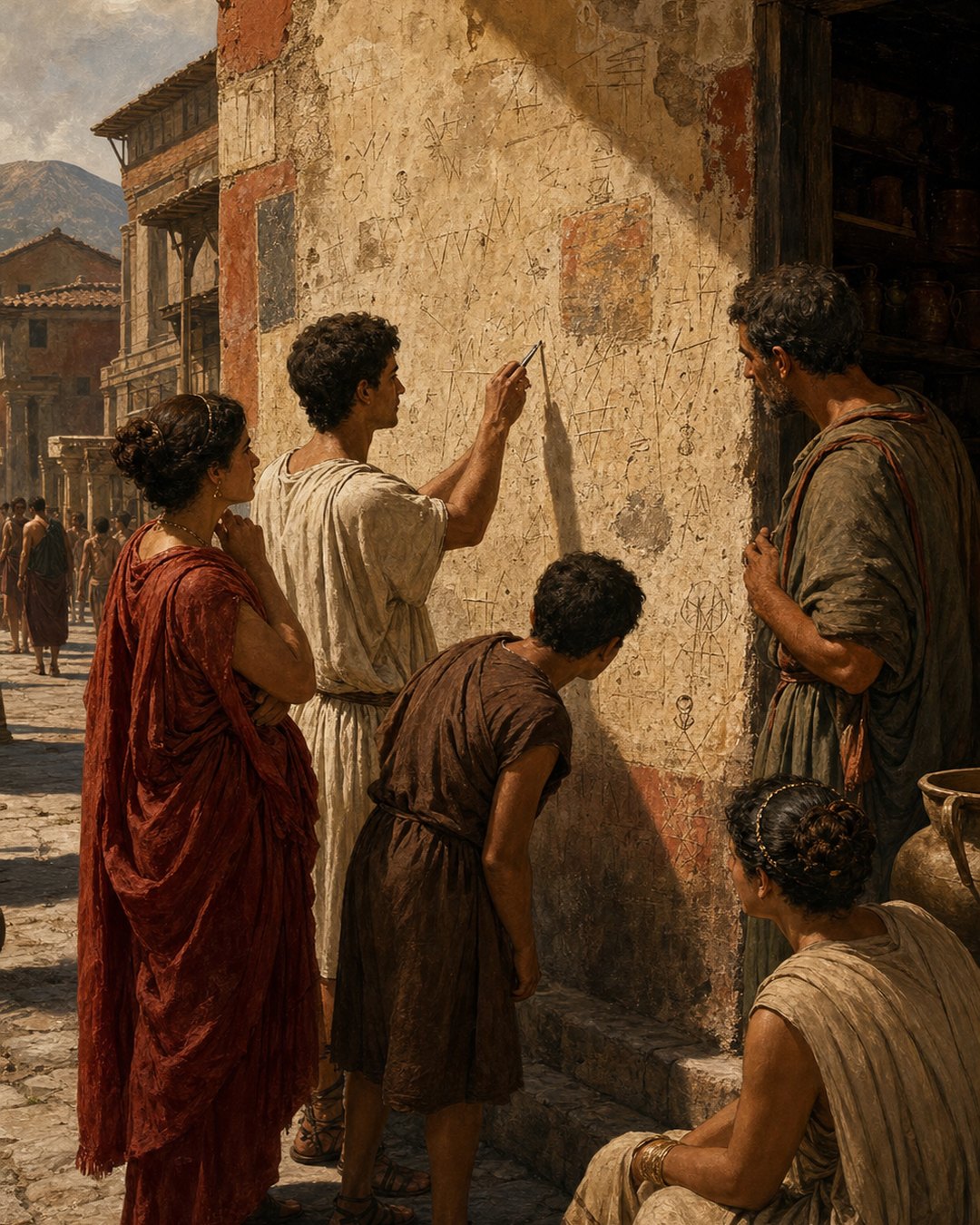
Pompeii’s walls did not wait for permission to speak. Someone scratched a name beside a doorway. Another person praised a gladiator, complained about a host, copied a remembered line of poetry, drew a ship, or answered a message already in the plaster. The result was not one civic announcement but thousands of small attempts to be noticed.
Official Rome favored durable words cut in stone and painted notices backed by patrons. Graffiti used the same public surfaces at a cheaper scale. A point, charcoal stub, or brush could attach a private impulse to a street, tavern, corridor, or room. The city’s preserved walls reveal conversation in fragments: boast without biography, joke without laughter, reply without the first speaker standing nearby.
A wall offered publication without a patron
Formal inscription was expensive. Stone had to be selected, dressed, laid out, cut, transported, and mounted. Even a painted political notice required materials, space, and people willing to associate their work with a candidate. Scratched graffiti lowered the threshold to the pressure of a hand against plaster.
That did not make every resident equally visible. Literacy, access, confidence, tools, and the risk of being challenged still mattered. Yet a short name or drawing could be made without holding office or commissioning a mason. The city acquired marks from people who would never receive an honorific inscription.
Surfaces shaped the audience. A message near a shop addressed passing customers; one in a tavern met drinkers with time to look; one inside a house might speak to guests, workers, or a smaller circle. Location was part of meaning even when the writer left no explanation.
The ease of marking also kept the medium temporary. Plaster could be washed, painted, patched, scratched over, or demolished. Most Roman graffiti vanished through ordinary maintenance. Pompeii is exceptional because catastrophe interrupted that cycle and preserved walls before the city’s next round of erasure.
Names turned presence into a claim
Many graffiti are simple names or declarations of presence. Modern readers may find them slight, but the act answers a durable human desire: I was here; this place included me; someone may read me after I leave. A name on a wall converts movement through the city into a mark.
Names can also carry relationships. Greetings, affection, rivalry, and association place one person beside another. A writer might praise a beloved, mock an opponent, celebrate a gladiator, or remember a companion. The wall becomes a social map assembled from statements too small for official records.
That map is incomplete. A surviving name does not automatically reveal legal status, occupation, age, or whether the writer and named person were the same. Scholars have to resist turning a two-word graffito into a full biography. The power of the evidence lies partly in its limits: identity appears, but only briefly.
This differs from the carefully framed identity of funerary inscriptions. A tomb text organized a life for memory with family relations and status. Graffiti caught people in the present tense, often without the solemnity that made claims easier to classify.
Jokes, desire, and anger crossed the same plaster
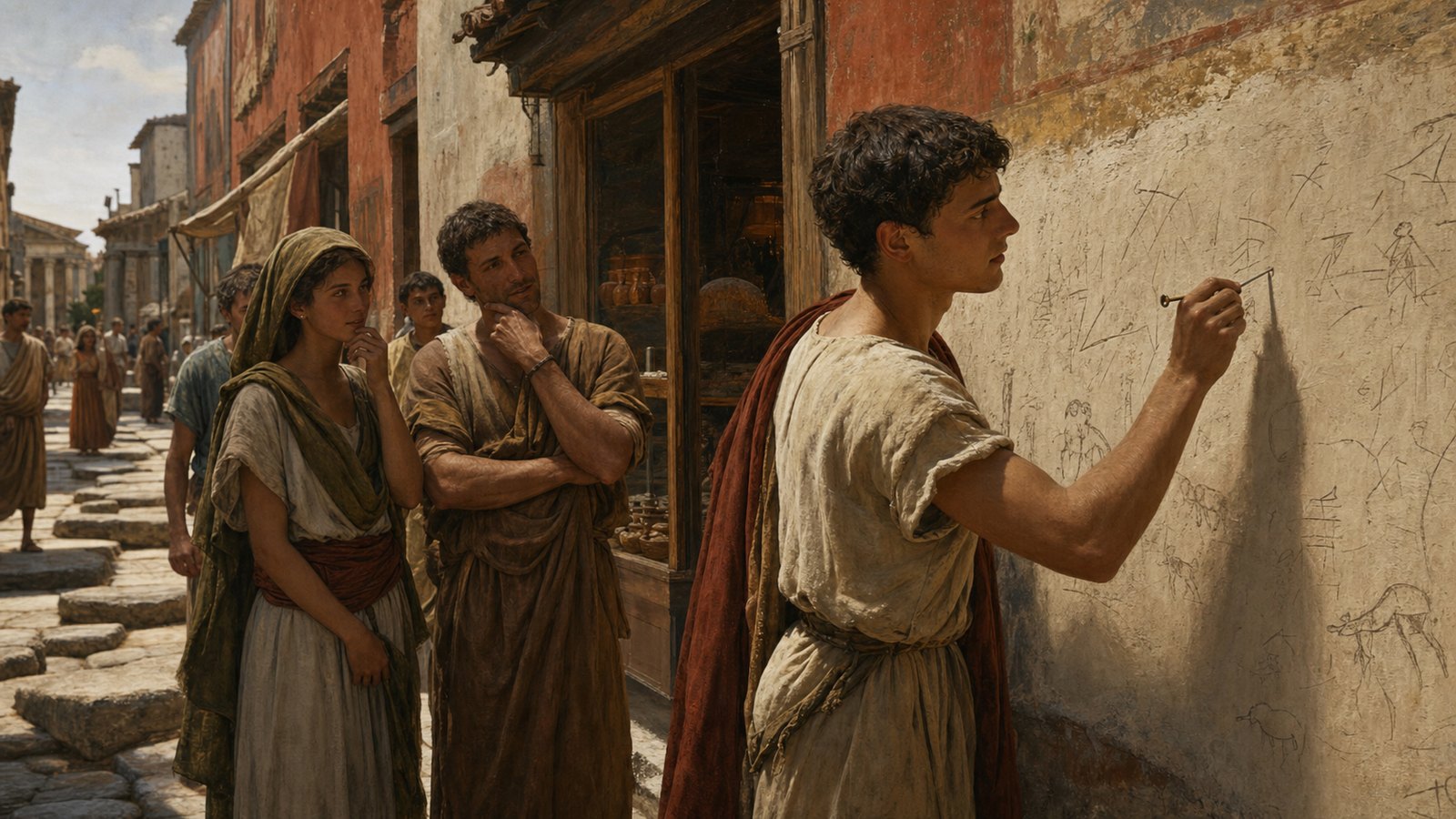
The range of subjects is unruly. Roman wall writers recorded jokes, insults, sexual remarks, prices, drinking, affection, complaints, and mundane observations. Drawings placed gladiators, ships, faces, animals, and geometric forms beside words. The archive is valuable because it refuses to behave like one genre.
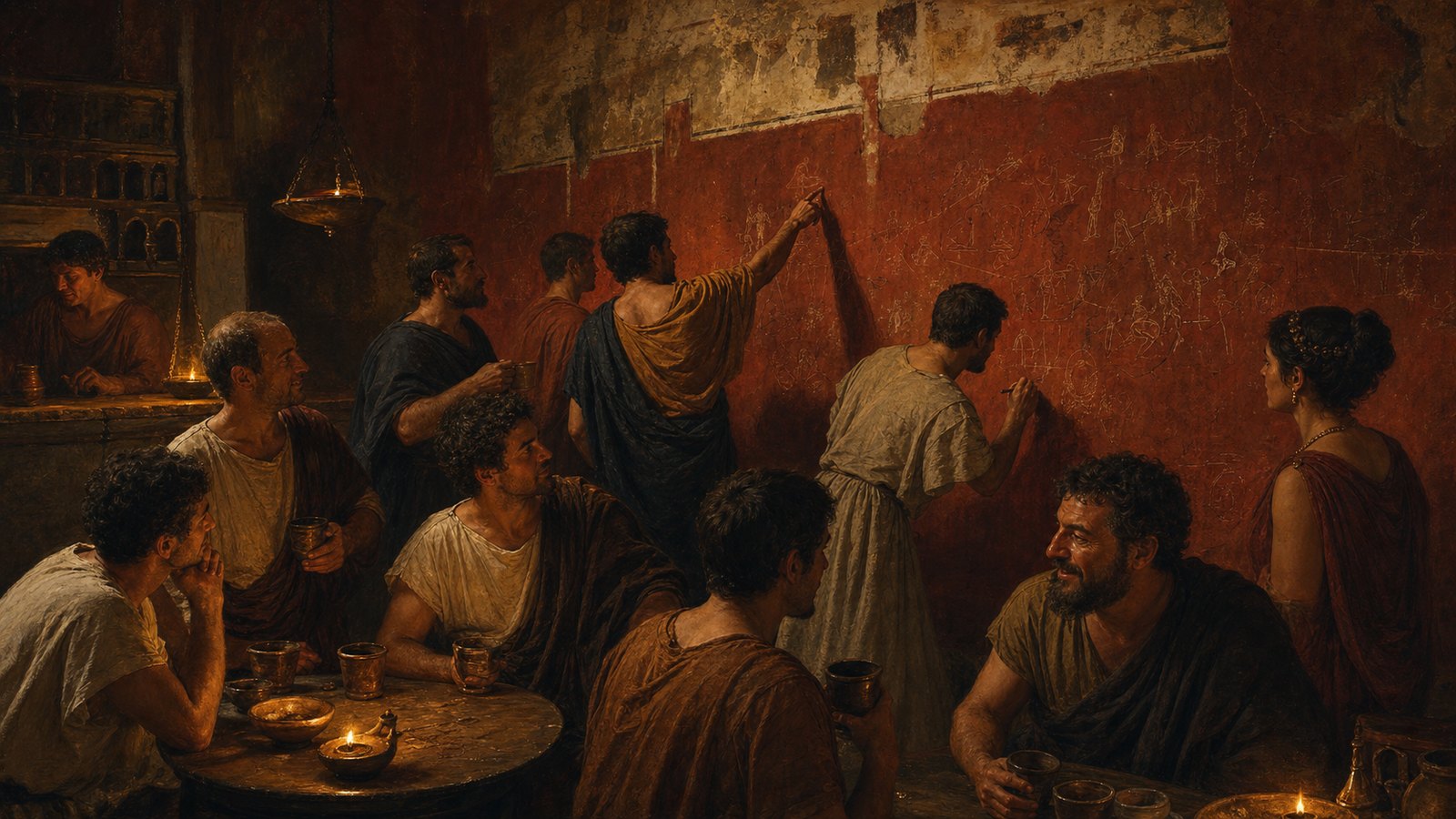
A tavern wall could accumulate competing moods during a single evening. One patron boasts; another ridicules him. A remembered verse appears beside a crude drawing. A name is repeated, crossed, or answered. Readers did not encounter each mark in a clean modern transcription but as part of a crowded surface with older traces underneath.
Replies show that a wall could sustain exchange. The second writer had to notice the first, decide that strangers might understand the connection, and place an answer close enough to be read as one. Conversation therefore continued even when participants never occupied the spot at the same moment.
The physical act could be intimate. A stylus catches in dry plaster. Dust gathers under a line. Charcoal blackens a fingertip. The writer leans close while companions watch the doorway. Publication takes seconds, but the body is briefly exposed as the person chooses to leave a thought where others can judge it.
Poetry escaped the classroom
Lines and fragments associated with poets, especially Virgil, appear among Roman graffiti. Their presence does not prove that every writer had mastered an entire literary work. It shows phrases circulating through schooling, memory, performance, copying, and repetition until they could be reused on a wall.
Some versions are incomplete or altered. That variation is evidence rather than merely error. A remembered line may have been adapted to a local joke, shortened to fit available plaster, or reconstructed by a writer whose ear knew more than his spelling. Literature lived through imperfect possession.
Misspellings and nonstandard forms help historians study the gap between formal written Latin and everyday language. A mistake can record pronunciation, partial schooling, or haste. It should not be treated as proof that the writer lacked intelligence. Standard forms are learned conventions, while wall writing catches people using them under informal conditions.
Graffiti therefore expands the history of Roman reading beyond libraries. Shelves and scrolls concentrated texts in collections. Walls show fragments leaving those collections, passing through voices and exercises, and arriving in places where a passerby could recognize a line without opening a book.
Official paint and informal scratches competed for attention
Pompeii is famous for painted electoral recommendations naming candidates and the groups that supported them. Those notices were planned interventions in civic space. Informal graffiti occupied some of the same visual territory but followed no shared campaign calendar or authorized design.
The difference matters. A painted endorsement aimed to coordinate voters around a public choice. A scratched insult or name might have no objective beyond immediate recognition. Yet both assumed that walls had audiences and that repeated exposure could make a person or phrase familiar.
Layers could collide. New paint covered older marks; fresh scratches cut across color; household maintenance removed an unwanted message; another writer used the cleaned space. The wall was not a neutral page but contested property whose owner, painter, candidate, customer, and passerby could want different things from it.
This competition helps explain why preservation is so uneven. The marks that survive are not a complete opinion poll of Pompeii. They are what happened to remain on particular surfaces when Vesuvius stopped ordinary revision in 79 CE. Absence from a wall can mean silence, cleaning, repainting, erosion, or excavation loss.
The eruption froze a medium designed to disappear
Ash and destruction killed Pompeii’s urban conversation while preserving parts of its setting. Houses, streets, shops, and public buildings retained inscriptions in relation to doorways, counters, rooms, and routes. Findspot lets a short message recover context that a detached object would lose.
Exposure after excavation created a second danger. Plaster that survived burial could fade, flake, or weather once uncovered. Early copies, photographs, and scholarly editions are therefore important even when the original mark is now difficult to see. Documentation became another layer between the ancient hand and the modern reader.
The fragments should not be romanticized as an unfiltered voice of every Roman. Pompeii was one city at one moment, and the writers who marked its walls were a self-selecting group. Translation, damage, editorial choices, and lost context all shape what reaches us.
Even with those cautions, Pompeii’s graffiti made the city talk back. Official monuments tell us how institutions wished to appear. Walls preserve citizens, visitors, workers, customers, lovers, jokers, and fans trying to interrupt that order for a few inches. Their marks survive because a temporary medium met a permanent disaster.
Sources & Further Reading
- World History Encyclopedia, Graffiti in the Roman World
- Roman graffiti overview and references
- Pompeii overview and references