
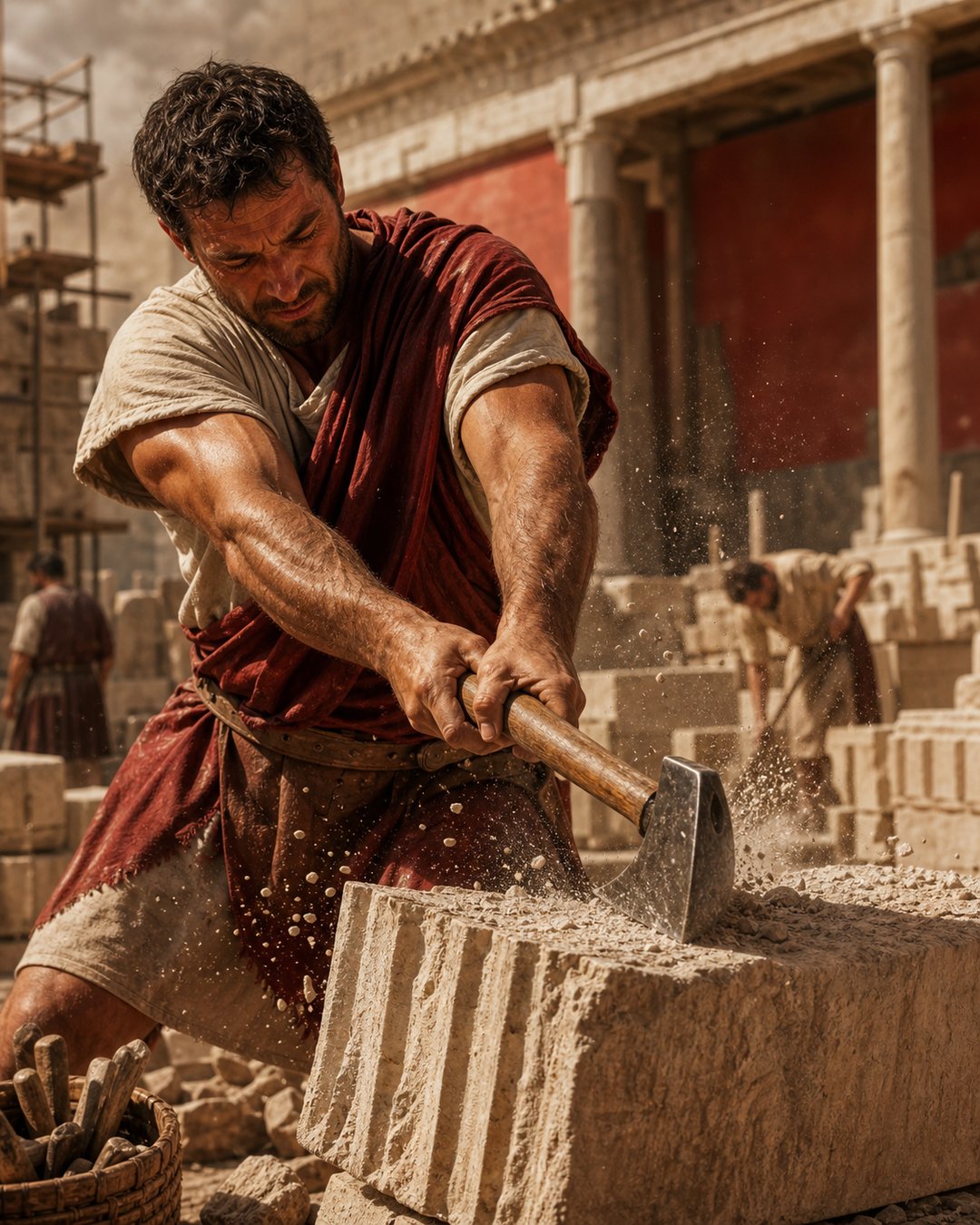
A scar in Roman stone does not always name the tool that made it. A broad flat mark may suggest a flat chisel; a combed mark may suggest a tooth chisel. Yet Roman workers also used stoneworking axes with flat or toothed edges, and Art of Making warns that distinguishing their traces from chisel work can be difficult.
The axe was essentially a pick whose point had widened into a cutting edge. That edge arrived through a handled swing rather than a separately placed chisel and hammer. Workers used it mainly for relatively rough work on soft limestone and sandstone. Its marks appear especially on Roman building blocks and sculpture in north-western Europe, North Africa and the Middle East.
This is not a story about a universal Roman axe. It is about inference. Archaeologists read movement from damage after the hand and handle have vanished. Edge shape, stone hardness, roughness, direction and regional context must cooperate before one surviving surface can be assigned confidently to one tool.
A Pick Became an Axe When Its Point Widened
Art of Making defines the stoneworking axe as essentially a pick with a wide cutting edge. The handle and swung head preserve the pick’s delivery, but the contact changes from a concentrated point to a line. Each impact can address more surface while giving up the deep puncture of a quarry pick.
The edge might be flat or toothed. A flat edge meets stone along a continuous blade. A toothed edge divides that width into several projecting contacts. Those alternatives echo the distinction between flat and tooth chisels, which is exactly why the marks can become difficult to separate after the tool itself disappears.
A wide edge makes sense during rough shaping of softer block. It can knock down ridges and organize an irregular face through repeated swings. The worker does not seek polish. The task is to bring a building block or sculptural mass closer to its required envelope while enough stone remains to absorb energetic mistakes.
The mechanism follows the quarry pick’s handled momentum, but distributes contact differently. A point penetrates locally and leaves curved repeated grooves. An axe edge spreads the arrival sideways, producing marks that can begin to look like the work of a broad hand-held chisel.
Flat and Toothed Edges Created Two Families of Scars
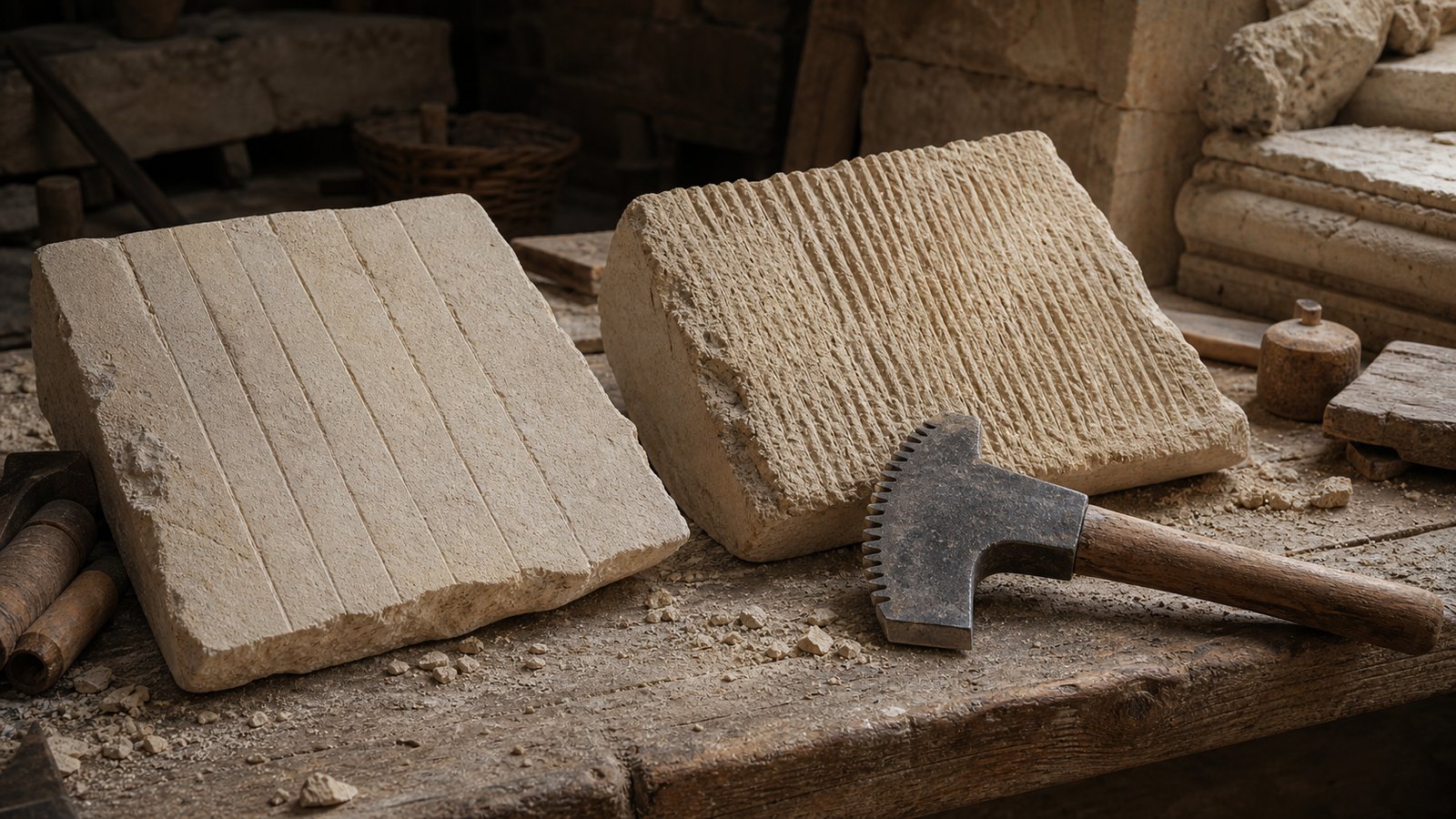
The flat-edged axe cuts one broad contact into soft stone. Repeated blows can leave parallel facets or bands. The toothed axe breaks that contact into rows, creating combed evidence. Art of Making does not prescribe one exact tooth count or edge width, so no universal Roman specimen should be invented.
These two families let workers select how aggressively the edge engaged. Teeth concentrate a wide swing into multiple small points and can clear material between them; a flat blade offers a continuous boundary. Both remain rough tools in the source’s account, not substitutes for every later smoothing stage.
The visible surface depends on overlap. A single blow may preserve a clear edge pattern, while later blows cross, clip or erase it. Weathering rounds the ridges. Reuse adds another campaign of marks. By excavation, the diagnostically neat scar imagined in a diagram may survive only as a partial rhythm.
The archive’s tooth-chisel article shows how three or more teeth could regularize rough stone under a hammer. The axe can create a similar combed appearance, but the handled swing changes reach, momentum and the worker’s bodily distance from contact.
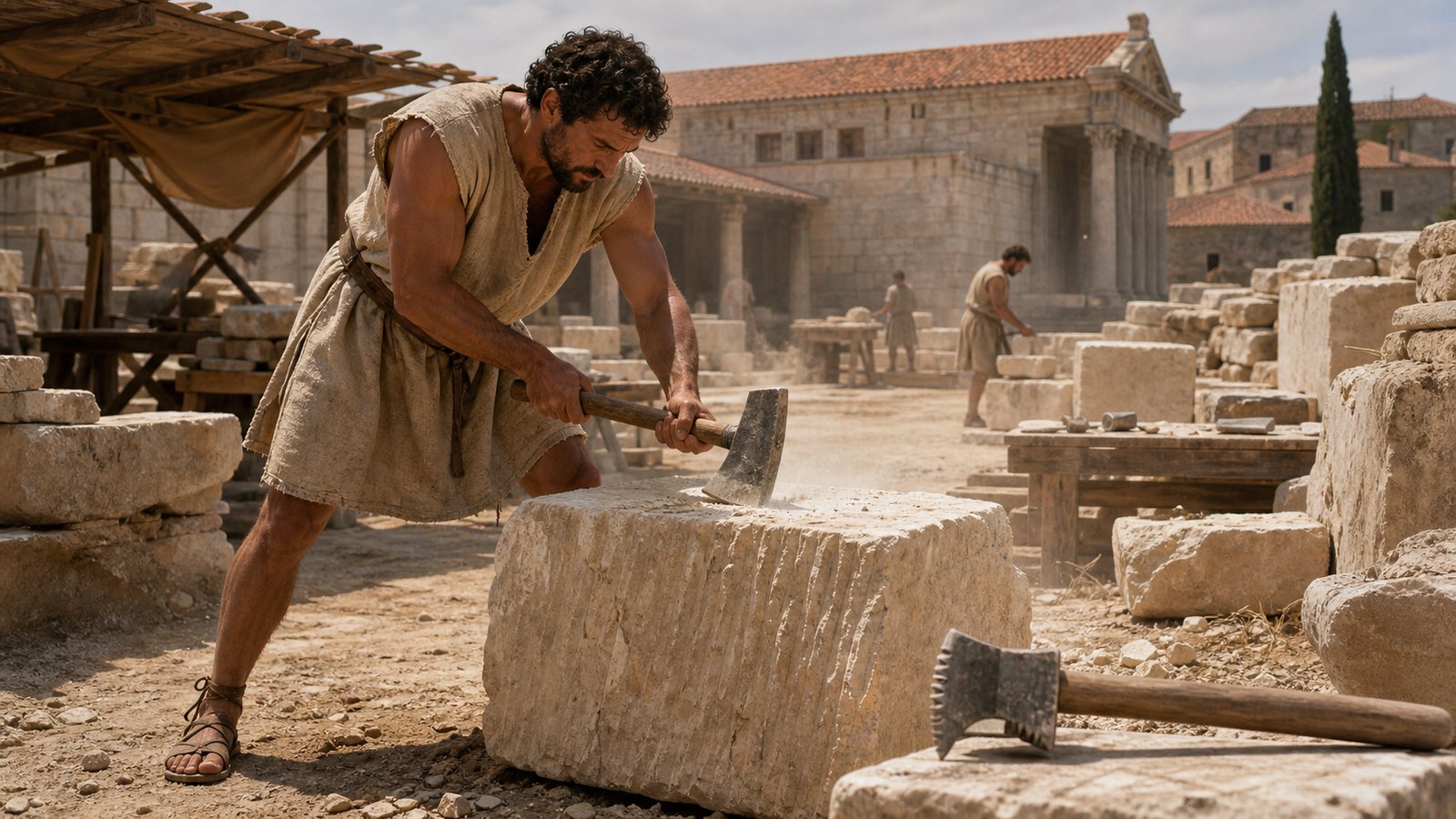
Limestone and Sandstone Accepted Rough Swung Work
Roman stone axes were typically used for relatively rough work on soft stones such as limestone and sandstone. These materials can yield under a wide swung edge without demanding the near-vertical concentrated point used against hard granite. Tool choice followed the stone’s willingness to fracture and cut.
Soft does not mean weak in every direction or identical from quarry to quarry. Bedding, inclusions, moisture and weathering can alter behavior. The source securely supports the broad material preference; it does not justify assigning every limestone mark to the same angle, force or finishing sequence.
Rough work often occurs before transport or installation, when unnecessary projections add weight and interfere with fit. It can also occur on sculpture while broad masses are still unresolved. The same tool class can therefore appear on architecture and figures without proving that one workshop organized every stage alike.
This material logic contrasts with the point chisel’s changing angles. Hard stone needed shattering concentration; marble allowed directed cutting; softer limestone or sandstone could accept the axe’s broad energetic edge during early shaping.
A Chisel Mark and an Axe Mark Can Share an Outline
Art of Making states the interpretive problem directly: distinguishing a flat-edged axe mark from a flat-chisel mark can be difficult, as can separating a toothed axe from a tooth chisel. The surviving outline records the edge more readily than it records whether the edge sat on a handle or a short shaft.
Both systems put shaped iron against stone. Both can advance in repeated parallel contacts. If later working removes the beginning and end of a stroke, the remaining central patch may preserve width and texture but not the arc, reset or impact spacing that identified the original gesture.
Tool-mark reading therefore needs more than resemblance. Investigators can consider direction across the surface, consistency of reach, curvature, overlap, accessibility and the stage of work. None supplies certainty alone. Together they can make one explanation more plausible while preserving honest doubt where evidence remains ambiguous.
That uncertainty is useful rather than embarrassing. It prevents the workshop from becoming a catalogue assembled after the fact. Roman workers chose among tools with overlapping effects. A named modern category helps comparison, but the stone may preserve function and movement more clearly than the ancient name.
The Map of Surviving Marks Is Regional, Not Universal
Axe marks are found most often in the Roman world on building blocks or sculpture in north-western Europe, North Africa and the Middle East. This distribution is a concrete clue. It says where the documented traces cluster without claiming that no axe existed or no similar action occurred elsewhere.
Regional concentration can reflect stone, building traditions, workshop teaching, survival and the monuments selected for study. The source does not reduce the pattern to one cause, so the article should not either. The safe conclusion is geographic: evidence is particularly visible across three broad zones of the Roman world.
The range also resists a Rome-centred workshop story. A technique can be Roman in chronology and connected practice without being equally common in the capital. Stoneworkers across distant provinces answered local materials and commissions with tools whose marks joined wider habits to regional choices.
On a building block, axe traces may survive where plaster, adjoining masonry or later finishing concealed them. On sculpture, an unfinished back or deep recess can protect rough work. The most informative surfaces may therefore be those ancient viewers were never expected to inspect closely.
The Missing Handle Must Be Reconstructed from Context
When an excavator sees the mark, the wooden handle and moving worker are gone. What remains is a negative event in stone: edge width, tooth rhythm, depth, direction and overlap. Reconstructing an axe means inferring the delivery system from evidence that primarily records contact.
Context narrows the possibilities. Soft limestone or sandstone, broad rough shaping, reachable arcs and a regional pattern consistent with documented axe use can support the identification. A confined recess, short isolated contacts or a finishing sequence may support a chisel instead. These are comparative questions, not automatic verdicts.
The ambiguity also changes how a museum label should sound. “Axe marks” can be a reasoned attribution, while “marks consistent with an axe or broad chisel” may be more accurate on another surface. Precision sometimes means naming two plausible tools instead of forcing the stone to choose one.
Roman stone axes matter because they make evidence harder in a productive way. Flat and toothed edges, swung through handles against limestone and sandstone, left rough marks across distant provinces. Those scars can masquerade as chisel work, reminding us that a surface preserves what touched it better than the whole body that moved.
Sources & Further Reading
- Art of Making, “Tool: Axe”
- Wikipedia, “Stone carving”