
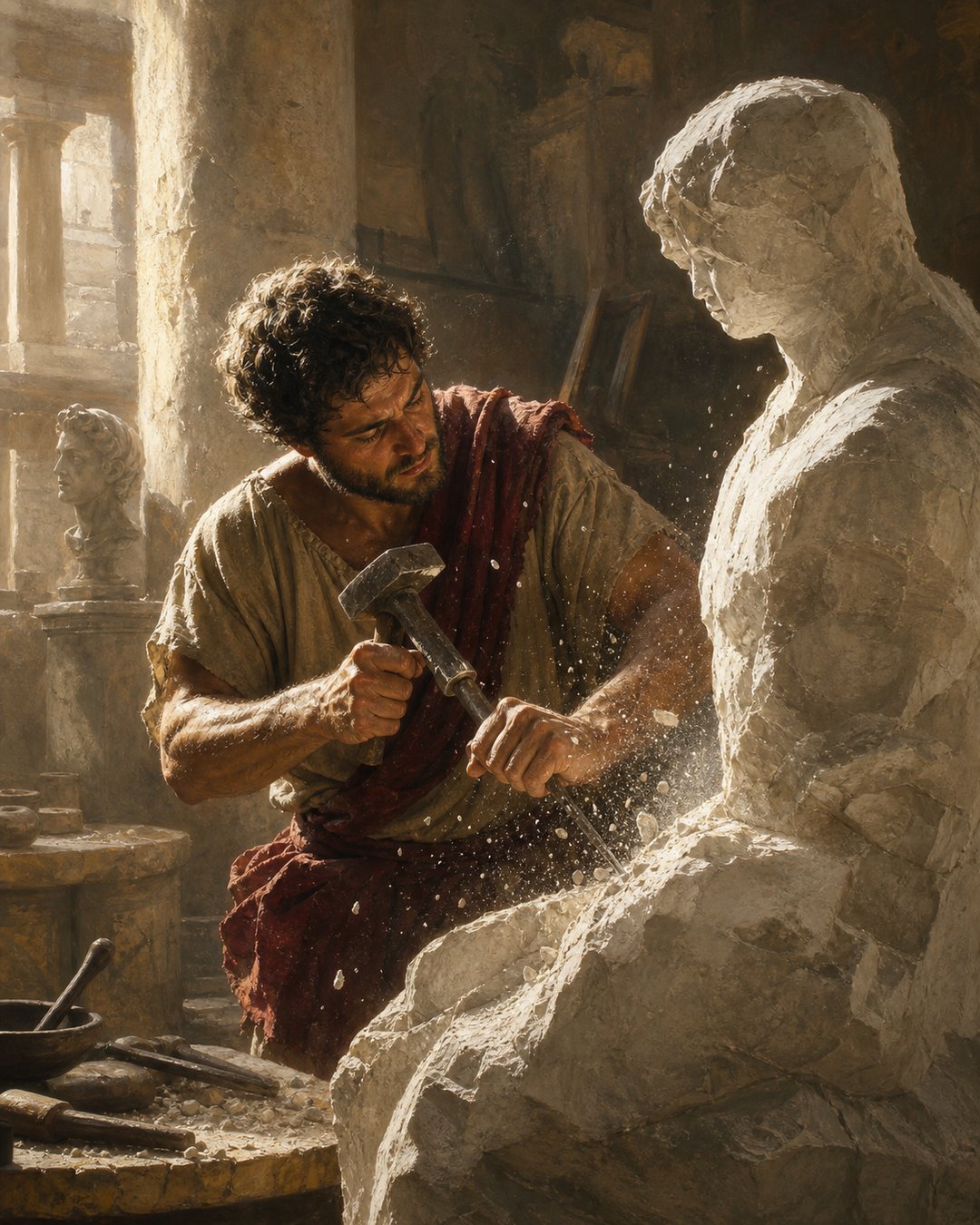
A Roman statue did not begin with a smooth plane or a delicate fold. It began with a large mass that had to disappear. The point chisel, an iron shaft with a pyramidal tip, performed so much of that removal that stone-carving scholar Peter Rockwell called it the workhorse of carving and estimated that it cut away at least 85 percent of a statue’s stone.
The tool looked elementary: twenty to thirty centimetres long, one to two and a half centimetres thick, struck by a metal hammer and sometimes a wooden mallet. Yet the same point behaved differently when its length, angle and rhythm changed. On granite it shattered; on marble it cut. Lifted between blows, it removed quickly. Kept against the surface, it drew controlled parallel lines.
That flexibility explains why a blunt pyramidal point belongs at the centre of Roman sculpture. The finished face conceals the hundreds of kilograms that never became art. Before a flat chisel clarified an edge or an abrasive found a shine, the point decided how the block would surrender.
A Twenty-to-Thirty-Centimetre Shaft Put Force Behind One Point
The point chisel was a hand-held metal shaft roughly twenty to thirty centimetres long and one to two and a half centimetres in diameter. One end received repeated blows. The other narrowed into a pyramidal point, concentrating the energy of the hammer into a contact much smaller than the worker’s hand.
Those dimensions kept the striking end clear of the stone while leaving the holding hand close enough to aim. The carver could rotate the shaft, alter its lean and move it after every impact. A longer handled quarry pick delivered a broad bodily swing; this chisel kept placement under the fingers.
The point itself varied with material. Art of Making notes that marble and limestone tools tended to have drawn-out points, while granite points were blunter. The stone therefore influenced the metal before the first blow. A geometry useful in one material could be too fragile or ineffective in another.
This close-held arrangement distinguishes the tool from the quarry pick’s bargain between force and control. Both end in points, but the chisel separates placement from power: one hand locates the iron and the other delivers the hammer.
Rockwell’s Eighty-Five Percent Happened Before the Finish
Peter Rockwell’s estimate is startling because viewers rarely notice point-chisel work on a completed statue. At least 85 percent of the removed stone, he wrote, could be cut away with this one workhorse. The figure measures subtraction rather than visible finish: most carving labor prepared surfaces that later tools transformed or erased.
Roughing-out means turning an oversized block into a manageable envelope around the intended figure. Every removed projection makes the form easier to see and the remaining mass lighter to handle, but each cut also reduces the margin for correction. The point works quickly precisely when much expendable stone still surrounds the design.
Basic shaping follows rough removal. A shoulder, knee, drapery mass or architectural moulding need not yet be smooth, but its volume has to stand in the right relationship to neighboring forms. Point marks can therefore be provisional measurements in stone, showing where removal has reached and where resistance remains.
The sequence anticipates the flat chisel’s cleaner line. A broad edge cannot efficiently erase the whole block. It becomes useful after the point has already spent most of the surplus, leaving a rough geography for finer contact to regularize.
Granite Required a Blow Near Ninety Degrees
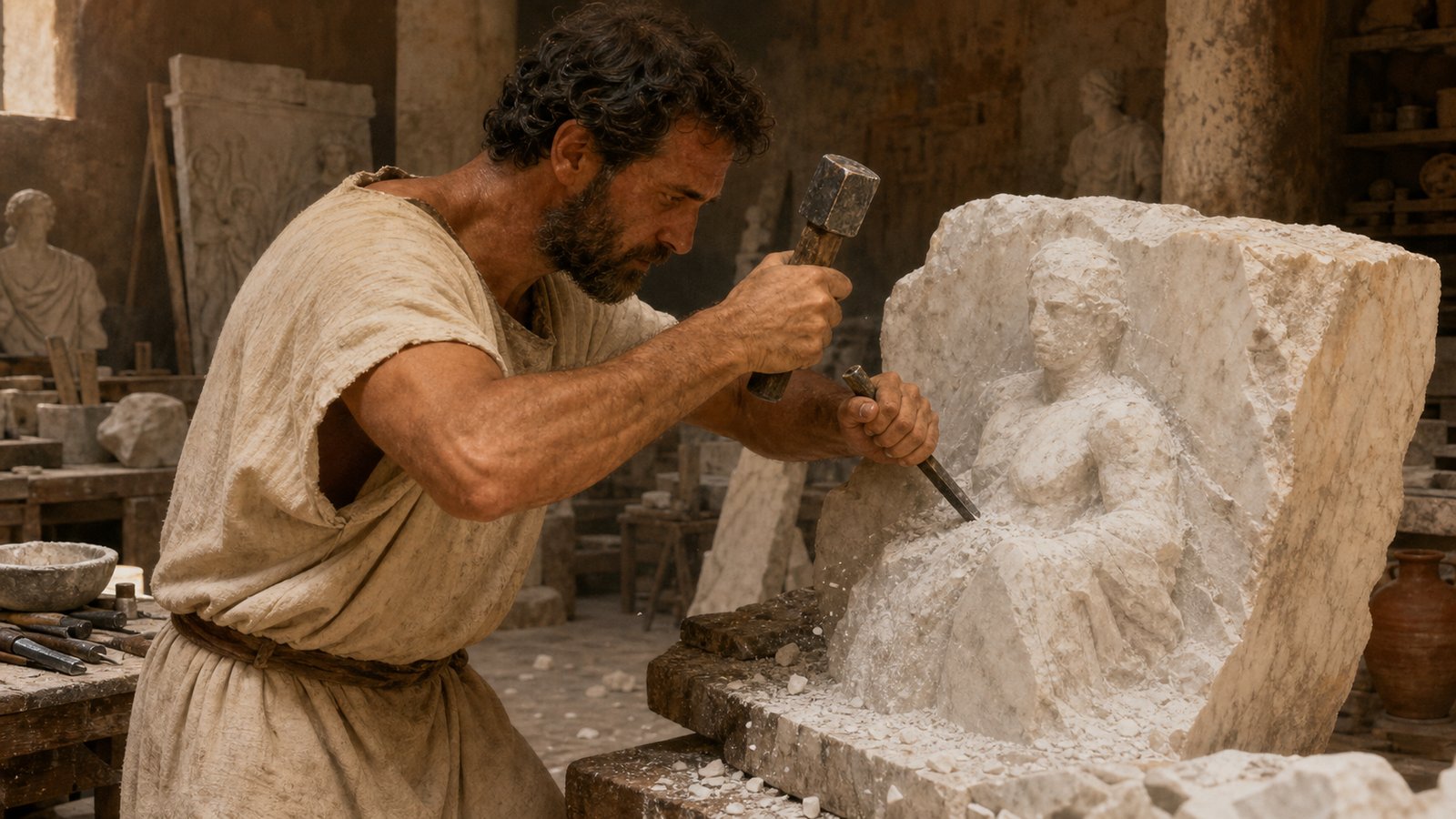
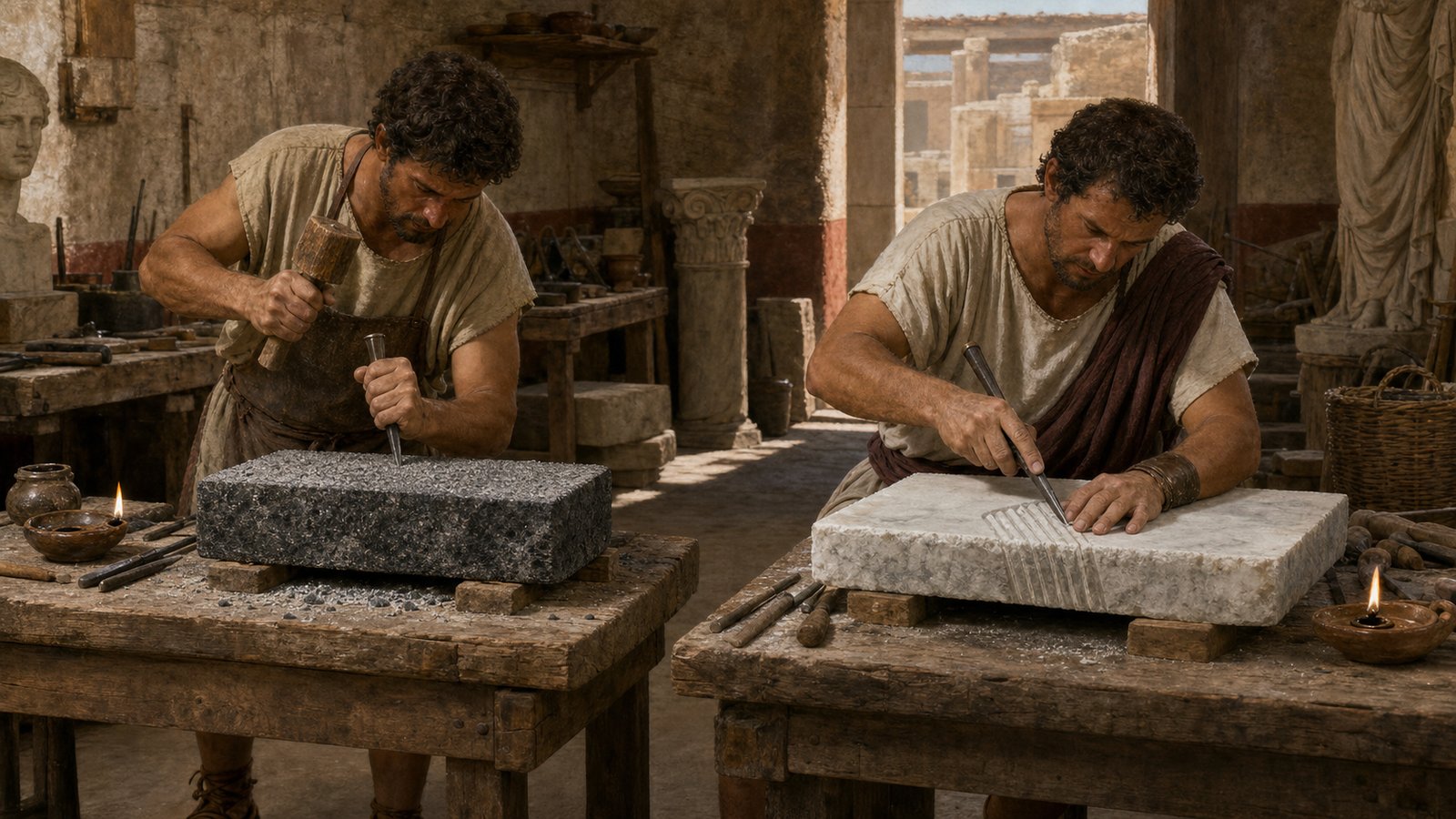
On granite and other hard stones, the point chisel was commonly held at about ninety degrees to the surface. The near-vertical impact shattered the immediate surface. Art of Making explains that a shallower approach could simply bounce from such hard material, returning energy to the tool instead of opening the stone.
The posture changed the hazard. A vertical chisel can send small fragments outward and shock back through the shaft. The holding hand must stay clear of the hammer while keeping the point from skating. Eyes, fingers and nearby finished edges all occupy the radius of one concentrated failure.
A blunt granite point makes sense within that impact. A very long fine tip would place less metal behind the contact and could deform or break under repeated hard rebounds. The source does not give one universal alloy or sharpening interval, so those workshop details should not be invented; surviving geometry supplies the secure contrast.
Granite work thus made surface failure the immediate goal. The worker did not ask the tool to glide. Each successful blow created a broken patch that later impacts could enlarge. A statue’s eventual continuity began as thousands of local disruptions, each no wider than the point’s reach.
Marble Yielded When the Point Leaned to Seventy Degrees or Less
Marble allowed a shallower posture, around seventy degrees or less. At that angle the point cut into the surface rather than merely shattering it. The distinction was practical: a worker could direct removal across the block and make the fracture travel with the intended form instead of exploding directly beneath the tip.
Angle is not decoration in a manual skill. It decides how much of a hammer blow enters the stone, how much pushes along it and how likely the tool is to bounce. The carver reads the sound, chip and resistance, then alters the next placement without needing every correction written as a rule.
A drawn-out point suits this cutting action because it can enter and advance through marble while the shaft remains clear. Yet the longer tip also needs discipline. Leaned too far or driven beside a fragile ridge, it can lever away material that the design requires. Speed and risk rise together.
The marble method shows why the same catalogue label does not mean one universal gesture. Tool, material and hand form a system. Roman carvers carried point chisels, but their real equipment included learned angles—a changing relationship between body, iron and the particular stone under the hammer.
Lifting the Tool Produced the Mason’s Stroke
For rapid marble removal, the carver could make successive blows while lifting the chisel between each one. Art of Making calls this pattern the mason’s stroke. The separate contacts cut a sequence of short grooves across the surface, allowing large quantities of material to disappear quickly.
Lifting resets the point. It lets the worker inspect the last chip, advance to fresh stone and choose another angle before the hammer falls. The groove sequence becomes a record of repeated decisions rather than one uninterrupted scrape. Closely spaced marks indicate how bodily rhythm translated into measured progress.
The method is fast because each impact attacks a new or newly weakened spot. It is also noisy and physically repetitive. Grip must survive vibration, the hammer must return accurately, and debris must be cleared before loose chips disguise the true surface. None of those consequences requires a modern machine analogy.
Mason’s-stroke traces often survive on roughed-out objects, especially at quarries. They are evidence of an intermediate state that transport and finishing usually conceal. A partly worked block can preserve the moment when the object was still mainly a problem of mass rather than an image.
Keeping Contact Made Parallel Lines Define the Form
At roughly forty-five degrees, the carver could avoid lifting the chisel between strokes. This sculptor’s stroke produced more controlled parallel lines used to define a shape. The point stayed engaged with the developing surface, so repeated blows advanced along a chosen direction instead of beginning isolated grooves.
The visual difference records a different intention. Short lifted cuts prioritize removal; running parallel marks organize form. The same pyramidal point crosses from rough work toward definition because the hand changes angle and continuity. A tool category alone cannot explain a surface without the stroke that made it.
Softer limestone introduced another adjustment. A limestone point or punch carried a wider cutting edge, usually about half a centimetre long. Art of Making says that width suited stones that a sharper point might shatter. The carver reduced concentration to protect material that failed too readily.
The point chisel’s importance lay in controlled variation. Twenty to thirty centimetres of iron could shatter granite at ninety degrees, cut marble below seventy, remove rapidly through lifted mason’s strokes, or define parallel form near forty-five. Most of the statue vanished under one tool because one tool contained several learned actions.
Sources & Further Reading
- Art of Making, “Tool: Point”
- Wikipedia, “Chisel”