
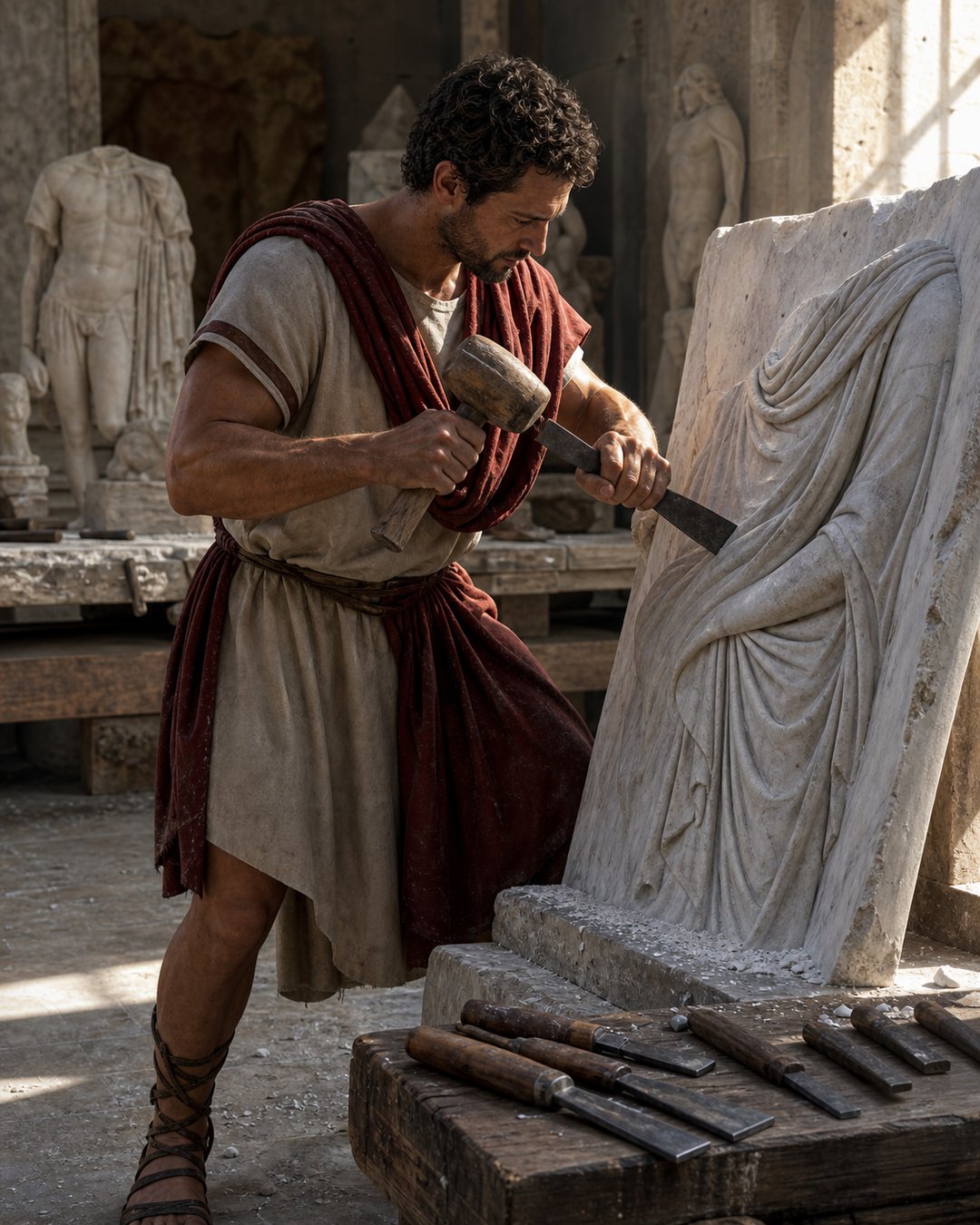
A hammer blow seems too blunt to produce a clean letter. Roman stone carvers solved that mismatch by placing a narrow piece of sharpened iron between hand and marble. The hammer supplied energy, but the flat chisel decided where that energy entered, how wide the removal became and whether the next mark joined the last one.
Art of Making describes a shaft fifteen to twenty-five centimetres long and one to two centimetres in diameter. Its cutting edge sat perpendicular to the shaft and could range from half a centimetre to ten centimetres wide. The tool was therefore not one fixed shape but a family of edges chosen for different scales of control.
Used around thirty-five to sixty degrees to the stone, the chisel could smooth, define finished forms or cut detail. Worked carefully, it left sets of nearly smooth parallel lines, sometimes barely visible. Roman public stone looked authoritative because a noisy sequence of impacts had been disciplined into marks the eye no longer noticed.
A Short Shaft Concentrated a Blow Along One Edge
The flat chisel described by Art of Making is handheld and struck with a metal hammer, or sometimes a wooden mallet. Its shaft carries force from the struck end to a sharpened cutting edge across the opposite end. The transverse edge turns a point impact at the head into a controlled line of contact at the stone.
Tool size sets the first boundary. A fifteen-to-twenty-five-centimetre shaft keeps the hand near enough to guide the cutting edge while leaving space for the striker. A diameter of one to two centimetres provides a grip and enough metal to endure repeated blows without making the tool so massive that small corrections become difficult.
The chisel does not multiply energy from nothing. It concentrates and directs what the hammer delivers. A broad, dull edge spreads a blow and may bruise the surface; a sharp narrow edge enters more decisively. The carver watches the stone’s response and adjusts force, position or tool rather than treating every blow as interchangeable.
This comes after the more dramatic work in Roman quarries. Quarry wedges exploit fractures to release mass. The flat chisel works where an uncontrolled fracture would destroy value. It asks a block to surrender one thin shaving or crisp boundary at a time.
Edge Width Changed the Scale of Every Decision
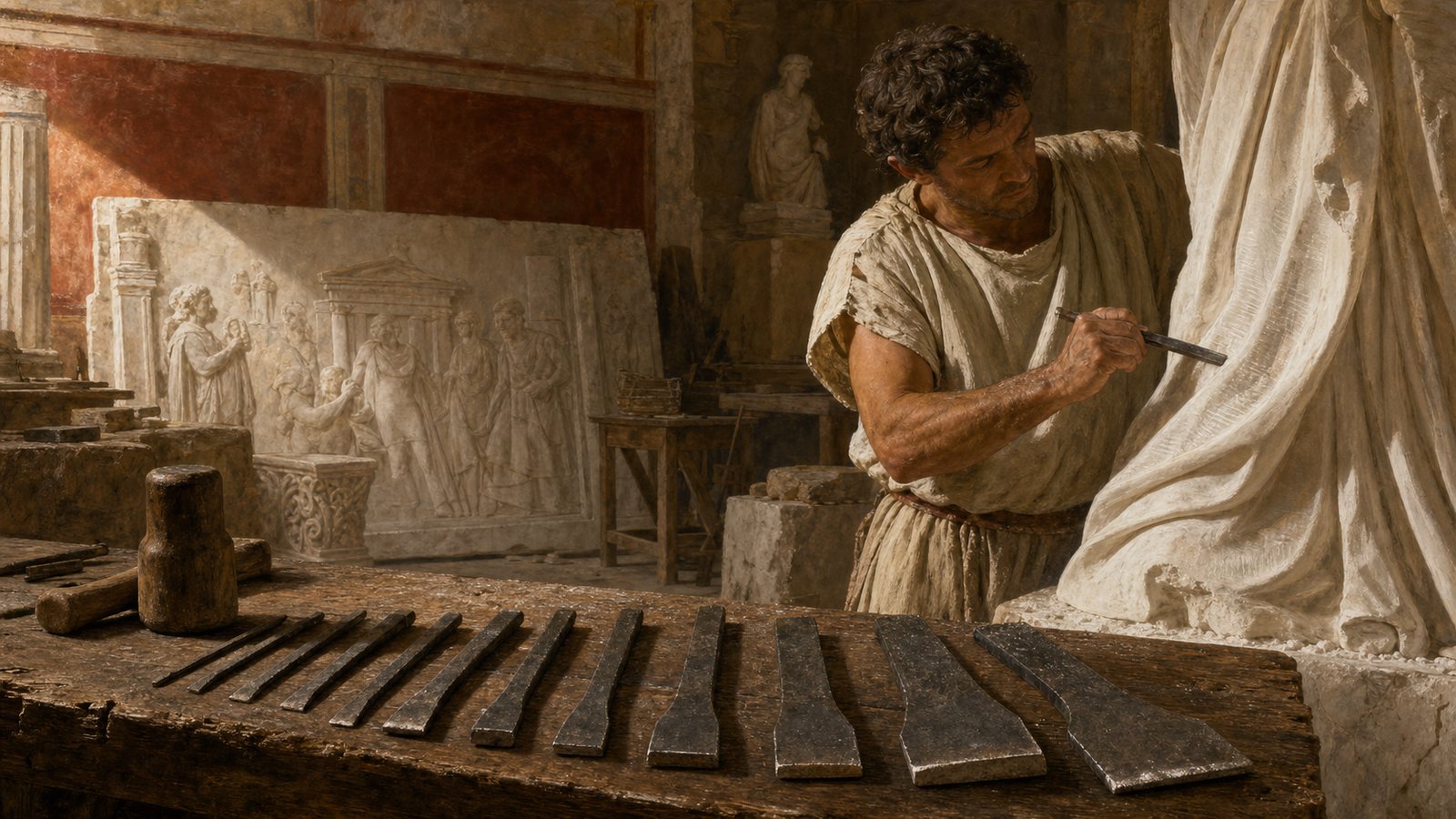
Art of Making gives an unusually broad range for the cutting edge: about 0.5 to 10 centimetres. Wider forms are sometimes called bolsters or droves. A half-centimetre edge can approach a tight detail; a ten-centimetre edge distributes work across a much larger band of surface.
Width changes more than speed. A broad tool bridges small hollows and encourages a common plane, useful during flattening or broad smoothing. A narrow tool can enter confined outlines, but it also makes each misplaced blow more visible. The correct edge depends on the geometry already present and the geometry still intended.
A workshop therefore needed sequences rather than a single favorite chisel. Earlier tools could remove bulk; successively more suitable edges refined form. The flat chisel occupied several stages because angle and force could make the same width act gently or aggressively.
The archive article on Roman files describes another method of incremental correction. A file spreads tiny cutting contacts along a stroke. A chisel packages removal into separate impacts. Both reward overlap and consistency, but their rhythms and risks remain distinct.
Rounded and Square Corners Protected Different Work
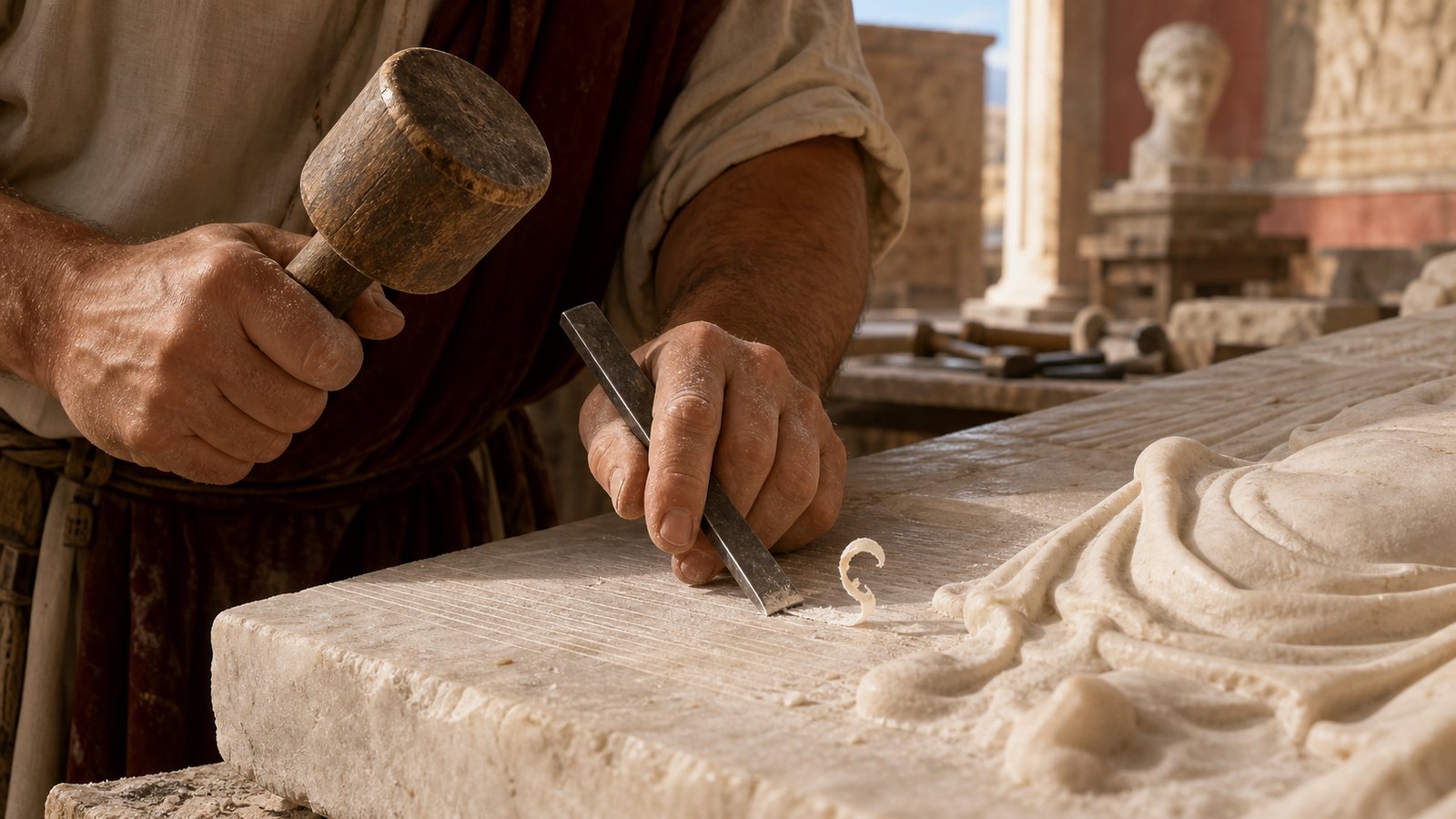
The cutting edge did not always end in the same corner profile. Art of Making notes that rounded corners avoided catching during delicate work. Squared and sharpened corners, by contrast, suited careful detail and especially letter carving. The ends of the edge were active design choices.
A square corner can enter the meeting of two strokes and establish a crisp termination. It can also dig unexpectedly if the tool tilts. A rounded corner is more forgiving while smoothing a curved or delicate surface because it reduces the chance that one end gouges a narrow trench beside the intended pass.
This means “flat” describes the main edge, not a complete absence of geometry. The carver considered width, sharpness and corner shape together. Regrinding altered all three, so maintenance could gradually change the work a familiar tool performed best.
Light made these differences legible. A fresh accidental groove casts a thin shadow across an otherwise even plane; a cleanly joined letter stroke holds darkness where the inscription requires it. Stone carving was partly the management of future shadow through present impacts.
Thirty-Five to Sixty Degrees Made Impact Travel Sideways
Art of Making places the usual working angle at roughly thirty-five to sixty degrees to the stone surface. Held upright, a chisel tends to drive more directly inward. Held obliquely, its edge can lift a shaving and move across the surface. The stated range allowed the carver to balance penetration against travel.
Angle works with hammer force. A firm blow at a steep angle can remove aggressively; a lighter blow at a shallower angle can skim. Stone type, grain, existing tool marks and proximity to an edge all affect the safe combination. The source therefore describes typical practice without implying one mechanically perfect number.
The hand holding the chisel supplied continuous correction between discrete impacts. It placed the edge, maintained the angle and rotated the shaft when a corner needed to lead. The striking hand—or a second worker in some arrangements—renewed energy. Tool control lived in the pause and repositioning as much as in the blow.
This separation resembles the two-person logic of Roman cord drilling. A drill could divide pulling from pressure and steering. A chisel divided impact from the cutting geometry that received it. In each case, force became useful only after another element constrained its direction.
Parallel Traces Were a Record of Overlapping Passes
The characteristic traces are almost smooth sets of parallel straight lines. Careful work can make them barely noticeable. Each line belongs to a pass or impact, but their regular overlap persuades the eye to read one continuous plane rather than dozens of separate removals.
Smoothing is therefore not the absence of marks. It is the organization of marks below the visual threshold that matters for the finished object. Later abrasion may reduce them further, yet the chisel first establishes the corrected form that polishing follows.
Parallel traces also expose mistakes in cadence. If one pass dives deeper, light catches the groove. If the edge turns unexpectedly, lines converge. The surface becomes a ledger of angle and pressure even when no written production record survives.
Careful carvers could read those traces while working. Dust brushed away from the edge revealed whether the next pass should overlap, cross or avoid the previous one. The stone offered feedback at every stage, and the tool’s regular geometry made deviation visible.
Letter Carving Made Tool Control a Public Fact
Squared sharpened corners were particularly useful for lettering, according to Art of Making. Letters require repeated boundaries that remain intelligible from a distance: verticals, diagonals, curves, junctions and terminals must survive changing light. The chisel turned language into cavities whose shadows reinforced their shapes.
That work connects directly to Roman funerary inscriptions. Names, ages, relationships and occupations became publicly durable only after layout and cutting. The social claim belonged to the commissioner and text; its legibility depended on a craftsperson managing edge, angle and blow.
Imperial and civic inscriptions increased the political scale without changing the mechanical foundation. A declaration might command a façade, but every line still emerged from local contact between sharpened metal and stone. Authority arrived through repeated small acts that had to remain consistent across an entire text.
The flat chisel’s importance is therefore not that it made impact disappear. It made impact answerable to geometry. Shaft length protected the guiding hand; edge width chose scale; corner profile managed risk; angle directed removal; overlapping strokes built finish. Rome’s clean stone lines were hammer blows taught where to stop.
Sources & Further Reading
- Art of Making, “Tool: Flat Chisel”
- Wikipedia, “Chisel”