
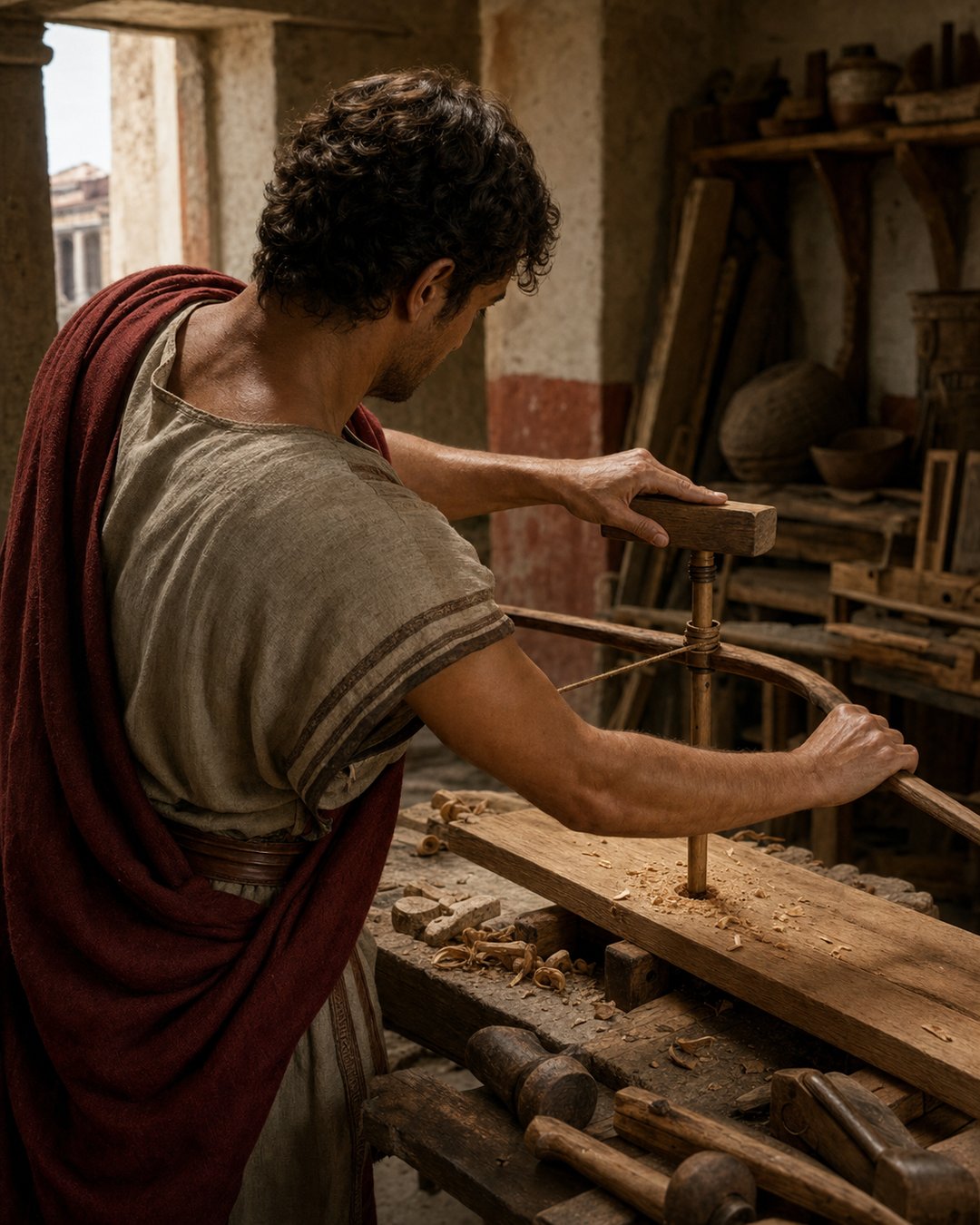
A hole looks like an absence, but making one without splitting the surrounding material is a demanding act of control. A chisel enters from one direction and can force a crack ahead of itself. A Roman drill attacked the same small circle again and again, removing material while the tool stayed centered. Its cutting edge mattered, but the stranger achievement was turning a straight pull into rotation.
The Art of Making research project identifies the strap or cord drill as the standard Roman form for stone. A chisel-like metal bit sat in a shaft that could turn freely inside a wooden handpiece. Cord wrapped several times around that shaft. One worker pulled the ends back and forth while another pressed and steered the drill. Power and judgment could therefore belong to different pairs of hands.
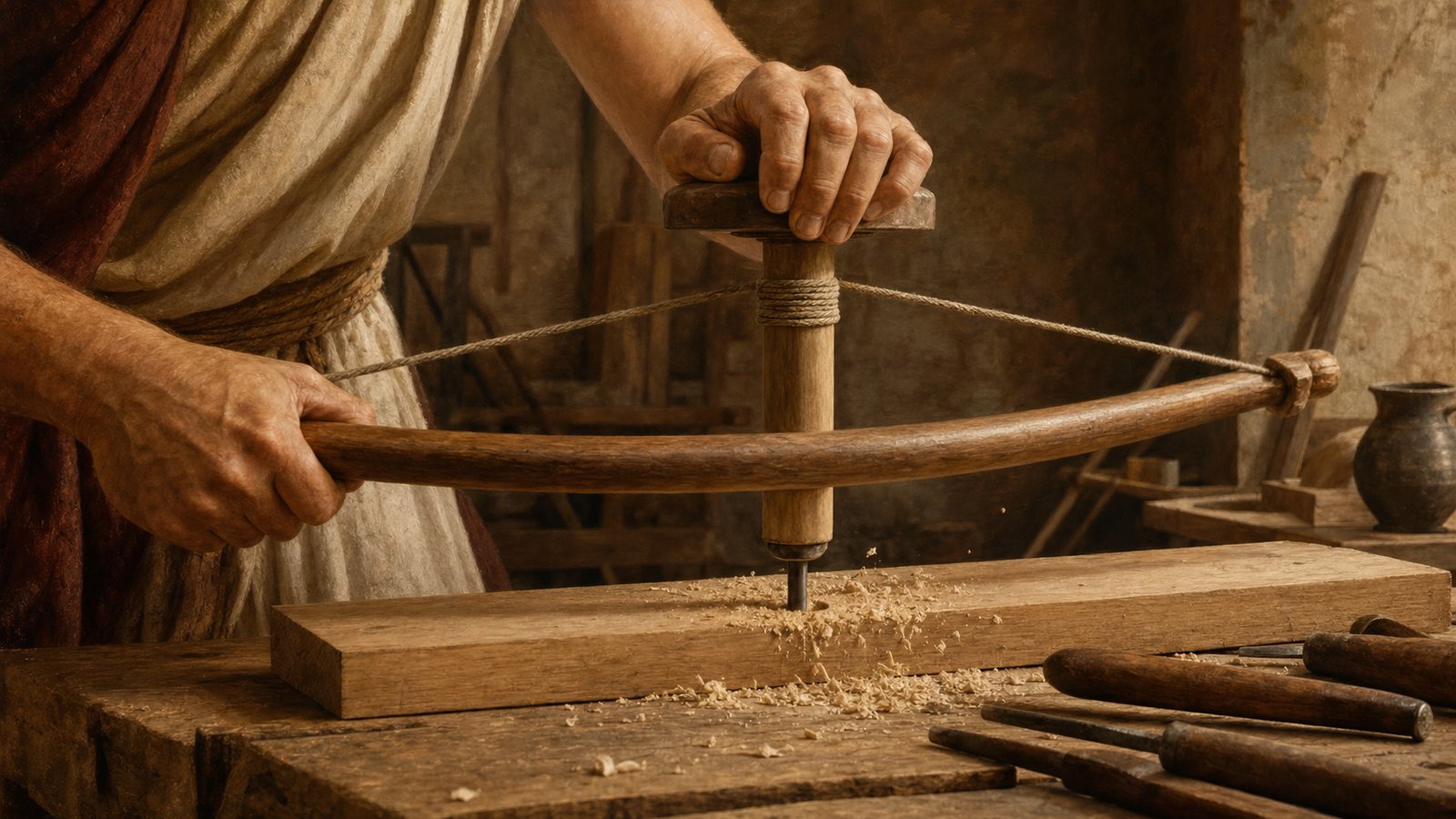
A related bow drill bent the same principle into a one-person tool: a bow kept the cord taut while a forward and backward stroke spun the wrapped shaft in alternating directions. Neither system needed a crank or continuous circular hand motion. Each borrowed the easiest movement for an arm to repeat and transformed it at the spindle.
The Cord Changed Direction but the Cutting Point Stayed Put
When a cord is wrapped around a shaft, pulling one end makes the shaft rotate as the cord unwraps. Pulling back reverses the rotation. The drill therefore turns first one way and then the other even though neither hand traces a circle. Rapid reciprocation keeps the bit working at one location while the operator renews motion on every stroke.
This reversing action suits a bit that scrapes or crushes on both passes. The Art of Making describes the Roman stone-drill bit as usually chisel-like rather than a modern spiral. Pressure brings that edge into contact; rotation sweeps it across the bottom of the forming hole. Dust and chips must escape or be cleared before they become a cushion beneath the bit.
The mechanism differs from the continuous rotation in Roman lathes. A lathe makes the workpiece turn past a cutting edge. The drill makes the edge turn inside work that remains still. Both preserve a centerline, but they distribute motion to opposite sides of the encounter.
Two Workers Could Divide Force from Accuracy
The Roman cord drill described by Art of Making used one person on the wrapped cord and another on the tool. The cord puller supplied repeated lateral motion. The drill operator held the wooden handpiece, placed the bit and pressed toward the stone. Because the shaft rotated freely inside the handle, the operator could keep both hands on guidance instead of spending one hand driving a bow.
That division was not decorative hierarchy. If the puller allowed the cord to slip, rotation stopped or became erratic. If the operator pressed too hard, the bit could bind; too lightly, it polished instead of cutting. Productive drilling required cadence between someone watching the hole and someone who might not see the cutting point clearly.
The source notes that both rotational speed and applied pressure could be varied. Those controls answer different problems. Faster movement increases cutting passes, while pressure decides how firmly each pass meets the stone. A delicate edge, a deep hole and a broad rough cavity do not ask for the same balance.
Rows of Round Holes Could Become One Deep Shadow
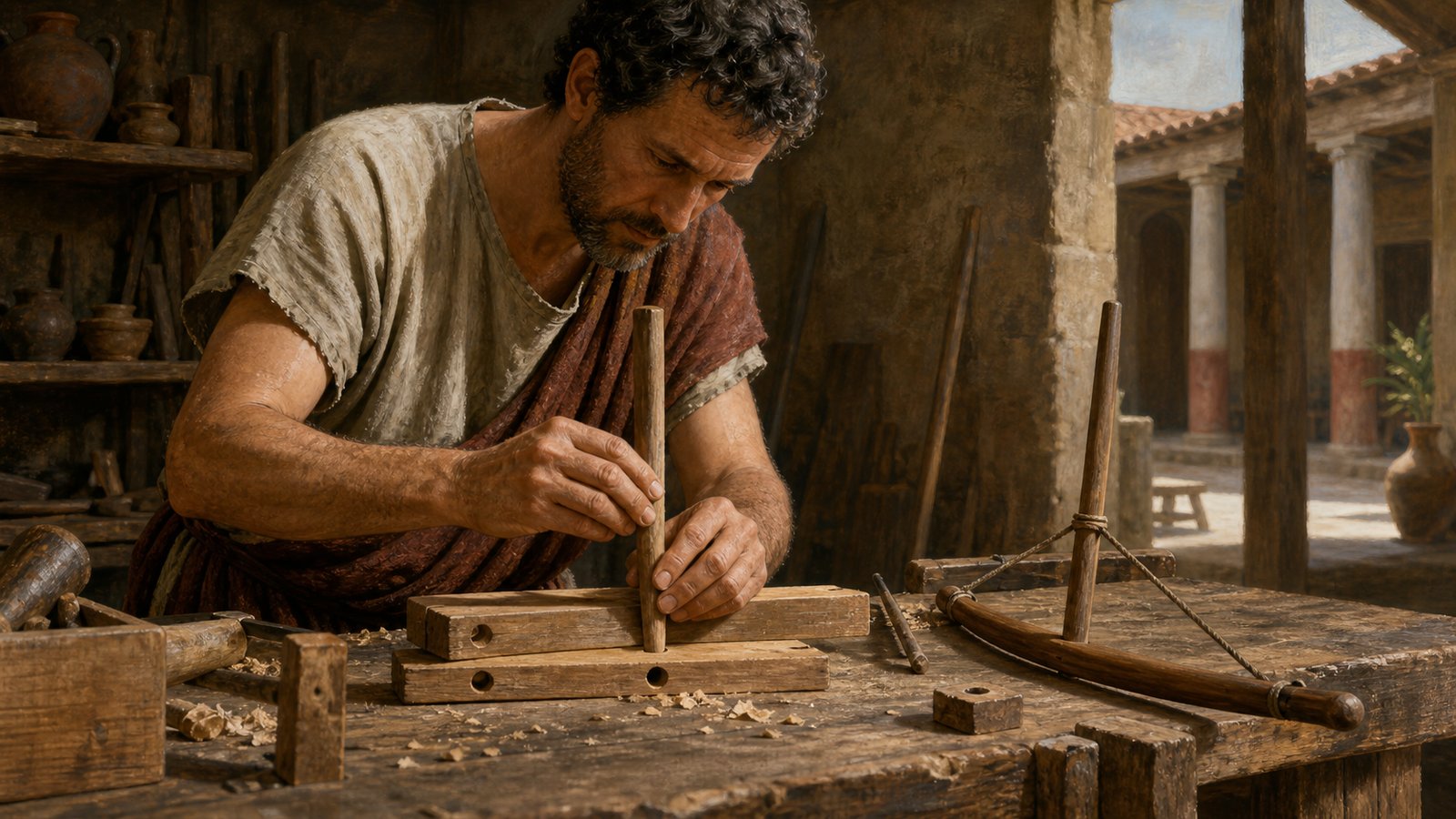
Roman carvers did not use drills only for isolated fittings. Art of Making explains that a deep channel could begin as a row of neighboring holes made at roughly ninety degrees to the surface. A fine flat chisel then knocked out the thin bridges between them. Drilling established depth repeatedly before the carver joined the cavities into a continuous recess.
This sequence reduced the danger of forcing one chisel deep into a delicate area. Each bore marked a controlled vertical limit. The later chisel worked across short partitions rather than trying to remove the whole channel at once. On unfinished work, the surviving row of circles preserves the operation before its evidence was erased.
The project reports that unjoined rows of drill holes appear on a range of Roman monuments and become increasingly common from the third century CE onward. The pattern is both a working trace and a reminder that smooth carved darkness often began as separate bright openings under a rotating bit.
A Running Drill Traded Depth for a Moving Groove
The same source describes a running-drill technique. A wooden support guided the bit while the operator entered the surface at about thirty-five to forty-five degrees, lifted the drill and moved it slightly along. The shallow overlapping holes could read as a channel rather than a sequence of deep vertical bores.
Changing the angle changed what rotation produced. At ninety degrees the tool sought a hole with fairly uniform diameter through its depth. At a shallow angle it cut a succession of scoops along the surface. The machine remained recognizable, yet wrist position and support turned it into a different carving instrument.
This is close in spirit to Roman files, which made shape through many small removals. The drill concentrated those removals around a spinning center; the file spread them along a stroke. Neither depended on one dramatic blow.
The Grave Plaque of Eutropos Preserved the Team
Art of Making points to the grave plaque of the Roman carver Eutropos from Urbino. It depicts Eutropos and an assistant using a cord drill while detailing a sarcophagus. The image matters because it shows the labor arrangement described by the mechanics: one figure directs the cutting tool while another sustains the cord movement.
The plaque does not give a stopwatch, a production total or the private thoughts of either worker. It safely records collaboration and the social visibility of a specialized tool. A drill was not merely a loose iron point. It was a temporary system assembled from bit, shaft, handle, cord, pressure, rhythm and trained partners.
In a compact bow-driven version, one worker combined the pulling rhythm and tool guidance. That portability could suit smaller woodworking, bone or craft tasks, while the two-person cord drill gave a stone carver both hands for pressure and placement. The shared principle was wrapped cord; scale and labor changed around it.
The Finished Hole Hid Most of the Skill That Made It
After a dowel entered a drilled socket or a carved channel was cleaned with a chisel, the rotation that prepared it disappeared. A round opening can look inevitable in finished wood or stone. It was not. The craftsperson had to start on a center, keep the shaft upright or choose a deliberate angle, clear waste, monitor depth and stop before the surrounding surface failed.
The article on Roman dividers follows the decision that could precede drilling: carry a distance and mark where a repeated opening belongs. The drill then converted that mark into volume. Measurement and removal were separate skills joined by a tiny point on the surface.
Roman drills reveal a workshop habit larger than the tool. Complicated effects could come from dividing motion into simple parts. An apprentice pulled; an operator pressed; cord translated; the shaft reversed; a bit cut; a chisel later erased the bridges. The finished cavity was quiet because the sequence had worked. Depth itself became measurable through repeated passes: clear the dust, return the bit, compare the recess, and stop at the intended limit. That patient cycle mattered wherever a fitting had to seat firmly or carved shadow had to remain narrow without breaking the surface beside it.
Sources & Further Reading
- Art of Making, “Tool: Drill”
- Wikipedia, “Bow drill”